Symbols of the same effort toward a clearer vision

From Edith Wharton’s A Motor-Flight Through France, speaking of the Amiens cathedral:

On the symbolic side especially it would be tempting to linger; so strongly does the contemplation of the great cathedrals fortify the conviction that their chief value, to this later age, is not so much æsthetic as moral. The world will doubtless always divide itself into two orders of mind: that which sees in past expressions of faith, political, religious or intellectual, only the bonds cast off by the spirit of man in its long invincible struggle for “more light”; and that which, while moved by the spectacle of the struggle, cherishes also every sign of those past limitations that were, after all, each in its turn, symbols of the same effort toward a clearer vision. To the former kind of mind the great Gothic cathedral will be chiefly interesting as a work of art and a page of history; and it is perhaps proof of the advantage of cultivating the other—the more complex—point of view, in which enfranchisement of thought exists in harmony with atavism of feeling, that it permits one to appreciate these archæological values to the full, yet subordinates them to the more impressive facts of which they are the immense and moving expression. To such minds, the rousing of the sense of reverence is the supreme gift of these mighty records of mediæval life: reverence for the persistent, slow-moving, far-reaching forces that brought them forth. A great Gothic cathedral sums up so much of history, it has cost so much in faith and toil, in blood and folly and saintly abnegation, it has sheltered such a long succession of lives, given collective voice to so many inarticulate and contradictory cravings, seen so much that was sublime and terrible, or foolish, pitiful and grotesque,11 that it is like some mysteriously preserved ancestor of the human race, some Wandering Jew grown sedentary and throned in stony contemplation, before whom the fleeting generations come and go.

Yes—reverence is the most precious emotion that such a building inspires: reverence for the accumulated experiences of the past, readiness to puzzle out their meaning, unwillingness to disturb rashly results so powerfully willed, so laboriously arrived at—the desire, in short, to keep intact as many links as possible between yesterday and to-morrow, to lose, in the ardour of new experiment, the least that may be of the long rich heritage of human experience. This, at any rate, might seem to be the cathedral’s word to the traveller from a land which has undertaken to get on without the past, or to regard it only as a “feature” of æsthetic interest, a sight to which one travels rather than a light by which one lives.

Dino Buzzati’s Bogeyman

From Dino Buzzati’s The Bogeyman from the recent collection, The Bewitched Bourgeois (originally in Corriere della Sera as FINE DEL BABAU and later reprinted as Il Babau in Le Notti Difficili)

Thus it comes as no surprise that Paudi spoke of the matter [of being visited by the Bogeyman] to several colleagues at the next meeting of the city council. “How can we permit such a disgrace, worthy of the Dark Ages, to continue in a metropolis which boasts of being in the vanguard of contemporary culture? Doesn’t this situation demand decisive action to remedy the problem?”

At first there were brief discussions in the corridors, informal exchanges of opinion. Soon thereafter, the prestige Paudi enjoyed cleared every obstacle from his path. Within two months, the problem was brought before the city council. It stands to reason that in order to avoid ridicule, the agenda of the meeting didn’t contain a word about the Bogeyman. The fifth item mentioned only “a deplorable cause of disturbance that threatens the nocturnal peace of the city.”

Contrary to what Paudi expected, not only did everyone give the matter serious consideration, but his thesis, which might seem obvious, encountered lively opposition. Voices rose to defend a tradition that was as much picturesque as inoffensive yet disappearing in the mists of time. They then proceeded to underscore the utter innocuousness of the nocturnal monster, which was, among other things, entirely silent, and they stressed the educational benefits of that presence. There was one council member who even spoke of “an attack on the cultural heritage of the city” in the event that repressive measures were taken. His speech was greeted with a burst of applause.

In favor of Paudi’s proposal, however, there finally prevailed irresistible arguments which so-called progress always marshals to dismantle the last fortresses of mystery. The Bogeyman was accused of leaving an unhealthy imprint on children’s spirits, of sometimes causing nightmares contrary to the principles of correct pedagogy. Hygienic considerations were also raised: it is indeed true that the nocturnal giant didn’t dirty the city or leave any kind of excrement scattered about, but who could guarantee he wasn’t a carrier of germs and viruses? Nor was anything certain known about his political creed: How could one exclude the possibility that his suggestions, which appeared so simple, if not crude, might conceal subversive plots?

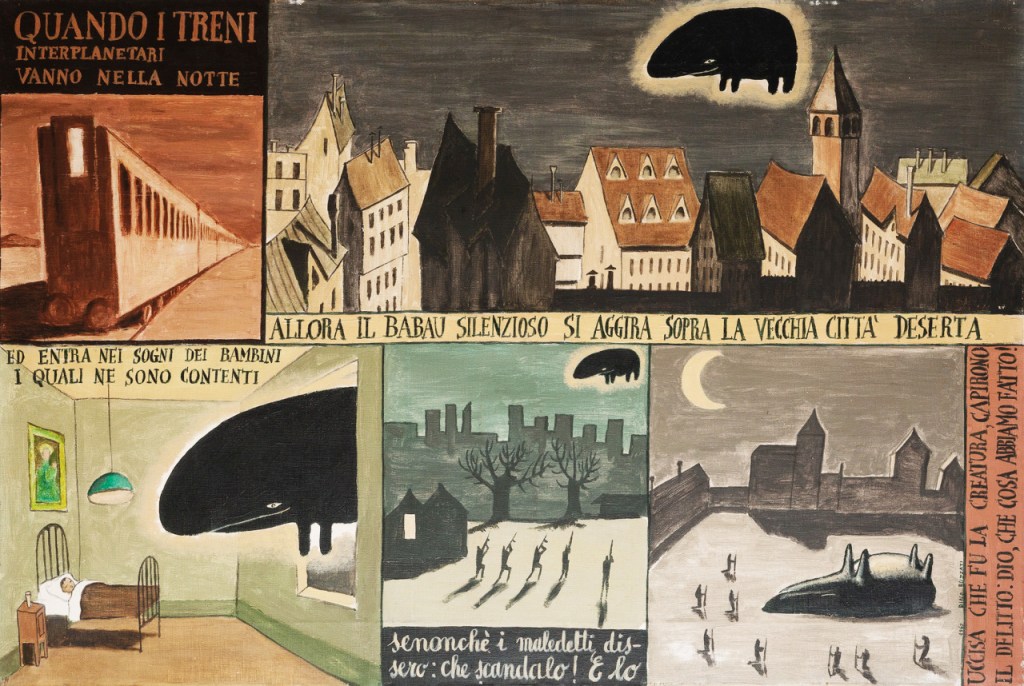
Buzzati did at least a few illustrations of the story sometime around when it was first published (Feb. 16, 1967), though it’s not easy to find firm dates for most of his art. Two of the below are clearly from the story while the third I take to be the babau in a happier day – or maybe it’s just classic cloud watching.

It’s interesting to note the difference between the story and the paintings in the police response to their ultimately slaying the bogeyman. The story has a simple “This is something I’d rather not see a second time” (Una cosa che preferirei non rivedere una seconda volta) while one painting has “God, what have we done!” (Dio, che cosa abbiamo fatto!) and the other the even more emphatic “God, my God, what have we done!” (Dio Dio Mio, che cosa abbiamo fatto!). I tried checked the Corriere archive – which is how I found the original title – to see if the text was different in the first version but was paywalled into continuing ignorance.

To go there is to destroy the magic, unless …

From a 1963 letter of Tokien’s (247 in the volume of letters) on the difficulties of putting the Silmarillion in publishable form.

I am doubtful myself about the undertaking. Part of the attraction of The L.R. [Lord of the Rings] is, I think, due to the glimpses of a large history in the background : an attraction like that of viewing far off an unvisited island, or seeing the towers of a distant city gleaming in a sunlit mist. To go there is to destroy the magic, unless new unattainable vistas are again revealed.

I found this passage in the introduction to The Book of Lost Tales, the first of twelve volumes in the History of Middle Earth – a set I’ve recently stumbled into owning. I’ve never thought myself enough a Tolkien fan to go outside the main lines but it occurs to me that when listening to the (Rob Inglis narrated) audiobooks last year I found myself most enjoying what I’ll unfashionably call the moral clarity and depth of the world. The action as action keeps its value and the world as world remains as convincing as ever but it’s somehow become Tolkien as thinker that is most intriguing. So I’m inclined to follow the cue of the divine book dispensary – which has never done me wrong – and (slowly) work through these volumes taking on faith the revelation of ‘new unattainable vistas’ of the specific sort I’m interested in.

The English only have half (and wholly) killed themselves in order to get away from England

My edition of A Short Walk in the Hindu Kush (Picador Travel Classics – a collection oddly more modern-oriented than the name suggests, to me at least) includes a charming preface by Evelyn Waugh that is fortunately short enough to quote in full:

Mr Eric Newby must not be confused with the other English writer of the same surname. I began reading A Short Walk in the Hindu Kush in the belief that it was the work of his namesake, whom I have long relished. I found something equally delightful but quite different.

Mr Eric Newby, I have since learned, is the author of an exciting sea-log, The Last Grain Race, an account of how at the age of eighteen he signed on as an apprentice of the Finnish barque Moshulu, lived in the fo’c’sle as the only Englishman, worked the ship, rounded both capes under sail in all the vicissitudes of the historic and now extinct passage from Australia to the United Kingdom of the grain-carrying windjammers. His career in the army was heroic and romantic. The bravado and endurance which had briefly made him a sailor were turned to the King’s service. After the war he went into the most improbable of trades, haute couture. It would strain the imagination to picture this stalwart young adventurer selling women’s clothes. We are relieved of the difficulty by his own deliciously funny description, which immediately captivates the reader of the opening chapters of A Short Walk. One can only use the absurdly trite phrase ‘the call of the wild’ to describe the peculiar impetus which carried Mr Newby from Mayfair to the wild mountains of Afghanistan. He was no sailor when he embarked in the Moshulu; he was no mountaineer when he decided to climb the Hindu Kush. A few days scrambling on the rocks in Wales, enchantingly chronicled here, were his sole preparation. It was not mountaineering that attracted him; the Alps abound in opportunities for every exertion of that kind. It was the longing, romantic, reasonless, which lies deep in the hearts of most Englishmen, to shun the celebrated spectacles of the tourist and without any concern with science or politics or commerce, simply to set their feet where few civilized feet have trod.

An American critic who read the manuscript of this book condemned it as ‘too English’. It is intensely English, despite the fact that most of its action takes place in wildly foreign places and that it is written in an idiomatic, uncalculated manner the very antithesis of ‘Mandarin’ stylishness. It rejoices the heart of fellow Englishmen, and should at least illuminate those who have any curiosity about the odd character of our Kingdom. It exemplifies the essential traditional (some, not I, will say deplorable) amateurism of the English. For more than two hundred years now Englishmen have been wandering about the world for their amusement, suspect everywhere as government agents, to the great embarrassment of our officials. The Scotch endured great hardships in the cause of commerce; the French in the cause of either power or evangelism. The English only have half (and wholly) killed themselves in order to get away from England. Mr Newby is the latest, but, I pray, not the last, of a whimsical tradition. And in his writing he has all the marks of his not entirely absurd antecedents. The understatement, the self-ridicule, the delight in the foreignness of foreigners, the complete denial of any attempt to enlist the sympathies of his readers in the hardships he has capriciously invited; finally in his formal self-effacement in the presence of the specialist (with the essential reserve of unexpressed self-respect) which concludes, almost too abruptly, this beguiling narrative – in all these qualities Mr Newby has delighted the heart of a man whose travelling days are done and who sees, all too often, his countrymen represented abroad by other, new and (dammit) lower types.

Dear reader, if you have any softness left for the idiosyncrasies of our rough island race, fall to and enjoy this characteristic artifact.

Mysteriously, even exaltedly, irrelevant

From Arthur Schnitzler’s Death of a Bachelor (in the collection Night Games):

“For God’s sake, read the ending,” commanded the doctor in a new voice. The businessman reached over, took the letter from the writer, who was feeling a kind of paralysis creep into his fingers, quickly dropped his eyes down to the end of the letter, and read these words:

“It was fate, my friends, and I can’t change it. I have possessed all your women. All.”

The businessman suddenly stopped and leafed back through the pages. “What are you doing?” asked the doctor.

“The letter was written nine years ago,” said the businessman.

“Read on,” commanded the writer. The businessman read:

“They were of course very different kinds of relationships. With one of them I lived almost as though married, for many months. With another it was more like what is called a wild adventure. With the third it went so far that I wanted to die together with her. The fourth I threw down the stairs because she betrayed me with another. And another was my lover just once. Are you all breathing in relief again, my friends? Don’t. It was perhaps the most beautiful hour of my … and of her life. So, my friends. I don’t have any more to say. I am now folding this piece of paper and putting it in my desk, and here may it wait either until I destroy it while in another mood, or until you get it in the hour that I’m lying on my deathbed. Goodbye.”

The doctor took the letter out of the businessman’s hand and seemed to read it carefully from beginning to end. Then he looked at the businessman, who stood there with his arms crossed, looking down with a scornful smirk. “Even though your wife died last year,” the doctor said calmly, “this applies to her also.”

The writer paced up and down in the room, occasionally shaking his head back and forth as though he had a cramp; suddenly he hissed between his teeth, “Scoundrel,” and followed the word as though it were a thing that dissolved in the air. He tried to recall the image of the young creature that he had once held in his arms as wife. Other images of women appeared, both those often remembered and those believed long forgotten, but the one he desired he could not force into his memory. For his wife’s body was now faded and odorless for him, and it had been all too long since she had been his beloved. But she had become something else for him, something more and something nobler: a friend and a companion, proud of his accomplishments, full of sympathy for his disappointments, full of insight into his deepest being. It appeared to him not impossible that the old bachelor in his meanness had attempted nothing less than to rob him, his secretly envied friend, of his companion. Because all the other things-what did they really mean in the end? He remembered certain adventures from recent and from more distant times that he could hardly have avoided in his successful artist’s life, adven tures that his wife had either smiled or wept away. Where were they all now? They had wilted just as had the distant hour in which his wife had thrown herself into the arms of an unworthy man, perhaps without consideration, without thought; almost as faded as the memory of this same hour was in that dead brain that was resting in the other room on the painfully rumpled pillows. Perhaps in the end it was a lie after all, everything written in the testament? Perhaps a pathetic ordinary man who knew he was condemned to be eternally forgotten had taken his last revenge on the chosen man over whose works death had no power. That could be the case. And even it were true-it still was a petty revenge and one that failed to succeed.

The doctor stared at the piece of paper in front of him, and he thought about the aging, gentle, and yes, kind woman who was now sleeping at home. He also thought about his three children: the eldest, who was just now serving his year of voluntary military service; the oldest daughter, who was engaged to a lawyer; and the youngest daughter, who was so charming and attractive that a famous artist had recently asked to paint her while she was at a ball. He thought about his comfortable home, and everything that was said in the dead man’s letter seemed to him not so much untrue as mysteriously, even exaltedly, irrelevant. He hardly felt that he had learned anything new at this moment. He remembered a peculiar episode of his life some fourteen or fifteen years ago, a time in which he had experienced certain problems with his medical career, and when, morose and finally reduced to a state of confusion, he had planned to leave his town, his wife, and his family. At that time he had begun to lead a kind of wild and thoughtless existence in which a peculiar and hysterical woman had played a role, a woman who had later committed suicide over another lover. How his life after that had gradually resumed its regular course he could not remember now at all. But it had to have been in that miserable epoch, which had passed just as it had arrived, like an illness, that his wife had deceived him. Yes, it had to have been then, and it was clear to him that he had really always known it. Wasn’t she once near to telling him about it? Didn’t she drop hints? Thirteen or fourteen years ago … on what occasion … ? Wasn’t it once in summer, on a vacation trip-late one evening on a hotel terrace? In vain he tried to remember the faded words.

The businessman stood at the window and looked into the gentle, white night. He tried with the best will in the world to remember his dead wife. But as much as he strained his inner senses, at first he only saw himself standing between the frame of an open door, in the light of a grey morning, wearing a black suit, accepting and reciprocating sympathetic handshakes, he remembered the flat odor of carbolic acid and flowers in his nose. Only gradually did he succeed in recalling her image. But at first it was only the image of an image. For he could really see only the large gold-framed portrait that was hanging in the salon over the piano at home, which showed a proud woman of about thirty in ballroom dress. Only then did she herself appear to him as the pale and shy young girl who had accepted his courtship almost twenty-five years ago. Then the image of a blossoming woman appeared before him, enthroned next to him in a box at the theatre, her eyes fixed on the stage and far from him emotionally. Then he remembered an eager woman who had received him with unexpected passion when he had returned from a long trip. Right after that he remembered a nervous, teary person with green, dull eyes, who had spoiled his days with all sorts of bad moods. Then once more he saw an anxious tender mother in a light morning robe, watching over the bed of a sick child who had also had to die. Finally he saw a pale being lying in bed with the corners of her mouth drawn in pain, cold drops of sweat on her forehead, in a room filled with ether, which had filled his soul with painful sympathy. He knew that all these images and a hundred others, which were now racing through his mind at incredible speed, were one and the same person, the person who had been lowered into the grave two years ago, whom he had mourned, and after whose death he had felt liberated. He felt as though he had to choose one of the images in order to arrive at some nameless feeling, because right now free-floating anger and shame were scanning a void. Indecisively he stood there and looked at the houses that were floating yellow and reddish in the moonlight in the gardens opposite, houses that seemed to be pale painted facades behind which there was nothingness.

“Good night,” said the physician and stood up. The businessman turned around. “I have nothing more to do here either.” The writer had taken the letter. put it unnoticed in his jacket pocket, and now opened the door to the next room. Slowly he went up to the deathbed, and the others saw how he looked silently down at the body, his hands behind his back. Then they left.

I saw a corpse in a field this morning

From Eric Newby’s A Short Walk in the Hindu Kush, a small comedic pause in between attempts to scale Mir Samir.

I had schemed to memorize a number of expressions in the Kafir language and surprise Hugh when we met up with the people, but, in the midst of all our other preoccupations, the book had been lost in one of the innumerable sacks; now with Nuristan just over the mountain, it was discovered in the bottom of the rice sack, where it had been ever since I had visited the market in Kabul.

Reading the 1,744 sentences with their English equivalents, I began to form a disturbing impression of the waking life of the Bashgali Kafirs.

‘Shtal latta wōs bā padrē ū prētt tū nashtontī mrlosh. Do you know what that is?’

It was too late to surprise Hugh with a sudden knowledge of the language.

‘What?’

‘In Bashgali it’s “If you have had diarrhoea many days you will surely die.”’

‘That’s not much use,’ he said. He wanted to get on with Conan Doyle.

‘What about this then? Bilugh âo na pī bilosh. It means, “Don’t drink much water; otherwise you won’t be able to travel.”’

‘I want to get on with my book.’

Wishing that Hyde-Clarke had been there to share my felicity I continued to mouth phrases aloud until Hugh moved away to another rock, unable to concentrate. Some of the opening gambits the Bashgalis allowed themselves in the conversation game were quite shattering. Inī ash ptul p’mich ē manchī mrisht wariā’m. ‘I saw a corpse in a field this morning’, and Tū chi sē biss gur bītī? ‘How long have you had a goitre?’, or even Iā jūk noi bazisnā prēlom. ‘My girl is a bride.’

Even the most casual remarks let drop by this remarkable people had the impact of a sledgehammer. Tū tōtt baglo piltiā. ‘Thy father fell into the river.’ I non angur ai; tū tā duts angur ai. ‘I have nine fingers; you have ten.’ Ōr manchī aiyo; buri aīsh kutt. ‘A dwarf has come to ask for food.’ And Iā chitt bitto tū jārlom, ‘I have an intention to kill you’, to which the reply came pat, Tū bilugh lē bidiwā manchī assish, ‘You are a very kind-hearted man.’

Their country seemed a place where the elements had an almost supernatural fury: Dum allangitī atsitī ī sundī basnâ brā. ‘A gust of wind came and took away all my clothes’, and where nature was implacable and cruel: Zhī marē badist tā wō ayō kakkok damītī gwā. ‘A lammergeier came down from the sky and took off my cock.’ Perhaps it was such misfortunes that had made the inhabitants so petulant: Tū biluk wari walal manchī assish. ‘You are a very jabbering man.’ Tū kai dugā iā ushpē pâ vich: tū pâ vilom. ‘Why do you kick my horse? I will kick you.’ Tū iā dugā oren vich? Tū iā oren vichibâ ō tū jārlam. ‘Why are you pushing me? If you push me I will do for you.’

A race difficult to ingratiate oneself with by small talk: Tō’st kazhīr krui p’ptī tā chuk zhi prots asht? ‘How many black spots are there on your white dog’s back?’ was the friendly inquiry to which came the chilling reply: Iā krũi brobar adr rang azzā: shtring na ass. ‘He is a yellow dog all over, and not spotted.’

Wheezes out law-phrase, whiffles Latin forth

A masterful portrait of an attorney from Book 1 of Robert Browning’s The Ring and the Book (1124-1161), this being the public defender for the man (and colleagues) accursed of murdering his wife. The notes are adapted from v.7 of the Oxford edition.

One lawyer shall admit us to behold
The manner of the making out a case,
First fashion of a speech; the chick in egg,
The masterpiece law’s bosom incubates.
How Don Giacinto of the Arcangeli,
Called Procurator of the Poor at Rome,
Now advocate for Guido and his mates,—
The jolly learned man of middle age,
Cheek and jowl all in laps with fat and law,
Mirthful as mighty, yet, as great hearts use,
Despite the name and fame that tempt our flesh,
Constant to that devotion of the hearth,
Still captive in those dear domestic ties!—
How he,—having a cause to triumph with,
All kind of interests to keep intact,
More than one efficacious* personage
To tranquillize, conciliate and secure,
And above all, public anxiety
To quiet, show its Guido in good hands,—
Also, as if such burdens were too light,
A certain family-feast to claim his care,
The birthday-banquet for the only son—
Paternity at smiling strife with law—
How he brings both to buckle in one bond;
And, thick at throat, with waterish under-eye,
Turns to his task and settles in his seat
And puts his utmost means in practice now:
Wheezes out law-phrase, whiffles** Latin forth,
And, just as though roast lamb would never be,
Makes logic levigate*** the big crime small:
Rubs palm on palm, rakes foot with itchy foot,
Conceives and inchoates**** the argument,
Sprinkling each flower appropriate to the time,
—Ovidian quip or Ciceronian crank,
A-bubble in the larynx while he laughs,
As he had fritters deep down frying there.
How he turns, twists, and tries the oily thing
Shall be—first speech for Guido ‘gainst the Fisc.

* – A Browning-ism – as ‘influential’
** – speaks in a whistling, breathy way. The description makes great play with Arcangeli being fat and rheumy.
*** – break down (into fragments), rub or grind (to a fine powder) from Med. L levigabilis
**** – begins, commences, from L. incohare or inchoare. This self-consciously Latinate word, like ‘levigate‘ before, is a comic suggestion of Arcangeli’s obsession with Latinity and his rhetorical pomp. OED records uses by Donne and Henry More, two of Browning’s favourite writers.

Not wisdom but pleasure

From Richard A. Lanham’s Tristram Shandy: The Games of Pleasure (pg. 52-53). A needed reminder after over a year off of why I started doing this in the first place.

In Walter Shandy, the commentators seem to agree, Sterne has created an antitype of this ideal portrait, an exhibi-tionistic, perfectly impotent theorist. “A full account of [his] epic frustrations would,” we are told in a recent article, “encompass a major part of the novel.” He is frustrated as philosopher, as father, as husband, as brother, as orator. Rather than exercising his philosophic principles, he hides behind them, “constantly exacerbated by his inability to control the accidents of everyday existence through his carefully contemplated hypotheses.” Plagued, as it seems to him, by chance, his real problems come not from circumstances “but… from his own impractical nature? As still another student points out, he is always isolated from the action he wishes to direct.’ He cannot “bring affairs to a satisfactory conclusion.” He can never communicate with his wife, find in her anything but an infinitely yielding, flaccid placidity. This failure is part of a general “failure to communicate, to make the essential connections between himself and the world around him.” Like Ovid, he is too witty for his own good: “Walter’s hypotheses begin in jest but end in earnest; his judgment at length becomes the dupe of his wit.” And, of course, his Ass that Kicks hardly represents the satisfactory sexual orchestration a modern therapist would recommend. Beyond all this, he enacts that most balked and baffled of men, a natural-born orator without an audience. Listen to him Uncle Toby willingly does; appreciate his art he cannot. Finally, if Professor Ralph Rader’s rumored speculation is correct, we are to deny Walter even the paternity of Tristram. He becomes the paradigm of modern man, powerless before an indifferent universe but manfully bearing up. Perhaps this side of his character has been sufficiently emphasized. As a corrective, we may want to recall that he does occasionally triumph, does manage, win or lose, to enjoy himself a good deal. He has, after all, chosen to live this way, finds retirement more agreeable than bartering as Turkey merchant with the mysterious Middle East. Walter is impotent, everyone seems to agree, when he confronts the real world. But viewed from the pleasure-principle vantage, this generalization carries less conviction. The novel’s point may be this: the world Walter Shandy confronts successfully and with pleasure, the world of speculation, is the real world. His successes, not his failures, constitute his raison d’être. “Arguments,” our author tells us, “however finely spun, can never change the nature of things – very true – so a truce with them.” Through Walter, Sterne negotiates his truce in Tristram Shandy.

And a bit later on pg 57:

Readers who find Walter a paradigm of frustration may be bringing to the novel a conception of rhetoric-or more largely of language different from that which Tristram brings. We tend to think that language communicates conceptual truth. Such manages the world. Not much managing gets done in Tristram Shandy, and one naturally concludes that language is at fault, that, as Traugott brilliantly makes clear, the book is in fact about how language is at fault. But if we think of language as, essentially, not controlling concept but yielding pleasure and Tristram conceives of it in this way -much of the frustration evaporates. The occasion here is death and Walter has a grand time with it. What more could any philosopher do? If language continually fools us – and Tristram is often at pains to tell us that it does – here we are getting back some of our own. Perhaps it is still fooling us, but at least it is in a pleasurable way.

We can call Sterne’s humor philosophical in this sense if we will. It clearly is meant as something for us to generalize upon. Yet I hardly think he saw this kind of thing as what man should or should not do, so much as simply what he does do. He is not at all cheering us up in the way Thackeray thought – or some modern critics think – the humorous moralist should do. He is simply telling us how language is used, how – let us vary the wisdom of a modern popular philosopher – what is spoken is often less important than the act of speaking. The operative force is not philosophy but rhetoric, not wisdom but pleasure.

Enter the city, said the wise man, it is all yours

Found in a small selection of Thomas Merton’s work called Silence, Joy but originally from his The Wisdom of the Desert (Saying 38):

Once there was a disciple of a Greek philosopher who was commanded by his Master for three years to give money to everyone who insulted him. When this period of trial was over, the Master said to him: Now you can go to Athens and learn wisdom. When the disciple was entering Athens he met a certain wise man who sat at the gate insulting everybody who came and went. He also insulted the disciple who immediately burst out laughing. Why do you laugh when I insult you? said the wise man. Because, said the disciple, for three years I have been paying for this kind of thing and now you give it to me for nothing. Enter the city, said the wise man, it is all yours.

Kiyoshi Saito’s Buddha Siamese

As I continue pursuing an interest in woodblock prints picked up early last year, my favorite artist remains Kiyoshi Saito. A few weeks back a print of his came to auction that I hadn’t seen before – his 1957 ‘Buddha Siamese.’ It went for well less than I expected so it’s now mine – fortunate, since I’d decided to fight for it regardless. There are copies at the Art Gallery of Greater Victoria (that has a surprisingly rich collection of the artist’s works) and the Fine Arts Museum of San Francisco but I can’t find any substantive info on the piece. The artist seems to have done a similar black and white image a few years later in 1962 but that’s all I have for now. Still, it’s too nice not to share. It’s now in my bedroom and my daughter shouts ‘Hi, Buddha’ each morning as she comes to wake me.