Julius Caesar and the Pied Piper

Returning to my earlier difficulty with these lines in Robert Browning’s Pied Piper of Hamelin:

Save one who, stout as Julius Caesar,
Swam across and lived to carry
(As he the manuscript he cherished)
To Rat-land home his commentary,

The short of it is that someone is confused, though it’s impossible to say whether it is Browning, his possible source, his recent editors, or me. The trouble is Browning’s choice of words – manuscript for what Caesar carries and commentary for what the rat to which he is compared carries. This choice encourages – but does not require – understanding an equivalency between the two words (i.e. Caesar’s manuscript was a commentary) and recent editors seem to take this possibility as a given.

Accordingly the editors of the OET Poetical Works of Robert Browning (v.3, pg. 286) comment on this passage:

as Lemprière records, the Commentaries on the Gallic wars were ‘nearly lost; and when Caesar saved his life in the bay of Alexandria, he was obliged to swim from his ship, with his arms in one hand and his commentaries in the other’. The story is likely to have been familiar to Willie Macready [the boy for whom the poem was written], since selections from Caesar are often read by beginners at Latin.

The source referenced is John Lemprière’s 1788 Bibliotheca Classica: or, A classical dictionary. In his entry on Caesar Lemprière has:

The learning of Cæsar deserves commendation, as well as his military character. He reformed the calendar. He wrote his commentaries on the Gallic wars, on the spot where he fought his battles; and the composition has been admired for the elegance as well as the correctness of its style. This valuable book was nearly lost; and when Cæsar saved his life in the bay of Alexandria, he was obliged to swim from his ship, with his arms in one hand and his commentaries in the other.

The Brownings owned at least two copies of this work so it’s not unreasonable to surmise that Browning’s account derived from the source, as (I think, though it’s been a while) is demonstrable with some other references.

The Longman editors follow suit but relate the saving of the manuscript as simple historical fact:

When Caesar’s ship was captured at Alexandria, he swam ashore carrying the MS of his historical memoir De Gallico Belli [=De Bello Gallico]; such texts were known as ‘commentarii.’ Oxford notes that Willie Macready probably knew the story, ‘since selections from Caesar are often read by beginners at Latin.’

The problem here is that none of the major classical sources mention what specifically Caesar saved. Here are Suetonius, Plutarch, and Cassius Dio.

At Alexandria, while assaulting a bridge, he was forced by a sudden sally of the enemy to take to a small skiff; when many others threw themselves into the same boat, he plunged into the sea, and after swimming for two hundred paces, got away to the nearest ship, holding up his left hand all the way, so as not to wet some papers (ne libelli quos tenebat madefierent) which he was carrying, and dragging his cloak after him with his teeth, to keep the enemy from getting it as a trophy

Suetonius Caesar 64

when a battle arose at Pharos, he sprang from the mole into a small boat and tried to go to the aid of his men in their struggle, but the Egyptians sailed up against him from every side, so that he threw himself into the sea and with great difficulty escaped by swimming. At this time, too, it is said that he was holding many papers in his hand ( ὅτε καὶ λέγεται βιβλίδια κρατῶν πολλὰ) and would not let them go, though missiles were flying at him and he was immersed in the sea, but held them above water with one hand and swam with the other;

Plutarch Caesar 49

While the fugitives were forcing their way into these in crowds anywhere they could, Caesar and many others fell into the sea. He would have perished miserably, being weighted down by his robes and pelted by the Egyptians (for his garments, being of purple, offered a good mark), had he not thrown off his clothing and then succeeded in swimming out to where a skiff lay, which he boarded. In this way he was saved, and that, too, without wetting one of the documents of which he held up a large number in his left hand as he swam (μηδὲν τῶν γραμμάτων βρέξας ἃ πολλὰ ἐν τῇ ἀριστερᾷ χειρὶ ἀνέχων ἐνήξατο).

Dio Cassius 42.40

The vocabulary of these sources is all very general:

  • libellus – a little book, pamphlet, manuscript, writing
  • βιβλίδια – a rare diminuitive of βιβλίον (just as libellus is of liber) – with the same range of meanings as above
  • γραμμάτων – plural of γράμμα – letter of the alphabet in singular; papers, documents, writings in the plural

Browning’s word choices ‘manuscript’ and ‘commentary’ are in line with any of the sources (the linked definitions provide the full range of offerings, though you sometimes need to use the non-English dictionaries to see them) so it’s not necessary to posit Lemprière as intermediary, especially if you allow for the possibility that Browning’s classical education would have naturally led him to associate Caesar with commentaries anyway. With a bit of either memory haziness or intentional poetic fudging he could reasonably have assumed or invented the equivalency on his own. He could equally well have intended no equivalency between ‘manuscript’ and ‘commentary’ and simply have been furthering the comparison of Caesar (author of commentaries) with the surviving rat (who delivers a commentary).

And then we have what started this sinkhole, the question of timeline. The tale of Caesar saving his libelli/βιβλίδια/γραμμάτα takes place in 47BCE. Modern scholarly consensus holds that Caesar’s commentaries on the Gallic wars, whether published annually or in a batch, would have been available by probably 50BCE (this is in no way my area of interest so see Kurt Raaflaub’s chapter in The Cambridge Companion to Julius Caesar for a brief summary and direction to fuller bibliography). I have no idea what late 18th century scholarship thought on this topic but I can’t help finding it very odd that Lemprière would have insisted Caesar saved his De Bello Gallico rather than the unfinished Commentarii de Bello Civile (covering years 49-48 BCE) he would’ve been more likely been working on at the time.

So all of this leaves us with the following list of possibilities:

  • Lemprière follows a (for my purposes) unknown predecessor in asserting the ‘papers’ Caesar saved were his De Bello Gallico and Browning then follows him.
  • Lemprière independently concludes the papers Caesar saved were his De Bello Gallico, disregarding an accepted publication timeline. Browning again follows him.
  • A non-Lemprière source misleads Browning in either of the above ways.
  • Browning arrives at his lines independently and mistakenly remembers the saved papers as the Gallic war commentaries.
  • Browning arrives at his lines independently and implicitly presents the saved papers as the Gallic war commentaries just because the boy for whom the poem was written would have known that work over others.
  • Browning arrives at his lines independently and intends the boy for whom the poem was written to understand ‘Civil War commentaries’ since he would have known that work. Modern editors lack classical education and miss the reference.
  • Browning arrives at his lines independently and, a better classical scholar than his editors believed, assumed the papers were Caesar’s never-completed commentaries on the civil war. The boy’s presumed knowledge does not factor into it.
  • Browning arrives at his lines independently and intends no comparison between ‘manuscript’ and ‘commentary’, just between Caesar and the surviving rat.
  • This has driven me mad.

I like the last.

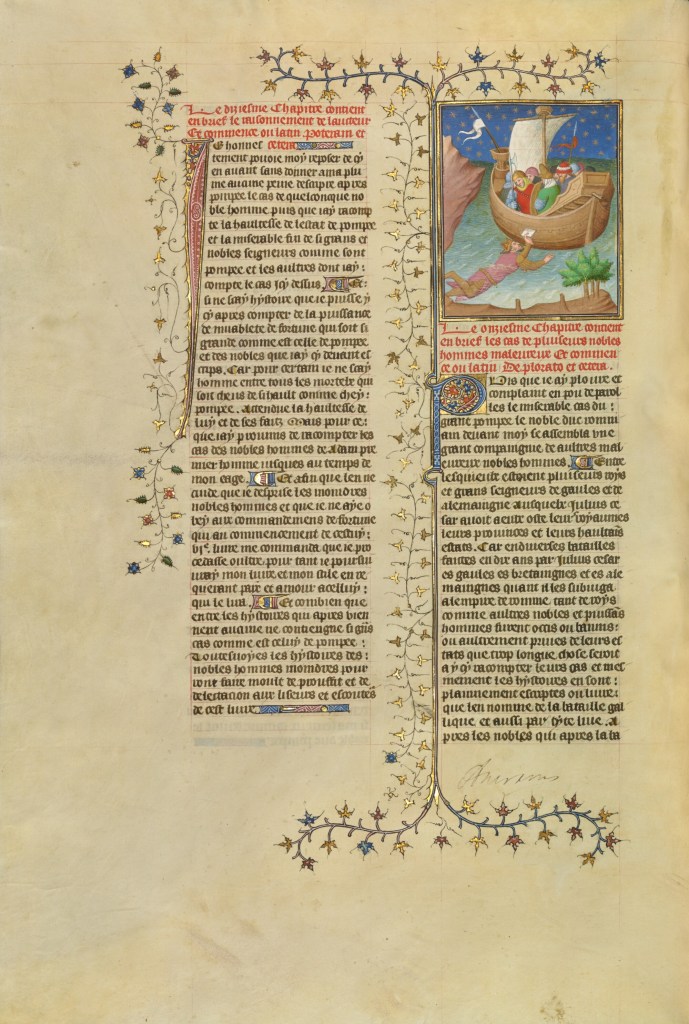
Here’s a 15th century image from the Getty of Caesar saving what a three-drink dinner encourages me to regard as a new possibility equally supported by the primary sources – a cocktail menu.
Into the street the Piper stept

From Robert Browning’s The Pied Piper of Hamelin (scroll down a bit if you follow the link).

Into the street the Piper stept,
Smiling first a little smile,
As if he knew what magic slept
In his quiet pipe the while;
Then, like a musical adept,
To blow the pipe his lips he wrinkled,
And green and blue his sharp eyes twinkled,
Like a candle-flame where salt is sprinkled;
And ere three shrill notes the pipe uttered,
You heard as if an army muttered;
And the muttering grew to a grumbling;
And the grumbling grew to a mighty rumbling;
And out of the houses the rats came tumbling.
Great rats, small rats, lean rats, brawny rats,
Brown rats, black rats, grey rats, tawny rats,
Grave old plodders, gay young friskers,
Fathers, mothers, uncles, cousins,
Cocking tails and pricking whiskers,
Families by tens and dozens,
Brothers, sisters, husbands, wives —
Followed the Piper for their lives.
From street to street he piped advancing,
And step for step they followed dancing,
Until they came to the river Weser
Wherein all plunged and perished
— Save one who, stout as Julius Caesar,
Swam across and lived to carry
(As he the manuscript he cherished)
To Rat-land home his commentary,
Which was, At the first shrill notes of the pipe,
I heard a sound as of scraping tripe,
And putting apples, wondrous ripe,
Into a cider-press’s gripe:
And a moving away of pickle-tub-boards,
And a leaving ajar of conserve-cupboards,
And a drawing the corks of train-oil-flasks,
And a breaking the hoops of butter-casks;
And it seemed as if a voice
(Sweeter than by harp or by psaltery
Is breathed) called out, Oh rats, rejoice!
The world is grown to one vast drysaltery!
‘So munch on, crunch on, take your nuncheon,
‘Breakfast, supper, dinner, luncheon!
And just as one bulky sugar-puncheon,
Ready staved, like a great sun shone
Glorious scarce an inch before me,
Just as methought it said, Come, bore me!
— I found the Weser rolling o’er me.

Since it is off the topic at hand I will make another post (The other post!) later on the reference to Julius Caesar saving his commentary. The standard explanation across the Longman, Ohio, and Oxford editions of Browning’s poems is to the effect that – quoting the Longman – ‘when Caesar’s ship was captured at Alexandria, he swam ashore carrying the MS of his historical memoir, De Gallico Belli (my Latin conscience has to correct that to De Bello Gallico).’ There are problems with this.

When the meadow was pure

An old version (5th c. BCE) of an even older complaint, from the proem of Choerilus of Samos’ lost Περσηίς or Περσικά, a history of the Persian wars. The first half of line 3 is preserved in Aristotle’s Rhetoric (3.14; 1415a1), the rest in a scholia to that section. This text is from Hugh Lloyd-Jones’ Supplementum Hellenisticum (fr. 317).

Ah, blessed the man who was skilful in song at that time,
the attendant of the Muses, when the meadow was pure.
But now, when all has been divided up and the poetic skills have their fixed limits,
we are left last as if in a race, nor is there any direction
in which a man, though he look everywhere, can fetch a newly yoked chariot.’

ἆ μάκαρ, ὅστις ἔην κεῖνον χρόνον ἴδρις ἀοιδῆς,
Μουσάων θεράπων, ὅτ’ ἀκήρατος ἦν ἔτι λειμών·
νῦν δ’ ὅτε πάντα δέδασται, ἔχουσι δὲ πείρατα τέχναι,
ὕστατοι ὥστε δρόμου καταλειπόμεθ’, οὐδέ πῃ ἔστι
πάντῃ παπταίνοντα νεοζυγὲς ἅρμα πελάσσαι.

Curse dolls

From Ovid’s Amores 3.7.27-30, memorable primarily as his impotence poem.

Is my body limp, cursed by Thessalian poison? Are incantations and herbs doing me harm,
or has some sorceress bewitched my name with crimson wax and driven sharp needles into my liver?

Num mea Thessalico languent devota veneno
corpora? num misero carmen et herba nocent,
sagave poenicea defixit nomina cera
et medium tenuis in iecur egit acus?

There’s a very similar passage at Heroides 6.91 – only the purpose there is the more traditional securing of the target’s love.

Among sepulchres she stalks, ungirded, with hair flowing loose, and gathers from the yet warm funeral pyre the appointed bones. She vows to their doom the absent, fashions the waxen image, and into its wretched heart drives the slender needle

per tumulos errat passis discincta capillis
certaque de tepidis colligit ossa rogis.
devovet absentis simulacraque cerea figit
et miserum tenuis in iecur urget acus

The practice of piercing a doll to work some manner of magic on a target it represents is well documented in scholarship – Daniel Ogden’s Magic, Witchcraft, and Ghosts in the Greek and Roman World: A Source Book has a full chapter of translated examples like the partial extract below (pg 248, PGM IV.296–466):

Take some wax or some clay from a potter’s wheel and mold two figures, male and female. Arm the male one like Ares, brandishing a sword in his left hand and striking the female’s neck on her right side. Put the female doll’s hands behind her back and make her kneel. You will fasten the stuff [ousia] on her head or on her neck. Inscribe the doll of the woman being attracted: on her head, “ISEÊ IAÔ ITHI OUNE BRIDÔ LÔTHIÔN NEBOUTOSOUALÊTH”; on her right ear, “OUER MÊCHAN”; on her left ear, “LIBABA ÔIMATHOTHO”; on her face, “AMOUNABREÔ”; over her right eye, “ÔRORMOTHIO AÊTH”; over the other one, “CHOBOUE”; on her right collarbone, “ADETA MEROU”; on her right arm, “ENE PSA ENESGAPH”; on the other one, “MELCHIOU MELCHIEDIA”; on her hands, “MELCHAMELCHOU AÊL”; on her breast, the name of the woman being attracted, with her metronymic; over her heart, “BALAMIN THÔOUTH”; under her stomach, “AOBÊS AÔBAR”; on her vulva, “BLICHIANEOI OUÔIA”; on her bottom, “PISSADARA”; on the soles of her feet, on the right one, “ELÔ”; on the other one, “ELÔAIOE.”

Take thirteen bronze needles and insert one of them into the brain while saying, “I pierce your brain (insert her name)”; insert two into her ears, two more into her eyes, one into her mouth, two below her rib cage, one into her hands, two into her vulva and anus, and two into the soles of her feet, while on each occasion saying once, “I pierce the (insert name of part) of (insert her name), so that she may think of no one, except me alone, (insert your name).” Take a lead tablet, inscribe the same spell on it, and say it through. Bind the tablet to the figures with the warp from a loom, in which you have made 365 knots while saying, as you know how to, “Abrasax, constrain her.”

Lay it as the sun sets beside the grave of one untimely dead or dead by violence, and lay flowers of the season there with it The inscribed and recited spell is this:

“I deposit with you this binding-curse [katadesmos], chthonic gods and Pluto; UESEMIGADON; Maiden Persephone Ereschigal and Adonis the BARBARITHA; underworld Hermes THÔOUTH PHÔKENTAZEPSEU AERCHTHATHOU MISONKTAI KALBANACHAMBRÊ; powerful Anubis PSIRINTH, holder of the keys to Hades; gods and demons of the underworld; untimely dead, male and female; lads and maidens; year on year, month on month, day on day, hour on hour. I adjure all demons in this place to assist this demon. Rouse yourself for me, whoever you are, whether male or female, and take yourself off to every district, every block, and every house. Bring her and bind her. Bring her (insert her name), the daughter of (insert her mother’s name), whose stuff you have, in love with me, (insert your name), whom (insert your mother’s name) bore. Let her not fornicate, let her not be buggered, and let her not do anything that brings pleasure with another man, unless with me alone, (insert your name), so that (insert her name) is not able either to drink or to eat, or hold out, or to endure it, or be calm, so that (insert her name) is not able to find sleep without me, (insert your name), because I adjure you in the name that inspires fear and trembling, the name at the sound of which the earth will be opened up, the name at the sound of which the frightening demons will be frightened, the name at the sound of which the rocks are shattered…..

There’s also a fascinating assemblage of items at the louvre – doll, curse tablet, storage vase – that give a better sense of at least the physical aspects of the cursing process. They’re off display for the moment but there are photos and a lovely writeup here – with additional curse examples.

The old hoard the Night shall keep

Because I mentioned it a few days back here is the final form of Tolkien’s The Hoard from The Adventures of Tomb Bombadil.

When the moon was new and the sun young
of silver and gold the gods sung:
in the green grass they silver spilled,
and the white waters they with gold filled.
Ere the pit was dug or Hell yawned,
ere dwarf was bred or dragon spawned,
there were Elves of old, and strong spells
under green hills in hollow dells
they sang as they wrought many fair things,
and the bright crowns of the Elf-kings.
But their doom fell, and their song waned,
by iron hewn and by steel chained.
Greed that sang not, nor with mouth smiled,
in dark holes their wealth piled,
graven silver and carven gold:
over Elvenhome the shadow rolled.

There was an old dwarf in a dark cave,
to silver and gold his fingers clave;
with hammer and tongs and anvil-stone
he worked his hands to the hard bone,
and coins he made, and strings of rings,
and thought to buy the power of kings.
But his eyes grew dim and his ears dull
and the skin yellow on his old skull;
through his bony claw with a pale sheen
the stony jewels slipped unseen.
No feet he heard, though the earth quaked,
when the young dragon his thirst slaked,
and the stream smoked at his dark door,
The flames hissed on the dank floor,
and he died alone in the red fire;
his bones were ashes in the hot mire.

There was an old dragon under grey stone;
his red eyes blinked as he lay alone.
His joy was dead and his youth spent,
he was knobbed and wrinkled, and his limbs bent
in the long years to his gold chained;
in his heart’s furnace the fire waned.
To his belly’s slime gems stuck thick,
silver and gold he would snuff and lick:
he knew the place of the least ring
beneath the shadow of his black wing.
Of thieves he thought on his hard bed,
and dreamed that on their flesh he fed,
their bones crushed, and their blood drank:
his ears drooped and his breath sank.
Mail-rings rang. He heard them not.
A voice echoed in his deep grot:
a young warrior with a bright sword
called him forth to defend his hoard.
His teeth were knives, and of horn his hide,
but iron tore him, and his flame died.

There was an old king on a high throne:
his white beard lay on knees of bone;
his mouth savoured neither meat nor drink,
nor his ears song; he could only think
of his huge chest with carven lid
where pale gems and gold lay hid
in secret treasury in the dark ground;
its strong doors were iron-bound.
The swords of his thanes were dull with rust,
his glory fallen, his rule unjust,
his halls hollow, and his bowers cold,
but king he was of elvish gold.
He heard not the horns in the mountain-pass,
he smelt not the blood on the trodden grass,
but his halls were burned, his kingdom lost;
in a cold pit his bones were tossed.

There is an old hoard in a dark rock,
forgotten behind doors none can unlock;
that grim gate no man can pass.
On the mound grows the green grass;
there sheep feed and the larks soar,
and the wind blows from the sea-shore.
The old hoard the Night shall keep,
while earth waits and the Elves sleep.

Beowulf and Tolkien’s dragon-sickness

From an appendix to Tom Shippey’s Beowulf translation, an article entitled Tolkien and Beowulf – A Lifelong Involvement. It is singularly appropriate to Tolkien to bury substantive thoughts in an appendix.

… The first visible sign of [Tolkien’s] involvement with the poem indeed comes from 1923, when he published a poem in The Gryphon (a Lees University journal), with the title “Iumonna Gold Galdre Bewunden.” These four words form line 3052 of Beowulf, and Tolkien translated them later as “the gold of bygone men … wound about with spells.” Tolkien was not strictly accurate here, for galdre is singular, not plural. More interesting is the question, “what kind of spell was meant in Beowulf?”, and this had already caused scholars some uncertainty.

Tolkien was, however, different from other scholars, both earlier and later, in two respects. One is that while they considered issues like line 3052 as purely textual problems, Tolkien tried to probe deeper to find both mythical meanings and real-world meanings. The other is that he found solutions of this kind not only in the poem itself, but in the scholarship which had built up over many years, rarely if ever providing definite answers, but creating a range of possibilities.

Setting the line in context, it occurs late in the poem, and the gold is the hoard of the dragon, which Beowulf has just killed at the cost of his own life. But that is not what the line says: it says the gold is “the gold of bygone men,” and earlier on there has been a scene in which a man, usually described as “the Last Survivor” of a fallen people, commits his people’s gold to the earth, since he no longer has the power to guard it. How, then, did it pass to the dragon? And since the “spell ” was clearly put on the gold by the “bygone men,” what was it supposed to do? If it was meant to shield the gold from discovery, it didn’t work. So it must have been a curse, laid on whoever should take the gold. Did it work on the dragon? Did it work, or would it have worked, on Beowulf, who lived long enough only to see the gold? These are not scholarly questions, being purely speculative, but they are suggestive ones.
One further complication (unless it is in fact a clue) is that while it is very clear that the Last Survivor commits the treasure to the earth (line 2247), before wandering off in some way to die (2269-70), the dragon immediately comes upon it and finds it “standing open,” opene standan….

The thought struck scholars very quickly that perhaps (in some earlier version of the story), the disappearance of the Last Survivor and the appearance of the dragon had been one and the same thing: the Last Survivor became the dragon. Old Norse sagas contain hints of the idea that if a man “lay down on his gold,” lagdisk a gullit, in his own funeral barrow, then he would turn into a dragon. That would explain,; for one thing, why dragons are to be found in mounds or barrows, as declared firmly by another Anglo-Saxon poem, draca sceal on hlawe, “dragon must be in mound,” and also where their gold comes from: it has been buried with the dead man, or rather, the not-dead man.

What does the spell or curse do, then? This is the question Tolkien answered in his poem of 1923, an answer which remained consistent through several minor and major reworkings of the poem all the way to its appearance as “The Hoard” in The Adventures of Tom Bombadil in 1962. Briefly, just as the Last Survivor is the dragon;, so the curse is the hoard itself. What it does is destroy successive owners morally, and eventually physically, cursing them with avarice and blindness.

In the 1923 version – Tolkien tinkered with details for nearly forty years, without losing the main shape and point of the poem – the gold was originally elvish, until the fall of the elf-kingdoms. It then passed to “an old dwarf,” who became a miser, counting his hoard, and not noticing the dragon who found his cave. In turn the dragon became old and failed to hear the approach of a “fearless warrior,” who called him to come out and fight for the gold . And the warrior became “an old king,” brooding on his riches and neglecting his kingdom, until he too was displaced and killed. Now the hoard is lost, and will remain so till the elves return: if they do, for the 1923 version ends with the word “awake,” the 1962 one with the world “sleep.”

The “spell” which winds inextricably round the hoard is, then, what Tolkien in The Hobbit would call “the dragon-sickness.” At the end of the story this affects first Thorin, though “the power that gold has upon which a dragon has long brooded,” and then kills the Master of Laketown, who flees with the gold he has been given and (like the dwarf, dragon and king of the poem) dies miserably, in his case “of starvation in the Waste, deserted by his companions.” “Dragon-sickness,” then, began as an interpretation of a difficult line in Beowulf …

Fire upon the flood

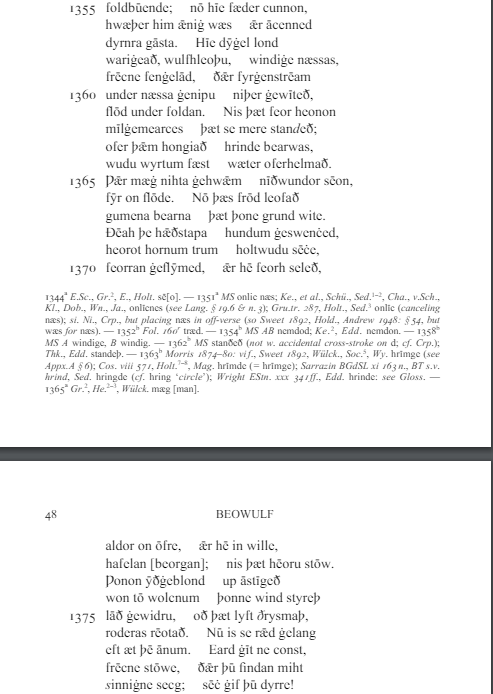
A comparison of Beowulf translations – Seamus Heaney, Tolkien, Tom Shippey, and R.D. Fulk. The passage is one of my favorites, Hrothgar’s description of the approach to the home of Grendel and his mother (lines 1355-1379). The title is Tolkien’s take on the – to me – central atmospheric line of the passage – fyr on flode. You’ll notice that Heaney is the only one to avoid the easy alliteration there. I used to regret the choice but I’m no longer sure his isn’t as effective anyway.

Seamus Heaney:

…. They are fatherless creatures,
and their whole ancestry is hidden in a past
of demons and ghosts. They dwell apart
among wolves on the hills, on windswept crags
and treacherous keshes, where cold streams
pour down the mountain and disappear
under mist and moorland. A few miles from here
a frost-stiffened wood waits and keeps watch
above a mere; the overhanging bank
is a maze of tree-roots mirrored in its surface.
At night there, something uncanny happens:
the water burns. And the mere bottom
has never been sounded by the sons of men.
On its bank, the heather-stepper halts:
the hart in flight from pursuing hounds
will turn to face them with firm-set horns
and die in the wood rather than dive
beneath its surface. That is no good place.
When wind blows up and stormy weather
makes clouds scud and the skies weep,
out of its depths a dirty surge
is pitched towards the heavens. Now help depends
again on you and on you alone.
The gap of danger where the demon waits
is still unknown to you. Seek it if you dare.

Tolkien (lines 1132-1152 for his rendering):

… of a father they knew not, nor
whether any such was ever before begotten for him among
the demons of the dark. In a hidden land they dwell upon
highlands wolfhaunted, and windy cliffs, and the perilous
passes of the fens, where the mountain-stream goes down
beneath the shadows of the cliffs, a river beneath the earth. It
is not far hence in measurement of miles that that mere lies,
over which there hang rimy thickets, and a wood clinging
by its roots overshadows the water. There may each night
be seen a wonder grim, fire upon the flood. There lives not
of the children of men one so wise that he should know the
depth of it. Even though harried by the hounds the ranger of
the heath, the hart strong in his horns, may seek that wood
being hunted from afar, sooner will he yield his life and
breath upon the shore, than he will enter to hide his head
therein: no pleasant place is that! Thence doth the tumult
of the waves arise darkly to the clouds, when wind arouses
tempests foul, until the airs are murky and the heavens weep.
‘Now once more doth hope of help depend on thee alone.
The abode as yet thou knowest not nor the perilous place
where thou canst find that creature stained with sin. Seek it
if thou durst!

Tom Shippey:

… Whether he was begotten
by any father from the dark spirits,
they do not know. They dwell, the giant pair,
in the hidden country, wolf-haunted slopes,
windy nesses, dangerous fenland,
where the stream pours down under the dark cliffs
from the mountain, to sink underground.
The mere lies from here not far in miles.
Over it there hang frosty-bound groves,
fast-rooted woods overshadow the water
Every night you can see a dreadful sight there,
fire in the flood. No child of men
is so wise as to know what lies beneath.
Although the proud-horned stag, the heath-treader,
is pressed by hounds, hunted from afar,
and seeks shelter in the wood, he will on the shore
give up life and breath, before, to save his head,
he will plunge in. That is an uncanny place.
When the wind stirs up foul weather,
the tossing waves rise dark to the clouds,
until the air drizzles, the heavens weep.
Now the decision is up to you alone.
You do not know the land, the dangerous place
where you can find the sinful creature.
Seek if you dare!

R.D Fulk’s prose version:

they knew of no father, whether any mysterious creatures had been born before him. They inhabit hidden country, wolf-hills, windy crags, a dangerous passage through fen, where a cascading river passes down under the gloom of cliffs, a watercourse under the earth. It is not far in miles from here that the pool stands; over it hang frost-covered groves, firmly rooted woods overshadow the water. There every night a dire portent can be seen, fire on the flood. There lives no offspring of men so well informed that he knows the bottom. Even if a heath-roamer beset by hounds, a hart firm of antlers, makes for the forest, driven far in flight, it will sooner give up the ghost, its life on the bank, than enter and save its head; that is not a pleasant place. There the tossing waves mount up dark to the clouds when the wind stirs up ugly storms, until they choke the air and the heavens weep. Now the course of action is again dependent on you alone. You are not yet acquainted with the region, that dangerous place where you can find the one who is the offender; go look if you dare!

And the original from the standard Klaeber’s Beowulf (4th edition). Unsurprisingly WordPress doesn’t care for the unique Old English characters so a screenshot will have to suffice:

Listening to their insides the least

From A l’ombre des jeunes filles en fleurs (v.2 of À la recherche du temps perdu) with the traditional Moncrieff-Kilmartin-Enright translation. Proust is underappreciated as the patron saint of neurotics.

Neurotic subjects are perhaps less addicted than any, despite the time-honoured phrase, to “listening to their insides”: they hear so many things going on by which they realise later that they were wrong to let themselves be alarmed, that they end by paying no attention to any of them. Their nervous systems have so often cried out to them for help, as though with some serious malady, when it was simply going to start snowing or they were going to move house, that they have acquired the habit of paying no more heed to these warnings than a soldier who in the heat of battle perceives them so little that he is capable, although dying, of carrying on for some days still the life of a man in perfect health.


Les névropathes sont peut-être, malgré l’expression consacrée, ceux qui « s’écoutent » le moins : ils entendent en eux tant de choses dont ils se rendent compte ensuite qu’ils avaient eu tort de s’alarmer, qu’ils finissent par ne plus faire attention à aucune. Leur système nerveux leur a si souvent crié : « Au secours ! » comme pour une grave maladie, quand tout simplement il allait tomber de la neige ou qu’on allait changer d’appartement, qu’ils prennent l’habitude de ne pas plus tenir compte de ces avertissements qu’un soldat, lequel dans l’ardeur de l’action, les perçoit si peu, qu’il est capable, étant mourant, de continuer encore quelques jours à mener la vie d’un homme en bonne santé.

Substitution of a Man for Ereshkigal

A substitution healing ritual found in Walter Burkert’s The Orientalizing Revolution. The core concept is familiar enough but the thoroughness here is especially impressive.

This text deals with the healing of a sick person. It bears the title “Substitution of a Man for Ereshkigal.” Ereshkigal is the Sumerian-Akkadian goddess of the underworld. The substitute is an “unmated goat.” It is put into bed with the sick person and is supposed to spend the night with him. At dawn the conjurer arrives, throws the goat and the sick person out of the bed onto the floor, touches the throat of the sick person with a wooden knife, and then cuts the throat of the goat with a real knife. The slaughtered goat is then stuffed with spices, it is dressed in a robe and given shoes, its eyes are adorned, the headgear of the sick person is wound round its head, and it is tended “as if it were a dead man” while the sick person leaves the house. The conjurer speaks an incantation, raises the lamentation for the dead over the body, brings offerings for the dead, makes libations of water, beer, roasted corn, milk, honey, cream, and oil; finally, with offerings for the “spirit of the dead of the family” and the goat, he buries the animal. In this way the sick person is delivered.

The spices are the one element I don’t understand – are they a purifying medicine on premise that the sickness by that point has transferred to the goat? Or are they representative of the sickness itself? Or somehow an analogue for what is in a person (=another step to making the goat more acceptable as substitute)? Or unrelated to any of that and just a first phase of offerings in a different form than the libations that conclude the ritual?

The main source Burkert gives is E. Ebeling’s Tod und Leben nach den Vorstellungen der Babylonien p.65-69.

Life is but a swivel of the eye

The Ballad of Early Rulers, an Ubi Sunt originally of Sumerian origin but with a life into the first millennium BCE. This rendering is from Yoram Cohen’s Wisdom From the Late Bronze Age and combines copies from Emar and Ugarit with further supplements from the Old Babylonian Sumerian Standard Version. Which is to say it’s a fictional patchwork that reads better than the individual fragmentary versions.

1 The fates are determined by Ea,
2 The lots are drawn according to the will of the gods,
3 Since always so it was.
4 Has it never been heard from the mouth of (our) predecessor(s)?
5 Above these were the kings… (the rest is corrupt)
6 Above the houses of their dwelling, below their house of eternity.
7 Like the distant heaven, nobody can reach (them),
8 Like the depths of the Netherworld, nobody can know (them),
9 Life is but a swivel of the eye,
10 Life of mankind cannot [last] forever.
11 Where is Alulu who reigned for 36,000 years?
12 Where is Entena who went up to the sky?
13 Where is Gilgameš who sought (eternal) life like (that of) Ziusudra?
14 Where is Huwawa who was subdued when bowing down (to
Gilgameš)?
15 Where is Enkidu who was famous in his strength [throughout the
land]?
16 Where is Bazi? Where is Zizi?
17 Where are they—the great kings (Ugarit Version I) // Where are the
great kings from past days up to now (Emar Version)?
18 They are not (anymore) engendered, are not born.
19 Life without light—how can it be better than death?
20 Young man let me teach you truly about (the nature of) your god.
21 Chase away grief from depression; have nothing to do with silence.
22 In exchange for a single day of happiness let pass a time of silence of
tens of thousands of days. (Ug. and Emar combined)
23 May Siraš rejoice over me as if over her little child!
24 Thus the fates of mankind are established

And for some orientation here’s a selection of Cohen’s commentary:

The Ballad of Early Rulers begins by stating that ever since the fates were determined by Ea life is transient and not meant to last forever. The poem then offers a list of early illustrious rulers. The reader is asked to question what their fate was in spite of their heroic deeds. Did these rulers ever reach immortality? Alulu, Entena, Gilgameš, Bazi, and Zizi, in spite of the fact that none like these past rulers are born anymore, were eventually mortal, so we are to understand.

As has been made evident by several scholars, the list of The Ballad of Early Rulers rests heavily on Mesopotamian scholarly and historiographical traditions, particularly on the Sumerian King List and, as will be seen, The Epic of Gilgameš. Alulu of The Ballad of Early Rulers can be identified with Alulim from the city of Eridu, the first king of the antediluvian section in the Sumerian King List. Alulim or, in his Akkadian rendering, Ayyalu is also known from the Uruk List of Kings and Sages, where he is mentioned in the company of the famous sage Adapa. Otherwise Alulu is also known as a magic power called upon to ward away pests in several incantations.

Following Alulu in The Ballad of Early Rulers is Entena, or, as he is better known to us, Etana King of Kiš, who also appears in the Sumerian King List. The mention of Etana’s ascent to heaven in The Ballad of Early Rulers (l. 12, partly preserved in the Sumerian Standard Version) refers to the mythological story The Epic of Etana. As in The Ballad of Early Rulers, the Sumerian King List speaks of “Etana, the shepherd, who ascended to heaven.”

After Kiš, the Sumerian King List informs us that kingship passed on to Uruk, whose most famous king was Gilgameš. As in the Sumerian King List, so in The Ballad of Early Rulers, it is Gilgameš who follows Etana. Both kings failed to reach immortality but were somewhat compensated for their brave but futile attempt when they achieved a place in the Netherworld as venerated figures.

Once Gilgameš is mentioned in The Ballad of Early Rulers, other characters known from his Epic show up. First comes Ziusudra, better known as Atra(m)-ḫasīs or Utnapištim, the only person to have reached immortality in Mesopotamian literary tradition. He is followed by Huwawa, Gilgameš’s adversary, and then by Enkidu, the hero’s companion.

The next two characters, Bazi and Zizi, are mentioned only in the Emar version. They are missing from Ugarit Version I (which mentions Enkidu and then jumps to line 17) and the Sumerian Standard Version. Nonetheless, in spite of what has repeatedly been claimed in the scholarly literature, both characters were not inserted in the list by scribes from Emar.

Like other early rulers of The Ballad of Early Rulers, Bazi and Zizi are also found in the Sumerian King List. Known from a recension of the Sumerian King List found at Tel Leilan (an ancient site located in the Habur Triangle), they are included in the section of the list dedicated to the kings of Mari. Like many other pre-Sargonic kings of the Sumerian King List, Bazi and Zizi were legendary figures of probably no historical background.