Not worth the poorest thought

From Ralph Waldo Emerson’s speech The American Scholar:

The world of any moment is the merest appearance. Some great decorum, some fetich of a government, some ephemeral trade, or war, or man, is cried up by half mankind and cried down by the other half, as if all depended on this particular up or down. The odds are that the whole question is not worth the poorest thought which the scholar has lost in listening to the controversy. Let him not quit his belief that a popgun is a popgun, though the ancient and honorable of the earth affirm it to be the crack of doom.

One Democritus cannot suffice

From Erasmus’ Praise of Folly (27):

For, as they point out. what is more foolish than for a candidate seeking office to flatter the people, to buy their favor with doles, to court the applause of so many fools, to be pleased by their shouts, to be carried about in parades as if he were a spectacle for the populace, to have his statue in the marketplace? To all these add the adoption of new names, and nicknames; then add those divine honors paid to very sorry fellows, and the deification, at great public ceremonies, of criminal tyrants. This sort of thing is most arrant folly. One Democritus cannot suffice for laughing at it. Who denies this?

Quid enim stultius, inquiunt, quam supplicem candidatum blandiri populo, congiariis favorem emere, venari tot stultorum applausus, acclamationibus sibi placere, in triumpho veluti signum aliquod populo spectandum circumferri, aeneum in foro stare? Adde his nominum et cognominum adoptiones. Adde divinos honores, homuncioni exhibitos, adde publicis cerimoniis in Deos relatos etiam sceleratissimos tyrannos. Stultissima sunt haec, et ad quae ridenda non unus sufficiat Democritus. Quis negat?

The pleasantest dotage that ever I read

From Andre du Laurens‘ 1594 treatise Discours de la conservation de la veuë: des maladies melancoliques: des catarrhes, & de la vieillesse, englished in 1599 by Richard Surphlet as A discourse of the preservation of the sight of melancholike diseases of rheumes and of old age:

The pleasantest dotage that euer I read, was of one Sienois a Gentleman, who had resolued with himselfe not to pisse, but to dye rather, and that because he imagined, that when he first pissed, all his towne would be drowned. The Phisitions shewing him, that all his bodie, and ten thousand moe such as his, were not able to containe so much as might drowne the least house in the towne, could not change his minde from this foolish imaginati∣on. In the end they seeing his obstinacie, and in what danger he put his life, found out a pleasant inuention. They caused the next house to be set on fire, & all the bells in the town to ring, they per∣swaded diuerse seruants to crie, to the fire, to the sire, & therewith∣all send of those of the best account in the town, to craue helpe, and shew the Gentleman that there is but one way to saue the towne, and that it was, that he should pisse quickelie and quench the sire. Then this sillie melancholike man which abstained from pissing for feare of loosing his towne, taking it for graunted, that it was now in great hazard, pissed and emptied his bladder of all that was in it, and was himselfe by that meanes preserued.

This was cited in Mary Ann Lund’s A User’s Guide to Melancholy, a book which is (to me) wrongly taken as an introduction to Burton’s Anatomy of Melancholy. It feels more an onramp, a brief overview of the renaissance conception of melancholy and the medical theories behind that conception. I think the same is achieved just as effectively by several other books that also provide broader overviews – Matthew Bell’s Melancholia: The Western Malady and Stanley Jackson’s Melancholia and Depression: From Hippocratic Times to Modern Times – but this one does have the benefit of sustained connection to the text and its author if you’re looking for the confidence to pick up Burton. There’s a Guardian review here and a far better (but paywalled) TLS here.

Thunder looses beds of eels

From Shakespeare’s Pericles, Prince of Tyre (4.2, the firmly Shakespearean portion of the play beginning at act 3):

I warrant you, mistress, thunder
shall not so awake the beds of eels as my giving
out her beauty stir up the lewdly-inclined.

The clear phallic play aside, the Arden note adds:

If not a proverb – Dent questions (?T276) ‘Thunder looses beds of eels’ – this was certainly a common zoological belief, appearing in Marston’s Scourge of Villainy (1598) and George Wither’s Abuses Stripped and Whipped (1613).

Dent in both Shakespeare’s Proverbial Language and the more catchingly titled Proverbial Language in English Drama Exclusive of Shakespeare, 1495–1616 is cagey about asserting the proverb despite compiling four other instances of the belief. In the former he cites:

1598 Marston Satire 7.78 – They are naught but Eeles, that never will appeare, / Till that tempestuous winds or thunder teare / Their slimie beds.

1613 G. Wither Abuses ed. 1863 168: Let loose, like beds of eels by thunder.

cl620 (1647) Fletcher & Massinger, False One 4.2.200f.: I’ll break like thunder / Amongst these beds of slimy Eeeles.

And in the latter adds:

1615 S.S. Honest Lawyer II C3v: Shall we cling, like a couple of Eeles, not to bee dissolv’d but by Thunder?

None of this addresses the question of the origin of the idea of eels fearing/stirred up by thunder, which is what I mainly cared about. I don’t have a definite answer, but I do have a logical chain. We begin with Pliny, as anyone seeking answers on odd beliefs about animals should do (Natural History 9.38):

Eels live eight years. They can even last five or six days at a time out of water if a north wind is blowing, but not so long with a south wind. But the same fish cannot endure winter in shallow nor in rough water; consequently they are chiefly caught at the Pleiads, as the rivers are then specially rough. They feed at night. They are the only fish that do not float on the surface when dead. There is a lake called Garda in the territory of Verona through which flows the river Mincio, at the outflow of which on a yearly occasion, about the month of October, when the lake is made rough evidently by the autumn star, they are massed together by the waves and rolled in such a marvellous shoal that masses of fish, a thousand in each, are found in the receptacles constructed in the river for the purpose.

I’ve edited the above to translate circa verginias as ‘at the Pleaids’ rather than ‘at the rising of the Pleaids’ since I think this confuses the issue.

The Pleiades were associated in the ancient world with storms at both their rise in Spring (April-ish) and especially their setting in Fall (Oct-Nov). So Hesiod in Works and Days (615-622):

 When the Pleiades and Hyades and the strength of Orion set [in October], that is the time to be mindful of plowing in good season. May the whole year be well-fitting in the earth. But if desire for storm-tossed seafaring seize you: when the Pleiades, fleeing Orion’s mighty strength, fall into the murky sea, at that time [in November] blasts of all sorts of winds rage; do not keep your boat any longer in the wine-dark sea at that time

Later Ovid in Heroides (18.187):

What when the seas have been assailed by the Pleiad, and the guardian of the Bear, and the Goat of Olenos? Either I know not how rash I am, or even then a love not cautious will send me forth on the deep

And a last instance in Statius’ Silvae (3.2.71):

Hence raging winds and indignant tempests and a roaring sky and more lightning for the Thunderer. Before ships were, the sea lay plunged in torpid slumber, Thetis did not joy to foam nor billows to splash the clouds. Waves swelled at sight of ships and tempest rose against man. ’Twas then that Pleiad and Olenian Goat were clouded and Orion worse than his wont.

It doesn’t seem a far leap to take that Pliny’s reported pattern of eel behavior and eel hunting season, whether scientifically accurate or not, was understood as connected to the rising or setting of the Pleiades and so to the stormy season. Hence by shorthand approximation to thunder generally. And so eels, unable to deal with storms or the rough water that follow, were viewable as loosed from bed by thunder.

To all this my vanity adds a much later reference in the opening of Robert Browning’s Old Pictures in Florence. I was proud of this as altogether my own but in due diligence checking the most recent edition of John Marston’s poetry (The Poems of John Marston ed. Arnold Davenport) I found a previous editor of the same (Bullen) had also pointed out the quote, taking it as Browning reporting a piece of ‘Italian folk-lore’:

The morn when first it thunders in March,
The eel in the pond gives a leap

I sometimes feel bad about doing these things on work time but I work for a university so it should all wash out as research.


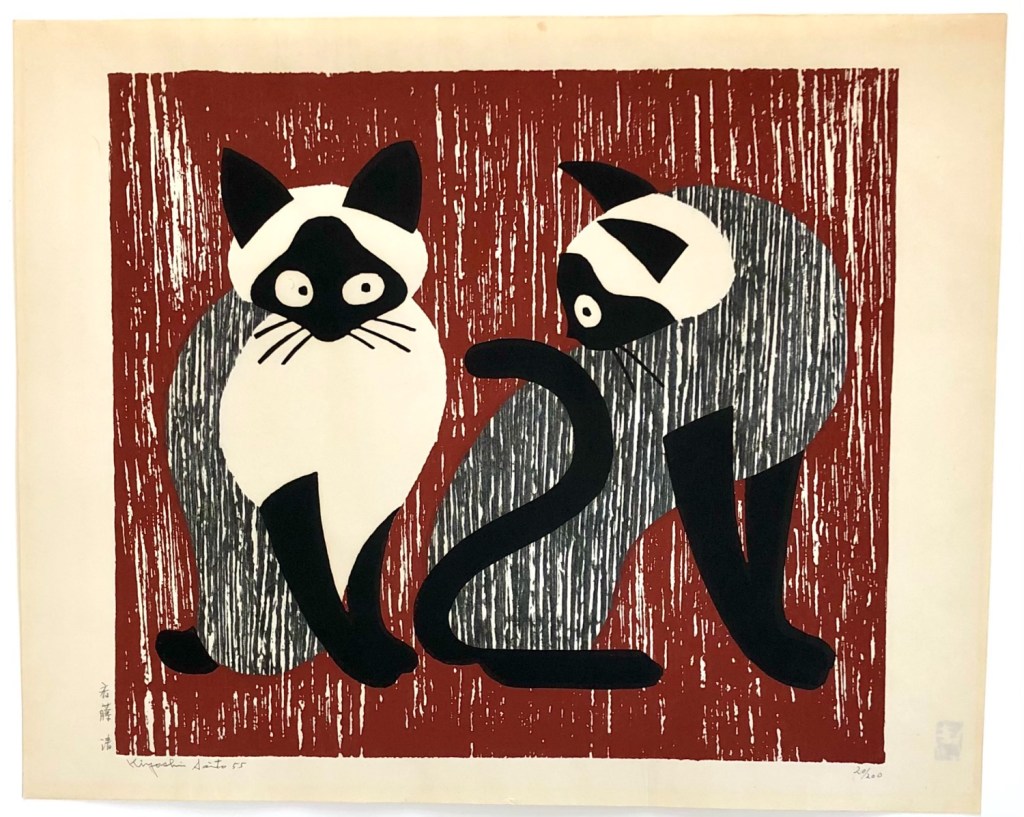
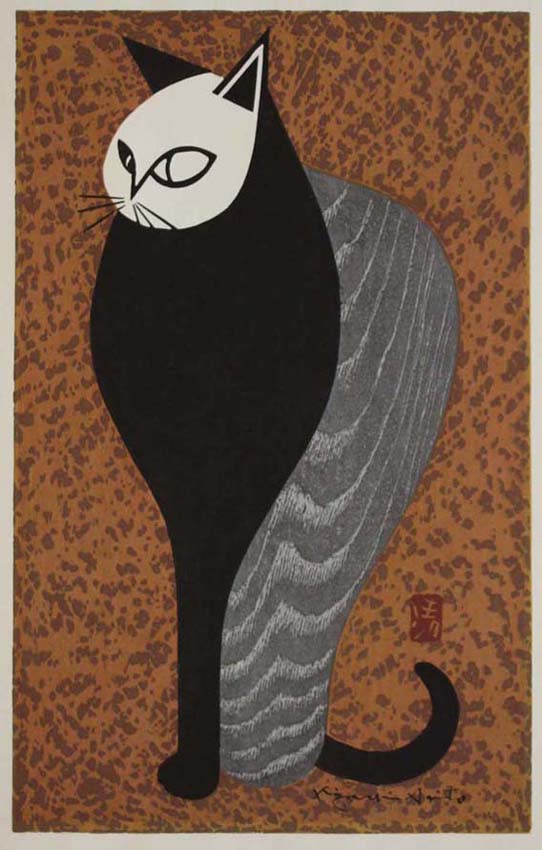
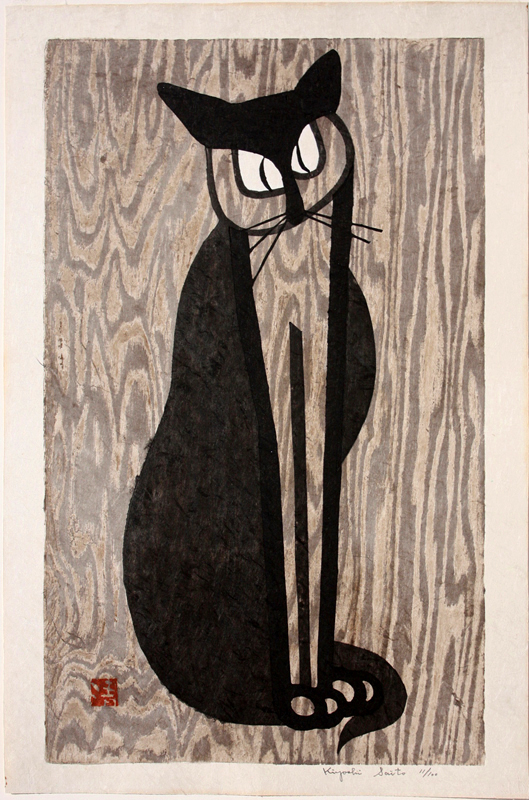
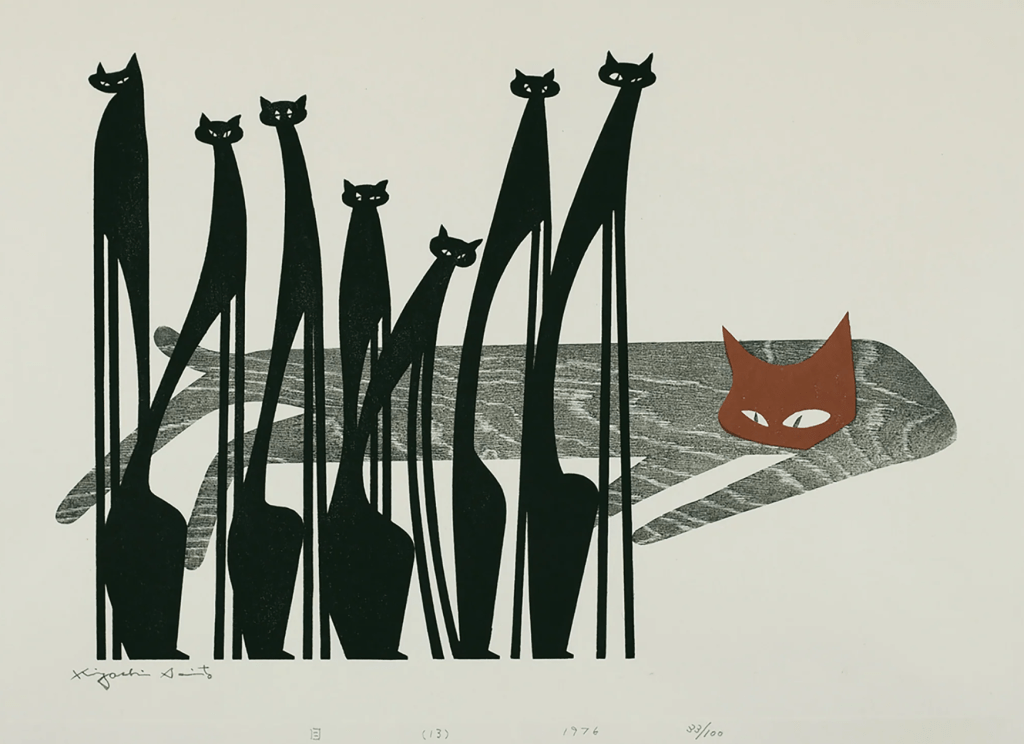
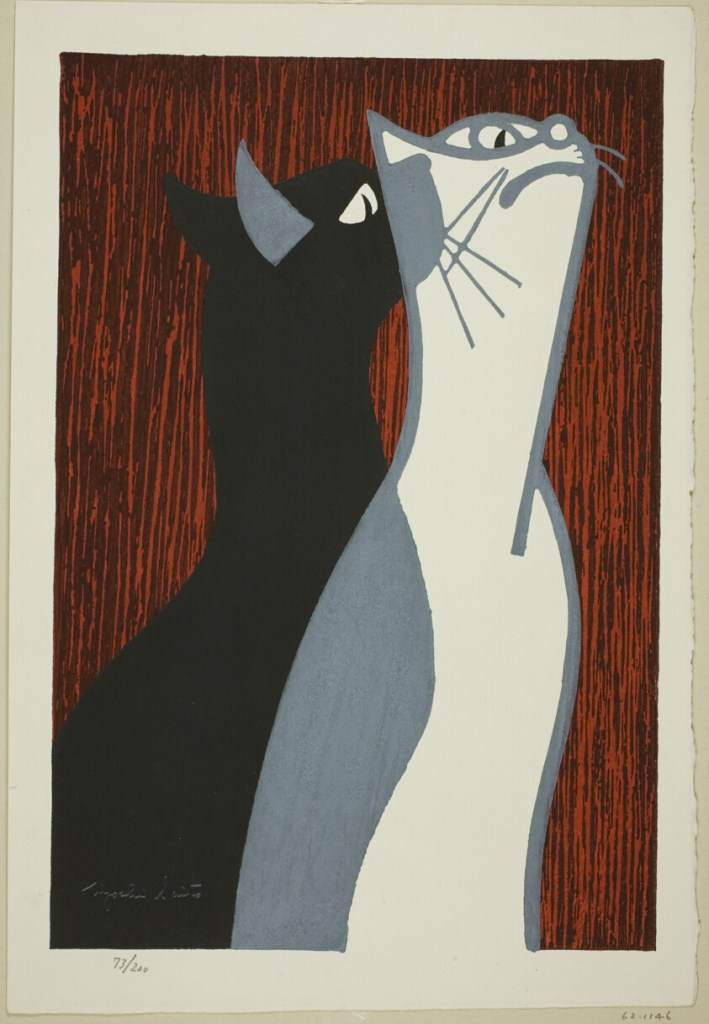
Some cats by Saito Kiyoshi

There are very few English resources on Saito. The fullest is a recent exhibition book (Saito Kiyoshi: Graphic Awakening) that follows overviews on his life and technique with brief sections on the genres he worked in. It’s hardly comprehensive as it claims but it gives more structure and examples than the other treatments I’ve found. Online there are brief (and mostly overlapping) biographies at two of the better dealer sites (Ronin Gallery and Moonlit Sea, with bibliography on the latter). These also feature works for sale while Ukiyo-e hosts a larger selection aggregated from a number of collections. Past that, Google is your friend since the best compilations are all in hard to find (and expensive when found) Japanese volumes.

But here are some of his cats. There’s a clear progression from the less stylized earlier row (1940s-50s) to the hyper-elongated (sometimes owl-ish) geometrics of the second row (1950s-70s) and later back to something of a blend in the third row (1980s, though the right-hand piece is, as best I can tell, a late revision of an earlier one from the 1960s).

The bellows blows up sin

From Shakespeare’s (and George Wilkins‘) Pericles, Prince of Tyre (1.2.276):

For flattery is the bellows blows up sin;
The thing the which is flatter’d, but a spark,
To which that wind gives heat and stronger glowing;

The italicized ‘wind’ is the subject of a number of editorial conjectures. The original (often corrupt) quarto text has ‘sparke‘ which cannot be right (spark then being object in the first instance and separate agent in the second). Other readings beside the one adopted here are ‘breath’, ‘blast’, and ‘spur.’ I rather like ‘blast’ for picking back up the ‘bellows blows’ bl repetition but I stick with the Arden.

Anyway, I liked the image and it struck me that it that I couldn’t think of another such use. That felt surprising since the metaphor feels an obvious one. It turns out there’s only one other use in Shakespeare, at the beginning of Antony and Cleopatra (1.1.9)

Nay, but this dotage of our general’s
O’erflows the measure: those his goodly eyes,
That o’er the files and musters of the war
Have glow’d like plated Mars, now bend, now turn,
The office and devotion of their view
Upon a tawny front: his captain’s heart,
Which in the scuffles of great fights hath burst
The buckles on his breast, reneges all temper,
And is become the bellows and the fan
To cool a gipsy’s lust.

I think I’ve always unreflectively misread this line by taking ‘bellows’ and ‘fan’ as synonyms both governing ‘cool’. But, following the OED’s figurative use definition – ‘applied to that which blows up or fans the fire of passion, discord, etc’ – there must be a contrast between the two and an implied verb for ‘bellows’ like ‘the bellows [to arouse] and the fan to cool.

Speaking of the OED, their entry provides Chaucer’s Parson’s Tale a few centuries earlier as the first figurative use:

Now shal ye understonde in what manere that sinne waxeth and encresseth in man. The firste thing is thilke norisshing of sinne of which I spak biforn, thilke flesshly concupiscence. And after that comth the subjeccioun of the devel – this is to ayn, the develes bely, with which he blowth in man the fir of flesshly concupiscence.

Now shall you understand in what manner that sin waxes or increases in man. The first thing is this nourishing of sin of which I spoke before, this fleshly concupiscence. And after that comes the subjection of the devil — this is to say, the devils bellows, with which he blows in man the fire of fleshly concupiscence.

To which I’d add, more by way of associative thinking than argument for connection, one of the Old English Exeter Book riddles (37, translation source here):

I saw these things—their belly was behind them,
swollen-up splendor. Its servant followed,
a powerfully eager man, and a great deal
had it endured what it experienced—
flying through its eye.

One doesn’t always die, when one must give up
what’s inside to another, but it comes soon,
a benefit to his bosom, its fruiting fulfilled—
he engenders his son, but is his own father as well.

Bellows is the generally proposed solution.

On Tarot as Bookmarks

Apologies, this will be a self-indulgent ramble.

We had some people over for dinner last night and someone browsing my books commented on my habit of using the major arcana of the Tarot as bookmarks. I’ve done this since undergrad and take it now as an unspoken eccentricity, but it originates in my earlier use of scrap ticket stubs for marks. I never knew how many of these I’d need so I just hoarded them in a bedside table until a girlfriend one day asked why my drawer was full of trash paper. Now I was conscious and so cowardly (pensando, consumai la ‘mpresa, to add some respectability). A few weeks later at a bookshop’s outdoor bargain shelves I found a copy of Oswald Wirth’s La Tarot: Des Imagiers Du Moyen Age (is this a translation?, I still don’t know). I opened it in passing curiosity and found at the rear a set of Wirth’s edition of the 22 major arcana. These I at once recognized as ideal bookmarks and have used as such ever since. I’ve now read a few books on the Tarot – Wirth’s, Jodorowsky’s, and the anonymous Meditations on the Tarot – and have a sense of what each arcana ‘should’ mean but I generally apply my own notion of associations for what card to use where. This is the fun of the system. Apart from a few ‘assigned’ cards with dedicated uses (listed below) the rest are pulled as fancy strikes and often switched halfway through volumes. A student once told me this revolving meditation on each arcana is a respectful and orthodox way to deploy the Tarot, but I mainly take it as a means of tracking how my feelings flex on the value of texts I’m reading.

These are the cards serving as set pieces always in use:

Sterne or Ovid – I – le Bateleur
Buddhism generally – VII – le Chariot (from Sanskrit Mahayana as ‘great vehicle’)
Proust – VIIII – L’Hermite
Dante – XVI – la Maison Dieu (originally XX – le Jugement but it seemed too pat)
Gita/Upanishads – XVII – les Etoiles
Shakespeare – XXI – le Monde

Wrangling in the Muses’ birdcage

A pretty and still relevant phrasing by Timon of Phlius speaking of the scholars and librarians of Alexandria:

In Egypt of the many tribes, many bookish scribblers are being fed, endlessly wrangling in the Muses’ birdcage.

Πολλοὶ μὲν βόσχονται ἐν Αἰγύπτῳ βιβλιαχοὶ χαραχῖται ἀπείριτα δηριόωντες Μουσέων ἐν ταλάρῳ

This quote even gets its on entry in LSJ as a unique metaphorical use of τάλαρος

After a while, write again.

A few months back a relative left me most of her personal library. Our interests were more adjacent that overlapping but she trusted I’d take care of what I wanted and spread the rest out to appreciative parties. One of the happier surprises among what I’ve kept is the six volume Enciclopedia Virgiliana, a project inspired by the success of the earlier Enciclopedia Dantesca (explained in brief here – though this legacy also brought me the lovely 1996 edizione di lusso). I’d used the work a couple of times – mainly for Virgil’s relationship to his Greek predecessors – but knew it less in its own right than as a recurring citation in the commentaries on Aeneid 2, 3, 6, 7, and 11 the scholar Nicholas Horsfall had done through from ~2000-2015. This morning I checked some entry, started flipping about, and discovered Horsfall himself had authored several articles. Curious if he’d written anything on the origins or progression of the project, I did a bit of searching and found an informal review in v.33 (1987) of Vergilius. The general thrust is flattering with a few expected scholar’s snipes at some of the entries and editorial choices but it ends with a set of ordering instructions that could only have been written by someone with enough time in Italy to be at peace with – but still baffled by – how the nation operates:

It should however be by now clear that we have here a massive new tool in Virgilian studies, that the specialist should not be without. The next step is to write to the Ufficio Abbonamenti, Istituto della Enciclopedia Italiana, 00186 Roma, Pza. Paganica 4, Casella Postale 717, in Italian (of course), asking for details of a subscription to the five volumes of the EV. Do not send US stamps. After a while, write again. If you are finally sent details and decide to subscribe, you will need to acquire a banker’s order for an exact sum in lire (non-contributors may need to find as much as 750 dollars at current rates). A different office will then need to realize that you should be sent a copy. Further reminders may well be necessary at this stage (tel. Rome 650881). And a wait while the beautifully packed volumes arrive by sea mail. This account will seem depressing; distinguished Italian scholars find it no easier to acquire series from Pza. Paganica. But let us be quite clear: the delays in acquisition and the irritations in use are definitely worth it in the end. Francesco della Corte deserves our warm gratitude.

The finest second-rate Veronese around

From Goethe’s Italian Journey (October 6):

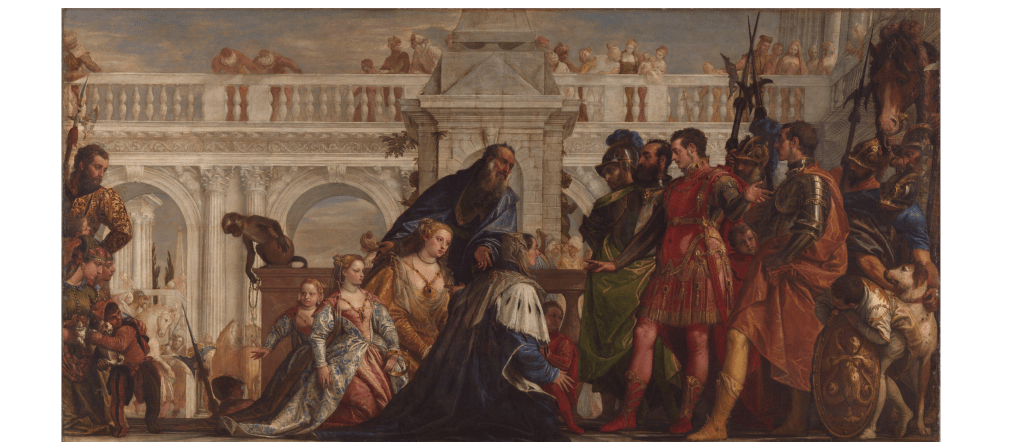
I visited the Pisani Moretta palace in order to see an exquisite painting by Paul Veronese: the women of Darius’s family are kneeling before Alexander and Hephaestion, the mother kneeling in front takes the latter to be the king, he denies it and points to the right one. According to legend, the artist was well received in this palace and worthily entertained there for some time; in return he secretly painted the picture as a gift, rolled it up, and shoved it under the bed. Truly, it deserves to have had a special origin, for it gives one an idea of this master’s whole worth. His great artistry in producing the most exquisite harmony, not by spreading a universal tone over the whole piece, but by skillfully distributing light and shadow, and equally wisely alternating the local colors, is very visible here, since we see the picture in a perfect state of preservation, as fresh as if done yesterday. For to be sure, when a picture of this kind has decayed, our enjoyment of it is immediately marred, without our knowing the reason.

If anyone wanted to remonstrate with the artist about the costuming, let him just tell himself that the painting is supposed to depict a story of the sixteenth century, and that will settle the whole matter. The gradation from the mother to the wife and daughters is very true and felicitous; the youngest princess, kneeling at the very end, is a pretty little mouse, with a pleasing, headstrong, defiant little face; she does not seem at all ready to accept her situation.

Zoomable full size here

I’d been curious before about the origin story, apocryphal as it of course feels, and found a good summing analysis in a Dec. 2009 Burlington Magazine review by Xavier Salomon. He combines arguments from the work reviewed – Claudia Terribile’s Del piacere della virtu. Paolo Verenese, Alessandro Magno e il patriziato veneziano – and from Nicholas Penny’s National Gallery catalog The Sixteenth-Century Italian Paintings: Volume II: Venice 1540-1600:

The story was a celebrated one and flourished with further embellishments. For Antoine Joseph Dezallier d’Argenville – the first to refer to the story – Veronese had taken refuge in the Palazzo Pisani at Este during a violent thunderstorm; for later writers the painter was recovering from a bad fall from a horse, or escaping the Inquisition. As unlikely as these events can seem, Gould was still dependent on them and his account of the painting was reasonably queried by Cocke. As Nicholas Penny has recently written, ‘it is unlikely that Veronese could have found a suitable canvas waiting for him, unlikely that he would have been able to work on such a large painting in secret, unlikely that he would have rolled it up while still wet, and very unlikely that any bed would have been large enough to conceal it’. Ridolfi mentioned the painting – in the Palazzo Pisani in Venice – in 1648 and, before that, in 1632, Giovanni Antonio Massani had written about it in a letter to Cardinal Francesco Barberini, in which he listed paintings by Veronese that he thought could be on the market. The Family of Darius was for Massani ‘a most beautiful thing, and worthy of a Prince’.

Following Gould’s and Cocke’s speculations regarding the canvas, Claudia Terribile’s impeccable research on the painting – already partly presented in an article – provides key pieces of evidence finally to understand for whom, when and why the Family of Darius was painted. Penny’s recent catalogue of the National Gallery’s Venetian paintings repeatedly cites Terribile’s arguments and pays homage to her archival discoveries. Both Penny and Terribile have produced exhaustive accounts of the painting, which will be of immense help for future studies on the picture and on Veronese. Terribile’s book expands on her previous article and looks at the Family of Darius comprehensively, and Penny’s catalogue entry is so detailed and thorough that it could be published as an independent booklet (much longer than Gould’s of 1978).

Terribile’s book is divided into two parts. The first deals with the original commission, context and history of the painting, while the second focuses on its iconography and meaning. By navigating through the family trees of various branches of the Pisani family, the author identified the patron of the canvas, Francesco Pisani (1514-67), and the painting’s original location, in the Palazzo Pisani at Montagnana, designed by Palladio. This had been tentatively suggested in the 1930s, but Terribile provides further proof to confirm it. When Francesco died, without children, he left his property to his cousin Zan Mattio, and through him to his heirs, whom he wished would assume the first name Francesco in his honour. In 1568 a lawsuit was underway between Zan Mattio and Francesco’s widow, Marietta Molin, who had been effectively disinherited. Zan Mattio complained that Marietta, in an attempt to regain her husband’s property, tried ‘even to remove the canvases and iron [fixtures] of the most precious picture of the story of Alexander the Great’, providing a terminus ante quem for Veronese’s painting. The picture is reasonably dated by Terribile (and by Penny) to the mid-1560s. Francesco must have been an important patron of both Palladio and Veronese, and the contract for Veronese’s early Transfiguration for the high altar of the cathedral of Montagnana was signed in Pisani’s house in 1555.

The post’s title, by the way, is how my grandfather called me over when introducing this painting. The phrase was curious enough to stick with me for thirty years until I finally realized today, thanks to a later portion of Salomon’s article, that it was another bit of his learned humor – the painting’s purchase in 1857 for the then monumental ~£13,500 prompting a parliamentary debate where someone called it a ‘second rate specimen.’ It took a while but the joke finally landed.