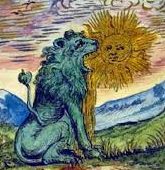
Dare you tell me I am not a lark bird asleep

From Jack London’s The Water Baby – in the Library of America anthology of his novels and stories. Compare the thought to the famous butterfly dream of Zhuangzi posted afterwards. I remember London had cited one or two Chinese poets in his John Barleycorn autobiography and am now curious what level of acquaintance with Chinese literature and thought he had.

“When I was younger I muddled my poor head over queerer religions,” old Kohokumu retorted.  “But listen, O Young Wise One, to my elderly wisdom.  This I know: as I grow old I seek less for the truth from without me, and find more of the truth from within me.  Why have I thought this thought of my return to my mother [the ocean] and of my rebirth from my mother into the sun?  You do not know.  I do not know, save that, without whisper of man’s voice or printed word, without prompting from otherwhere, this thought has arisen from within me, from the deeps of me that are as deep as the sea.  I am not a god.  I do not make things.  Therefore I have not made this thought.  I do not know its father or its mother.  It is of old time before me, and therefore it is true.  Man does not make truth.  Man, if he be not blind, only recognizes truth when he sees it.  Is this thought that I have thought a dream?”

“Perhaps it is you that are a dream,” I laughed.  “And that I, and sky, and sea, and the iron-hard land, are dreams, all dreams.”

“I have often thought that,” he assured me soberly.  “It may well be so.  Last night I dreamed I was a lark bird, a beautiful singing lark of the sky like the larks on the upland pastures of Haleakala.  And I flew up, up, toward the sun, singing, singing, as old Kohokumu never sang.  I tell you now that I dreamed I was a lark bird singing in the sky.  But may not I, the real I, be the lark bird?  And may not the telling of it be the dream that I, the lark bird, am dreaming now?  Who are you to tell me ay or no?  Dare you tell me I am not a lark bird asleep and dreaming that I am old Kohokumu?”

And Zhuangzi’s dream, in Burton Watson’s translation (The Complete Works of Zhuangzi):

“Once Zhuang Zhou dreamed he was a butterfly, a butterfly flitting and fluttering around, happy with himself and doing as he pleased. He didn’t know he was Zhuang Zhou. Suddenly he woke up, and there he was, solid and unmistakable Zhuang Zhou. But he didn’t know if he were Zhuang Zhou who had dreamed he was a butterfly or a butterfly dreaming he was Zhuang Zhou. Between Zhuang Zhou and a butterfly, there must be some distinction! This is called the Transformation of Things.”

See, they return

Ezra Pound’s The Return. W.B. Yeats called this “the most beautiful poem that has been written in the free form, one of the few in which I find real organic truth.”

See, they return; ah, see the tentative 
Movements, and the slow feet,           
The trouble in the pace and the uncertain       
Wavering!       

See, they return, one, and by one,               
With fear, as half-awakened;  
As if the snow should hesitate            
And murmur in the wind,       
            and half turn back;      
These were the “Wing’d-with-Awe,”          
            inviolable.        

Gods of the wingèd shoe!       
With them the silver hounds,  
            sniffing the trace of air!          

Haie! Haie!             
    These were the swift to harry;         
These the keen-scented;          
These were the souls of blood.           

Slow on the leash,       
            pallid the leash-men!

Virgil set out to write a masterpiece; curiously, he succeeded.

I am rereading Troilus and Cressida and, for lack of engagement, my mind keeps wandering to Homer and Virgil. So here, by association, is Borges’ prologue to The Aeneid from his A Personal Library project (translation included in Selected Non-Fictions):

Leibniz has a parable about two libraries: one of a hundred different books of different worth, the other of a hundred books that are all equally perfect. It is significant that the latter consists of a hundred Aeneids. Voltaire wrote that Virgil may be the work of Homer, but he is the greatest of Homer’s works. Virgil’s preeminence lasted for sixteen hundred years in Europe; the Romantic movement denied and almost erased him. Today he is threatened by our custom of reading books as a function of history, not of aesthetics.

The Aeneid is the highest example of what has been called, without discredit, the artificial epic; that is to say, the deliberate work of a single man, not that which human generations, without knowing it, have created. Virgil set out to write a masterpiece; curiously, he succeeded. I say “curiously” because masterpieces tend to be the daughters of chance or of negligence. As though it were a short poem, this epic was polished, line by line, with the felicitous care that Petronius praised-I’ll never know why-in Horace. Let us examine, almost at random, a few examples.

Virgil does not tell us that the Achaeans waited for darkness to enter Troy; he speaks of the friendly silence of the moon. He does not write that Troy was destroyed, but rather, “Troy was.” He does not write that a life was unfortunate, but rather “The gods understood him in another way.” To express what is now called pantheism, he says, “All things are full of Jupiter.” He does not condemn the aggressive madness of men; he calls it “the love of iron.” He does not tell us that Aeneas and the Sybil wandered alone among the shadows in the dark night; he writes, “Ibant obscuri sola sub nocte per umbram.” This is not a mere rhetorical figure, a hyperbaton: “alone” and “dark” have not changed places in the phrase; both forms, the usual and the Virgilian, correspond with equal precision to the scene they represent.

The selection of each word and each turn of phrase also makes Virgil the classic of the classics, in some serene way, a Baroque poet. The carefulness of his writing did not impede the fluidity of his narration of Aeneas’ deeds and adventures. There are events that are almost magical: Aeneas, exiled from Troy, disembarks in Carthage and sees on the walls of a temple images of the Trojan War, images of Priam, Achilles, Hector, and even himself. There are tragic events: the Queen of Carthage who watches the Greek boats leaving and knows that her lover has abandoned her. There is a predictable abundance of heroism, such as these words spoken by a warrior: “My son, learn from me strength and genuine valor; and from others, luck.”

Virgil. Of all the poets of the earth, there is none other who has been listened to with such love. Even beyond Augustus, Rome, and the empire that, across other nations and languages, is still the Empire. Virgil is our friend. When Dante made Virgil his guide and the most continual character in the Commedia, he gave an enduring aesthetic form to that which all men feel with gratitude.

It was because it was completely unclear, even to myself, which it had been

From Han’s Crime by Shiga Naoya – in the collection The Paper Door and Other Stories. I would like to post the full story but I work daily with intellectual property issues and grudgingly respect the rulings of my betters. The short is that a sort of circus performer, Han, kills his wife through a missed placement during their knife throwing act. When it comes out that there was ill-feeling between the two, Han is arrested and interrogated on the murder:

“But, between my thinking about such a thing and actually deciding to kill her, there was still a wide gap. That day, from early morning on, I felt insanely keyed up. Because of my bodily fatigue, my nerves were edgy, without elasticity. Unable to remain still, I stayed outside all morning. I walked about restlessly, away from the others. I kept thinking that no matter what I would have to do something. But I no longer thought of killing her, as I had the night before. And I was not at all worried about that day’s performance. If I had been, I would not have chosen that particular act….

….A knife in my hand, I stood at a set distance straight across from her. For the first time since the night before, we exchanged looks. Only then did I realize the danger of having chosen this act for tonight. Unless I practiced the utmost care, I thought, there would be trouble. I must alleviate, as best I could, the day’s restless agitation and my strained, edgy nerves. But no matter how I tried, a weariness that had eaten into my heart would not let me. I began to feel that I could not trust my own arm. Closing my eyes, I attempted to calm myself. My body started to sway. The moment came. I drove in the first knife above her head. It went in slightly higher than usual. Then I drove in one knife each under the pits of her arms which were raised to shoulder level. As each knife left my fingertips, something clung to it an instant, as if to hold it back. I felt as if I no longer knew where the knives would go in. Each time one hit, I thought: Thank God. Calm down, calm down, I thought. But I could feel in my arm the constraint that comes from a thing’s having become conscious. I drove in a knife to the left of her throat. I was about to drive in the next one to the right, when suddenly a strange look came over her face. She must have felt an impulse of violent fear. Did she have a premonition that the knife about to fly at her would go through her neck? I don’t know. I only felt that face of violent fear, thrown back at my heart with the same force as the knife. Dizziness struck me. But even so, with all my strength, almost without a target, as though aiming in the dark, I threw the knife …”

The judge was silent.

“I’ve killed her at last, I thought.”

“How do you mean? That you’d done it on purpose?”

“Yes. I suddenly felt as if I had.”

“Afterwards, you knelt by the body in silent prayer…?”

“That was a trick that occurred to me at the moment. I knew everyone thought I seriously believed in Christianity. While pretending to pray, I was thinking about what attitude I should take.”

“You felt sure that what you’d done was intentional?”

“Yes. And I thought right away I could make out it was an accident.”

“But why did you think it was deliberate murder?”

“Because of my feelings, which were unhinged.”

“So you thought you’d skillfully deceived the others?”

“Thinking about it later, I was shocked at myself. I acted surprised in a natural manner, was considerably agitated, and also displayed grief. But any perceptive person, I believe, could have seen that I was playacting. Recalling my behavior, I sweated cold sweat. That night, I decided that I would have to be found innocent. First of all, I was extremely encouraged by the fact that there was not a scrap of objective proof of my crime. Everyone knew we’d been on bad terms, of course, so there was bound to be a suspicion of murder. I couldn’t do anything about that. But if I insisted, throughout, that it was an accident, that would be the end of it. That we’d gotten along badly might make people conjecture, but it was no proof. In the end, I thought, I would be acquitted for lack of evidence. Thinking back over the incident, I made up a rough version of my plea, as plausible as possible, so that it would seem like an accident. Soon, though, for some reason, a doubt rose up in me as to whether I myself believed it was murder. The night before, I had thought about killing her, but was that alone a reason for deciding, myself, that it was murder? Gradually, despite myself, I became unsure. A sudden excitement swept over me. I felt so excited I couldn’t sit still. I was so happy, I was beside myself. I wanted to shout for joy.”

“Was it because you yourself could now believe that it was an accident?”

“No. I’m still unsure of that. It was because it was completely unclear, even to myself, which it had been. It was because I could now tell the truth and be found innocent. Being found innocent meant everything to me now. For that purpose, rather than trying to deceive myself and insisting that it was an accident, it was far better to be able to be honest, even if it meant saying I didn’t know which it was. I could no longer assert that it was an accident, nor, on the other hand, could I say that it was a deliberate act. I was so happy because come what may it was no longer a question of a confession of guilt.”

I stood still and was a tree amid the wood

I’ve been watching the Lord of the Rings for the first time in a decade and am remembering how grand the Ents are. Related by association, here is The Tree from Ezra Pound’s Personae

I stood still and was a tree amid the wood,
Knowing the truth of things unseen before;
Of Daphne and the laurel bow
And that god-feasting couple old
that grew elm-oak amid the wold.
‘Twas not until the gods had been
Kindly entreated, and been brought within
Unto the hearth of their heart’s home
That they might do this wonder thing;
Nathless I have been a tree amid the wood
And many a new thing understood
That was rank folly to my head before.

I really must insist on your oiling those chains

From Oscar Wilde’s The Canterville Ghost, an appropriately Wildean blend of satire, ghost story, and fairy tale. Amongst the details I never appreciated as a child are the various turn of the century miracle fix products the family plagues the ghost with – my favorite being the Tammany Rising Sun Lubricator (which the ghost does later steal and use):

At eleven o’clock the family retired, and by half-past all the lights were out. Some time after, Mr. Otis was awakened by a curious noise in the corridor, outside his room. It sounded like the clank of metal, and seemed to be coming nearer every moment. He got up at once, struck a match, and looked at the time. It was exactly one o’clock. He was quite calm, and felt his pulse, which was not at all feverish. The strange noise still continued, and with it he heard distinctly the sound of footsteps. He put on his slippers, took a small oblong phial out of his dressing-case, and opened the door. Right in front of him he saw, in the wan moonlight, an old man of terrible aspect. His eyes were as red burning coals; long grey hair fell over his shoulders in matted coils; his garments, which were of antique cut, were soiled and ragged, and from his wrists and ankles hung heavy manacles and rusty gyves.

“My dear sir,” said Mr. Otis, “I really must insist on your oiling those chains, and have brought you for that purpose a small bottle of the Tammany Rising Sun Lubricator. It is said to be completely efficacious upon one application, and there are several testimonials to that effect on the wrapper from some of our most eminent native divines. I shall leave it here for you by the bedroom candles, and will be happy to supply you with more, should you require it.” With these words the United States Minister laid the bottle down on a marble table, and, closing his door, retired to rest.

There’s also the Pinkerton’s Champion Stain Remover and Paragon Detergent:

“How horrid!” cried Mrs. Otis; “I don’t at all care for blood-stains in a sitting-room. It must be removed at once.”

The old woman smiled, and answered in the same low, mysterious voice, “It is the blood of Lady Eleanore de Canterville, who was murdered on that very spot by her own husband, Sir Simon de Canterville, in 1575. Sir Simon survived her nine years, and disappeared suddenly under very mysterious circumstances. His body has never been discovered, but his guilty spirit still haunts the Chase. The blood-stain has been much admired by tourists and others, and cannot be removed.”

“That is all nonsense,” cried Washington Otis; “Pinkerton’s Champion Stain Remover and Paragon Detergent will clean it up in no time,” and before the terrified housekeeper could interfere, he had fallen upon his knees, and was rapidly scouring the floor with a small stick of what looked like a black cosmetic.

And finally Doctor Dobell’s tincture:

On reaching the top of the staircase he recovered himself, and determined to give his celebrated peal of demoniac laughter. This he had on more than one occasion found extremely useful. It was said to have turned Lord Raker’s wig grey in a single night, and had certainly made three of Lady Canterville’s French governesses give warning before their month was up. He accordingly laughed his most horrible laugh, till the old vaulted roof rang and rang again, but hardly had the fearful echo died away when a door opened, and Mrs. Otis came out in a light blue dressing-gown. “I am afraid you are far from well,” she said, “and have brought you a bottle of Doctor Dobell’s tincture. If it is indigestion, you will find it a most excellent remedy.”

And, like the haggard, check at every feather that comes before his eye

From Twelfth Night (3.1), a unique image here of the high-strung and restless nature of a constantly exercised wit :

VIOLA
This fellow is wise enough to play the fool;
And to do that well craves a kind of wit:
He must observe their mood on whom he jests,
The quality of persons, and the time,
And, like the haggard, check at every feather
That comes before his eye. This is a practice
As full of labour as a wise man’s art
For folly that he wisely shows is fit;
But wise men, folly-fallen, quite taint their wit.

A haggard is a female hawk caught as an adult and difficult to train. Check is a more difficult word and since we should all take any available chance to improve our knowledge of technical hawking and falconry terms, I give the full OED entry below for definitions 6A and 6B:

Hawking.
a. to check at the fist: to refuse to come to, recoil from, ‘shy’ at the fist.

a1529 J. Skelton Why come ye nat to Courte (?1545) 732 Till he cheked at the fist.

1557 Earl of Surrey et al. Songes & Sonettes (new ed.) f. 94v The hauke may check, that now comes fair to fiist.

1618 S. Latham New & 2nd Bk. Falconrie xi. 37 She will neuer vnderstand what it is to checke at the fist: but..wil proue a certaine and bold commer.

b. See quot. 1615, 1852; and cf. check n.1 6a.
Sir Walter Scott’s archaic use appears to be erroneous, since one falcon does not ‘check’ at another, and Marmion would not figure himself as ‘base game’ crossing the path of nobler quarry.

1615 S. Latham Falconry (new ed.) Words of Art expl. Checke, or to kill Checke, is when Crows, Rooks, Pies, or other birds comming in the view of the Hawke, she forsaketh her naturall flight to flie at them.

a1616 W. Shakespeare Twelfth Night (1623) iii. i. 63 Like the Haggard, checke at euery Feather That comes before his eye.

1808 W. Scott Marmion i. vi. 28 E’en such a falcon, on his shield. The golden legend bore aright, ‘Who checks at me, to death is dight.’

1852 R. F. Burton Falconry in Valley of Indus iii. 31 She ‘checked’ first at one bird, then at the other. [Note] To ‘check’ is to forsake the quarry, and fly at any chance bird that crosses the path.

The 1852 gloss – “to ‘check’ is to forsake the quarry, and fly at any chance bird that crosses the path” – is a very pretty capturing of wit’s hyperactive and undisciplined (but not ineffective) response to the things around it.


And all the time igniting herself, like smoking wood

From Chretien De Troye’s Yvain – the narrator’s commentary on the lady Laudine’s self-justification for her feelings towards Yvain (her husband’s killer). The modelling of her internal dialogue – not quoted but lines ~1750-70 – is one of the highlights of the poem, as is this near-Homeric image below. The translation is Burton Raffel’s.


And so, by this same proof,
She found reason and right and wisdom,
And no need for her to hate him,
Ensuring herself what she wanted
And all the time igniting
Herself, like smoking wood,
Bursting into flame when it’s stirred,
Smouldering if no one blows it
Awake.

Better a witty fool, than a foolish wit

From Twelfth Night (1.5):

Feste
Wit, an’t be thy will, put me into good fooling!
Those wits, that think they have thee, do very oft
prove fools; and I, that am sure I lack thee, may
pass for a wise man: for what says Quinapalus?
‘Better a witty fool, than a foolish wit.’

The Arden note says:

An invented Latin authority, probably inspired – given the context of rhetorical and logical discussion (cf. syllogism, 46) – by Quintilian(us), author of the Institutio Oratoria, a book much studied in Elizabethan schools and universities. This allusion may be ‘contaminated’ by another Latin auctoritas, Apuleius, author of The Golden Ass, and by the name of the Roman coin quinarius or quinary, worth five bronze ‘asses’ and bearing the type of the victoriate, whose ‘weight standard had come from Illyria.’ Shakespeare seems to be imitating Rabelais’ pseudo-pedantic way with invented auctoritates. In any case, as Mahood observes, ‘this no longer gets a laugh.’

The pseudo authority feels right but I’ll add another comically farfetched possibility that just occurred to me. Continuing the Latin theme of the Arden note, start with the definition of the word palus in Lewis and Short:

I Lit. (very freq. and class.; syn.: sudes, stipes): ut figam palum in parietem, Plaut. Mil. 4, 4, 4; id. Men. 2, 3, 53: damnati ad supplicium traditi, ad palum alligati, Cic. Verr. 2, 5, 5, § 11: palis adjungere vitem, Tib. 1, 8 (7), 33; Ov. F. 1, 665: palos et ridicas dolare, Col. 11, 2, 11; Varr. 1. 1.—The Roman soldiers learned to fight by attacking a stake set in the ground, Veg. Mil. 1, 11; 2, 23; hence, aut quis non vidit vulnera pali? Juv. 6, 246.—And, transf.: exerceamur ad palum: et, ne imparatos fortuna deprehendat, fiat nobis paupertas familiaris, Sen. Ep. 18, 6.—In the lang. of gladiators, palus primus or palusprimus (called also machaera Herculeana, Capitol. Pert. 8), a gladiator’s sword of wood, borne by the secutores, whence their leader was also called primus palus, Lampr. Commod. 15; Inscr. Marin. Fratr. Arv. p. 694.—Prov.: quasi palo pectus tundor, of one astonished, stunned, Plaut. Rud. 5, 2, 2.—
II Transf., = membrum virile, Hor. S. 1, 8, 5.

The element I want is option 2, the unique transferred meaning of membrum virile. The single passage is from Horace’s Satires and quoted below:

Once I was a fig-wood stem, a worthless log, when the carpenter, doubtful whether to make a stool or a Priapus, chose that I be a god. A god, then, I became, of thieves and birds the special terror; for thieves my right hand keeps in check, and this red stake, protruding from unsightly groin…..

Olim truncus eram ficulnus, inutile lignum,cum faber, incertus scamnum faceretne Priapum,maluit esse deum. deus inde ego, furum aviumque maxima formido; nam fures dextra coercet obscenoque ruber porrectus ab inguine palus;…..

The English disguises this but the narrating Priapus describes itself as possessed of an ‘ab inguine palus‘ – which produces a sound sequence ‘guinepalus‘ terribly close to Shakespeare’s ‘quinapalus.’ Which would then turn the reference to a learned but bawdy citation of his own dick as his source of wisdom. I have now proven the undesirability of a foolish wit.