
And learning a mere hoard of gold kept by a devil, till sack commences it and sets it in act and use.

From Henry IV pt. 2 (4.4):

LANCASTER
Fare you well, Falstaff: I, in my condition,
Shall better speak of you than you deserve.

Exeunt all but Falstaff

FALSTAFF
I would you had but the wit: ’twere better than
your dukedom. Good faith, this same young sober-
blooded boy doth not love me; nor a man cannot make
him laugh; but that’s no marvel, he drinks no wine.
There’s never none of these demure boys come to any
proof; for thin drink doth so over-cool their blood,
and making many fish-meals, that they fall into a
kind of male green-sickness; and then when they
marry, they get wenches: they are generally fools
and cowards; which some of us should be too, but for
inflammation. A good sherris sack hath a two-fold
operation in it. It ascends me into the brain;
dries me there all the foolish and dull and curdy
vapours which environ it; makes it apprehensive,
quick, forgetive, full of nimble fiery and
delectable shapes, which, delivered o’er to the
voice, the tongue, which is the birth, becomes
excellent wit. The second property of your
excellent sherris is, the warming of the blood;
which, before cold and settled, left the liver
white and pale, which is the badge of pusillanimity
and cowardice; but the sherris warms it and makes
it course from the inwards to the parts extreme:
it illumineth the face, which as a beacon gives
warning to all the rest of this little kingdom,
man, to arm; and then the vital commoners and
inland petty spirits muster me all to their captain,
the heart, who, great and puffed up with this
retinue, doth any deed of courage; and this valour
comes of sherris. So that skill in the weapon is
nothing without sack, for that sets it a-work; and
learning a mere hoard of gold kept by a devil, till
sack commences it and sets it in act and use.
Hereof comes it that Prince Harry is valiant; for
the cold blood he did naturally inherit of his
father, he hath, like lean, sterile and bare land,
manured, husbanded and tilled with excellent
endeavour of drinking good and good store of fertile
sherris, that he is become very hot and valiant. If
I had a thousand sons, the first humane principle I
would teach them should be, to forswear thin
potations and to addict themselves to sack.

I’d like to know whether any specific reference – folklore or literary – is behind the line ‘a mere hoard of gold kept by a devil.’ Both my Arden and my Oxford texts go no further than ‘alludes to the superstition that buried treasure was guarded by evil spirits’ but that somehow isn’t satisfying. There seems to me an alchemical reference of sorts where knowledge (as gold) is imprisoned (hoarded by a devil) until the right chemical agent (sack – below praised for its ‘warming’ virtues) induces the reaction that first stirs (commences) then sets it moving (in act and use).

Ex Libris #2 – Dante’s Lyric Poetry

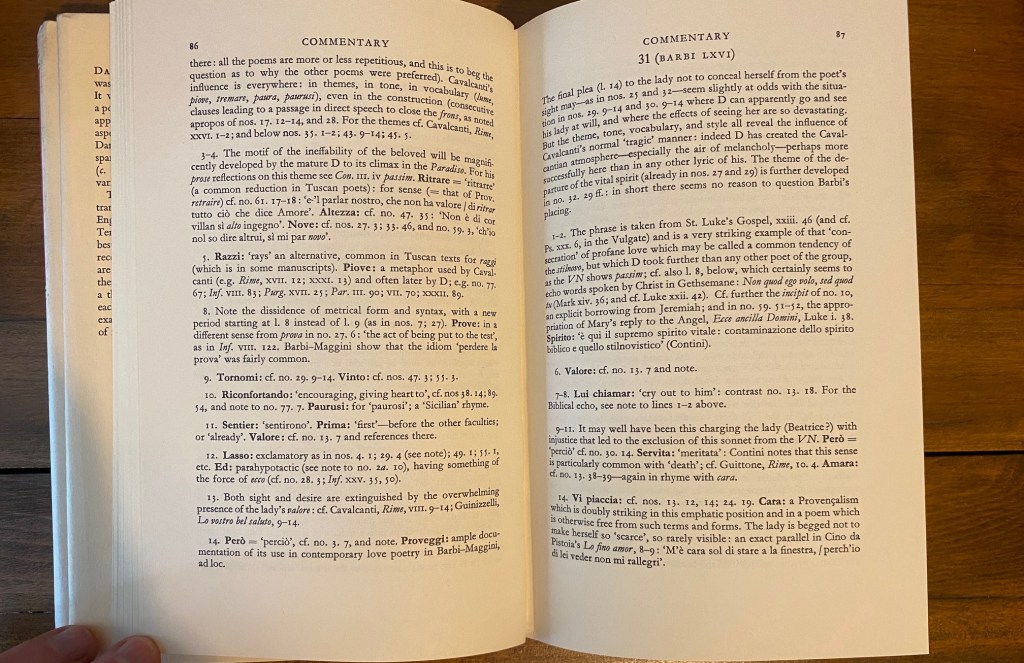
Dante’s lyrics – his Rime – haven’t received much attention in English. Although there is a wonderful recent treatment with overview essays and some commentary – the 2014 Dante’s Lyric Poetry: Poems of Youth and of the ‘Vita Nuova’ in the Univ. of Toronto Lorenzo Da Ponte Italian Library – the fullest edition remains the Foster and Boyde Dante’s Lyric Poetry first printed in 1967 and reprinted five years later. This set is now very scarce – doubly so if you don’t want ex-library copies – and almost invariably ugly in price. But I recently tripped into a bargain of a near new copy so once again I add to the lumber room.

How chances mock, and changes fill the cup of alteration with divers liquors

From Henry IV pt.2 (3.1):

O God! that one might read the book of fate,
And see the revolution of the times
Make mountains level, and the continent,
Weary of solid firmness, melt itself
Into the sea! and, other times, to see
The beachy girdle of the ocean
Too wide for Neptune’s hips; how chances mock,
And changes fill the cup of alteration
With divers liquors! O, if this were seen,
The happiest youth, viewing his progress through,
What perils past, what crosses to ensue,
Would shut the book, and sit him down and die.

But whoever ceases to desire to live there has thereby ceased to deserve to do so

From Boethius’s Consolation of Philosophy (Consolatio Philosophiae, 1.5):

When I had done thus baying my unabated grief, she said, with a calm expression, unaffected by my complainings: “When I saw you weeping in your grief I knew at once that you were wretchedly banished; but how remote was that banishment I should not have known if your speech had not told me. But how far from your homeland have you strayed! Strayed, not been driven, I say; or if you prefer to be thought of as driven, then how far have you driven yourself! For in your case it could never have rightly been possible for anyone else to do this. You must remember what your native country is: not one like that of the old Athenians, governed by the rule of the many, but “there is one ruler, one king,”a who delights in associating with his subjects, not in driving them out; to be guided by his hand and obey his justice is true freedom. Surely you know the ancient and fundamental law of your city, by which it is ordained that it is not right to exile one who has chosen to dwell there? No one who is settled within her walls and fortifications need ever fear the punishment of banishment: but whoever ceases to desire to live there has thereby ceased to deserve to do so. So I am moved more by the sight of you than of this place. I seek not so much a library with its walls ornamented with ivory and glass, as the storeroom of your mind, in which I have laid up not books, but what makes them of any value, the opinions set down in my books in times past.

Haec ubi continuato dolore delatravi, illa vultu placido nihilque meis questibus mota: “Cum te,” inquit, “maestum lacrimantemque vidissem, ilico miserum exsulemque cognovi. Sed quam id longinquum esset exilium, nisi tua prodidisset oratio, nesciebam. Sed tu quam procul a patria non quidem pulsus es sed aberrasti; ac si te pulsum existimari mavis, te potius ipse pepulisti. Nam id quidem de te numquam cuiquam fas fuisset. Si enim cuius 10oriundus sis patriae reminiscare, non uti Atheniensium quondam multitudinis imperio regitur, sed

εἷς κoίρανός ἐστιν, εἷς βασιλεύς

qui frequentia civium non depulsione laetetur; cuius agi frenis atque obtemperare iustitiae summa libertas est. An ignoras illam tuae civitatis antiquissimam legem, qua sanctum est ei ius exulare non esse quisquis in ea sedem fundare maluerit? Nam qui vallo eius ac munimine continetur, nullus metus est ne exul esse mereatur. At quisquis eam inhabitare velle desierit, pariter desinit etiam mereri. Itaque non tam me loci huius quam tua facies movet nec bibliothecae potius comptos ebore ac vitro parietes quam tuae mentis sedem requiro, in qua non libros sed id quod libris pretium facit, librorum quondam meorum sententias, collocavi.

Malo me fortunae poeniteat, quam victoriae pudeat

From Montaigne’s Essais 1.6, L’Heure des Parlemens Dangereuse / The Hour of Parley is Dangerous:


….Et plus genereusement encore ce grand Alexandre à Polypercon, qui lui suadoit de se servir de l’avantage que l’obscurité de la nuict luy donnoit pour assaillir Darius: Point, fit-il, ce n’est pas à moy d’employer des victoires desrobées:

malo me fortunae poeniteat, quam victoriae pudeat.

And nobler still was the answer made by Alexander the Great to Polypercon, who was urging him one night to take advantage of the darkness to launch an attack against Darius: ‘Certainly not. I am not the man to thieve a victory and then follow it up!’

‘Malo me fortunae poeniteat, quam victoriae pudeat.’
I would rather complain of Fortune than feel ashamed of victory.

The story is taken from Quintus Curtius’ History of Alexander (4.13) where Alexander adds the additional argument, (carefully?) omitted by Montaigne, that the plan wouldn’t work anyway.

Almost all agreed with Parmenion [whose plan was to attack at night]; Polypercon thought that victory undoubtedly depended upon that plan. Alexander, looking solemnly at the latter—for he had lately chided Parmenion more severely than he wished and did not have the heart to upbraid him again—said: “The craft which you recommend to me is that of petty robbers and thieves; for their sole desire is to deceive. I will not suffer my glory always to be impaired by the absence of Darius, or by confined places, or by deceit by night. I am determined to attack openly by daylight; I prefer to regret my fortune rather than be ashamed of my victory. Besides, this consideration too is added; I am well aware that the barbarians keep watch by night and stand under arms, so that it is not really possible to deceive them. Therefore do you prepare for battle.” When they had been thus aroused, he bade them take food and rest.

Omnes ferme Parmenioni assentiebantur; Polypercon haud dubie in eo consilio positam victoriam arbitrabatur. Quem intuens rex—namque Parmenionem, nuper acrius quam vellet increpitum, rursus castigare non sustinebat—: “Latrunculorum” inquit, “et furum ista sollertia est quam praecipitis mihi; quippe illorum votum unicum est fallere. Meae vero gloriae semper aut absentiam Darei aut angustias locorum aut furtum noctis obstare non patiar. Palam luce aggredi certum est; malo me meae fortunae paeniteat quam victoriae pudeat. Ad haec illud quoque accedit; vigilias agere barbaros et in armis stare, ut ne decipi quidem possint, compertum habeo. Itaque ad proelium vos parate.” Sic incitatos ad corpora curanda dimisit.

Thus ornament is but the guiled shore to a most dangerous sea

From The Merchant of Venice, Bassanio’s reasoning as he puzzles through the test for Portia’s hand:

So may the outward shows be least themselves:
The world is still deceived with ornament.
In law, what plea so tainted and corrupt,
But, being seasoned with a gracious voice,
Obscures the show of evil? In religion,
What damned error, but some sober brow
Will bless it and approve it with a text,
Hiding the grossness with fair ornament?
There is no vice so simple but assumes
Some mark of virtue on his outward parts:
How many cowards, whose hearts are all as false
As stairs of sand, wear yet upon their chins
The beards of Hercules and frowning Mars;
Who, inward search’d, have livers white as milk;
And these assume but valour’s excrement
To render them redoubted! Look on beauty,
And you shall see ’tis purchased by the weight;
Which therein works a miracle in nature,
Making them lightest that wear most of it:
So are those crisped snaky golden locks
Which make such wanton gambols with the wind,
Upon supposed fairness, often known
To be the dowry of a second head,
The skull that bred them in the sepulchre.
Thus ornament is but the guiled shore
To a most dangerous sea; the beauteous scarf
Veiling an Indian beauty; in a word,
The seeming truth which cunning times put on
To entrap the wisest.

Ἀμαθέστερον πως εἰπὲ καὶ σαφέστερον

Erasmus Adage 39. Erasmus’ concluding paragraph reminded me of a very good book I read several years ago – Philosophy Between The Lines: The Lost History of Esoteric Writing.

Among the Greeks is a proverb certainly less elegant but nevertheless just as effective: ‘Speak with less learning and with more clarity’ (Ἀμαθέστερον καὶ σαφέστερον εἰπέ), which is found in the same Aulus Gellius: “You know, I believe, that old and widespread phrase, ‘Speak with less learning and with more clarity,’ that is speak with less learning and more simplicity, do it more openly and clearly. It appears this is taken from a comedy of Aristophanes titled The Frogs:

Ἀμαθέστερον πως εἰπὲ καὶ σαφέστερον
Speak with less learning and with more clarity

In that play Bacchus is assessing an obscure statement of Euripides’, which he had set forth with insufficient lucidity. Suidas and the scholiast call attention to a proverb hidden there, which is reported in this way:

Σαφέστερόν μοι κἀμαθέστερον φράσον
Tell me more clearly and less learnedly

I suspect it is taken hence – that in antiquity those sages (σοφοί), as they call them, were accustomed to hide in wrappings of enigmas the mysteries of their wisdom, doubtlessly so that the generality, profane and not yet initiated to the rites of philosophy, not be able to follow them. And even today some professors of philosophy and theology, when they treat of things that some mere woman or workman might say, in order that they might seem learned, enfold and roll up the matter in subtleties (lit. thorns) and worded burdens. So Plato darkened his own philosophy with his talk of numbers. So Aristotle rendered many things much darker through mathematical analogies.


Inelegantius quidem est illud apud Graecos, sed idem tamen pollet: Ἀμαθέστερον καὶ σαφέστερον εἰπέ, quod apud eundem refertur Gellium. Nosti enim, inquit, credo, verbum illud vetus et peruulgatum, Ἀμαθέστερον εἰπὲ καὶ σαφέστερον, id est Indoctius rudiusque quodammodo loquere et apertius ac clarius fare. Sumptum apparet ex Aristophanis comoedia, cui titulus Βάτραχοι, id est Ranae:

Ἀμαθέστερον πως εἰπὲ καὶ σαφέστερον, id est
Indoctius proloquitor atque clarius.

Quo carmine Bacchus Euripidis obscuritatem taxat, qui nescio quid parum dilucide proposuerat. Suidas et interpres admonent subesse prouerbium, quod hunc ad modum feratur:

Σαφέστερόν μοι κἀμαθέστερον φράσον, id est
Apertius mihi loquere atque indoctius.

Suspicor inde sumptum, quod antiquitus illi σοφοί, quos vocant, soleant mysteria sapientiae quibusdam aenigmatum inuolucris data opera obtegere, videlicet ne prophana turba ac nondum philosophiae sacris initiata posset assequi•. [C] Quin et hodie nonnulli philosophiae ac theologiae professores, cum ea quandoque tradant, quae quaeuis muliercula aut cerdo dicturus sit, tamen quo docti videantur, rem spinis quibusdam ac verborum portentis implicant et inuoluunt. Sic Plato numeris suis obscurauit suam philosophiam. Sic Aristoteles multa mathematicis collationibus reddidit obscuriora.

The line from Frogs is 1455, part of an extended exchange where Dionysus, deciding between Aeschylus or Euripides to take back up to Athens, has them both provide advice on how to fix the city. A running theme here is, as phrased in 1434 (ὁ μὲν σοφῶς γὰρ εἶπεν, ὁ δ᾿ ἕτερος σαφῶς), the distinction between the one speaking clearly (σαφῶς) and and the other wisely (σοφῶς). The ordering of the text and assignment of lines in this passage is much contested but the immediate trigger for the proverb is Euripides advising:

ΕΥΡΙΠΙΔΗΣ
ὅταν τὰ νῦν ἄπιστα πίσθ᾿ ἡγώμεθα,τὰ δ᾿ ὄντα πίστ᾿ ἄπιστα—

ΔΙΟΝΥΣΟΣ
πῶς; οὐ μανθάνω.
ἀμαθέστερόν πως εἰπὲ καὶ σαφέστερον

Euripides
When we put our trust in what’s untrusted, and what’s trustworthy is untrusted—

Dionysus
How’s that? I don’t follow. Try to speak somewhat less cleverly and more clearly.

Let Generosity be painted there

From Boccaccio’s Decameron – the eighth tale of the first day. The translation is the Penguin of G.H. McWilliam, though I’m trying the Naxos audiobook with a Guido Waldman rendering.

In Genoa, then, a long time ago, there lived a gentleman called Ermino de’ Grimaldi, who was generally acknowledged, on account of his vast wealth and huge estates, to be by far the richest citizen in the Italy of his day. Not only was he richer than any man in Italy, he was incomparably greedier and more tight-fisted than every other grasper or miser in the whole wide world. For he would entertain on a shoestring, and in contrast to the normal habits of the Genoese (who are wont to dress in the height of fashion), he would sooner go about in rags than spend any money on his personal appearance. Nor was his attitude to food and drink any different. It was therefore not surprising that he had lost the surname of Grimaldi and was simply known to one and all as Ermino Skinflint.

Now, it so happened that whilst this fellow, by spending not a penny, was busily increasing his fortune, there arrived in Genoa a worthy courtier, Guiglielmo Borsiere by name, who was refined of manner and eloquent of tongue … the aforesaid Guiglielmo received a warm and ready welcome from all the best families in Genoa. And after he had spent a number of days in the city, and listened to several accounts of Ermino’s greed and miserliness, he was eager to see what manner of man he was.

Ermino had already been told what an excellent fellow Guiglielmo Borsiere was, and since, for all his meanness, he still preserved a glimmer of civility, he received him very sociably, with cheerful countenance, and began to converse with him on various different topics. As they talked, he conveyed him, along with certain other Genoese who were present, to a splendid house he had recently caused to be built for his use. And having shown him all over the building, he said:

‘Well now, Guiglielmo, as one who has seen and heard many things in his time, could you perhaps suggest a thing that no man has ever seen, which I could commission to be painted in the main hall of this house of mine?’

To which Guiglielmo, on hearing him talk in this unseemly fashion, replied:

‘Sir, I do not think I could suggest a thing that no man has ever seen, unless it were a fit of the sneezes or something of that sort. But if you like, I can certainly suggest a thing I do not believe that you yourself have ever seen.’

‘Ah,’ said Ermino, who was not expecting the answer he was about to be given, ‘then I beg you to tell me what it is.’

Whereupon Guiglielmo promptly replied:

‘Let Generosity be painted there.’

When Ermino heard this word, he was so overcome with shame, that his character was suddenly and almost totally transformed.

‘Guiglielmo,’ he said, ‘I shall have it painted there in such a way that neither you nor anyone else will ever again have cause to tell me that I have not seen and known it.’

Guiglielmo’s remark had such a potent effect upon Ermino that from that day forth he became the most courteous and generous gentleman in the Genoa of his time, and was respected above all others, not only by his fellow-citizens, but by visitors to the city.

We are protected by such a wall as may not be scaled by raging stupidity

From Boethius’ Consolation of Philosophy (1.3, Loeb text and translation). For American election season and all election seasons.

Just so the clouds of misery were dispelled, and I drank in the clear light, recovering enough to recognize my healer’s face. So, when I looked on her clearly and steadily, I saw the nurse who brought me up, whose house I had from my youth frequented, the lady Philosophy. And I said: “Why have you come, Queen of all the virtues, why have you come down from your high seat in heaven to these wastes where I am banished? So that you too stand in the dock with me, falsely accused?” “Should I desert you, my pupil?” she replied; “Should I not share your labour and help to bear your burden, which you bear because my name is hated? It could not be right that Philosophy should leave an innocent man companionless on the road. Surely I should then be afraid that I should be charged myself; I should shudder with horror at such an unheard-of thing! Do you think that this is the first time that Wisdom has been attacked and endangered by a wicked society? Did I not often of old also, before my Plato’s time, have to battle in mighty struggle with arrogant stupidity? And in his day, was I not beside his teacher Socrates when he won the prize of a martyr’s death? And after him the crowd of Epicureans and Stoics and the rest strove as far as they could to seize his legacy, carrying me off protesting and struggling, as if I were part of the booty, tearing my dress, which I wove with my own hands, and then went off with their torn-off shreds, thinking they possessed all of me. And because they seemed to be wearing certain bits of my dress, some were ignorantly accepted as my servants, and were abused by the delusions of the uneducated mob. But even if you knew nothing of Anaxagoras’ flight from Athens, or Socrates’ draught of hemlock, or Zeno’s sufferings, all these being foreign events, surely you could have thought of Canius and Seneca and Soranusa whose stories are neither ancient nor obscure? The only cause of their deaths was that they were brought up in my ways, so that their behaviour and pursuits were seen to be utterly different from those of wicked men. So it is no wonder if we are buffeted by storms blustering round us on the sea of this life, since we are especially bound to anger the wicked. Though their forces are large, yet we should hold them in contempt, for they are leaderless and are simply carried hither and thither at random in their crazed ignorance. If ever they range against us and press about us too strongly, Wisdom our captain withdraws her forces into her citadel, while our enemies busy themselves ransacking useless baggage. But we are safe from all their mad tumult and from our heights we can laugh at them as they carry off all those worthless things; we are protected by such a wall as may not be scaled by raging stupidity.

Haud aliter tristitiae nebulis dissolutis hausi caelum et ad cognoscendam medicantis faciem mentem recepi. Itaque ubi in eam deduxi oculos intuitumque defixi, respicio nutricem meam cuius ab adulescentia laribus obversatus fueram Philosophiam. “Et quid,” inquam, “tu in has exilii nostri solitudines o omnium magistra virtutum supero cardine delapsa venisti? An ut tu quoque mecum rea falsis criminationibus agiteris?

“An,” inquit illa, “to alumne desererem nec sarcinam quam mei nominis invidia sustulisti, communicate tecum labore partirer? Atqui Philosophiae fas non erat incomitatum relinquere iter innocentis; meam scilicet criminationem vererer et quasi novum aliquid acciderit, perhorrescerem? Nunc enim primum censes apud inprobos mores lacessitam periculis esse sapientiam? Nonne apud veteres quoque ante nostri Platonis aetatem magnum saepe certamen cum stultitiae temeritate certavimus eodemque


superstite praeceptor eius Socrates iniustae victoriam mortis me adstante promeruit? Cuius hereditatem cum deinceps Epicureum vulgus ac Stoicum ceterique pro sua quisque parte raptum ire molirentur meque reclamantem renitentemque velut in partem praedae traherent, vestem quam meis texueram manibus, disciderunt abreptisque ab ea panniculis totam me sibi cessisse credentes abiere. In quibus quoniam quaedam nostri habitus vestigia videbantur, meos esse familiares inprudentia rata nonnullus eorum profanae multitudinis errore pervertit.

Quod si nec Anaxagorae fugam nec Socratis venenum nec Zenonis tormenta quoniam sunt peregrina novisti, at Canios, at Senecas, at Soranos quorum nec pervetusta nec incelebris memoria est, scire potuisti. Quos nihil aliud in cladem detraxit nisi quod nostris moribus instituti studiis improborum dissimillimi videbantur. Itaque nihil est quod admirere, si in hoc vitae salo circumflantibus agitemur procellis, quibus hoc maxime propositum est pessimis displicere. Quorum quidem tametsi est numerosus exercitus, spernendus tamen est, quoniam nullo duce regitur, sed errore tantum temere ac passim lymphante raptatur. Qui si quando contra nos aciem struens valentior incubuerit, nostra quidem dux copias suas in arcem contrahit, illi vero circa diripiendas inutiles sarcinulas occupantur. At nos desuper inridemus vilissima rerum quaeque rapientes securi totius furiosi tumultus eoque vallo muniti quo grassanti stultitiae adspirare fas non sit.

Where the pleasure of the harangue was as ten, and the pain of the misfortune but as five

I rarely get upset. I can’t take anger – mine or anyone’s – seriously. But when, as earlier today, I do get upset, I soon shed it in the same way Walter Shandy shed his grief – by taking so much pleasure in the chance for expression that I forget altogether the cause. From Tristram Shandy (v. 3, ch. 3):

My father managed his affliction otherwise; and indeed differently from most men either ancient or modern; for he neither wept it away, as the Hebrews and the Romans—or slept it off, as the Laplanders—or hanged it, as the English, or drowned it, as the Germans,—nor did he curse it, or damn it, or excommunicate it, or rhyme it, or lillabullero it.——

——He got rid of it, however.

Will your worships give me leave to squeeze in a story between these two pages?

When Tully was bereft of his dear daughter Tullia, at first he laid it to his heart,—he listened to the voice of nature, and modulated his own unto it.—O my Tullia! my daughter! my child!—still, still, still,—’twas O my Tullia!—my Tullia! Methinks I see my Tullia, I hear my Tullia, I talk with my Tullia.—But as soon as he began to look into the stores of philosophy, and consider how many excellent things might be said upon the occasion—no body upon earth can conceive, says the great orator, how happy, how joyful it made me.

My father was as proud of his eloquence as MARCUS TULLIUS CICERO could be for his life, and, for aught I am convinced of to the contrary at present, with as much reason: it was indeed his strength—and his weakness too.——His strength—for he was by nature eloquent; and his weakness—for he was hourly a dupe to it; and, provided an occasion in life would but permit him to shew his talents, or say either a wise thing, a witty, or a shrewd one—(bating the case of a systematic misfortune)—he had all he wanted.—A blessing which tied up my father’s tongue, and a misfortune which let it loose with a good grace, were pretty equal: sometimes, indeed, the misfortune was the better of the two; for instance, where the pleasure of the harangue was as ten, and the pain of the misfortune but as five—my father gained half in half, and consequently was as well again off, as if it had never befallen him.