The finest second-rate Veronese around

From Goethe’s Italian Journey (October 6):

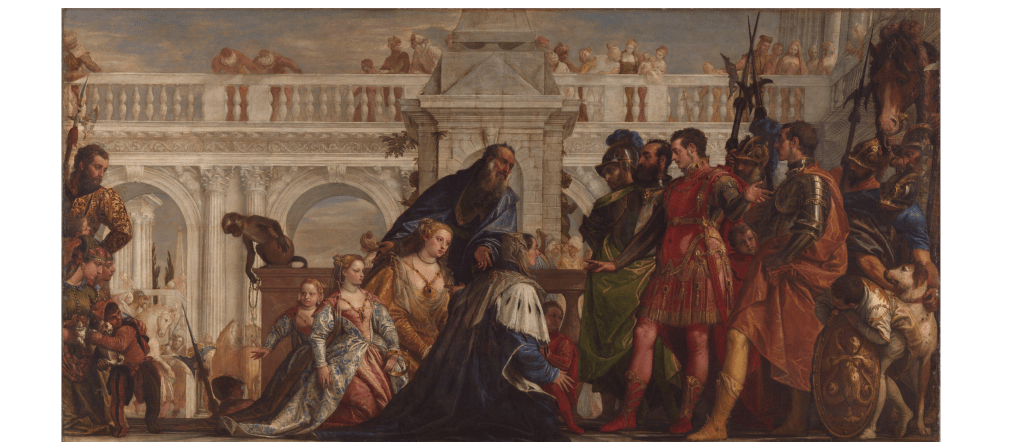
I visited the Pisani Moretta palace in order to see an exquisite painting by Paul Veronese: the women of Darius’s family are kneeling before Alexander and Hephaestion, the mother kneeling in front takes the latter to be the king, he denies it and points to the right one. According to legend, the artist was well received in this palace and worthily entertained there for some time; in return he secretly painted the picture as a gift, rolled it up, and shoved it under the bed. Truly, it deserves to have had a special origin, for it gives one an idea of this master’s whole worth. His great artistry in producing the most exquisite harmony, not by spreading a universal tone over the whole piece, but by skillfully distributing light and shadow, and equally wisely alternating the local colors, is very visible here, since we see the picture in a perfect state of preservation, as fresh as if done yesterday. For to be sure, when a picture of this kind has decayed, our enjoyment of it is immediately marred, without our knowing the reason.

If anyone wanted to remonstrate with the artist about the costuming, let him just tell himself that the painting is supposed to depict a story of the sixteenth century, and that will settle the whole matter. The gradation from the mother to the wife and daughters is very true and felicitous; the youngest princess, kneeling at the very end, is a pretty little mouse, with a pleasing, headstrong, defiant little face; she does not seem at all ready to accept her situation.
Zoomable full size here

I’d been curious before about the origin story, apocryphal as it of course feels, and found a good summing analysis in a Dec. 2009 Burlington Magazine review by Xavier Salomon. He combines arguments from the work reviewed – Claudia Terribile’s Del piacere della virtu. Paolo Verenese, Alessandro Magno e il patriziato veneziano – and from Nicholas Penny’s National Gallery catalog The Sixteenth-Century Italian Paintings: Volume II: Venice 1540-1600:

The story was a celebrated one and flourished with further embellishments. For Antoine Joseph Dezallier d’Argenville – the first to refer to the story – Veronese had taken refuge in the Palazzo Pisani at Este during a violent thunderstorm; for later writers the painter was recovering from a bad fall from a horse, or escaping the Inquisition. As unlikely as these events can seem, Gould was still dependent on them and his account of the painting was reasonably queried by Cocke. As Nicholas Penny has recently written, ‘it is unlikely that Veronese could have found a suitable canvas waiting for him, unlikely that he would have been able to work on such a large painting in secret, unlikely that he would have rolled it up while still wet, and very unlikely that any bed would have been large enough to conceal it’. Ridolfi mentioned the painting – in the Palazzo Pisani in Venice – in 1648 and, before that, in 1632, Giovanni Antonio Massani had written about it in a letter to Cardinal Francesco Barberini, in which he listed paintings by Veronese that he thought could be on the market. The Family of Darius was for Massani ‘a most beautiful thing, and worthy of a Prince’.

Following Gould’s and Cocke’s speculations regarding the canvas, Claudia Terribile’s impeccable research on the painting – already partly presented in an article – provides key pieces of evidence finally to understand for whom, when and why the Family of Darius was painted. Penny’s recent catalogue of the National Gallery’s Venetian paintings repeatedly cites Terribile’s arguments and pays homage to her archival discoveries. Both Penny and Terribile have produced exhaustive accounts of the painting, which will be of immense help for future studies on the picture and on Veronese. Terribile’s book expands on her previous article and looks at the Family of Darius comprehensively, and Penny’s catalogue entry is so detailed and thorough that it could be published as an independent booklet (much longer than Gould’s of 1978).

Terribile’s book is divided into two parts. The first deals with the original commission, context and history of the painting, while the second focuses on its iconography and meaning. By navigating through the family trees of various branches of the Pisani family, the author identified the patron of the canvas, Francesco Pisani (1514-67), and the painting’s original location, in the Palazzo Pisani at Montagnana, designed by Palladio. This had been tentatively suggested in the 1930s, but Terribile provides further proof to confirm it. When Francesco died, without children, he left his property to his cousin Zan Mattio, and through him to his heirs, whom he wished would assume the first name Francesco in his honour. In 1568 a lawsuit was underway between Zan Mattio and Francesco’s widow, Marietta Molin, who had been effectively disinherited. Zan Mattio complained that Marietta, in an attempt to regain her husband’s property, tried ‘even to remove the canvases and iron [fixtures] of the most precious picture of the story of Alexander the Great’, providing a terminus ante quem for Veronese’s painting. The picture is reasonably dated by Terribile (and by Penny) to the mid-1560s. Francesco must have been an important patron of both Palladio and Veronese, and the contract for Veronese’s early Transfiguration for the high altar of the cathedral of Montagnana was signed in Pisani’s house in 1555.

The post’s title, by the way, is how my grandfather called me over when introducing this painting. The phrase was curious enough to stick with me for thirty years until I finally realized today, thanks to a later portion of Salomon’s article, that it was another bit of his learned humor – the painting’s purchase in 1857 for the then monumental ~£13,500 prompting a parliamentary debate where someone called it a ‘second rate specimen.’ It took a while but the joke finally landed.
I call this a comedy

From early in Goethe’s Italian Journey (Oct. 3, Venice):

But today I saw a different sort of comedy [than the opera], which pleased me more. I heard a legal case being tried in public in the ducal palace; it was an important one and, luckily for me, undertaken during the council recess. One of the lawyers was everything any exaggerated buffo should be. Portly figure, short but agile, a monstrously aquiline profile, a voice of brass, and a vehemence implying that what he said was meant from the bottom of his heart. I call this a comedy, because no doubt everything is settled before these public presentations take place; the judges already know the verdict, and the litigants know what to expect. However, this method pleases me a great deal more than the way we crouch in small rooms and lawyers’ offices. And now I shall try to describe the circumstances and how agreeably, unpretentiously, and naturally everything proceeds.

In a spacious hall of the palace the judges sat at one side in a semicircle. Opposite them the lawyers for both parties, on a rostrum capable of holding several persons side by side, and on a bench directly in front of them, the plaintiff and defendant in person. The plaintiffs lawyer had stepped down from the rostrum, for today’s session was not scheduled to include any controversy. All the documents, pro and contra, although already printed, were to be read aloud.

A haggard clerk in a wretched black robe, a thick pad of paper in his hand, readied himself to perform the duty of reader. Moreover the hall was crowded with spectators and listeners. The legal question itself, as well as the persons it concerned, could not but seem significant to the Venetians.

Entailments are distinctly favored in this nation; once a possession is stamped with this character, it keeps it forever. Even if by some twist or circumstance it was sold several hundred years ago, and has passed through many hands, finally, when the case comes up, the descendants of the original family have the last word, and the estates must be handed over.

This time the lawsuit was extremely important, for the complaint was against the doge himself, or rather, against his wife, who accordingly, veiled by her zendale, was sitting there in person on the little bench, only a short distance away from the plaintiff. A lady of a certain age, noble figure, comely face, on which a serious, nay, if you will, somewhat irritated expression was to be seen. The Venetians were very proud of the fact that their sovereign lady had to appear before them and the court in her own palace.

The clerk began to read, and only now did I grasp the significance of a little man sitting on a low stool behind a small table in view of the judges, not far from the lawyers’ rostrum, and especially of the hourglass he had laid down in front of him. Namely, as long as the clerk reads, the sand does not run; but the lawyer, when he wants to comment, is generally allowed only a certain time period. The clerk reads, the hourglass is recumbent, the little man has his hand on it. When the lawyer opens his mouth, the hourglass is immediately set upright, but is lowered again the moment he is silent. The great skill here resides in interrupting the flow of reading, in making fleeting comments, in arousing and demanding attention. Now the little Saturn gets into the most embarrassing difficulties. He is required to change the horizontal and vertical positions of the hourglass every moment, he sees himself in the situation of the evil spirits in the puppet play, who, when the mischievous harlequin quickly alternates his “berlique! berloque!” do not know whether they should come or go.

Anyone who has heard lawyers collating documents in their chanceries can imagine this reading aloud—rapid, monotonous, but still enunciated with sufficient clarity. A skillful lawyer knows how to interrupt the tedium with jokes, and the audience shows its delight in them with most immoderate laughter. I must mention one joke, the most memorable among those I understood. The clerk was just reciting a document in which one of these owners deemed unlawful was disposing of the estates in question. The lawyer bade him read more slowly, and when he distinctly pronounced the word, “I give, I bequeath!” the orator vehemently attacked him, shouting, “What do you intend to give? bequeath what? You poor hungry devil! You know that nothing in this world belongs to you. But,” he continued, seeming to reflect on the matter, “that illustrious owner was in the very same situation, what he meant to give, to bequeath, belonged to him as little as to you.” There was a tremendous burst of laughter, but the hourglass immediately resumed its horizontal position. The reader hummed on, making an angry face at the lawyer; but those jests were all prearranged.

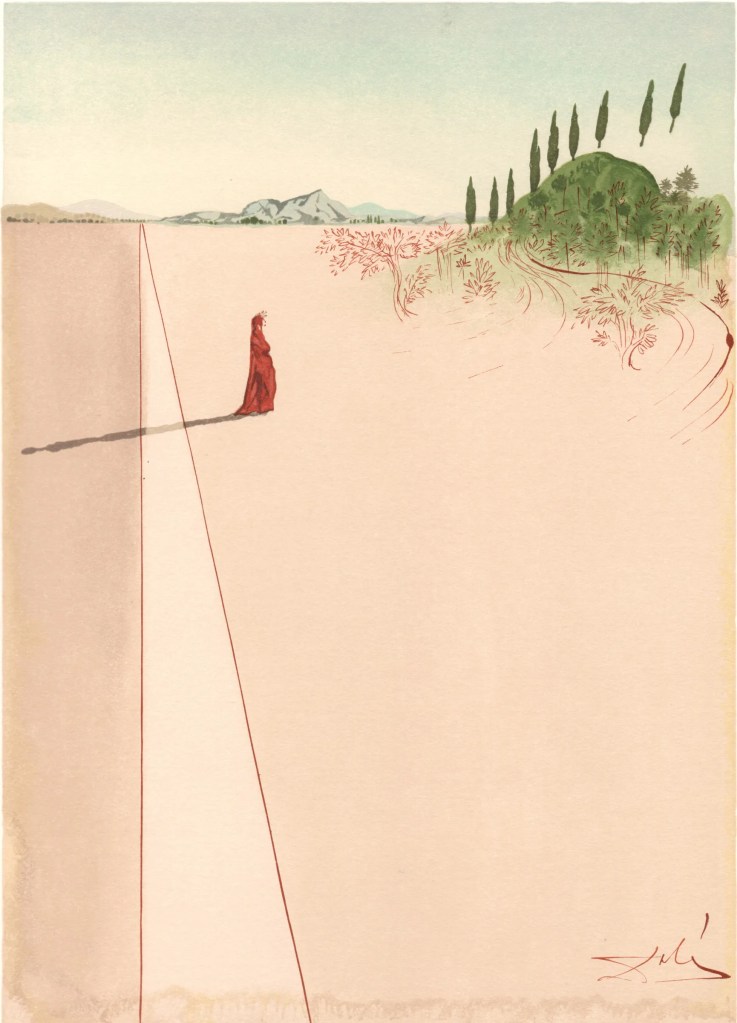
Departure on the Grand Journey

Salvador Dali’s illustration for the first canto of the Inferno, properly titled Départ pour le grand voyage.

I found a copy for a steal recently and have been looking into the production process, the description of which I now pilfer from this good intro:

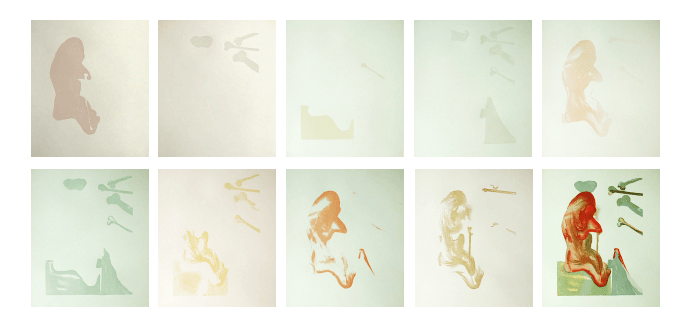
Translating Dalí’s 100 watercolours for The Divine Comedy into wood engravings for printing was a daunting undertaking. Master engraver Raymond Jacquet and his assistants Jean Taricco and Paul Bassin were commissioned by Jean Estrade, the Artistic Director of Les Heures Claires, to work with Dalí to create the engraved interpretations of his watercolours. This involved deconstructing each image into separate colours and the carving of a single block for each colour. Each of these colour proofs is known as a ‘decomposition’ and each watercolour would require more than 30 of these decompositions to create the completed engraved translation.

The process of engraving the blocks would start with the drawing of a perfect negative of the original watercolour on to the block with carbon or lithographic pencil. The design would then be incised into the block using a burin (engraving tool). Painstaking care was needed to ensure that the thickness of the incised line would translate the colour of the watercolour correctly and so Dalí’s constant attention and supervision was required throughout the four years it took to produce the engraved proofs.

In total 3,500 engraved blocks were needed to complete The Divine Comedy and importantly, Jacquet decided to print different colours from the same block, meaning that each block was permanently altered during the printing process. This not only meant that there was simply no margin for error in the printing of the edition but also ensured that the integrity of the edition was preserved as subsequent unauthorised printings or forgeries made from the blocks would not be possible. Another feature of the publication that demonstrated Jacquet’s commitment to the highest of standards was his decision to use resin blocks. Traditionally, wood engraving was executed on sections of box wood, however Jacquet’s preference for harder, more durable resin blocks allowed for finer detail to be achieved in the engraving of the blocks and richer quality in the final printing. This was crucial in ensuring that all impressions across both the French and Italian editions were printed to a consistent, high standard.

The same gallery also has one of the better sources for seeing the full series.

The imperishable need of man to live in beauty

From the third chapter of Johan Huizinga’s Homo Ludens: A Study of the Play-Element in Culture:

The play quality of the “gift ritual” found all over the earth has emerged with singular clarity since Malinowski gave a vivacious and extremely circumstantial account in his masterly Argonauts of the Western Pacific, of the so-called kula system which he observed among the Trobriand Islanders and their neighbours in Melanesia. The kula is a ceremonial voyage starting at fixed times from one of the island groups east of New Guinea and going in two opposite directions. Its purpose is the mutual exchange, by the various tribes concerned, of certain articles having no economic value either as necessities or useful implements, but highly prized as precious and notorious ornaments. These ornaments are necklaces of red, and bracelets of white, shells. Many of them bear names, like the famous gems of Western history. In the kula they pass temporarily from the possession of one group into that of the other, which thereby takes upon itself the obligation to pass them on within a certain space of time to the next link in the kula chain. The objects have a sacred value, are possessed of magic powers, and each has a history relating how it was first won, etc. Some of them are so precious that their entry into the gift-cycle causes a sensation. The whole proceeding is accompanied by all kinds of formalities interspersed with feasting and magic, in an atmosphere of mutual obligation and trust. Hospitality abounds, and at the end of the ceremony everybody feels he has had his full share of honour and glory. The voyage itself is often adventurous and beset with perils. The entire cultural treasury of the tribes concerned is bound up with the kula, it comprises their ornamental carving of canoes, their poetry, their code of honour and manners. Some trading in useful articles attaches itself to the kula voyages, but only incidentally. Nowhere else, perhaps, does an archaic community take on the lineaments of a noble game more purely than with these Papuans of Melanesia. Competition expresses itself in a form so pure and unalloyed that it seems to excel all similar customs practised by peoples much more advanced in civilization. At the root of this sacred rite we recognize unmistakably the imperishable need of man to live in beauty. There is no satisfying this need save in play.

Like the receding clamor of a caravan

From Nobody, Son of Nobody, ‘renditions’ of poems by the 10th/11th century Sufi Shaikh Abu-Saeed Abil-Kheir (alternately rendered as Abu Sa’id Abu’l-Khayr).

Some argue destiny and free will unceasingly,
others negotiate rewards, garden palaces
with ever virgin concubines,
while yet others pride themselves
in the constant braying of their intellect.
Like the receding clamor of a caravan
leaving the center, fading into the ocean of this desert,
far, far away it all moves from this Silence,
which sits at Your gate, Beloved.

There’s another more recent edition of his poems I’ve not been able to look at but otherwise his presence in English seems limited to more or less brief mention as a major shaper of the Sufi tradition.

What the bird with the human head knew

By Anne Sexton:

I went to the bird
with the human head,
and asked,
Please Sir,
where is God?

God is too busy
to be here on earth,
His angels are like one thousand geese assembled
and always flapping.
But I can tell you where the well of God is.

Is it on earth?
I asked.
He replied,
Yes. It was dragged down
from paradise by one of the geese.

I walked many days,
past witches that eat grandmothers knitting booties
as if they were collecting a debt.
Then, in the middle of the desert
I found the well,
it bubbled up and down like a litter of cats
and there was water,
and I drank,
and there was water,
and I drank.

Then the well spoke to me.

It said: Abundance is scooped from abundance,
yet abundance remains.

Then I knew.

People who make no mental effort

From The Asian Journal of Thomas Merton, a recording of of his 1968 trip to Bangkok, India, and Sri Lanka. This is a note from his Nov. 7 entry as he enjoyed a series of interviews with the Dalai Lama.

People who make no mental effort, even if they remain in mountain retreats, are like animals hibernating in their holes, only accumulating causes for a descent into hell.

The textual notes mark this as a Tibetan saying quoted by the Dalai Lama in his 1965 Introduction to Buddhism.

The Great Buddha at Kamakura

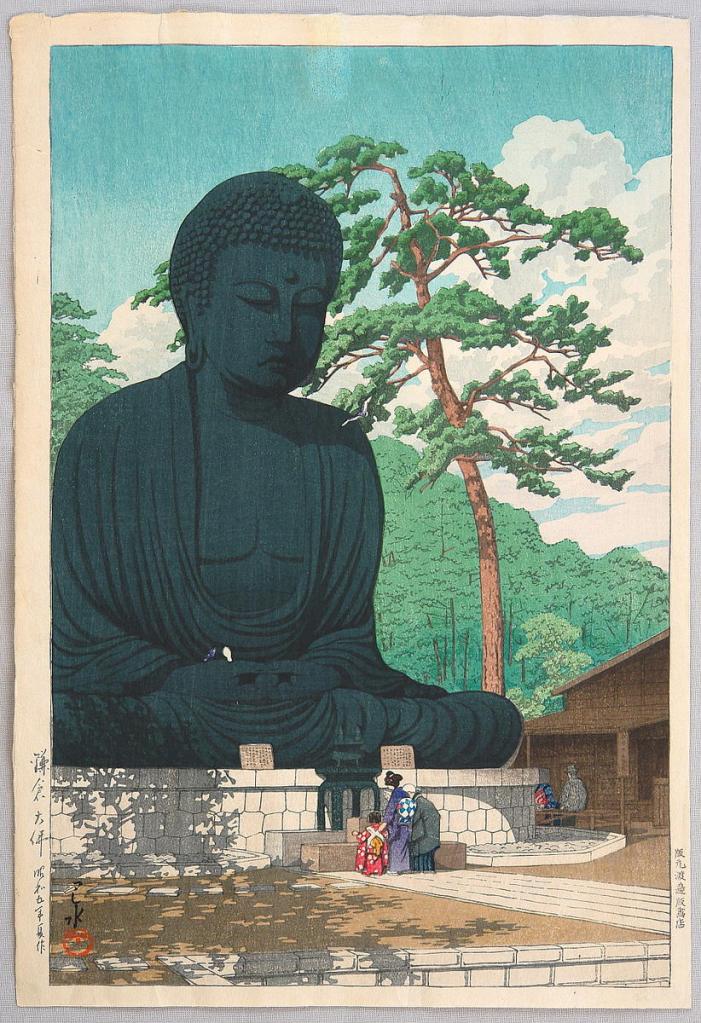
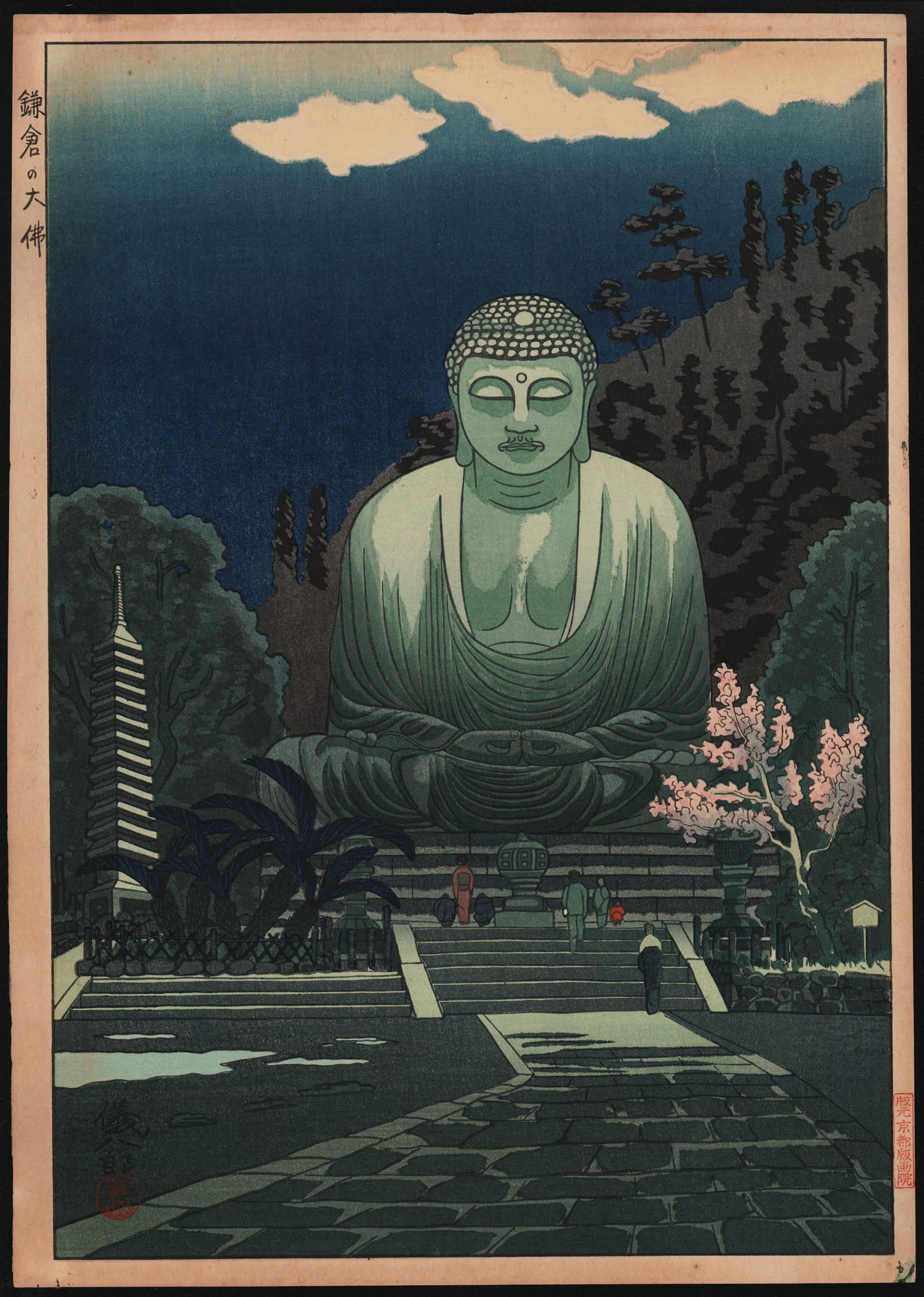
There are two great images of this Buddha statue, one from 1930 by Kawase Hasui and another from ~1950 by Gihachiro Okuyama. The Kawase Hasui (first below) is likely the finer but I prefer the glow of Okuyama’s (which, conveniently, was a good deal cheaper and easier to locate). The Buddha itself has a fine history. It was cast ~1250 after the destruction of a wooden predecessor in a storm. It was at multiple points housed in temples that were also washed away in storms so following a 1498 tsunami it was left to breath free.

Other interests aside, I have a slight nostalgia connection to this piece in that the Buddha of Kamakura is mentioned in the epigraph of the opening chapter of one my favorite childhood novels, Rudyard Kipling’s Kim:

I’ve learned today that these lines are an excerpt from a poem of his from the collection The Five Nations. I put it in full below.

An alternative Tantalus

Homer’s lavishly depicted Tantalus is the commonly known version but there is a second tradition attested in several of the major archaic poets that, while simpler, is not without its charm. First, the Odyssey (11.582):

καὶ μὴν Τάνταλον εἰσεῖδον κρατέρ᾽ ἄλγε᾽ ἔχοντα
ἑστεῶτ᾽ ἐν λίμνῃ: ἡ δὲ προσέπλαζε γενείῳ:
στεῦτο δὲ διψάων, πιέειν δ᾽ οὐκ εἶχεν ἑλέσθαι:
ὁσσάκι γὰρ κύψει᾽ ὁ γέρων πιέειν μενεαίνων,
τοσσάχ᾽ ὕδωρ ἀπολέσκετ᾽ ἀναβροχέν, ἀμφὶ δὲ ποσσὶ
γαῖα μέλαινα φάνεσκε, καταζήνασκε δὲ δαίμων.
δένδρεα δ᾽ ὑψιπέτηλα κατὰ κρῆθεν χέε καρπόν,
ὄγχναι καὶ ῥοιαὶ καὶ μηλέαι ἀγλαόκαρποι
συκέαι τε γλυκεραὶ καὶ ἐλαῖαι τηλεθόωσαι:
τῶν ὁπότ᾽ ἰθύσει᾽ ὁ γέρων ἐπὶ χερσὶ μάσασθαι,
τὰς δ᾽ ἄνεμος ῥίπτασκε ποτὶ νέφεα σκιόεντα.

Aye, and I saw Tantalus in violent torment, standing in a pool, and the water came nigh unto his chin. He seemed as one athirst, but could not take and drink; for as often as that old man stooped down, eager to drink, so often would the water be swallowed up and vanish away, and at his feet the black earth would appear, for some god made all dry. And trees, high and leafy, let stream their fruits above his head, pears, and pomegranates, and apple trees with their bright fruit, and sweet figs, and luxuriant olives. But as often as that old man would reach out toward these, to clutch them with his hands, the wind would toss them to the shadowy clouds.

For the alternative, Pindar’s Olympian 1.54-58 is the fullest surviving account:

εἰ δὲ δή τιν᾿ ἄνδρα θνατὸν Ὀλύμπου σκοποί
ἐτίμασαν, ἦν Τάνταλος οὗτος· ἀλ-λὰ γὰρ καταπέψαι
μέγαν ὄλβον οὐκ ἐδυνάσθη, κόρῳ δ᾿ ἕλεν
ἄταν ὑπέροπλον, ἅν τοι πατὴρ ὕπερ
κρέμασε καρτερὸν αὐτῷ λίθον,τὸν αἰεὶ μενοινῶν κεφαλᾶς βαλεῖν
εὐφροσύνας ἀλᾶται.

If in fact the wardens of Olympus honored any mortal
man, Tantalus was that one. He, however, could not digest
his great good fortune, and because of his greed he won
an overwhelming punishment in the form of a massive rock which the Father suspended above him;
in his constant eagerness to cast it away from his head
he is banished from joy.

A scholiast on these lines points to images in Alcaeus and Alcman. Alcman’s is curious for hinting at a blend of the two traditions – the rock as what blocks his pleasure rather than the spontaneous withdrawal of the goods. That reading of asmenoisin / agreeable things is very unclear, however.

καὶ Ἀλκαῖος δὲ καὶ Ἀλκμὰν λίθον φασὶν ἐπαιωρεῖσθαι τῷ Ταντάλῳ· <ὁ μὲν Ἀλκαῖος·>
κεῖται πὲρ κεφάλας μέγας, ὦ Αἰσιμίδα, λίθος.
ὁ δὲ Ἀλκμὰν οὕτως
†ἀνὴρ δ᾿ ἐν ἀσμένοισιν ἀλιτηρὸς ἧστ᾿ ἐπὶθάκας κατὰ πέτρας ὁρέων μὲν οὐδὲν δοκέων δέ†

Alcaeus and Alcman say that a stone hangs over Tantalus;

Alcaeus (fr 365):
“a great stone, Aesimidas, lies over your (my? his?) head”

and Alcman (fr 79)
“a sinner, he sat among agreeable things on a seat under a rock, seeing nothing, but supposing that he did.”

There’s also a fragment of Archilochus 91 referencing the same tradition (my pasting didn’t like the conjectural indicators under a few letters)

μηδ᾿ ὁ Τα]τάου θος τῆσδ᾿ ὑπὲρ νήσου κρεμάσθω

let the stone of Tantalus not hang over this island

The greatest harm good people do

From Oscar Wilde’s Lady Windermere’s Fan.

Do you know I am afraid that good people do a great deal of harm in this world.  Certainly the greatest harm they do is that they make badness of such extraordinary importance.

I remembered this play as much better in performance. While reading last night I dozed off and dreamed a version that tread the line between absurdist and horror. Each time an actor delivered one of Wilde’s set-piece quips they stopped speaking and held their mouth open as a voice – the same every time – boomed from above ‘I can resist everything but temptation’ or ‘scandal is gossip made tedious by morality.’ That done, all actors resumed as normal until the next quip five seconds later.