Shall I leave all this constant company, And follow headlong, wild uncertaine thee?

The opening of John Donne’s first Satire.  I have the added commentary of the Oxford texts edition of The Satires, Epigrams and Verse Letters edited by W.Milgate but I’m enjoying the scans of the 1633 edition at the Digital Donne

Away thou fondling motley humorist,
Leave mee, and in this standing woodden chest,
Consorted with these few bookes, let me lye
In prison, and here be coffin’d, when I dye;
Here are Gods conduits; grave Divines, and here
Natures Secretary, the Philosopher.
And jolly Statesmen, which teach how to tie
The sinewes of a cities mistique bodie;
Here gathering Chroniclers, and by them stand
Giddie fantastique Poëts of each land.
Shall I leave all this constant company,
And follow headlong, wild uncertaine thee?

The fleet crosses the mountain

From The Conquest of Byzantium in Stefan Zweig’s Shooting Stars: Ten Historical Miniatures (the Pushkin Press Anthea Bell translation).

THE FLEET CROSSES THE MOUNTAIN

The exuberant delight of the besieged citizens lasts for a night, and night always beguiles the senses with fantasy, confusing hope with the sweet poison of dreams. For the length of that night the besieged believe that they are secure and safe. For as those four ships have landed soldiers and provisions without mishap, more will come now, week after week, or so they dream. Europe has not forgotten them, and already, in their over-hasty expectations, they think of the siege as lifted, the enemy discouraged and conquered.
But Mahomet too is a dreamer, if a dreamer of that other and much rarer kind, one who knows how to transform dreams into reality. And even as the Genoese, in their delusions, think that they and their galleons are safe in the harbour of the Golden Horn, he is drafting a plan of such fantastic audacity that in all honesty it can be set beside the boldest deeds of Hannibal and Napoleon in the history of warfare. Byzantium lies before him like a golden fruit, but he cannot pluck it. The main reason is the Golden Horn, that inlet of the sea cutting deep into the land, a long bay that secures one flank of Constantinople. To penetrate that bay is in practice impossible, for the Genoese city of Galata, to which Mahomet has pledged neutrality, lies at the entrance, and from there the chain is stretched across to the enemy city. So his fleet cannot get into the bay by thrusting forward, and the Christian fleet could be attacked only from the inner basin, where Genoese territory ends. But how can he get a fleet into that inner bay? One could be built, but that would take months and months, and the Sultan is too impatient to wait so long.
It was then that Mahomet made the brilliant plan of transporting his fleet from the outer sea, where it is useless to him, across the tongue of land and into the inner harbour of the Golden Horn. The breathtakingly bold idea of crossing a mountainous strip of land with hundreds of ships looks at first sight so absurd and impracticable that the Byzantines and the Genoese of Galata take as little account of it in their strategic calculations as the Romans before them and the Austrians after them did of the swift crossing of the Alps by Hannibal and Napoleon. All worldly experience tells us that ships can travel only by water, and a fleet of them can never cross a mountain. But it is always the true sign of a daemonic will that it can turn the impossible into reality, and in warfare military genius scorns the rules of war, and at a given moment turns to creative improvisation rather than the old tried and trusted methods. A vast operation begins, one almost without an equal in the annals of history. In secrecy, Mahomet has countless wooden rollers brought and fixed to sleighs by carpenters. The ships are drawn up out of the sea and fixed to the sleighs as if on a movable dry dock. At the same time thousands of labourers are at work levelling out the narrow mule-track going up the hill of Pera and then down again, to make it as even as possible for traffic. To conceal from the enemy the sudden presence of so many workmen, the Sultan has a terrifying cannonade of mortars opened up over the neutral city of Galata every day and night; it is pointless in itself, and its only purpose is to distract attention and cover the movement of ships over the mountains and valleys from one body of water to another. While the enemy is occupied, suspecting no attack except from the land, the countless round wooden rollers, well treated with oil and grease, begin to move, and now ship after ship is hauled over the mountain on those rollers, drawn in its sleigh-like runners by countless pairs of oxen and with the help of the sailors pushing from behind. As soon as night hides the sight, this miraculous journey begins. Silent as all that is great, well thought out as all that is clever, the miracle of miracles is performed: an entire fleet crosses the mountain.
The crucial element in all great military operations is always the moment of surprise. And here Mahomet’s particular genius proves its worth magnificently. No one has any idea what he plans—“if a hair in my beard knew my thoughts I would pluck it out,” that brilliantly wily man once said of himself—and in perfect order, while the cannon ostentatiously thunder against the walls, his commands are carried out. Seventy ships are moved over mountain and valley, through vineyards and fields and woods, from one sea to another on that single night of 22nd April. Next morning the citizens of Byzantium think they are dreaming: an enemy fleet brought here as if by a ghostly hand, sailing with pennants hoisted and fully manned, in the heart of their supposedly unapproachable bay. They are still rubbing their eyes, at a loss to imagine how this miracle was worked, when fanfares and cymbals and drums are already playing jubilant music right under the wall of their flank, hitherto protected by the harbour. As a result of this brilliant coup, the whole Golden Horn except for the neutral space occupied by Galata, where the Christian fleet is boxed in, belongs to the Sultan and his army. Unobstructed, he can now lead his troops over a pontoon bridge against the weaker wall. The weaker flank of the city is thus under threat, and the ranks of the defenders, sparse enough anyway, have to stretch over yet more space. An iron fist has closed more and more tightly round the victim’s throat.

A Babylonish dialect, which learned pedants much affect

From Samuel Butler’s Hudibras.  Sub out the now dowdy Greek and Latin for some ever-novel cross-disciplinary scrapings and the description still flies for academia today.

(This is the 17th century poet, not the 19th century author famous for The Way of All Flesh and infamous for The Authoress of the Odyssey.)

His ordinary rate of speech
In loftiness of sound was rich;
A Babylonish dialect,
Which learned pedants much affect.
It was a parti-colour’d dress 95
Of patch’d and pie-bald languages;
‘Twas English cut on Greek and Latin,
Like fustian heretofore on satin;
It had an odd promiscuous tone,
As if h’ had talk’d three parts in one; 100
Which made some think, when he did gabble,
Th’ had heard three labourers of Babel;
Or CERBERUS himself pronounce
A leash of languages at once.
This he as volubly would vent 105
As if his stock would ne’er be spent:
And truly, to support that charge,
He had supplies as vast and large;
For he cou’d coin, or counterfeit
New words, with little or no wit: 110
Words so debas’d and hard, no stone
Was hard enough to touch them on;
And when with hasty noise he spoke ’em,
The ignorant for current took ’em;
That had the orator, who once 115
Did fill his mouth with pebble stones
When he harangu’d, but known his phrase
He would have us’d no other ways.

The pebbled orator is Demosthenes, who – per Plutarch – fixed a speech impediment in this fashion.

By the light of my living common sense

From the conclusion of Chesterton’s Club of Queer Trades:

At last came the moment which I knew must in some way enlighten us, the time of the club speeches and the club toasts. Basil Grant rose to his feet amid a surge of songs and cheers.

“Gentlemen,” he said, “it is a custom in this society that the president for the year opens the proceedings not by any general toast of sentiment, but by calling upon each member to give a brief account of his trade. We then drink to that calling and to all who follow it. It is my business, as the senior member, to open by stating my claim to membership of this club. Years ago, gentlemen, I was a judge; I did my best in that capacity to do justice and to administer the law. But it gradually dawned on me that in my work, as it was, I was not touching even the fringe of justice. I was seated in the seat of the mighty, I was robed in scarlet and ermine; nevertheless, I held a small and lowly and futile post. I had to go by a mean rule as much as a postman, and my red and gold was worth no more than his. Daily there passed before me taut and passionate problems, the stringency of which I had to pretend to relieve by silly imprisonments or silly damages, while I knew all the time, by the light of my living common sense, that they would have been far better relieved by a kiss or a thrashing, or a few words of explanation, or a duel, or a tour in the West Highlands. Then, as this grew on me, there grew on me continuously the sense of a mountainous frivolity. Every word said in the court, a whisper or an oath, seemed more connected with life than the words I had to say. Then came the time when I publicly blasphemed the whole bosh, was classed as a madman and melted from public life.”

Something in the atmosphere told me that it was not only Rupert and I who were listening with intensity to this statement.

“Well, I discovered that I could be of no real use. I offered myself privately as a purely moral judge to settle purely moral differences. Before very long these unofficial courts of honour (kept strictly secret) had spread over the whole of society. People were tried before me not for the practical trifles for which nobody cares, such as committing a murder, or keeping a dog without a licence. My criminals were tried for the faults which really make social life impossible. They were tried before me for selfishness, or for an impossible vanity, or for scandalmongering, or for stinginess to guests or dependents. Of course these courts had no sort of real coercive powers. The fulfilment of their punishments rested entirely on the honour of the ladies and gentlemen involved, including the honour of the culprits. But you would be amazed to know how completely our orders were always obeyed.

Yet by a special gift, an art of arts, more insight and more outsight

From Robert Browning’s The Ring and the Book (1.700-775ish).  I find it impossible to make tidy extracts from Browning.  He piles and piles and only grows better.

I find first
Writ down for very A B C of fact,
“In the beginning God made heaven and earth;”
From which, no matter with what lisp, I spell
And speak you out a consequence—that man,
Man,—as befits the made, the inferior thing,—
Purposed, since made, to grow, not make in turn,
Yet forced to try and make, else fail to grow,—
Formed to rise, reach at, if not grasp and gain
The good beyond him,—which attempt is growth,—
Repeats God’s process in man’s due degree,
Attaining man’s proportionate result,—
Creates, no, but resuscitates, perhaps.
Inalienable, the arch-prerogative
Which turns thought, act—conceives, expresses too!
No less, man, bounded, yearning to be free,
May so proiect his surplusage of soul
In search of body, so add self to self
By owning what lay ownerless before,—
So find, so fill full, so appropriate forms—
That, although nothing which had never life
Shall get life from him, be, not having been,
Yet, something dead may get to live again,
Something with too much life or not enough,
Which, either way imperfect, ended once:
An end whereat man’s impulse intervenes,
Makes new beginning, starts the dead alive,
Completes the incomplete and saves the thing.
Man’s breath were vain to light a virgin wick,—
Half-burned-out, all but quite-quenched wicks o’ the lamp
Stationed for temple-service on this earth,
These indeed let him breathe on and relume!
For such man’s feat is, in the due degree,
—Mimic creation, galvanism for life,
But still a glory portioned in the scale.
Why did the mage say,—feeling as we are wont
For truth, and stopping midway short of truth,
And resting on a lie,—”I raise a ghost”?
“Because,” he taught adepts, “man makes not man.
“Yet by a special gift, an art of arts,
“More insight and more outsight and much more
“Will to use both of these than boast my mates,
“I can detach from me, commission forth
“Half of my soul; which in its pilgrimage
“O’er old unwandered waste ways of the world,
“May chance upon some fragment of a whole,
“Rag of flesh, scrap of bone in dim disuse,
“Smoking flax that fed fire once: prompt therein
“I enter, spark-like, put old powers to play,
“Push lines out to the limit, lead forth last
“(By a moonrise through a ruin of a crypt)
“What shall be mistily seen, murmuringly heard,
“Mistakenly felt: then write my name with Faust’s!”
Oh, Faust, why Faust? Was not Elisha once?—
Who bade them lay his staff on a corpse-face.
There was no voice, no hearing: he went in
Therefore, and shut the door upon them twain,
And prayed unto the Lord: and he went up
And lay upon the corpse, dead on the couch,
And put his mouth upon its mouth, his eyes
Upon its eyes, his hands upon its hands,
And stretched him on the flesh; the flesh waxed warm:
And he returned, walked to and fro the house,
And went up, stretched him on the flesh again,
And the eyes opened. ‘T is a credible feat
With the right man and way.

The Death of Hyacinth

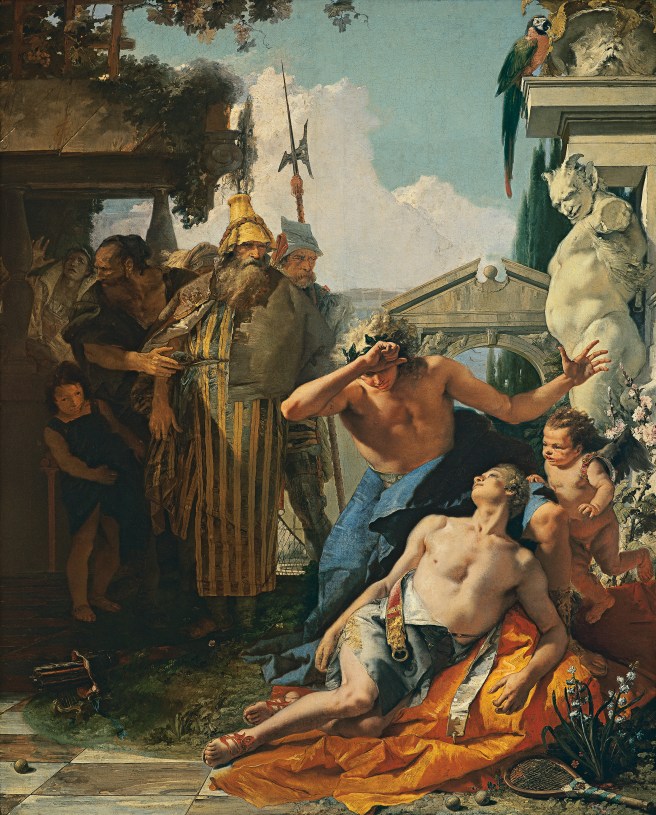
Continuing to think about the tennis-ball of error quote from yesterday, I had the additional thought that the image could also contain a suggestion of man’s deadliness – tennis in those days being more fatality-prone than now.  This led to Wikipedia pointing me to a curious Tiepolo in the Thyssen museum (that I’ve likely never looked at because I don’t care for Tiepolo or the period) where the painter has apparently substituted the traditional deadly discus for a tennis racket and balls in his Death of Hyacinth.

Museo Thyssen- Bornemisza

Poor man! what art? A tennis-ball of error

By John Hall from Grierson’s Metaphysical and Lyric Poems of the Seventeenth Century

The ‘tennis-ball of error’ must come from the instability of life – the back and forth of which Hall hits on throughout the poem.  In that sense it’s simply a more specific – but still striking for unexpectedness – variant of the traditional ‘fortune’s plaything’ idea.

Alternate title for this post would be “Like children crying for some Mercury”

On an Hour-Glass

MY life is measur’d by this glass, this glass
By all those little sands that thorough pass.
See how they press, see how they strive, which shall
With greatest speed and greatest quickness fall.
See how they raise a little mount, and then 5
With their own weight do level it again.
But when th’ have all got thorough, they give o’er
Their nimble sliding down, and move no more.
Just such is man, whose hours still forward run,
Being almost finish’d ere they are begun; 10
So perfect nothings, such light blasts are we,
That ere we’re aught at all, we cease to be.
Do what we will, our hasty minutes fly,
And while we sleep, what do we else but die?
How transient are our joys, how short their day! 15
They creep on towards us, but fly away.
How stinging are our sorrows! where they gain
But the least footing, there they will remain.
How groundless are our hopes, how they deceive
Our childish thoughts, and only sorrow leave! 20
How real are our fears! they blast us still,
Still rend us, still with gnawing passions fill;
How senseless are our wishes, yet how great!
With what toil we pursue them, with what sweat!
Yet most times for our hurts, so small we see, 25
Like children crying for some Mercury.
This gapes for marriage, yet his fickle head
Knows not what cares wait on a marriage bed:
This vows virginity, yet knows not what
Loneness, grief, discontent, attends that state. 30
Desires of wealth another’s wishes hold,
And yet how many have been chok’d with gold?
This only hunts for honour, yet who shall
Ascend the higher, shall more wretched fall.
This thirsts for knowledge, yet how is it bought? 35
With many a sleepless night, and racking thought.
This needs will travel, yet how dangers lay
Most secret ambuscados in the way?
These triumph in their beauty, though it shall
Like a pluck’d rose or fading lily fall. 40
Another boasts strong arms: ’las! giants have
By silly dwarfs been dragg’d unto their grave.
These ruffle in rich silk: though ne’er so gay,
A well-plum’d peacock is more gay than they.
Poor man! what art? A tennis-ball of error, 45
A ship of glass toss’d in a sea of terror;
Issuing in blood and sorrow from the womb,
Crawling in tears and mourning to the tomb:
How slippery are thy paths! How sure thy fall!
How art thou nothing, when th’ art most all!

We give him back his childhood

From The Tremendous Adventures of Major Brown in G.K. Chesterton’s The Club of Queer Trades:

“Then I must explain with more elaboration,” said Mr Northover, with a sigh. “The Adventure and Romance Agency has been started to meet a great modern desire. On every side, in conversation and in literature, we hear of the desire for a larger theatre of events for something to waylay us and lead us splendidly astray. Now the man who feels this desire for a varied life pays a yearly or a quarterly sum to the Adventure and Romance Agency; in return, the Adventure and Romance Agency undertakes to surround him with startling and weird events. As a man is leaving his front door, an excited sweep approaches him and assures him of a plot against his life; he gets into a cab, and is driven to an opium den; he receives a mysterious telegram or a dramatic visit, and is immediately in a vortex of incidents. A very picturesque and moving story is first written by one of the staff of distinguished novelists …

“How on earth does the thing work?” asked Rupert Grant, with bright and fascinated eyes.

“We believe that we are doing a noble work,” said Northover warmly. “It has continually struck us that there is no element in modern life that is more lamentable than the fact that the modern man has to seek all artistic existence in a sedentary state. If he wishes to float into fairyland, he reads a book; if he wishes to dash into the thick of battle, he reads a book; if he wishes to soar into heaven, he reads a book; if he wishes to slide down the banisters, he reads a book. We give him these visions, but we give him exercise at the same time, the necessity of leaping from wall to wall, of fighting strange gentlemen, of running down long streets from pursuers—all healthy and pleasant exercises. We give him a glimpse of that great morning world of Robin Hood or the Knights Errant, when one great game was played under the splendid sky. We give him back his childhood, that godlike time when we can act stories, be our own heroes, and at the same instant dance and dream.”

Diverted by the worst voluptuousnes, which is an Hydroptique immoderate desire of humane learning and languages

From John Donne’s Letters (number 43):

To Sir H. Goodere

SIR,

EVERY tuesday I make account that I turn a great hour-glass, and consider that a weeks life is run out since I writ. But if I aske my self what I have done in the last watch, or would do in the next, I can say nothing; if I say that I have passed it without hurting any, so may the Spider in my window. The primitive Monkes were excusable in their retirings and enclosures of themselves: for even of them every one cultivated his own garden and orchard, that is, his soul and body, by meditation, and manufactures; and they ought the world no more since they consumed none of her sweetnesse, nor begot others to burden her. But for me, if I were able to husband all my time so thriftily, as not onely not to wound my soul in any minute by actuall sinne, but not to rob and cousen her by giving any part to pleasure or businesse, but bestow it all upon her in meditation, yet even in that I should wound her more, and contract another guiltinesse: As the Eagle were very unnaturall if because she is able to do it, she should pearch a whole day upon a tree, staring in contemplation of the majestie and glory of the Sun, and let her young Eglets starve in the nest. Two of the most precious things which God hath afforded us here, for the agony and exercise of our sense and spirit, which are a thirst and inhiation after the next life, and a frequency of prayer and meditation in this, are often envenomed, and putrefied, and stray into a corrupt disease: for as God doth thus occasion, and positively concurre to evill, that when a man is purposed to do a great sin, God infuses some good thoughts which make him choose a lesse sin, or leave out some circumstance which aggravated that; so the devill doth not only suffer but provoke us to some things naturally good, upon condition that we shall omit some other more necessary and more obligatory. And this is his greatest subtilty; because herein we have the deceitfull comfort of having done well, and can very hardly spie our errour because it is but an insensible omission, and no accusing act. With the first of these I have often suspected my self to be overtaken; which is, with a desire of the next life: which though I know it is not merely out of a wearinesse of this, because I had the same desires when I went with the tyde, and enjoyed fairer hopes then now: yet I doubt worldly encombrances have encreased it. I would not that death should take me asleep. I would not have him meerly seise me, and onely declare me to be dead, but win me, and overcome me. When I must shipwrack, I would do it in a Sea, where mine impotencie might have some excuse; not in a sullen weedy lake, where I could not have so much as exercise for my swimming. Therefore I would fain do something; but that I cannot tell what, is no wonder. For to chuse, is to do: but to be no part of any body, is to be nothing. At most, the greatest persons, are but great wens, and excrescences; men of wit and delightfull conversation, but as moalls for ornament, except they be so incorporated into the body of the world, that they contribute something to the sustentation of the whole. This I made account that I begun early, when I understood the study of our laws: but was diverted by the worst voluptuousnes, which is an Hydroptique immoderate desire of humane learning and languages: beautifull ornaments to great fortunes; but mine needed an occupation, and a course which I thought.  I entred well into, when I submitted my self to such a service, as I thought might imploy those poor advantages, which I had. And there I stumbled too, yet I would try again: for to this hour I am nothing, or so little, that I am scarce subject and argument good enough for one of mine own letters: yet I fear, that doth not ever proceed from a good root, that I am so well content to be lesse, that is dead. You, Sir, are farre enough from these descents, your vertue keeps you secure, and your naturall disposition to mirth will preserve you; but lose none of these holds, a slip is often as dangerous as a bruise, and though you cannot fall to my lownesse, yet in a much lesse distraction you may meet my sadnesse, for he is no safer which falls from an high tower into the leads, then he which falls from thence to the ground: make therefore to your self some mark, and go towards it alegrement. Though I be in such a planetary and erratique fortune, that I can do nothing constantly, yet you may finde some constancy in my constant advising you to it.

Your hearty true friend
J. Donne

Here lie two flamens, and both those, the best

By Thomas Carew out of Herbert Grierson’s Metaphysical Lyrics and Poems of the Seventeenth Century.

I’m feeling the need for a splash more irreverence – in both senses –  in my reading these days.

An Elegy upon the Death of the Dean of Paul’s, Dr. John Donne
Can we not force from widow’d poetry,
Now thou art dead (great Donne) one elegy
To crown thy hearse? Why yet dare we not trust,
Though with unkneaded dough-bak’d prose, thy dust,
Such as th’ unscissor’d churchman from the flower
Of fading rhetoric, short-liv’d as his hour,
Dry as the sand that measures it, should lay
Upon thy ashes, on the funeral day?
Have we no voice, no tune? Didst thou dispense
Through all our language, both the words and sense?
‘Tis a sad truth. The pulpit may her plain
And sober Christian precepts still retain,
Doctrines it may, and wholesome uses, frame,
Grave homilies and lectures, but the flame
Of thy brave soul (that shot such heat and light
As burnt our earth and made our darkness bright,
Committed holy rapes upon our will,
Did through the eye the melting heart distil,
And the deep knowledge of dark truths so teach
As sense might judge what fancy could not reach)
Must be desir’d forever. So the fire
That fills with spirit and heat the Delphic quire,
Which, kindled first by thy Promethean breath,
Glow’d here a while, lies quench’d now in thy death.
The Muses’ garden, with pedantic weeds
O’erspread, was purg’d by thee; the lazy seeds
Of servile imitation thrown away,
And fresh invention planted; thou didst pay
The debts of our penurious bankrupt age;
Licentious thefts, that make poetic rage
A mimic fury, when our souls must be
Possess’d, or with Anacreon’s ecstasy,
Or Pindar’s, not their own; the subtle cheat
Of sly exchanges, and the juggling feat
Of two-edg’d words, or whatsoever wrong
By ours was done the Greek or Latin tongue,
Thou hast redeem’d, and open’d us a mine
Of rich and pregnant fancy; drawn a line
Of masculine expression, which had good
Old Orpheus seen, or all the ancient brood
Our superstitious fools admire, and hold
Their lead more precious than thy burnish’d gold,
Thou hadst been their exchequer, and no more
They each in other’s dust had rak’d for ore.
Thou shalt yield no precedence, but of time,
And the blind fate of language, whose tun’d chime
More charms the outward sense; yet thou mayst claim
From so great disadvantage greater fame,
Since to the awe of thy imperious wit
Our stubborn language bends, made only fit
With her tough thick-ribb’d hoops to gird about
Thy giant fancy, which had prov’d too stout
For their soft melting phrases. As in time
They had the start, so did they cull the prime
Buds of invention many a hundred year,
And left the rifled fields, besides the fear
To touch their harvest; yet from those bare lands
Of what is purely thine, thy only hands,
(And that thy smallest work) have gleaned more
Than all those times and tongues could reap before.
         But thou art gone, and thy strict laws will be
Too hard for libertines in poetry;
They will repeal the goodly exil’d train
Of gods and goddesses, which in thy just reign
Were banish’d nobler poems; now with these,
The silenc’d tales o’ th’ Metamorphoses
Shall stuff their lines, and swell the windy page,
Till verse, refin’d by thee, in this last age
Turn ballad rhyme, or those old idols be
Ador’d again, with new apostasy.
         Oh, pardon me, that break with untun’d verse
The reverend silence that attends thy hearse,
Whose awful solemn murmurs were to thee,
More than these faint lines, a loud elegy,
That did proclaim in a dumb eloquence
The death of all the arts; whose influence,
Grown feeble, in these panting numbers lies,
Gasping short-winded accents, and so dies.
So doth the swiftly turning wheel not stand
In th’ instant we withdraw the moving hand,
But some small time maintain a faint weak course,
By virtue of the first impulsive force;
And so, whilst I cast on thy funeral pile
Thy crown of bays, oh, let it crack awhile,
And spit disdain, till the devouring flashes
Suck all the moisture up, then turn to ashes.
         I will not draw the envy to engross
All thy perfections, or weep all our loss;
Those are too numerous for an elegy,
And this too great to be express’d by me.
Though every pen should share a distinct part,
Yet art thou theme enough to tire all art;
Let others carve the rest, it shall suffice
I on thy tomb this epitaph incise:
         Here lies a king, that rul’d as he thought fit
         The universal monarchy of wit;
         Here lie two flamens, and both those, the best,
         Apollo’s first, at last, the true God’s priest.