
Sed tela tamen sua quisque cruentat

I have been rereading Ovid’s Metamorphoses the last few days – probably inspired by a mention in Calvino’s Six Memos that I read last week.  I’d never before realized how funny – both absurd and grotesque – Ovid is.  I first tried formulating this as “Ovid is the only Roman with a healthy sense of humor” – and contrasting him with the flaccid posturing ‘wit’ of Horace on one hand and the bestializing brutality of Persius and Juvenal (or their satiric personae) on the other.  In the latter camp I’d partially include Petronius – but only if we give more weight to the Cena Trimalchionis than some of the other fragments like the goose debacle.  But then I remembered Apuleius and trailed off…

Anyway, here is the killing of the Calydonian Boar by Meleager (8.420-424):

The others vent their joy by wild bouts of applause and crowd around to press the victor’s hand. They gaze in wonder at the huge beast lying stretched out over so much ground, and still think it hardly safe to touch him. But each dips his spear in the blood.

gaudia testantur socii clamore secundovictricemque petunt dextrae coniungere dextraminmanemque ferum multa tellure iacentemmirantes spectant neque adhuc contingere tutum esse putant, sed tela tamen sua quisque cruentat.

It is the delicacy of the insult in that final sentence – ‘they still think it hardly safe to touch him … but each dips his spear in the blood.’  Terrified of the corpse but still wanting visual justification for claiming a share of the credit.  It is a masterstroke of compressed psychological portraiture – and one I’d imagine very likely inspired by Ovid’s watching wealthy Romans of his own time dip their unused spears in the blood of poor animals slain by their slaves.
E il naufragar m’è dolce in questo mare

Another Giacomo Leopardi poem, L’infinito.  Line distribution aside, I feel marginally better about my translation – though far from good.

Sempre caro mi fu quest’ermo colle,
e questa siepe, che da tanta parte
dell’ultimo orizzonte il guardo esclude.
Ma sedendo e mirando, interminati
spazi di là da quella, e sovrumani
silenzi, e profondissima quïete
io nel pensier mi fingo; ove per poco
il cor non si spaura. E come il vento
odo stormir tra queste piante, io quello
infinito silenzio a questa voce
vo comparando: e mi sovvien l’eterno,
e le morte stagioni, e la presente
e viva, e il suon di lei. Così tra questa
immensità s’annega il pensier mio:
e il naufragar m’è dolce in questo mare.

Always dear to me was this lonely hill,
and this hedge, which from so many sides
cuts off the view of the most distant horizon.
But sitting and wondering, I paint for myself in my thoughts
endless spaces beyond it, and more than human
silences, and most profound quiet. Where almost
my heart grows scared. And like the wind
I hear rustle among those trees, I keep
comparing the infinite silence to that voice.
And there comes to my mind eternity,
and the dead seasons, and the current
and living one, and its sound. So among this
immensity is drowned my thought.
And the shipwreck in this sea is sweet to me.

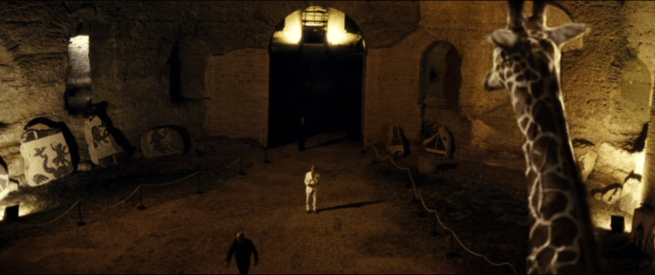
Upon the mountainous ruins of the Baths of Caracalla

From Shelley’s preface to Prometheus Unbound:

This Poem was chiefly written upon the mountainous ruins of the Baths of Caracalla, among the flowery glades, and thickets of odoriferous blossoming trees, which are extended in ever winding labyrinths upon its immense platforms and dizzy arches suspended in the air. The bright blue sky of Rome, and the effect of the vigorous awakening spring in that divinest climate, and the new life with which it drenches the spirits even to intoxication, were the inspiration of this drama.

Many years ago I saw an outdoor ballet in the same ruins of those baths.  They also feature in a scene in what I without hesitation find the greatest movie of the past several decades – The Great Beauty.

2b80e53c1e8e32f81f0c3ac2cd2df457

It was his soul that suffered, and his soul I could not reach

From Melville’s Bartleby the Scrivener:

Revolving all these things, and coupling them with the recently discovered fact that he made my office his constant abiding place and home, and not forgetful of his morbid moodiness; revolving all these things, a prudential feeling began to steal over me. My first emotions had been those of pure melancholy and sincerest pity; but just in proportion as the forlornness of Bartleby grew and grew to my imagination, did that same melancholy merge into fear, that pity into repulsion. So true it is, and so terrible too, that up to a certain point the thought or sight of misery enlists our best affections; but, in certain special cases, beyond that point it does not. They err who would assert that invariably this is owing to the inherent selfishness of the human heart. It rather proceeds from a certain hopelessness of remedying excessive and organic ill. To a sensitive being, pity is not seldom pain. And when at last it is perceived that such pity cannot lead to effectual succor, common sense bids the soul rid of it. What I saw that morning persuaded me that the scrivener was the victim of innate and incurable disorder. I might give alms to his body; but his body did not pain him; it was his soul that suffered, and his soul I could not reach.

I love all men who dive

From a letter of Herman Melville’s – March 3, 1849, pages depend on which edition of correspondence you pull from but it’s also heavily quoted elsewhere.

Now, there is a something about every man elevated above mediocrity, which is for the most part instantly perceptible … I love all men who dive.  Any fish can swim near the surface, but it takes a great whale to go down stairs file miles or more; and if he don’t attain the bottom, why, all the lead in Galena can’t fashion the plummit that will.  I’m not talking of Mr. Emerson now, but of the whole corps of thought-divers that have been diving and coming up again with blood-shot eyes since the world began.

οὔ τί με ταύτης χρεὼ τιμῆς

Iliad 9.585-601.  ish.

ὣς ὃ μὲν Αἰτωλοῖσιν ἀπήμυνεν κακὸν ἦμαρ
εἴξας ᾧ θυμῷ: τῷ δ᾽ οὐκέτι δῶρα τέλεσσαν
πολλά τε καὶ χαρίεντα, κακὸν δ᾽ ἤμυνε καὶ αὔτως.
ἀλλὰ σὺ μή μοι ταῦτα νόει φρεσί, μὴ δέ σε δαίμων
ἐνταῦθα τρέψειε φίλος: κάκιον δέ κεν εἴη
νηυσὶν καιομένῃσιν ἀμυνέμεν: ἀλλ᾽ ἐπὶ δώρων
ἔρχεο: ἶσον γάρ σε θεῷ τίσουσιν Ἀχαιοί.
εἰ δέ κ᾽ ἄτερ δώρων πόλεμον φθισήνορα δύῃς
οὐκέθ᾽ ὁμῶς τιμῆς ἔσεαι πόλεμόν περ ἀλαλκών.

τὸν δ᾽ ἀπαμειβόμενος προσέφη πόδας ὠκὺς Ἀχιλλεύς:
‘Φοῖνιξ ἄττα γεραιὲ διοτρεφὲς οὔ τί με ταύτης
χρεὼ τιμῆς: φρονέω δὲ τετιμῆσθαι Διὸς αἴσῃ,
ἥ μ᾽ ἕξει παρὰ νηυσὶ κορωνίσιν εἰς ὅ κ᾽ ἀϋτμὴ
ἐν στήθεσσι μένῃ καί μοι φίλα γούνατ᾽ ὀρώρῃ.

“So he [Meleager] warded off from the Aitolians the evil day [of defeat]
yielding in his spirit.  But no longer did they complete for him those gifts
many and pleasing  – but even so he warded off that evil.
But you must not think thus in your heart – do not let your own god
turn you this way. Much worse would it be
when the ships are already burning to defend them. But with a view to the gifts
come now.  For like a god do the Achaeans honor you.
But if without the gifts you should enter man-destroying war
no longer will you be of like honor, even though you ward off the war.

In response to him spoke forth swift-footed Achilles.
“Phoinix, my father, venerable old man, cherished by Zeus – in no way
have I need of such honor. But I think I am honored by Zeus’ apportioning,
which will be mine among these prowed ships as long as breath
remains in my chest and my own knees have strength.”

Ma sazietà di lingua il cor non sente

From Giacomo Leopardi’s notes to his own Canzoni.  I usually feel decent about my translations but this is straight trash.  The two issues are the import of sazietà – around which the whole poem revolves – and the choice for rendering lingua.  The dual sense of lingua/tongue as anatomy/language exists in English but the ‘tongue as language’ sense feels a forced archaism in modern speech little in keeping with Leopardi’s feel here.   For sazietà the straight sense of ‘satiety, fullness’ does not feel effective in English – ‘satiety with this but never with that’ – so I want to push it to ‘overfullness with this but never with that’.  But I don’t think that sense is allowed by the Italian so maybe my complaint is with the formulation of the thought itself.  Meh.

Il cor di tutte
Cose alfin sente sazietà, del sonno,
Della danza, del canto e dell’amore,
Piacer più cari che il parlar di lingua,
Ma sazietà di lingua il cor non sente.

The heart – with everything –
can feel sated, with sleep
dance, song, and love,
things more pleasing than the speech of the tongue,
but satiety of language the heart does not feel.

I still feel a very great satisfaction when I find myself alone in a street, without a tutor by my side

From Iris Origo’s Leopardi: A Study in Solitude (my page numbers are from the original printing, though there is a recent reprint by Pushkin Press).  Vignettes of Giacomo Leopardi’s father, whose own autobiography – surprisingly still in print, blessed be small Italian publishers – I’m now trying to obtain of a copy of.

…And a few days later Napoleon himself rode through [Recanati], on his way to Rome.  He rode hastily, Conte Monaldo related, surrounded by guards with their hands on the trigger of their muskets, and all the population turned out to see him. “But I”, wrote the Count, “refused to approach the window, thinking it too great an honour for such a villain, that an honest man should rise to see him pass.” (pg4)


…When barely eighteen, he assumed, as head of the family, the complete management of the whole property – yet he was still forbidden by his mother to go out of the house, unless accompanied by his preceptor.  This restriction, although not unusual in families such as his, was particularly galling to Monaldo. “To this day,” he wrote in his Memoirs, “although I am the father of twelve children (living and dead), a magistrate of the city, and forty-eight years of age, I still feel a very great satisfaction when I find myself alone in a street, without a tutor by my side.” (pg5)


Conte Monaldo himself, when he required a little pocket-money [from his wife, who controlled the purse strings], was forced to resort to subterfuge; he would plot with the bailiff, to sell a barrel of wine or a sack of wheat behind his wife’s back, or he would take to her two books from his own library, saying that he needed a few scudi to pay for them. “Thus,” he remarked, “I used to steal from myself.”

It must be added that often these subterfuges were practised by Conte Monaldo in the cause of charity: the cloister, for instance, of the monastery of the Minori Osservanti was built entirely at his expense, but, to avoid his wife’s vigilance, the building materials had to be carried there at night.  And the story is even told that on one winter’s evening, on being accosted by a half-naked beggar, the Count retired into the shadow of a doorway, took off his trousers, gave them to the wretched man – and thus, wrapping himself in his cloak, made his way home. (pg14-15)

As a plate of marmalade would improve a pan of sirreverence

From Tobias Smollett’s The Expedition of Humphry Clinker – in Jeremy’s letter of April 30.

In the mean time, I must entertain you with an incident, that seems to confirm the judgment of those two cynic philosophers [my uncle Matthew Bramble and his friend Mr Quin]. I took the liberty to differ in opinion from Mr Bramble, when he observed, that the mixture of people in the entertainments of this place [Bath] was destructive of all order and urbanity; that it rendered the plebeians insufferably arrogant and troublesome, and vulgarized the deportment and sentiments of those who moved in the upper spheres of life. He said such a preposterous coalition would bring us into contempt with all our neighbours; and was worse, in fact, than debasing the gold coin of the nation. I argued, on the contrary, that those plebeians who discovered such eagerness to imitate the dress and equipage of their superiors, would likewise, in time, adopt their maxims and their manners, be polished by their conversation, and refined by their example; but when I appealed to Mr Quin, and asked if he did not think that such an unreserved mixture would improve the whole mass? ‘Yes (said he) as a plate of marmalade would improve a pan of sirreverence.

The OED gives sirreverence as in origin a shortening of saving your reverence -> save reverence -> sareverence -> sirreverence.  The ‘beg your pardon’ sense would initially have followed whatever was said that may have been found indecent but the phrase/word itself later – to avoid the indecency altogether – came in as substitute.  Presumably becoming an indecency itself.  The first appearance in the clear sense of ‘excrement’ is from 1592 in R. Greene’s Black Bookes Messenger (sig. D3):

His face,… and his necke, were all besmeared with the soft sirreverence, so as hee stunke.

Peter Motteux’s 1694 translation of Rabelais (bk4.52) includes another instance:

For four … Days I hardly scumber’d one poor Butt of Sir~reverence

Scumber itself is from Old French descombrer (modern decombrer) which means ‘to relieve of a load’.  The evacuation sense adds itself.

Incidentally, Rabelais’ original text is:

ie ne fiantay qu’une petite crotte

Fienter has the meaning “Débarrasser (un cheval) de la fiente” (relieve [a horse] of shit) and crotte itself just means fiente.

Another reminder that Motteux is always the best Rabelais translator.

τὴν ἄρετ᾽ ἐξ ἐνάρων πόλιν Ἠετίωνος ὀλέσσας

From the embassy’s arrival in Iliad 9.180.

They went along the shore of the splashing sea
praying much to the earth-holding Earth-Shaker
to readily persuade the great heart of the son of Aeacus.
To the tents and ships of the Myrmidons they came,
and him they found delighting his heart with a clear-toned lyre
beautiful and skillfully embellished, and the bridge on it was made of silver,
then he took from the spoils when he had sacked the city of Etion:
With it he used to delight his spirit, and he sang the famous deeds of men.
Patroklos, alone with him, sat opposite keeping silence,
waiting until the son of Aeacus should leave off his singing….

τὼ δὲ βάτην παρὰ θῖνα πολυφλοίσβοιο θαλάσσης
πολλὰ μάλ᾽ εὐχομένω γαιηόχῳ ἐννοσιγαίῳ
ῥηϊδίως πεπιθεῖν μεγάλας φρένας Αἰακίδαο.
Μυρμιδόνων δ᾽ ἐπί τε κλισίας καὶ νῆας ἱκέσθην,
τὸν δ᾽ εὗρον φρένα τερπόμενον φόρμιγγι λιγείῃ
καλῇ δαιδαλέῃ, ἐπὶ δ᾽ ἀργύρεον ζυγὸν ἦεν,
τὴν ἄρετ᾽ ἐξ ἐνάρων πόλιν Ἠετίωνος ὀλέσσας:
τῇ ὅ γε θυμὸν ἔτερπεν, ἄειδε δ᾽ ἄρα κλέα ἀνδρῶν.
Πάτροκλος δέ οἱ οἶος ἐναντίος ἧστο σιωπῇ,
δέγμενος Αἰακίδην ὁπότε λήξειεν ἀείδων,

The scene is well-known for the depiction of Achilles playing the lyre himself for himself (the only amateur singer in Homer and only song not performed for a group) and for the thematic resonance of his singing κλέα ἀνδρῶν (deeds of men).  It’s also been routinely observed that Achilles didn’t bring the lyre with him (which potentially suggests that the pleasure of song was felt to be incompatible with war, a social stricture which would explain why there are no singers in the Iliad otherwise), but I’ve never seen anyone poke at the potential character implications of the timeline and circumstances of its acquisition.  But I’m lazy and do no more than point the way.