
The Normand hole and a kick in the ass – some more occasional drinking terms

In the spirit of yesterday’s deoc an doruis and by happy coincidence here are a few other terms of drinking interest I ran across today in a collection of Guy de Maupassant stories, Contes de la Becasse:

From Farce Normande:

Between each course everyone made a hole – the Normand hole – with a glass of (apple) brandy which flung fire in the body and madness in the mind.


Entre chaque plat on faisait un trou, le trou normand, avec un verre d’eau-de-vie qui jetait du feu dans le corps et de la folie dans les têtes.

I’m honestly at a loss on how to put this in English since the relevant phrase – le trou normand – is literally just ‘the Normand hole’.  It refers to a drink taken between courses in the hope of facilitating digestion/dulling the senses just enough that you can keep going for the next.  Eau-de-vie in the Normand context has to be apple brandy (Calvados)

From Les Sabots:

She went to find a cup, sat down again, tasted the black liquor [coffee], made a grimace, but, under the master’s furious eye, drank it down to the bottom.  Then they had to drink the first glass of (apple) brandy for the rinse, the second for the followup-rinse, and the third for a kick in the ass.


Elle alla chercher une tasse, se rassit, goûta la noire liqueur, fit la grimace, mais, sous l’œil furieux du maître, avala jusqu’au bout.Puis il lui fallut boire le premier verre d’eau-de-vie de la rincette, le second du pousse-rincette, et le troisième du coup-de-pied-au-cul.

Rincette is defined as the ‘little bit of liqueur poured in a cup after drinking coffee’

Pousse-rincette is, here, simply the followup to the first rinse.  The term seems more generally a synonym for the rincette – it is closer to the contemporary pousse-café.

Coup-de-pied-au-cul is literally ‘a kick in the ass.’  I can’t tell if this is a witticism of Maupassant’s or a legitimate Normand phrase now lost to use.


Let us have another one as a deoc an doruis

From A Little Cloud in James Joyce’s Dubliners:

“And to clinch the bargain,” said Little Chandler, “we’ll just have one more now.”

Ignatius Gallaher took out a large gold watch and looked at it.

“Is it to be the last?” he said. “Because you know, I have an a.p.”

“O, yes, positively,” said Little Chandler.

“Very well, then,” said Ignatius Gallaher, “let us have another one as a deoc an doruis—that’s good vernacular for a small whisky, I believe.”

Don Gifford’s Joyce Annotated gives this as – “Irish: (literally) a door-drink; one for the road.”  The Scottish version is Deoch an doris (drink of the door).

There’s also a French variant which I’ve never encountered except in books – le coup de l’étrier – literally ‘drink/glass of the stirrup.’  Huysmans uses it in ch. 11 of À Rebours: “Voyons, fit-il, pour se verser du courage, buvons le coup de l’étrier; et il remplit un verre de brandy, tout en réclamant sa note.”

The Italian version – which I’ve heard used but as something closer to English nightcap – is an exact equivalent of the French – Bicchiere della staffa

Fools admire everything in an author of reputation. For my part, I read only to please myself.

From Voltaire’s Candide, again during the tour of Pococurante’s estate – which, along with the ending in Constantinople, turns out to be the only portion of the work I genuinely enjoy.

“May I presume to ask you, sir,” said Candide, “whether you do not receive a great deal of pleasure from reading Horace?”

“There are maxims in this writer,” answered Pococurante, “from which a man of the world may reap great benefit, and being written in energetic verse they are more easily impressed upon the memory. But I care little for his journey to Brundusium, and his account of a bad dinner, or of his low quarrel between one Rupilius whose words he says were full of poisonous filth, and another whose language was imbued with vinegar. I have read with much distaste his indelicate verses against old women and witches; nor do I see any merit in telling his friend Mæcenas that if he will but rank him in the choir of lyric poets, his lofty head shall touch the stars. Fools admire everything in an author of reputation. For my part, I read only to please myself. I like only that which serves my purpose.”


Oserais-je vous demander, monsieur, dit Candide, si vous n’avez pas un grand plaisir à lire Horace? Il y a des maximes, dit Pococurante, dont un homme du monde peut faire son profit, et qui, étant resserrées dans des vers énergiques, se gravent plus aisément dans la mémoire: mais je me soucie fort peu de son voyage à Brindes, et de sa description d’un mauvais dîner, et de la querelle de crocheteurs entre je ne sais quel Pupilus dont les paroles, dit-il, étaient pleines de pus, et un autre dont les paroles étaient du vinaigre. Je n’ai lu qu’avec un extrême dégoût ses vers grossiers contre des vieilles et contre des sorcières; et je ne vois pas quel mérite il peut y avoir à dire à son ami Mecenas que, s’il est mis par lui au rang des poètes lyriques, il frappera les astres de son front sublime. Les sots admirent tout dans un auteur estimé. Je ne lis que pour moi; je n’aime que ce qui est à mon usage.

There is some pleasure in having no pleasure?

From Voltaire’s Candide, following Candide and Martin’s tour of Pococurante’s estate:

“Well,” said Candide to Martin when they had taken their leave, “you will agree that this is the happiest of mortals, for he is above everything he possesses.”

“But do you not see,” answered Martin, “that he is disgusted with all he possesses? Plato observed a long while ago that those stomachs are not the best that reject all sorts of food.”

“But is there not a pleasure,” said Candide, “in criticising everything, in pointing out faults where others see nothing but beauties?”

“That is to say,” replied Martin, “that there is some pleasure in having no pleasure?”

Or çà, dit Candide à Martin, vous conviendrez que voilà le plus heureux de tous les hommes, car il est au-dessus de tout ce qu’il possède. Ne voyez-vous pas, dit Martin, qu’il est dégoûté de tout ce qu’il possède? Platon a dit, il y a long-temps, que les meilleurs estomacs ne sont pas ceux qui rebutent tous les aliments. Mais, dit Candide, n’y a-t-il pas du plaisir à tout critiquer, à sentir des défauts où les autres hommes croient voir des beautés? C’est-à-dire, reprit Martin, qu’il y a du plaisir à n’avoir pas de plaisir?


What was the stanchest code of ethics but a trunk with a series of false bottoms?

I’m sad I waited so long to read Edith Wharton’s short stories.  I’d appreciated Age of Innocence but I doubt I’d have made it back to her if it hadn’t been for finding a stray copy of her Glimpses of the Moon in the civilized section of the Uffizi store last fall.  I still don’t know why it was there – where nearly everything else is specialty art and history – but blessings upon whoever wanted to fluff out their literary offerings.  This is from one of her earlier stories, A Cup of Cold Water.  It is not in the least original as an idea but the perfect aptness of the image is what I’m finding so appealing in her.

The desire to see Miss Talcott had driven Woburn to the Gildermeres’; but
once in the ball-room he made no effort to find her. The people about him
seemed more like strangers than those he had passed in the street. He
stood in the doorway, studying the petty manoeuvres of the women and the
resigned amenities of their partners. Was it possible that these were his
friends? These mincing women, all paint and dye and whalebone, these
apathetic men who looked as much alike as the figures that children cut
out of a folded sheet of paper? Was it to live among such puppets that he
had sold his soul? What had any of these people done that was noble,
exceptional, distinguished? Who knew them by name even, except their
tradesmen and the society reporters? Who were they, that they should sit
in judgment on him?

The bald man with the globular stomach, who stood at Mrs. Gildermere’s
elbow surveying the dancers, was old Boylston, who had made his pile in
wrecking railroads; the smooth chap with glazed eyes, at whom a pretty
girl smiled up so confidingly, was Collerton, the political lawyer, who
had been mixed up to his own advantage in an ugly lobbying transaction;
near him stood Brice Lyndham, whose recent failure had ruined his friends
and associates, but had not visibly affected the welfare of his large and
expensive family. The slim fellow dancing with Miss Gildermere was Alec
Vance, who lived on a salary of five thousand a year, but whose wife was
such a good manager that they kept a brougham and victoria and always put
in their season at Newport and their spring trip to Europe. The little
ferret-faced youth in the corner was Regie Colby, who wrote the _Entre-
Nous_ paragraphs in the _Social Searchlight_: the women were charming to
him and he got all the financial tips he wanted from their husbands and
fathers.

And the women? Well, the women knew all about the men, and flattered them
and married them and tried to catch them for their daughters. It was a
domino-party at which the guests were forbidden to unmask, though they all
saw through each other’s disguises.

And these were the people who, within twenty-four hours, would be agreeing
that they had always felt there was something wrong about Woburn! They
would be extremely sorry for him, of course, poor devil; but there are
certain standards, after all–what would society be without standards? His
new friends, his future associates, were the suspicious-looking man whom
the policeman had ordered to move on, and the drunken woman asleep on the
door-step. To these he was linked by the freemasonry of failure.

Miss Talcott passed him on Collerton’s arm; she was giving him one of the
smiles of which Woburn had fancied himself sole owner. Collerton was a
sharp fellow; he must have made a lot in that last deal; probably she
would marry him. How much did she know about the transaction? She was a
shrewd girl and her father was in Wall Street. If Woburn’s luck had turned
the other way she might have married him instead; and if he had confessed
his sin to her one evening, as they drove home from the opera in their new
brougham, she would have said that really it was of no use to tell her,
for she never could understand about business, but that she did entreat
him in future to be nicer to Regie Colby. Even now, if he made a big
strike somewhere, and came back in ten years with a beard and a steam
yacht, they would all deny that anything had been proved against him, and
Mrs. Collerton might blush and remind him of their friendship. Well–why
not? Was not all morality based on a convention? What was the stanchest
code of ethics but a trunk with a series of false bottoms? Now and then
one had the illusion of getting down to absolute right or wrong, but it
was only a false bottom–a removable hypothesis–with another false bottom
underneath. There was no getting beyond the relative.

Xingu, of course…

From Edith Wharton’s Xingu, as a reading circle of society women host a fashionable author for a lunch talk:

 “You must excuse us, Mrs. Dane, for not being able, just at present, to talk of anything but [your book] ‘The Wings of Death.”’

“Yes,” said Miss Van Vluyck, with a sudden resolve to carry the war into the enemy’s camp. “We are so anxious to know the exact purpose you had in mind in writing your wonderful book.”

“You will find,” Mrs. Plinth interposed, “that we are not superficial readers.”

“We are eager to hear from you,” Miss Van Vluyck continued, “if the pessimistic tendency of the book is an expression of your own convictions or—”

“Or merely,” Miss Glyde thrust in, “a sombre background brushed in to throw your figures into more vivid relief. Are you not primarily plastic?”

“I have always maintained,” Mrs. Ballinger interposed, “that you represent the purely objective method—”

Osric Dane helped herself critically to coffee. “How do you define objective?” she then enquired.

There was a flurried pause before Laura Glyde intensely murmured: “In reading you we don’t define, we feel.”

Otsric Dane smiled. “The cerebellum,” she remarked, “is not infrequently the seat of the literary emotions.” And she took a second lump of sugar.

The sting that this remark was vaguely felt to conceal was almost neutralised by the satisfaction of being addressed in such technical language.

“Ah, the cerebellum,” said Miss Van Vluyck complacently. “The club took a course in psychology last winter.”

“Which psychology?” asked Osric Dane.

There was an agonising pause, during which each member of the club secretly deplored the distressing inefficiency of the others. Only Mrs. Roby went on placidly sipping her chartreuse. At last Mrs. Ballinger said, with an attempt at a high tone: “Well, really, you know, it was last year that we took psychology, and this winter we have been so absorbed in—”

She broke off, nervously trying to recall some of the club’s discussions; but her faculties seemed to be paralysed by the petrifying stare of Osric Dane. What had the club been absorbed in? Mrs. Ballinger, with a vague purpose of gaining time, repeated slowly: “We’ve been so intensely absorbed in—”

Mrs. Roby put down her liqueur glass and drew near the group with a smile.

“In Xingu?” she gently prompted.

A thrill ran through the other members. They exchanged confused glances, and then, with one accord, turned a gaze of mingled relief and interrogation on their rescuer. The expression of each denoted a different phase of the same emotion. Mrs. Plinth was the first to compose her features to an air of reassurance: after a moment’s hasty adjustment her look almost implied that it was she who had given the word to Mrs. Ballinger.

“Xingu, of course!” exclaimed the latter with her accustomed promptness, while Miss Van Vluyck and Laura Glyde seemed to be plumbing the depths of memory, and Mrs. Leveret, feeling apprehensively for Appropriate Allusions, was somehow reassured by the uncomfortable pressure of its bulk against her person.

Osric Dane’s change of countenance was no less striking than that of her entertainers. She too put down her coffee-cup, but with a look of distinct annoyance; she too wore, for a brief moment, what Mrs. Roby afterward described as the look of feeling for something in the back of her head; and before she could dissemble these momentary signs of weakness, Mrs. Roby, turning to her with a deferential smile, had said: “And we’ve been so hoping that to-day you would tell us just what you think of it.”

Osric Dane received the homage of the smile as a matter of course; but the accompanying question obviously embarrassed her, and it became clear to her observers that she was not quick at shifting her facial scenery. It was as though her countenance had so long been set in an expression of unchallenged superiority that the muscles had stiffened, and refused to obey her orders.

“Xingu—” she said, as if seeking in her turn to gain time.

The full 25ish page story is here.  I do not believe it is a coincidence the clever one is the only one sipping Chartreuse…

They don’t know it – but how much they’re missing!

From Edith Wharton’s Roman Fever (pg. 15 of Roman Fever and Other Stories).

“I was just thinking,” she said slowly, “what different things Rome stands for to each generation of travellers.  To our grandmother, Roman fever; to our mothers, sentimental dangers – how we used to be guarded! – to our daughters, no more dangers than the middle of Main Street.  They don’t know it – but how much they’re missing!”

This brief passage feels pregnant with far more meaning than its obvious value in the titular story – akin to the social and generation commentary via the hotel room in Forster’s A Room With a View, only skewing differently in its final value.

The higher one goes the less it wearies.

Purgatorio Canto IV 88-96, Virgil to Dante pilgrim on their coming path.  The translation is Singleton’s – which one day I will spend hours here justifying against the verse versions more generally in favor but for now I leave it to a half oblique Tristram Shandy quote – “Now this I like;—when we cannot get at the very thing we wish—never to take up with the next best in degree to it:—no; that’s pitiful beyond description”

And he to me, “This mountain is such that ever at the beginning below it is toilsome, but the higher one goes the less it wearies.  Therefore, when it shall seem to you so pleasant that the going up is a s easy for you as going downstream in a boat, then will you be at the end of this path: hope there to rest your weariness; no more I answer, and this I know for true.

Ed elli a me: «Questa montagna è tale,
che sempre al cominciar di sotto è grave;
e quant’ om più va sù, e men fa male.

Però, quand’ ella ti parrà soave
tanto, che sù andar ti fia leggero
com’ a seconda giù andar per nave,

allor sarai al fin d’esto sentiero;
quivi di riposar l’affanno aspetta.
Più non rispondo, e questo so per vero».

Those who seek thus seek wrongly

From Meister Eckhart’s The Talks of Instruction (M O’C Walshe translation):

Therefore start first with yourself, and resign yourself.  In truth, unless you flee first from yourself, then wherever you flee to, you will find obstacles and restlessness no matter where it is.  If people seek peace in outward things, whether in places or in methods or in people or in deeds or in banishment or in poverty or in humiliation, however great or whatever kind all this may be, this is all in vain and brings them no peace.  Those who seek thus seek wrongly; the further they go the less they find what they are seeking.  They are like a man who has taken a wrong turning : the further he goes, the more he goes astray.  But what should he do? He should resign himself to begin with, and then he has abandoned all things.  In truth, if a man gave up a kingdom or the whole word and did not give up (him)self, he would have given up nothing.  But if a man gives up himself, then whatever he keeps, wealth, honour or whatever it may be, still he has given up everything.

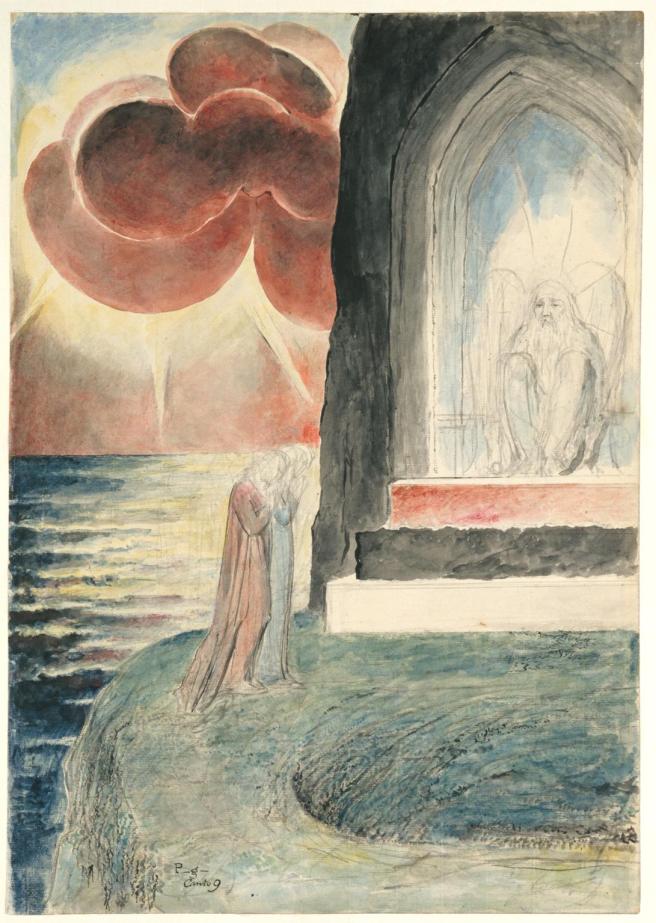
William Blake in Purgatory

Two illustrations from William Blake’s series on the Divine Comedy, both from Canto 9 (76-114) of Purgatory.  I’ve had prints of both on my walls for years – though I just now realize they are less than appropriately mounted over my bar – but thanks to Taschen’s beautiful edition of this series I’m finally able to have everything at hand as visual accompaniment to reading.  If only someone would do the same for the Dali series.

Dante and Virgil Approaching the Angel Who Guards the Entrance of Purgatory 1824-7 by William Blake 1757-1827I now made out a gate and, there below it,
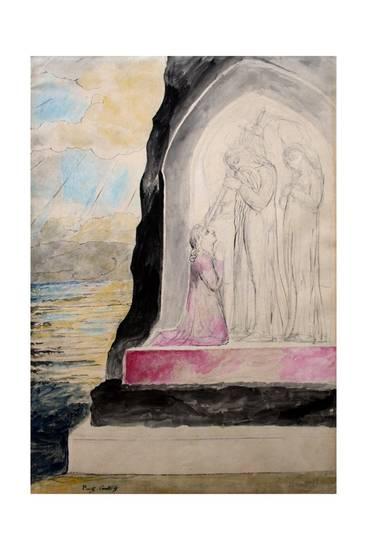
three steps—their colors different—leading to it,
and a custodian who had not yet spoken.

As I looked more and more directly at him,
I saw him seated on the upper step—
his face so radiant, I could not bear it;

and in his hand he held a naked sword,
which so reflected rays toward us that I,
time and again, tried to sustain that sight

in vain. “Speak out from there; what are you seeking?”
so he began to speak. “Where is your escort?
Take care lest you be harmed by climbing here.”

My master answered him: “But just before,
a lady came from Heaven and, familiar
with these things, told us: ‘That’s the gate; go there.’”

“And may she speed you on your path of goodness!”
the gracious guardian of the gate began
again. “Come forward, therefore, to our stairs.”

There we approached, and the first step was white
marble, so polished and so clear that I
was mirrored there as I appear in life.

The second step, made out of crumbling rock,
rough—textured, scorched, with cracks that ran across
its length and width, was darker than deep purple.

The third, resting above more massively,
appeared to me to be of porphyry,
as flaming red as blood that spurts from veins.

And on this upper step, God’s angel—seated
upon the threshold, which appeared to me
to be of adamant—kept his feet planted.

purgatory92

My guide, with much good will, had me ascend
by way of these three steps, enjoining me:
“Do ask him humbly to unbolt the gate.”

I threw myself devoutly at his holy
feet, asking him to open out of mercy;
but first I beat three times upon my breast.

Upon my forehead, he traced seven P’s
with his sword’s point and said: “When you have entered
within, take care to wash away these wounds.”

For the few di color che sanno:

vidi una porta, e tre gradi di sotto
per gire ad essa, di color diversi,
e un portier ch’ancor non facea motto.

E come l’occhio più e più v’apersi,
vidil seder sovra ’l grado sovrano,
tal ne la faccia ch’io non lo soffersi;

e una spada nuda avëa in mano,
che reflettëa i raggi sì ver’ noi,
ch’io drizzava spesso il viso in vano.

«Dite costinci: che volete voi?»,
cominciò elli a dire, «ov’ è la scorta?
Guardate che ’l venir sù non vi nòi».

«Donna del ciel, di queste cose accorta»,
rispuose ’l mio maestro a lui, «pur dianzi
ne disse: “Andate là: quivi è la porta”».

«Ed ella i passi vostri in bene avanzi»,
ricominciò il cortese portinaio:
«Venite dunque a’ nostri gradi innanzi».

Là ne venimmo; e lo scaglion primaio
bianco marmo era sì pulito e terso,
ch’io mi specchiai in esso qual io paio.

Era il secondo tinto più che perso,
d’una petrina ruvida e arsiccia,
crepata per lo lungo e per traverso.

Lo terzo, che di sopra s’ammassiccia,
porfido mi parea, sì fiammeggiante
come sangue che fuor di vena spiccia.

Sovra questo tenëa ambo le piante
l’angel di Dio, sedendo in su la soglia
che mi sembiava pietra di diamante.

Per li tre gradi sù di buona voglia
mi trasse il duca mio, dicendo: «Chiedi
umilemente che ’l serrame scioglia».

Divoto mi gittai a’ santi piedi;
misericordia chiesi e ch’el m’aprisse,
ma tre volte nel petto pria mi diedi.

Sette P ne la fronte mi descrisse
col punton de la spada, e «Fa che lavi,
quando se’ dentro, queste piaghe» disse.