
The universe is one great set of reference books from which he picks and chooses as his restless mind veers on

From Philip K Dick’s The Transmigration of Timothy Archer (somewhere in ch.9):

The son, his son, my husband, subordinated to an intellectual matter-I could never, myself, view it that way. This amounts to a depersonalization of Jeff Archer; he is converted into an instrument, a device for learning; why, he is converted into a talking book. Like all these books that Tim forever reaches for, especially in moments of crisis. Everything worth knowing can be found in a book; conversely, if Jeff is important he is important not as a person but as a book; it is books for books’ sakes then, not knowledge, even, for the sake of knowledge. The book is the reality. For Tim to love and appreciate his son, he must-as impossible as this may seem-he must regard him as a kind of book. The universe to Tim Archer is one great set of reference books from which he picks and chooses as his restless mind veers on, always seeking the new, always turning away from the old; it is the very opposite of that passage from Faust that he read; Tim has not found the moment where he says, “Stay”; it is still fleeing from him, still in motion.

A nice addition to Alberto Manguel’s ‘world as a book’ theme in Library At Night (or History of Reading?, I enjoy him but he re-uses the same material so much it’s hard to keep straight).  Though – to use Goethe against Dick’s Goethe – this restlessness itself feels much in the questing spirit of the angel’s

He who strives always to the utmost
Him we can redeem

Wer immer strebend sich bemüht,
Den können wir erlösen (11936-7)
Why do you hoard? Why do you squander?

From Inferno Canto 7 (19-35), on the avaricious and the prodigal.  I enjoy the Inferno least of the Commedia sections but I love this scene as – at least by my slightly warped application – a favorite image of head-pounding communication failure.  When I watch people in meetings exchange the same arguments on loop I chant to myself Perché tieni?” e “Perché burli? The text and translation are Singleton’s.

Ah, justice of God! who crams together so many new travails and penalties as I saw? And why does our guilt so waste us? As does the wave, there over Charybdis, breaking itself against the wave it meets, so must the folk here dance their round. Here I saw far more people than elsewhere, both on the one side and on the other, howling loudly, rolling weights, which they pushed with their chests; they clashed together, and then right there each wheeled round, rolling back his weight, shouting, “Why do you hoard?” and “Why do you squander?” Thus they returned along the gloomy circle on either hand to the opposite point, shouting at each other again their reproachful refrain; then, having reached that point, each turned back through his half-circle to the next joust.

Ahi giustizia di Dio! tante chi stipa
nove travaglie e pene quant’ io viddi?
e perché nostra colpa sì ne scipa?

Come fa l’onda là sovra Cariddi,
che si frange con quella in cui s’intoppa,
così convien che qui la gente riddi.

Qui vid’ i’ gente più ch’altrove troppa,
e d’una parte e d’altra, con grand’ urli,
voltando pesi per forza di poppa.

Percotëansi ‘ncontro; e poscia pur lì
si rivolgea ciascun, voltando a retro,
gridando: “Perché tieni?” e “Perché burli?”

Così tornavan per lo cerchio tetro
da ogne mano a l’opposito punto,
gridandosi anche loro ontoso metro;

poi si volgea ciascun, quand’ era giunto,
per lo suo mezzo cerchio a l’altra giostra.

A kind of bastard infallibility

From Leslie Stephen’s essay on Horace Walpole in Hours in a Library.  I just like the phrasing.

In truth Walpole has no pretensions whatever to be regarded as a great original creator, or even as one of the few infallible critics. The only man of his time who had some claim to that last title was his friend Gray, who shared his Gothic tastes with greatly superior knowledge. But he was indefinitely superior to the great mass of commonplace writers, who attain a kind of bastard infallibility by always accepting the average verdict of the time; which, on the principle of the vox populi, is more often right than that of any dissenter.

They’re light and easy to carry, and useful for the voyage

From Lucian’s Dialogues of the Dead (number 20 in the Loeb edition, whose good-enough translation I also use here).  The scene is the Styx as Hermes guides a batch of the newly dead – including the Cynic philosopher Menippus, Lucian’s sometimes mouthpiece – to Charon’s crossing:

Charon
Let me tell you how you stand; This boat is small for you, as you can see, and unsound, and leaks almost all over; if it lists one way or the other, it will capsize and sink. Yet you come in such numbers all at once, each of you laden with luggage. If, then, you take all this on board, I’m afraid you’ll be sorry for it later on, particularly those of you that can’t swim.
Dead Men
Well, what shall we do to have a good passage?
Charon
I’ll tell you. Strip yourselves before you come on board, and leave all this useless stuff on the shore; for, even then, the ferry will hardly hold you. It will be up to you, Hermes, to let none of them aboard after this, unless he has stripped himself and thrown away his trappings, as I said he must. Go and stand by the gangway, and sort them out for admission. Make them strip, before you let them on board.
…..
Hermes
But here’s an august personage, to judge by his appearance, and a proud man. Who can he be, with his haughty eyebrows, thoughtful mien, and bushy beard?

Menippus
A Philosopher, Hermes, or rather an impostor, full of talk of marvels. Strip him too, and you’ll see many amusing things covered up under his cloak.

Hermes
You there, off first with your clothes, and then with all this here. Ye gods, what hypocrisy he carries, what ignorance, contentiousness, vanity, unanswerable puzzles, thorny argumentations, and complicated conceptions—yes, and plenty of wasted effort, and no little nonsense, and idle talk, and splitting of hairs, and, good heavens, here’s gold too, and soft living, shamelessness, temper, luxury, and effeminacy! I can see them, however much you try to hide them. Away with your falsehood too, and your pride, and notions of your superiority over the rest of men. If you came on board with all these, not even a battleship would be big enough for you.
….

What’s this? Crying, you scum? Afraid to face death? Get in with you.

Menippus
He still has the heaviest thing of all under his arm.

Hermes
What, Menippus?

Menippus
Flattery, Hermes, which was often most useful to him in life.

Philosopher
What about you then, Menippus? Off with your independence, plain speaking, cheerfulness, noble bearing, and laughter. You’re the only one that laughs.

Hermes
Do nothing of the sort, but keep them, Menippus; they’re light and easy to carry, and useful for the voyage. But you, Rhetorician, throw away your endless loquacity, your antitheses, balanced clauses, periods, foreign phrases, and everything else that makes your speeches so heavy.


The very air is laden with discordant howls and thick with oaths and ribald songs

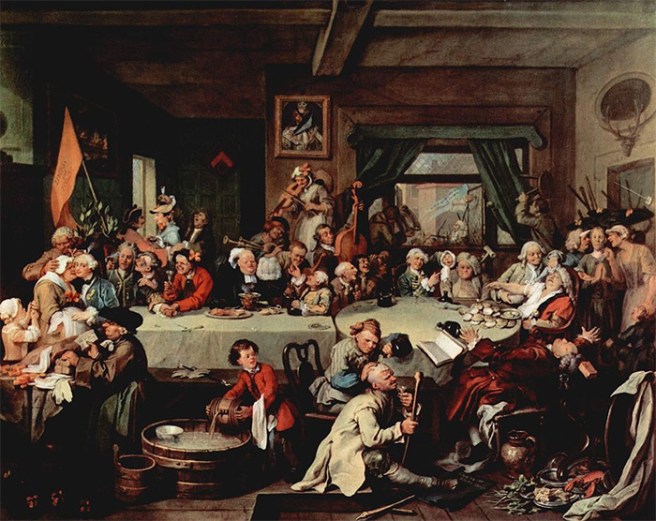
Leslie Stephen from his essay on Horace Walpole in Hours in a Library – imagining the dandy Walpole’s visits to his constituents, with reference to William Hogarth’s An Election Entertainment pictured below:

hogarth_election

 Yet we can fancy Walpole’s occasional visit to his constituents, and imagine him forced to preside at one of those election feasts which still survive on Hogarth’s canvas. Substitute him for the luckless fine gentleman in a laced coat, who represents the successful candidate in the first picture of the series. A drunken voter is dropping lighted pipe ashes upon his wig; a hideous old hag is picking his pockets; a boy is brewing oceans of punch in a mash-tub; a man is blowing bagpipes in his ear; a fat parson close by is gorging the remains of a haunch of venison; a butcher is pouring gin on his neighbour’s broken head; an alderman—a very mountain of roast beef—is sinking back in a fit, whilst a barber is trying to bleed him; brickbats are flying in at the windows; the room reeks with the stale smell of heavy viands and the fresh vapours of punch and gin, whilst the very air is laden with discordant howls and thick with oaths and ribald songs.

This also reminded me of a metro ride I took the other day.  Always better off walking the extra stops.

Rambling through one of the finest lumber rooms in the world

Like father like daughter (who resented/hated but unconsciously/unavoidably mirrored much of him). Yesterday was Sir Leslie Stephen on Thomas Browne, today Virginia Woolf from her essay The Elizabethan Lumber Room in The Common Reader:

He is the first of the autobiographers. Swooping and soaring at the highest altitudes he stoops suddenly with loving particularity upon the details of his own body. His height was moderate, he tells us, his eyes large and luminous; his skin dark but constantly suffused with blushes. He dressed very plainly. He seldom laughed. He collected coins, kept maggots in boxes, dissected the lungs of frogs, braved the stench of the spermaceti whale, tolerated Jews, had a good word for the deformity of the toad, and combined a scientific and sceptical attitude towards most things with an unfortunate belief in witches. In short, as we say when we cannot help laughing at the oddities of people we admire most, he was a character, and the first to make us feel that the most sublime speculations of the human imagination are issued from a particular man, whom we can love. In the midst of the solemnities of the Urn Burial we smile when he remarks that afflictions induce callosities. The smile broadens to laughter as we mouth out the splendid pomposities, the astonishing conjectures of the Religio Medici. Whatever he writes is stamped with his own idiosyncrasy, and we first became conscious of impurities which hereafter stain literature with so many freakish colours that, however hard we try, make it difficult to be certain whether we are looking at a man or his writing. Now we are in the presence of sublime imagination; now rambling through one of the finest lumber rooms in the world — a chamber stuffed from floor to ceiling with ivory, old iron, broken pots, urns, unicorns’ horns, and magic glasses full of emerald lights and blue mystery.

It is odd she so forgets Montaigne – whom she admires in similar terms elsewhere.

The two illustrious brothers Shandy combined in one person

From Sir Leslie Stephen’s essay on Sir Thomas Browne in Hours in a Library (first essay in vol. 2 of my 4 vol. edition – a different one is on Gutenberg):

A mind endowed with an insatiable curiosity as to all things knowable and unknowable; an imagination which tinges with poetical hues the vast accumulation of incoherent facts thus stored in a capacious memory; and a strangely vivid humour that is always detecting the quaintest analogies, and, as it were, striking light from the most unexpected collocations of uncompromising materials: such talents are by themselves enough to provide a man with work for life, and to make all his work delightful. To them, moreover, we must add a disposition absolutely incapable of controversial bitterness; ‘a constitution,’ as he says of himself, ‘so general that it consorts and sympathises with all things;’ an absence of all antipathies to loathsome objects in nature, for all theological systems; an admiration even of our natural enemies, the French, the Spaniards, the Italians, and the Dutch; a love of all climates, of all countries; and, in short, an utter incapacity to ‘absolutely detest or hate any essence except the devil.’ … A man so endowed … is admirably qualified to discover one great secret of human happiness. No man was ever better prepared to keep not only one, but a whole stableful of hobbies, nor more certain to ride them so as to amuse himself, without loss of temper or dignity, and without rude collisions against his neighbours. That happy art is given to few, and thanks to his skill in it, Sir Thomas reminds us strongly of the two illustrious brothers Shandy combined in one person. To the exquisite kindliness and simplicity of Uncle Toby he unites the omnivorous intellectual appetite and the humorous pedantry of the head of the family.

Proust is what comes to me, not what I summon

From Roland Barthes’ Le plaisir du texte (pg 58-59):

Reading a text reported by Stendhal (but which is not his), I find Proust there through a small detail … in the same way, in Flaubert, there are flowering normandy apples that I read based on Proust …

I recognize that Proust’s work is, at least for me, the reference work, the general mathesis, the mandala of the entire literary cosmogony – as were the letters of Mme de Sevigne for the narrator’s grandmother, the novels of chivalry for Don Quixote, etc.; That does not at all mean that I am a “specialist” in Proust: Proust is what comes to me, not what I summon;  He is not an “authority”; simply a circular memory.  And that is indeed the inter-text: the impossibility of living outside the infinite text.

Lisant un texte rapporte par Stendhal (mais qui n’est pas de lui), j’y retrouve Proust par un detail minuscule … de la meme facon, dans Flaubert, ce sont les pommiers normands en fleurs que je lis a partir de Proust…

Je comprends que l’oeuvre de Proust est, du moins pour moi, l’oeuvre de reference, la mathesis generale, le mandala de toute la cosmogonie litteraire – comme l’etaient les Lettres de Mme de Sevigne pour la grand-mere du narrateur, les romans de chevalerie pour don Quichotte, etc.; cela ne veut pas du tout dire que je sois un “spcialiste” de Proust: Proust, c’est ce qui me vient, ce n’est pas ce que j’appelle; ce n’est pas une “autorite”; simplement un souvenir circulaire.  Et c’est bien cela l’inter-texte: l’impossibilie de vivre hors du texte infini

I have read many books, but to little purpose, for want of good method

From Robert Burton’s Anatomy of Melancholy, in the prologue “Democritus Junior to the Reader.”  I’ve never made it past these first hundred pages but maybe someday.

Yet thus much I will say of myself, and that I hope without all suspicion of pride, or self-conceit, I have lived a silent, sedentary, solitary, private life, mihi et musis in the University, as long almost as Xenocrates in Athens, ad senectam fere to learn wisdom as he did, penned up most part in my study…. I had a great desire (not able to attain to a superficial skill in any) to have some smattering in all, to be aliquis in omnibus, nullus in singulis,  which Plato commends, out of him Lipsius approves and furthers, as fit to be imprinted in all curious wits, not to be a slave of one science, or dwell altogether in one subject, as most do, but to rove abroad, centum puer artium, to have an oar in every man’s boat, to taste of every dish, and sip of every cup, which, saith Montaigne, was well performed by Aristotle, and his learned countryman Adrian Turnebus. This roving humour (though not with like success) I have ever had, and like a ranging spaniel, that barks at every bird he sees, leaving his game, I have followed all, saving that which I should, and may justly complain, and truly, qui ubique est, nusquam est, which Gesner did in modesty, that I have read many books, but to little purpose, for want of good method;

Such convenience is not to be enjoyed — nor such liberty taken — with the living

From the letters of Laurence Sterne:

…Indeed I have no inclination to visit, or say a syllable to but a few persons in this lower vale of vanity and tears beside you: — But I often derive a peculiar satisfaction in conversing with the ancient and modern dead, —- who yet live and speak excellently in their works. — My neighbors think me often alone, — and yet at such times I am in company with more than five hundred mutes —- each of whom, at my pleasure, communicates his ideas to me by dumb signs — quite as intelligibly as any person living can do by uttering of words. — They always keep the distance from me which I direct —- and, with a motion of my hand, I can bring them as near to me as I please.  I lay hands on fifty of them sometimes in an evening, and handle them as I like — they never complain of ill-usage, — and when dismissed from my presence, — tho’ ever so abruptly —- take no offence.  Such convenience is not to be enjoyed — nor such liberty taken — with the living: —- We are bound —- in point of good manners to admit all our pretended friends when they knock for entrance, and dispense with all the nonsense or impertinence which they broach ’till they think proper to with-draw…