Give me your hearing and your heart, for words will quickly disappear

From Chretien de Troye’s Yvain ou Le Chevalier au Lion (Yvain or the Knight of the Lion), lines 150-170ish. I’m giving the two English renderings I have on hand, the first by Ruth Hardwood Cline and the second by Burton Raffel. It’s been a few years since I read either but I think Cline was the more accurate while Raffel the more readable – the rhyming starts to jingle too much in my head.

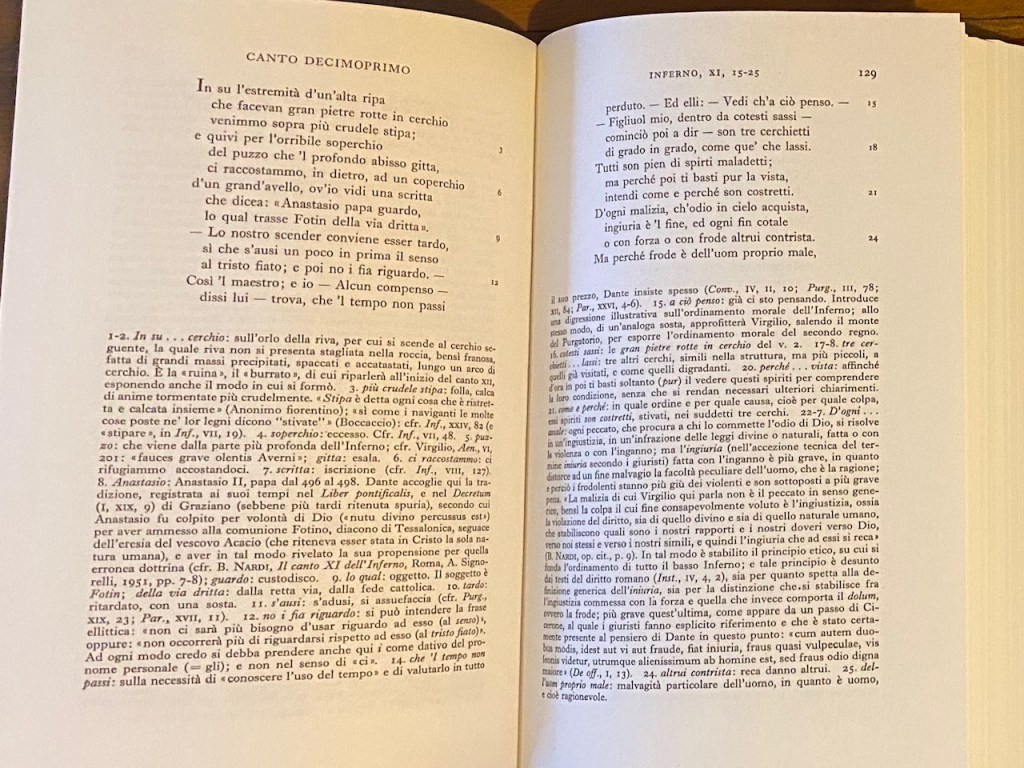
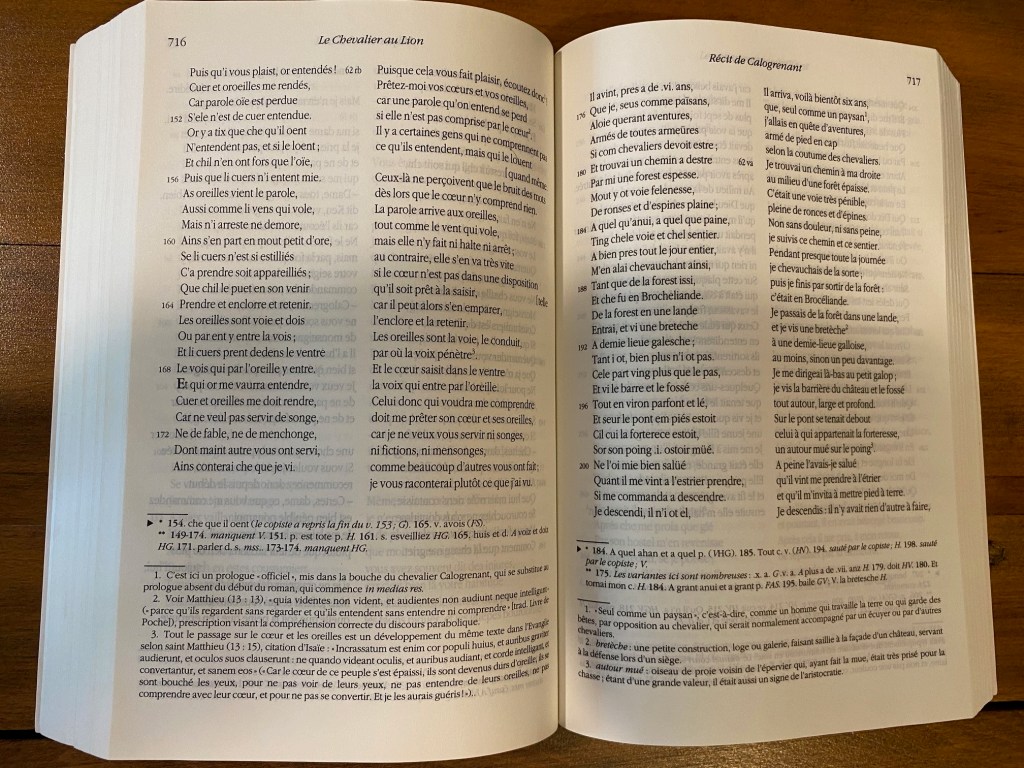
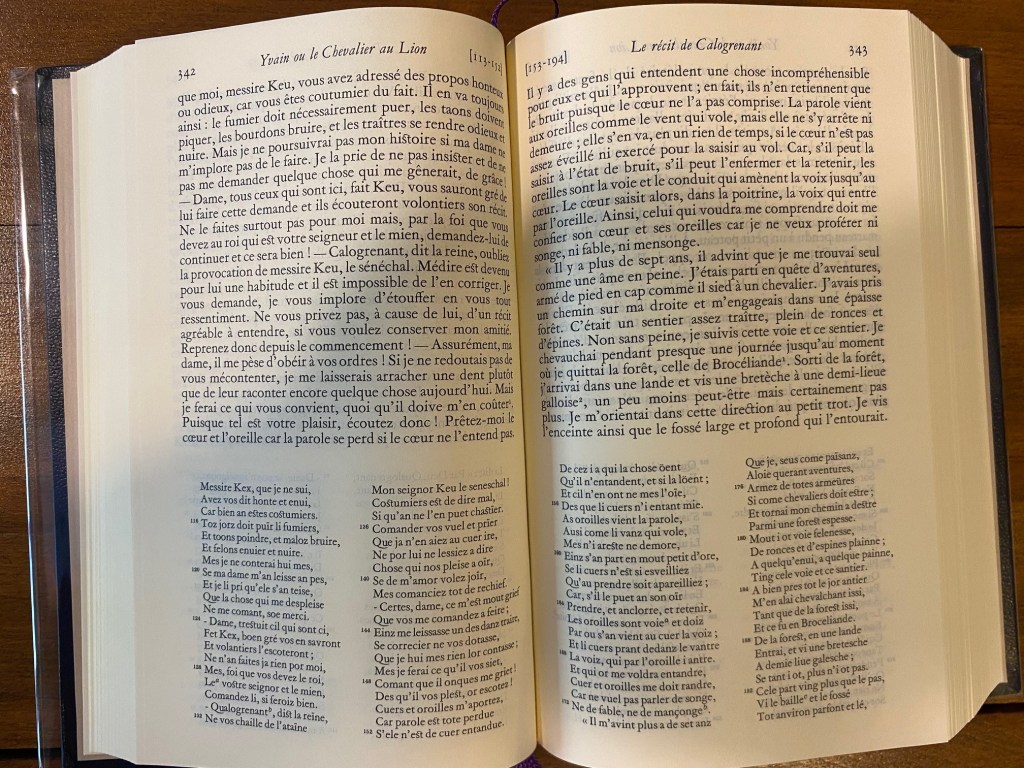
I’m this time using a modern French prose version in the Pleiade edition (lower picture). So far I prefer the facing metrical setup of the Livre de Poche Romans de Chretien de Troyes (upper picture) I’ve used before but we’ll see. The Old French text included below is from the University of Ottawa Dictionnaire Électronique de Chrétien de Troyes.

Cline’s Translation
Give me your hearing and your heart,
for words will quickly disappear,
if they aren’t heard in heart and ear.
Some men will hear and then commend
things that they cannot comprehend.
Their sense of hearing lets them hear it,
but once the heart has lost the spirit,
the words will fall upon the ears
just like the wind that blows and veers.
The words don’t Unger there or stay;
in a short while they fly away,
if the unwary heart’s asleep,
because the heart alone can keep
the words enclosed. The ears, they say,
are just the channel and the way
by which the voice comes to the heart.
But the heart’s able to impart
the voice that enters through the ears
unto the breast of him who hears.
So he who would hear me must start
by giving me his ears and heart,
because, however it may seem,
it’s not a lie, tall tale, or dream

Raffel’s Translation
Give me your ears and your mind!
The spoken word is lost
If your heart and your mind can’t hear it.
There are men, I assure you, who listen
Happily and hear nothing,
Men little more than ears,
Their brains distant, detached.
Words can come to the ear
Like blowing wind, and neither
Stop nor remain, just passing
By, like fleeting time,
If hearts and minds aren’t awake,
Aren’t ready and willing to receive them.
Only the heart can take them
In, and hold them, and keep them.
The ears are a road, a door,
For the voice to reach the heart,
And hearts accept the voice
In themselves, though it comes through the ear.
So anyone who truly hears me,
Give me your ears and your minds,
For my tale has nothing to do
With dreams, or fables, or lies,
Like so many others have offered,
But only what I saw myself.

Original
Cuers et oroilles m’aportez,
Car parole est tote perdue
S’ele n’est de cuer entandue.
De cez i a qui la chose oent
Qu’il n’entandent, et si la loent ;
Et cil n’en ont ne mes l’oïe,
Des que li cuers n’i entant mie ;
As oroilles vient la parole,
Ausi come li vanz qui vole,
Mes n’i areste ne demore,
Einz s’an part en mout petit d’ore
Se li cuers n’est si esveilliez
Qu’au prendre soit apareilliez ;
Car, s’il la puet an son oïr
Prendre, et anclorre, et retenir,
Les oroilles sont voie et doiz
Par ou s’an vient au cuer la voiz ;
Et li cuers prant dedanz le vantre
La voiz qui par l’oroille i antre.
Et qui or me voldra entandre,
Cuer et oroilles me doit randre,
Car ne vuel pas parler de songe,
Ne de fable ne de mançonge.
Reason, an ignis fatuus of the mind

From John Wilmot’s A Satyr against Reason and Mankind:

Reason, an ignis fatuus of the mind,
Which, leaving light of nature, sense, behind,
Pathless and dangerous wand’ring ways it takes
Through error’s fenny bogs and thorny brakes;
Whilst the misguided follower climbs with pain
Mountains of whimseys, heaped in his own brain;
Stumbling from thought to thought, falls headlong down
Into doubt’s boundless sea where, like to drown,
Books bear him up awhile, and make him try
To swim with bladders of philosophy;
In hopes still to o’ertake th’ escaping light;
The vapour dances in his dazzling sight
Till, spent, it leaves him to eternal night.
Then old age and experience, hand in hand,
Lead him to death, and make him understand,
After a search so painful and so long,
That all his life he has been in the wrong.
Huddled in dirt the reasoning engine lies,
Who was so proud, so witty, and so wise.

Vengeance of Jenny’s case!

From The Merry Wives of Windsor (4.1). Having taught Latin in the past, this scene both hurts and humours my heart.

MISTRESS PAGE
Sir Hugh, my husband says my son profits nothing in
the world at his book. I pray you, ask him some
questions in his accidence.
SIR HUGH EVANS
Come hither, William; hold up your head; come.
MISTRESS PAGE
Come on, sirrah; hold up your head; answer your
master, be not afraid.
……..
SIR HUGH EVANS
What is your genitive case plural, William?
WILLIAM PAGE
Genitive case!
SIR HUGH EVANS
Ay.
WILLIAM PAGE
Genitive,–horum, harum, horum.
MISTRESS QUICKLY
Vengeance of Jenny’s case!* fie on her! never name
her, child, if she be a whore.
SIR HUGH EVANS
For shame, ‘oman.
MISTRESS QUICKLY
You do ill to teach the child such words: he
teaches him to hick and to hack**, which they’ll do
fast enough of themselves, and to call ‘horum:’*** fie upon you!
SIR HUGH EVANS
‘Oman, art thou lunatics? hast thou no
understandings for thy cases and the numbers of the
genders? Thou art as foolish Christian creatures as
I would desires.

* Quickly interprets the words genitive case as a gross allusion to the vagina (case) of a whore, since prostitutes were mostly known by diminutive nicknames.
** Quickly takes the nominative case of the pronoun to mean to hiccup (for drunkeness) and to go whoring.
*** fuck them; Quickly’s interpretation of the plural genitive horum.

Pitiless memory, ever gazing back at the time that is past

The opening lines of Dante’s Rime L, text and translation from my (new) Foster and Boyde edition. The full work can be found here (Italian only).


La dispietata mente, che pur mira
di retro al tempo che se n’è andato,
da l’un dei lati mi combatte il core;
e ’l disio amoroso, che mi tira
ver lo dolce paese c’ho lasciato,
d’altra part’è con la forza d’Amore;

Pitiless memory, ever gazing back at the time that is past, assails my heart on the one side; on the other, with the power of Love, is the love-longing that draws me towards the dear place where I have left.

For use almost can change the stamp of nature

Hamlet to Gertrude at 3.4.159-167, on the power of habit. And because I hear Proust in the background of everything I imagine a connection to his ‘L’habitude! aménageuse habile‘ early in Swann’s Way and similar reflections elsewhere (which is less absurd if you remember that he did give Hamlet as his sole response to the ‘heroes in fiction’ prompt in the original Proust questionnaire).

HAMLET
That monster, custom, who all sense doth eat,
Of habits devil, is angel yet in this,
That to the use of actions fair and good
He likewise gives a frock or livery,
That aptly is put on. Refrain to-night,
And that shall lend a kind of easiness
To the next abstinence: the next more easy;
For use almost can change the stamp of nature,
and either [in]* the devil, or throw him out
With wondrous potency.

The reading of what follows ‘either’ in the next to last line here is a fun point of conjecture. Q2 has nothing (‘and either the devil, or throw him out’) and Q3 has (I think) ‘and either maister the devil, or throw him out.’ Other suggestions go:

and either master ev’n the devil, or throw him out
and either master the devil, or throw him out
and either curb the devil, or throw him out
and either entertain the devil, or throw him out
and either house the devil, or throw him out
and either lodge the devil, or throw him out
and either shame the devil, or throw him out

Arden takes ‘shame’ from the proverb ‘tell truth and shame the devil’ Shakespeare uses elsewhere but I like the neater Oxford conjecture of a lost preposition – that when replaced gives a synchesis:
______A______B___________B___A
either in the devil, or throw him out

He intended the Injunction, rather than the Artillery of Heaven

There is much fun in a history of readings and misreadings, textual editing, and the battles than ensue. Here’s the start of Hamlet’s first monologue (1.2):

HAMLET
O, that this too too solid flesh would melt
Thaw and resolve itself into a dew!
Or that the Everlasting had not fix’d
His canon ‘gainst self-slaughter! O God! God!

Alexander Pope’s 1725 edition of Shakespeare has ‘cannon’ here. Lewis Theobald, afterwards a key early editor of Shakespeare, disagreed with this reading and a host of others and let fly the following year in his Shakespeare Restored, or a Specimen of the many Errors as well Committed as Unamended by Mr Pope in his late edition of this poet; designed not only to correct the said Edition, but to restore the true Reading of Shakespeare in all the Editions ever published. His entry for this passage (pages 15-17 in the edition linked) is well reasoned – building primarily on Shakespeare’s own usages – but his best work is his snark – “[Shakespeare] intended the Injunction, rather than the Artillery of Heaven.”

Pope struck back a few years later by making Theobald (as Tibbald) the ‘hero’ of the first three books of his Dunciad (A). I’ll add a few lines for partial illustration (bk 1 251-260, the goddess Dulness is speaking):


I see a King! who leads my chosen sons
To lands, that flow with clenches and with puns:
‘Till each fam’d Theatre my empire own,
‘Till Albion, as Hibernia, bless my throne!
I see! I see! –‘ Then rapt, she spoke no more.
‘God save King Tibbald!’ Grubstreet alleys roar.
So when Jove’s block descended from on high,
(As sings they great fore-father, Ogilby,)
Loud thunder to its bottom shook the bog,
And the hoard nation croak’d, God save King Log!

I have fantasized a magical work, a panel that is also a microcosm: Dante’s poem is that panel whose edges enclose the universe.

From the prologue to Nine Dantesque Essays in Borges’ Selected Non-Fictions:

Imagine, in an Oriental library, a panel painted many centuries ago. It may be Arabic, and we are told that all the legends of The Thousand and One Nights are represented on its surface; it may be Chinese, and we learn that it illustrates a novel that has hundreds or thousands of characters. In the tumult of its forms, one shape-a tree like an inverted cone; a group of mosques, vermilion in color, against an iron wall-catches our attention, and from there we move on to others. The day declines, the light is wearing thin, and as we go deeper into the carved surface we understand that there is nothing on earth that is not there. What was, is, and shall be, the history of past and future, the things I have had and those I will have, all of it awaits us somewhere in this serene labyrinth …. I have fantasized a magical work, a panel that is also a microcosm: Dante’s poem is that panel whose edges enclose the universe. Yet I believe that if we were able to read it in innocence (but that happiness is barred to us), its universality would not be the first thing we would notice, and still less its grandiose sublimity. We would, I believe, notice other, less overwhelming and far more delightful characteristics much sooner, perhaps first of all the one singled out by the British Danteans: the varied and felicitous invention of precise traits. In describing a man intertwined with a serpent, it is not enough for Dante to say that the man is being transformed into a serpent and the serpent into a man; he compares this mutual metamorphosis to a flame devouring a page, preceded by a reddish strip where whiteness dies but that is not yet black (Inferno XXV, 64). It is not enough for him to say that in the darkness of the seventh circle the damned must squint to see him; he compares them to men gazing at each other beneath a dim moon or to an old tailor threading a needle (Inferno XV, 19). It is not enough for him to say that the water in the depths of the universe has frozen; he adds that it looks like glass, not water (Inferno XXXII, 24) …. Such comparisons were in Macaulay’s mind when he declared, in opposition to Cary, that Milton’s “vague sublimity” and “magnificent generalities” moved him less than Dante’s specifics. Later, Ruskin (Modern Painters IV, XIV) also condemned Milton’s fog and uncertainty and approved of the strictly accurate topography by which Dante engineered his infernal plane. It is common knowledge that poets proceed by hyperbole: for Petrarch or for Gongora, every woman’s hair is gold and all water is crystal. This crude, mechanical alphabet of symbols corrupts the rigor of words and appears to arise from the indifference of an imperfect observation. Dante forbids himself this error; not one word in his book is unjustified.
The precision I have just noted is not a rhetorical artifice but an affirmation of the integrity, the plenitude, with which each incident of the poem has been imagined. The same may be said of the psychological traits which are at once so admirable and so modest. The poem is interwoven with such traits, of which I will cite a few. The souls destined for hell weep and blaspheme against God; then, when they step onto Charon’s bark, their fear changes to desire and an intolerable eagerness (Inferno III, 124). Dante hears from Virgil’s own lips that Virgil will never enter heaven; immediately he calls him “master” and “sir,” perhaps to show that this confession does not lessen his affection, perhaps because, knowing Virgil to be lost, he loves him all the more (Inferno IV, 39). In the black hurricane of the second circle, Dante wishes to learn the root of Paolo and Francesca’s love; Francesca tells him that the two loved each other without knowing it, “soli eravamo e sanza alcun sospetto” [we were alone, suspecting nothing] , and that their love was revealed to them by a casual reading. Virgil rails against proud spirits who aspire to encompass infinite divinity with mere reason; suddenly he bows his head and is silent, because one of those unfortunates is he (Purgatorio III, 34). On the rugged slope of Purgatory, the shade of Sordello the Mantuan inquires of Virgil’s shade as to its homeland; Virgil says Mantua; Sordello interrupts and embraces him (Purgatorio VI, 58). The novels of our own day follow mental processes with extravagant verbosity; Dante allows them to glimmer in an intention or a gesture.

Ex Libris #3 – Enciclopedia Dantesca

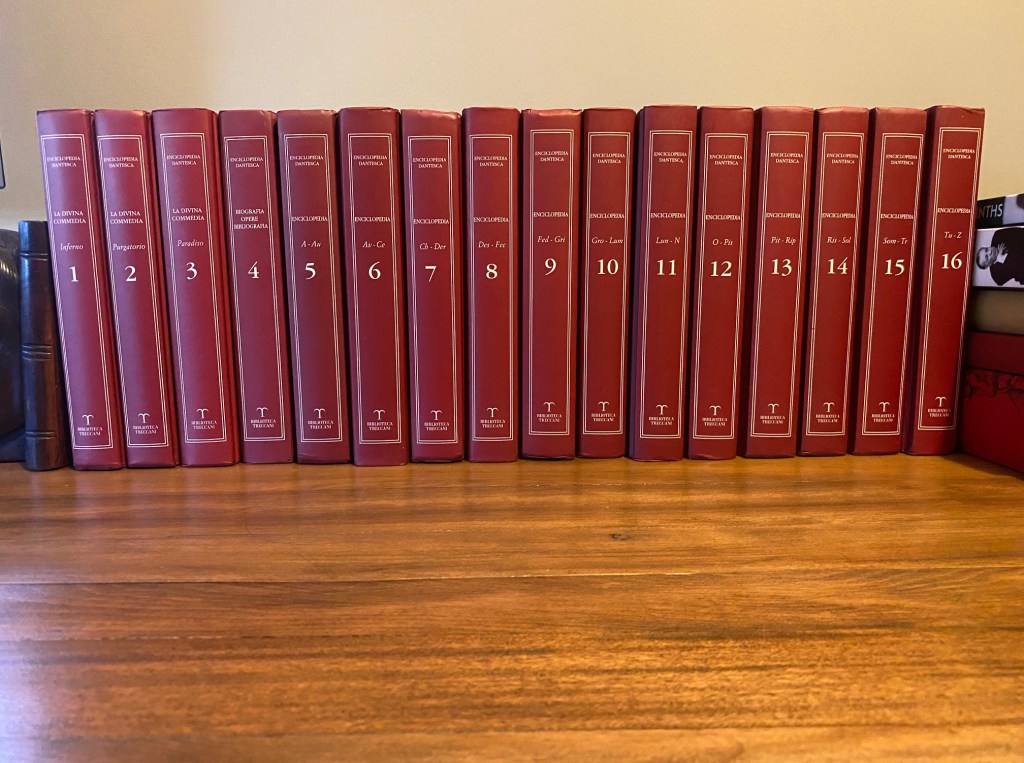
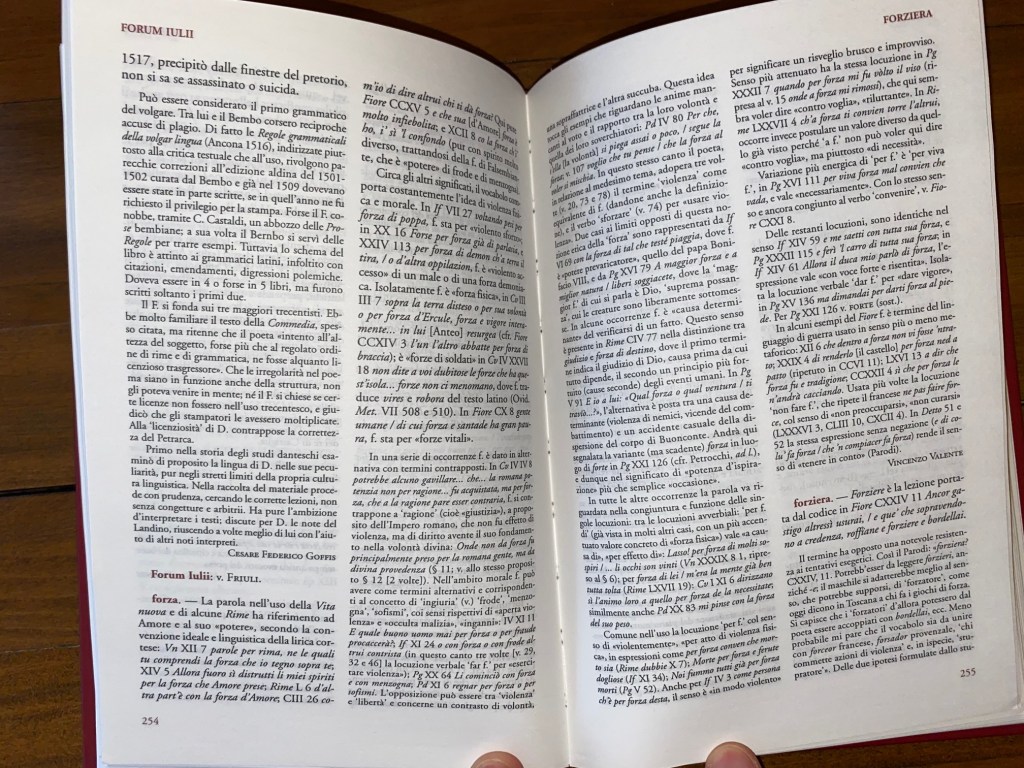
We all have dream books and this has long been one of mine. As I understand it, the notion of the current Enciclopedia Dantesca was born toward the end of the Second World War when the editor Umberto Bosco recognized the need for an update to the 1895 Enciclopedia Dantesca directed by Giovanni Andrea Scartazzini (digitized copies of which are available for view here). It took until 1965 – the 700th anniversary of Dante’s birth – for the project to gain enough interest to be put into production. Work then proceeded and between 1970 and 1977 six total volumes were published. These were revised and reprinted in 1984 (the revision seems mostly to have been an expanded bibliography), and that revision was itself reprinted in a limited run luxury edition in 1996 (which is the one I’ve had out from my library for 6? years). Then in 2005 the enciclopedia saw another revision, this time adding bibliography for 1985-2005 and at least retouching the biography (I don’t have the 1996 volume at hand to compare so I can’t be sure the extent). This latest printing, distributed across an impressive 16 volumes, is now in my personal library – though homeless until I shift about some other books. There is an online version here that includes everything but volumes 1-4 – the texts, commentary, biography, and bibliographies – but it’s not quite the same.

It harrows me with fear and wonder

A man can waste much time with an apparatus criticus and alternate readings. From Hamlet (1.1.39-43).

Enter Ghost
MARCELLUS
Peace, break thee off; look, where it comes again!
BERNARDO
In the same figure, like the king that’s dead.
MARCELLUS
Thou art a scholar; speak to it, Horatio.
BERNARDO
Looks it not like the king? mark it, Horatio.
HORATIO
Most like: it harrows me with fear and wonder.

Of the major texts, Folio has ‘harrows’, Quarto 2 ‘horrowes’, and Quarto 1 ‘horrors’. The Arden 3rd note reads:

Q2’s ‘horrowes’ is usually assumed to be an obsolete form of F’s ‘harrowes,’ a word which recurs in both texts at 1.5.16. The metaphor derives from the agricultural implement that breaks up the ground after ploughing, and OED records these as the earliest examples of the transferred use. OED also implies that there is no direct connection with ‘the harrowing of Hell’, where ‘harrow’ derives from ‘to harry’ (to raid or despoint), but, given the context of Shakespeare’s usages, there might have been a link in his mind.

The Oxord has:

harrows distresses, lacerates (OED 4). According to OED, this is the earliest use of the word in a figurative sense. Q2’s horrowes may be a varient spelling; but Q1’s horrors looks like an auditory error by the reporter.

A Synoptic Hamlet: a Critical-Synoptic Edition of the Second Quarto and First Folio Texts of Hamlet has:

horrows/ harrows Horrows: ‘horrifies’ (Andrews). Harrow: “To lacerate or wound the feelings of; to vex, pain, or distress greatly (OED 4). As Andrews suggests, in ‘horrows’ the meanings of ‘horror’ (cf. Q1’s ‘horrors’) and harrow may merge in a probable Shakesperean neologism. Cf. ‘This strikes our heart with horrowe & amazemt’ in the anonymous Jacobean play Tom a Lincoln (Proudfoot 1992: 51). In Pyle’s opinion (116), ‘horrowes’ “is simply a variant of harrows … spelling with o often occur in the 16th and 17th centuries where we should expect an a” ….. Jenkins give the examples in A Remedy of Sedition (1536), “They horrowe with spades.”

I could continue expanding references and commentary (and I wish I had the Andrews edition to add) but the short is that no one has any clear answer and everyone is willing to entertain a Shakespearean coinage – either by novel transference of meaning (using ‘harrow’ from the agricultural implement) or outright new verb formation. Accordingly, I make less an ass of myself in adding my own conjecture and connecting Q2’s ‘horrowes’ with Latin ‘horrere.’ Lewis and Short define here but I’ll cite the similar and possibly more relevant Dictionary of Medieval Latin from British Sources definition (with full usage illustrations in the link):

1 to bristle; b (fig.). c to stand up like spikes.
2 to shudder, shiver.
3 to be or become horrible, shocking, disgusting. 
4 to be or become horrified.

With that in mind, advance to Hamlet’s first encounter with the Ghost (1.4.55ish):

What may this mean,
That thou, dead corse, again in complete steel
Revisit’st thus the glimpses of the moon,
Making night hideous; and we fools of nature
So horridly to shake our disposition
With thoughts beyond the reaches of our souls?

The Arden editors gloss horridly thus:

horrendously (a stronger meaning than modern ‘horrid’, possibly with a glance at the literal meaning of Latin horridus, bristing or with hair standing on end: see 1.5.19-20).

Here I would add that the DMLBS entry for horridus includes the additional sense ‘causing horror, dreadful.’ And that, bearing in mind the etymological connection with horrere and the above ‘shudder, shiver’ sense of the word, one can posit a clear play in line 55’s ‘so horridly to shake.’

Now to the second half of Hamlet’s encounter with the Ghost:

But that I am forbid
To tell the secrets of my prison-house,
I could a tale unfold whose lightest word
Would harrow up thy soul, freeze thy young blood,
Make thy two eyes, like stars, start from their spheres,
Thy knotted and combined locks to part
And each particular hair to stand on end,
Like quills upon the fretful porpentine:


Here there is no issue with the textual history – harrow is the universal reading – so I would instead draw attention to the hair imagery, which we’ve seen above is latent in the first two appearances of the ghost and directly connects to the imagery of horrere.

My vanity’s proposal is twofold. First, the less defensible element, that the harrow of 1.5 contaminated the reading of horrowes in 1.1. The only reason for preferring harrow is deference to the OED – that it feels less bold to add a new sense to an existing word than create a new one altogether. Second, that the root senses of horrere at least lurk as background associations in all three appearances of the Ghost – most expressly in the first (by my reading ‘horrowes’), more subtly in the second (submerged in ‘horridly’ but activated by ‘shake’), and as a verbal echo harrow/horrow/horrere triggered by hair-standing imagery in the third. All accomplished by a man with little Latin.

And this is why I stick to extracts. Playful and pointless argumentation takes too long.

Stoop, Romans, stoop, and let us bathe our hands in Caesar’s blood

From Julius Caesar (3.1).

CASSIUS
Where is Antony?
TREBONIUS
Fled to his house amazed:
Men, wives and children stare, cry out and run
As it were doomsday.
BRUTUS
Fates, we will know your pleasures:
That we shall die, we know; ’tis but the time
And drawing days out, that men stand upon.
CASSIUS
Why, he that cuts off twenty years of life
Cuts off so many years of fearing death.
BRUTUS
Grant that, and then is death a benefit:
So are we Caesar’s friends, that have abridged
His time of fearing death. Stoop, Romans, stoop,
And let us bathe our hands in Caesar’s blood
Up to the elbows, and besmear our swords:
Then walk we forth, even to the market-place,
And, waving our red weapons o’er our heads,
Let’s all cry ‘Peace, freedom and liberty!’
CASSIUS
Stoop, then, and wash. How many ages hence
Shall this our lofty scene be acted over
In states unborn and accents yet unknown!
BRUTUS
How many times shall Caesar bleed in sport,
That now on Pompey’s basis lies along
No worthier than the dust!

I find this scene one of the most terrifying miniatures in all Shakespeare’s psychological portraiture. A single line pushes Brutus from a predictable – from the classical rhetoric perspective – over-reasoned justification (‘So are we Caesar’s friends, that have abridged / His time of fearing death’) to a surreal dissociative break (Stoop, Romans, stoop, / And let us bathe our hands in Caesar’s blood … waving our red weapons o’er our heads, / Let’s all cry ‘Peace, freedom and liberty!’). Cassius’ attempted realigning of the ‘lofty scene’ as future exemplar flops out as Brutus picks up the performative-iterative element only to ritualise the slaughter over the exemplar – “How many times shall Caesar bleed in sport.” Any possible value of the action is here submerged in the character’s inability to focus on anything but the blood. The bathing in blood is not in Plutarch or any other source.