Beowulf and Tolkien’s dragon-sickness

From an appendix to Tom Shippey’s Beowulf translation, an article entitled Tolkien and Beowulf – A Lifelong Involvement. It is singularly appropriate to Tolkien to bury substantive thoughts in an appendix.

… The first visible sign of [Tolkien’s] involvement with the poem indeed comes from 1923, when he published a poem in The Gryphon (a Lees University journal), with the title “Iumonna Gold Galdre Bewunden.” These four words form line 3052 of Beowulf, and Tolkien translated them later as “the gold of bygone men … wound about with spells.” Tolkien was not strictly accurate here, for galdre is singular, not plural. More interesting is the question, “what kind of spell was meant in Beowulf?”, and this had already caused scholars some uncertainty.

Tolkien was, however, different from other scholars, both earlier and later, in two respects. One is that while they considered issues like line 3052 as purely textual problems, Tolkien tried to probe deeper to find both mythical meanings and real-world meanings. The other is that he found solutions of this kind not only in the poem itself, but in the scholarship which had built up over many years, rarely if ever providing definite answers, but creating a range of possibilities.

Setting the line in context, it occurs late in the poem, and the gold is the hoard of the dragon, which Beowulf has just killed at the cost of his own life. But that is not what the line says: it says the gold is “the gold of bygone men,” and earlier on there has been a scene in which a man, usually described as “the Last Survivor” of a fallen people, commits his people’s gold to the earth, since he no longer has the power to guard it. How, then, did it pass to the dragon? And since the “spell ” was clearly put on the gold by the “bygone men,” what was it supposed to do? If it was meant to shield the gold from discovery, it didn’t work. So it must have been a curse, laid on whoever should take the gold. Did it work on the dragon? Did it work, or would it have worked, on Beowulf, who lived long enough only to see the gold? These are not scholarly questions, being purely speculative, but they are suggestive ones.
One further complication (unless it is in fact a clue) is that while it is very clear that the Last Survivor commits the treasure to the earth (line 2247), before wandering off in some way to die (2269-70), the dragon immediately comes upon it and finds it “standing open,” opene standan….

The thought struck scholars very quickly that perhaps (in some earlier version of the story), the disappearance of the Last Survivor and the appearance of the dragon had been one and the same thing: the Last Survivor became the dragon. Old Norse sagas contain hints of the idea that if a man “lay down on his gold,” lagdisk a gullit, in his own funeral barrow, then he would turn into a dragon. That would explain,; for one thing, why dragons are to be found in mounds or barrows, as declared firmly by another Anglo-Saxon poem, draca sceal on hlawe, “dragon must be in mound,” and also where their gold comes from: it has been buried with the dead man, or rather, the not-dead man.

What does the spell or curse do, then? This is the question Tolkien answered in his poem of 1923, an answer which remained consistent through several minor and major reworkings of the poem all the way to its appearance as “The Hoard” in The Adventures of Tom Bombadil in 1962. Briefly, just as the Last Survivor is the dragon;, so the curse is the hoard itself. What it does is destroy successive owners morally, and eventually physically, cursing them with avarice and blindness.

In the 1923 version – Tolkien tinkered with details for nearly forty years, without losing the main shape and point of the poem – the gold was originally elvish, until the fall of the elf-kingdoms. It then passed to “an old dwarf,” who became a miser, counting his hoard, and not noticing the dragon who found his cave. In turn the dragon became old and failed to hear the approach of a “fearless warrior,” who called him to come out and fight for the gold . And the warrior became “an old king,” brooding on his riches and neglecting his kingdom, until he too was displaced and killed. Now the hoard is lost, and will remain so till the elves return: if they do, for the 1923 version ends with the word “awake,” the 1962 one with the world “sleep.”

The “spell” which winds inextricably round the hoard is, then, what Tolkien in The Hobbit would call “the dragon-sickness.” At the end of the story this affects first Thorin, though “the power that gold has upon which a dragon has long brooded,” and then kills the Master of Laketown, who flees with the gold he has been given and (like the dwarf, dragon and king of the poem) dies miserably, in his case “of starvation in the Waste, deserted by his companions.” “Dragon-sickness,” then, began as an interpretation of a difficult line in Beowulf …
Fire upon the flood

A comparison of Beowulf translations – Seamus Heaney, Tolkien, Tom Shippey, and R.D. Fulk. The passage is one of my favorites, Hrothgar’s description of the approach to the home of Grendel and his mother (lines 1355-1379). The title is Tolkien’s take on the – to me – central atmospheric line of the passage – fyr on flode. You’ll notice that Heaney is the only one to avoid the easy alliteration there. I used to regret the choice but I’m no longer sure his isn’t as effective anyway.

Seamus Heaney:

…. They are fatherless creatures,
and their whole ancestry is hidden in a past
of demons and ghosts. They dwell apart
among wolves on the hills, on windswept crags
and treacherous keshes, where cold streams
pour down the mountain and disappear
under mist and moorland. A few miles from here
a frost-stiffened wood waits and keeps watch
above a mere; the overhanging bank
is a maze of tree-roots mirrored in its surface.
At night there, something uncanny happens:
the water burns. And the mere bottom
has never been sounded by the sons of men.
On its bank, the heather-stepper halts:
the hart in flight from pursuing hounds
will turn to face them with firm-set horns
and die in the wood rather than dive
beneath its surface. That is no good place.
When wind blows up and stormy weather
makes clouds scud and the skies weep,
out of its depths a dirty surge
is pitched towards the heavens. Now help depends
again on you and on you alone.
The gap of danger where the demon waits
is still unknown to you. Seek it if you dare.

Tolkien (lines 1132-1152 for his rendering):

… of a father they knew not, nor
whether any such was ever before begotten for him among
the demons of the dark. In a hidden land they dwell upon
highlands wolfhaunted, and windy cliffs, and the perilous
passes of the fens, where the mountain-stream goes down
beneath the shadows of the cliffs, a river beneath the earth. It
is not far hence in measurement of miles that that mere lies,
over which there hang rimy thickets, and a wood clinging
by its roots overshadows the water. There may each night
be seen a wonder grim, fire upon the flood. There lives not
of the children of men one so wise that he should know the
depth of it. Even though harried by the hounds the ranger of
the heath, the hart strong in his horns, may seek that wood
being hunted from afar, sooner will he yield his life and
breath upon the shore, than he will enter to hide his head
therein: no pleasant place is that! Thence doth the tumult
of the waves arise darkly to the clouds, when wind arouses
tempests foul, until the airs are murky and the heavens weep.
‘Now once more doth hope of help depend on thee alone.
The abode as yet thou knowest not nor the perilous place
where thou canst find that creature stained with sin. Seek it
if thou durst!

Tom Shippey:

… Whether he was begotten
by any father from the dark spirits,
they do not know. They dwell, the giant pair,
in the hidden country, wolf-haunted slopes,
windy nesses, dangerous fenland,
where the stream pours down under the dark cliffs
from the mountain, to sink underground.
The mere lies from here not far in miles.
Over it there hang frosty-bound groves,
fast-rooted woods overshadow the water
Every night you can see a dreadful sight there,
fire in the flood. No child of men
is so wise as to know what lies beneath.
Although the proud-horned stag, the heath-treader,
is pressed by hounds, hunted from afar,
and seeks shelter in the wood, he will on the shore
give up life and breath, before, to save his head,
he will plunge in. That is an uncanny place.
When the wind stirs up foul weather,
the tossing waves rise dark to the clouds,
until the air drizzles, the heavens weep.
Now the decision is up to you alone.
You do not know the land, the dangerous place
where you can find the sinful creature.
Seek if you dare!

R.D Fulk’s prose version:

they knew of no father, whether any mysterious creatures had been born before him. They inhabit hidden country, wolf-hills, windy crags, a dangerous passage through fen, where a cascading river passes down under the gloom of cliffs, a watercourse under the earth. It is not far in miles from here that the pool stands; over it hang frost-covered groves, firmly rooted woods overshadow the water. There every night a dire portent can be seen, fire on the flood. There lives no offspring of men so well informed that he knows the bottom. Even if a heath-roamer beset by hounds, a hart firm of antlers, makes for the forest, driven far in flight, it will sooner give up the ghost, its life on the bank, than enter and save its head; that is not a pleasant place. There the tossing waves mount up dark to the clouds when the wind stirs up ugly storms, until they choke the air and the heavens weep. Now the course of action is again dependent on you alone. You are not yet acquainted with the region, that dangerous place where you can find the one who is the offender; go look if you dare!

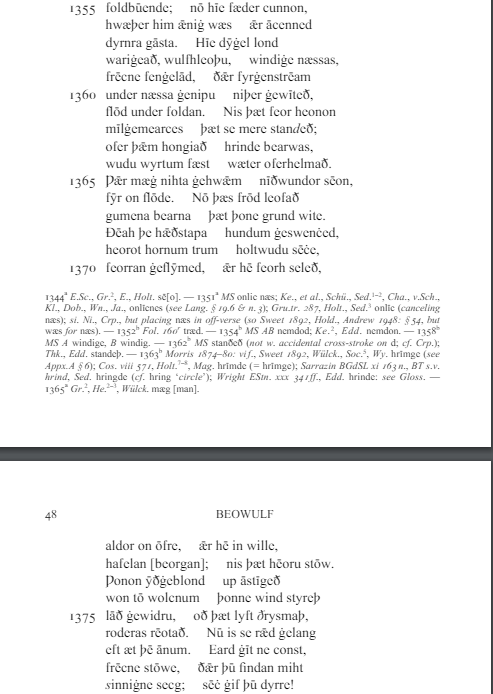
And the original from the standard Klaeber’s Beowulf (4th edition). Unsurprisingly WordPress doesn’t care for the unique Old English characters so a screenshot will have to suffice:

In off the moors, down through the mist-bands / God-cursed Grendel came greedily loping

In off the moors, down through the mist-bands
God-cursed Grendel came greedily loping.
The bane of the race of men roamed forth,
hunting for a prey in the high hall.
Under the cloud-murk he moved towards it
until it shone above him, a sheer keep
of fortified gold.

Seamus Heaney’s Beowulf – already the greatest translation of anything I’d have even the pretense of boldness to judge the quality of – is made even better by his doing a reading himself.

It’s missing here but I feel the version I first listened to years ago – BBC radio, I think – also included a quality conversation on the process of translation, specifically his creation of archaizing/exoticizing effects through inclusion of Irish regional vocabulary remembered from his youth.