From the Burton Raffel translation of Chretien de Troyes’ Lancelot, The Knight of the Cart, Lancelot’s crossing of the sword bridge. An edition of the original text can be found here (~lines 3000-3125 given here). I can’t find a good collection of images online but this article plus a quick google image search will point to how iconic the scene became – though to me some of the representations (like the one below) take an accidental Boschian aspect from the artist’s realization that all you really need is a knight on a large knife (compare from Hell in Earthly Delights and the center panel in the Bruges Last Judgment).
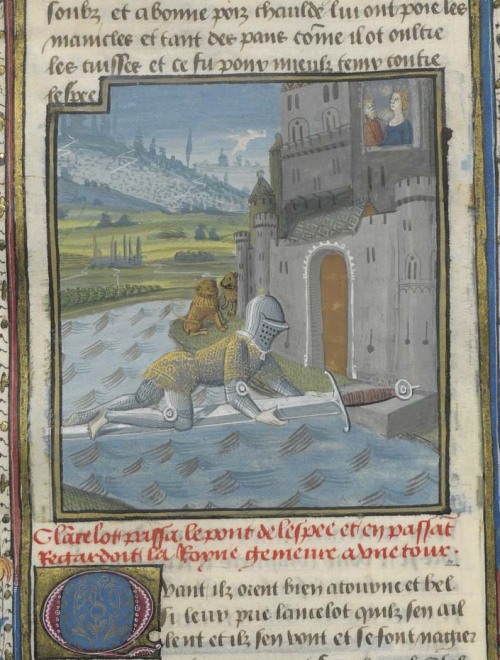
Following the most direct
Route, just as the light
Was fading, about nine
That night, they saw the Sword Bridge.
They stopped and dismounted at the foot
Of the terrifying structure, looking
Down at the treacherous water,
Black and boiling, swift
And harsh, as horribly evil
As if it flowed from the devil
Himself, deep and dangerous
Like nothing else in this world:
Whoever fell in would sink
Like a rock in the salty sea.
And the bridge that spanned it was just
As different from other bridges;
Believe me, nothing lie it
Had ever existed, or ever
Would, neither as huge
Or as wickedly built-a single
Gleaming sword-blade crossing
That ice-cold water, stiff
And strong, as wide as a pair
Of spears, and attached at either
End to massive tree-trunk
Stumps. No one would worry
About it bending or breaking:
It would clearly stand, no matter
What weight it was asked to bear.
But those who’d come with our knight
Were most concerned at seeing,
Or thinking they saw, a pair
Of lions, or perhaps they were leopards,
Chained to a boulder on the far
Side of the bridge. The water,
The bridge, and the two great beasts
Gave them such a shock
That from head to foot they trembled
With fear: “My lord, allow us
To advise you, seeing what we see,
For advice is what you need.
This bridge is wickedly built,
Evilly put together.
Change your mind nowOr else you’ll lose the chance.
A man must think both long
And hard before he acts.
Suppose you get acrossBut it isn’t going to happen:
No one can hold back the wind
And stop it from blowing, or forbid
Birds to open their beaks
And sing, and keep them silent,
Or climb into a mother’s
Womb and be born again:
All these things are just as
Impossible as draining the sea.
How can you expect
Those furious lions, chained up
Over there, not
To kill you, and drink the blood
From your veins, and swallow your flesh,
And finish by gnawing your bones?
My nerves are strong, but I
Can barely allow my eyes
To see them. If you’re not careful,
They’ll surely kill you, I know it,
They’ll rip you right apart
And tear off your arms and legs.
Expect no mercy: they have none.
So take pity on yourself.
Stay here with us! Don’t
Commit so grave a sin
Against yourself, aware
Of mortal risk, yet seeking it
Out.” He replied, laughing,
“Gentlemen, I’m deeply grateful
That you care so much for my welfare:
You’re good and generous friends.
I know quite well you wish me
To come to no harm. But my faith
In God, my trust in Him,
Compels me to believe Hell protect me.
Neither bridge nor water
Nor this harsh world can worry
Me. I intend to cross,
Whatever the risk. I’d rather
Die than turn and go back!”
There was nothing more to be said,
But pity and sorrow wrung them
Both with bitter tears.
And our knight made ready, as best
He could, to cross the gulf,
Preparing, in the strangest way,
By removing the armor from his hands
And feet, as if making sure
He could not arrive uninjured!
Then he held tight to the sword-blade
Bridge, as sharp as a razor,
Hands and feet both bare
For he’d left himself no covering,
Neither shoes nor stockings
Not fearing sharp edges slicing
Away at his flesh, much
Preferring bloody wounds
To falling into that icy
Water from which he would never
Emerge. Accepting the immense
Pain and suffering, he crossed,
Hands and knees and feet
Bleeding. But Love, who had led him
There, helped him as he went,
And turned his pain to pleasure.
When he came to the other side
None of his wounds were hurting.
And then he recalled the pair
Of lions he’d seen, or thought
He’d seen, before he crossed,
But looking here and there
All he could see was a lizard,
And nothing there that could harm him
Raising his hand to his face
He stared at his ring, and knew
At once the pair of lions
Were imagined, and nowhere in sight,
But conjured out of magic.
 Extracts

