Et j’ai deux fois vainqueur traversé l’Achéron

Spiralling associative chains, beginning with the Sybil to Aeneas (6.135):

Quod si tantus amor menti, si tanta cupido est,
bis Stygios innare lacus, bis nigra videre
Tartara, et insano iuvat indulgere labori,
accipe, quae peragenda prius.

In Ahl’s Oxford Classics:

Yet, if there’s love so strong in your mind, so mighty a passion
Twice to float over the Stygian lakes, twice gaze upon deep black
Tartarus, if it’s your pleasure to wanton in labours of madness,
Grasp what you must do first.

And moving to Gerard de Nerval’s El Desdichado:

Je suis le ténébreux,- le Veuf, – l’inconsolé,
Le Prince d’Aquitaine à la tour abolie:
Ma seule étoile est morte, et mon luth constellé
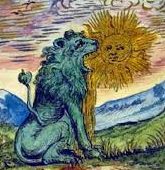
Porte le soleil noir de la Mélancolie.

Dans la nuit du Tombeau, Toi qui m’as consolé,
Rends-moi le Pausilippe et la mer d’Italie,
La fleur qui plaisait tant à mon coeur désolé,
Et la treille où le Pampre à la rose s’allie.

Suis-je Amour ou Phoebus ?…. Lusignan ou Biron ?
Mon front est rouge encor du baiser de la Reine ;
J’ai rêvé dans la grotte où nage la Sirène…

Et j’ai deux fois vainqueur traversé l’Achéron :
Modulant tour à tour sur la lyre d’Orphée
Les soupirs de la Sainte et les cris de la Fée.

And in the Penguin Selected Writings translation by Richard Sieburth:

I am the man of gloom – the widower – the unconsoled, the prince of Aquitaine, his tower in ruins: My sole star is dead – and my constellated lute bears the Black Sun of Melancholia.

In the night of the tomb, you who consoled me, give me back Posilipo and the Italian sea, the flower that so pleased my desolate heart, and the arbour where the vine and the rose are entwined.

Am I Amor or Phoebus? … Lusignan or Biron? My brow still burns from the kiss of the queen; I have dreamed in the grotto where the siren swims …

And I have twice victorious crossed the Acheron: Modulating on Orpheus’ lyre now the sighs of the saint, now the fairy’s cry.

And back to the beginning, a Homeric hapax from Odyssey 12.21, Circe to Odysseus:

σχέτλιοι, οἳ ζώοντες ὑπήλθετε δῶμ᾽ Ἀίδαο,
δισθανέες, ὅτε τ᾽ ἄλλοι ἅπαξ θνῄσκουσ᾽ ἄνθρωποι.

Unwearying, you who alive go down to the house of Hades,
twice-dying, when other men die once.

Closing with an unrelated echo from Dante, Inferno 24 4. Which commentaries tell me is also a hapax suggested by Jude’s (12) ‘arbores…. bis mortuae’ (trees twice dead).

e l’ombre, che parean cose rimorte,
per le fosse de li occhi ammirazione
traean di me, di mio vivere accorte.

And the Longfellow translation:

And shadows, that appeared things doubly dead,
From out the sepulchres of their eyes betrayed
Wonder at me, aware that I was living.
Un dì si venne a me Malinconia

Sonnet 41 (or LXXII) of Dante, first in the Foster and Boyde Oxford edition of Dante’s Lyric Poetry

One day Melancholy came to me and said: ‘I want to
stay with you awhile’; and it seemed to me she brought
Sorrow and Wrath with her as companions. And I said:
‘Be off! Away with you!’ But she answered like a Greek:
and while she continued speaking with me, perfectly at her
ease, I looked and saw Love drawing near, dressed in
a new black cloak, with a hat on his head, and weeping
real tears. And I said to him: ‘What’s the matter, poor
fellow?’ And he replied: ‘I’m troubled and sad, for our
lady is dying, dear brother.’

And Richard Lansing in the more recent University of Toronto Dante’s Lyric Poetry:

Once Melancholy came to me and said
“I plan to stay with you a little while”;
and it appeared to me she’d brought along
both Sorrow and Distress for company.
I said to her, “Away with you, be gone!”
But like a Greek she answered haughtily
and while she spoke to me with perfect ease,
I looked and saw the Love was drawing near,
attired in brand-new clothing that was black,
and wearing on his head a hat as well,
and he was truly weeping real tears.
I said to him: “What troubles you, poor man?”
And he replied: “I mourn and feel deep pain
because our lady, brother, lies near death.”

And now the Italian – the Societa Dantesca Italiana text:

Un dì si venne a me Malinconia
e disse: “Io voglio un poco stare teco”;
e parve a me ch’ella menasse seco
Dolore e Ira per sua compagnia.

E io le dissi: “Partiti, va via”;
ed ella mi rispose come un greco:
e ragionando a grande agio meco,
guardai e vidi Amore, che venia

vestito di novo d’un drappo nero,
e nel suo capo portava un cappello;
e certo lacrimava pur di vero.

Ed eo li dissi: “Che hai, cattivello?”.
Ed el rispose: “Eo ho guai e pensero,
ché nostra donna mor, dolce fratello”.

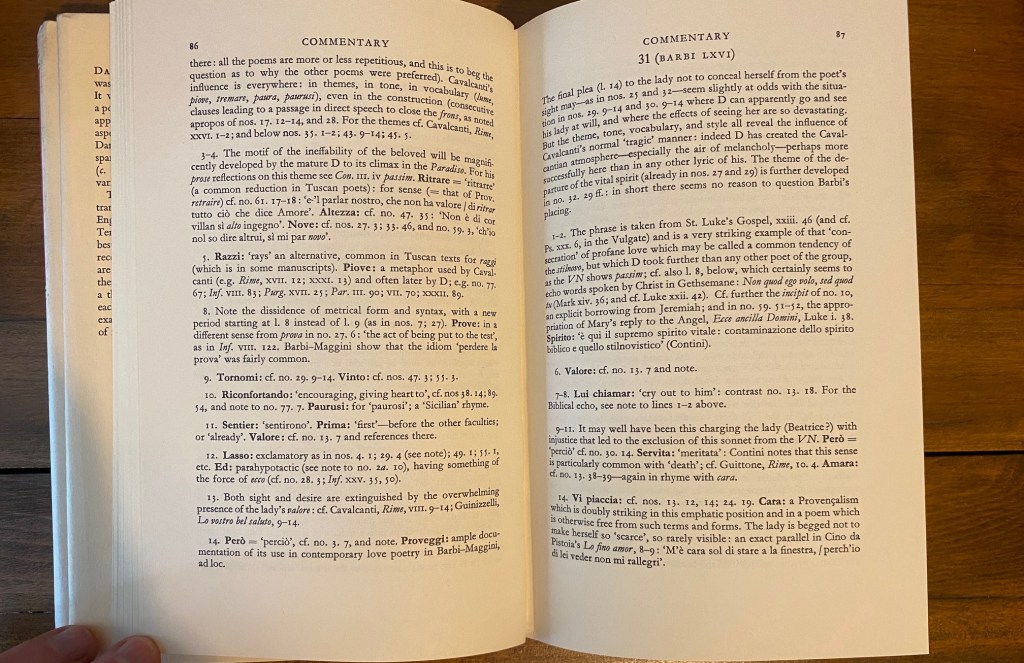
Pitiless memory, ever gazing back at the time that is past

The opening lines of Dante’s Rime L, text and translation from my (new) Foster and Boyde edition. The full work can be found here (Italian only).


La dispietata mente, che pur mira
di retro al tempo che se n’è andato,
da l’un dei lati mi combatte il core;
e ’l disio amoroso, che mi tira
ver lo dolce paese c’ho lasciato,
d’altra part’è con la forza d’Amore;

Pitiless memory, ever gazing back at the time that is past, assails my heart on the one side; on the other, with the power of Love, is the love-longing that draws me towards the dear place where I have left.

I have fantasized a magical work, a panel that is also a microcosm: Dante’s poem is that panel whose edges enclose the universe.

From the prologue to Nine Dantesque Essays in Borges’ Selected Non-Fictions:

Imagine, in an Oriental library, a panel painted many centuries ago. It may be Arabic, and we are told that all the legends of The Thousand and One Nights are represented on its surface; it may be Chinese, and we learn that it illustrates a novel that has hundreds or thousands of characters. In the tumult of its forms, one shape-a tree like an inverted cone; a group of mosques, vermilion in color, against an iron wall-catches our attention, and from there we move on to others. The day declines, the light is wearing thin, and as we go deeper into the carved surface we understand that there is nothing on earth that is not there. What was, is, and shall be, the history of past and future, the things I have had and those I will have, all of it awaits us somewhere in this serene labyrinth …. I have fantasized a magical work, a panel that is also a microcosm: Dante’s poem is that panel whose edges enclose the universe. Yet I believe that if we were able to read it in innocence (but that happiness is barred to us), its universality would not be the first thing we would notice, and still less its grandiose sublimity. We would, I believe, notice other, less overwhelming and far more delightful characteristics much sooner, perhaps first of all the one singled out by the British Danteans: the varied and felicitous invention of precise traits. In describing a man intertwined with a serpent, it is not enough for Dante to say that the man is being transformed into a serpent and the serpent into a man; he compares this mutual metamorphosis to a flame devouring a page, preceded by a reddish strip where whiteness dies but that is not yet black (Inferno XXV, 64). It is not enough for him to say that in the darkness of the seventh circle the damned must squint to see him; he compares them to men gazing at each other beneath a dim moon or to an old tailor threading a needle (Inferno XV, 19). It is not enough for him to say that the water in the depths of the universe has frozen; he adds that it looks like glass, not water (Inferno XXXII, 24) …. Such comparisons were in Macaulay’s mind when he declared, in opposition to Cary, that Milton’s “vague sublimity” and “magnificent generalities” moved him less than Dante’s specifics. Later, Ruskin (Modern Painters IV, XIV) also condemned Milton’s fog and uncertainty and approved of the strictly accurate topography by which Dante engineered his infernal plane. It is common knowledge that poets proceed by hyperbole: for Petrarch or for Gongora, every woman’s hair is gold and all water is crystal. This crude, mechanical alphabet of symbols corrupts the rigor of words and appears to arise from the indifference of an imperfect observation. Dante forbids himself this error; not one word in his book is unjustified.
The precision I have just noted is not a rhetorical artifice but an affirmation of the integrity, the plenitude, with which each incident of the poem has been imagined. The same may be said of the psychological traits which are at once so admirable and so modest. The poem is interwoven with such traits, of which I will cite a few. The souls destined for hell weep and blaspheme against God; then, when they step onto Charon’s bark, their fear changes to desire and an intolerable eagerness (Inferno III, 124). Dante hears from Virgil’s own lips that Virgil will never enter heaven; immediately he calls him “master” and “sir,” perhaps to show that this confession does not lessen his affection, perhaps because, knowing Virgil to be lost, he loves him all the more (Inferno IV, 39). In the black hurricane of the second circle, Dante wishes to learn the root of Paolo and Francesca’s love; Francesca tells him that the two loved each other without knowing it, “soli eravamo e sanza alcun sospetto” [we were alone, suspecting nothing] , and that their love was revealed to them by a casual reading. Virgil rails against proud spirits who aspire to encompass infinite divinity with mere reason; suddenly he bows his head and is silent, because one of those unfortunates is he (Purgatorio III, 34). On the rugged slope of Purgatory, the shade of Sordello the Mantuan inquires of Virgil’s shade as to its homeland; Virgil says Mantua; Sordello interrupts and embraces him (Purgatorio VI, 58). The novels of our own day follow mental processes with extravagant verbosity; Dante allows them to glimmer in an intention or a gesture.

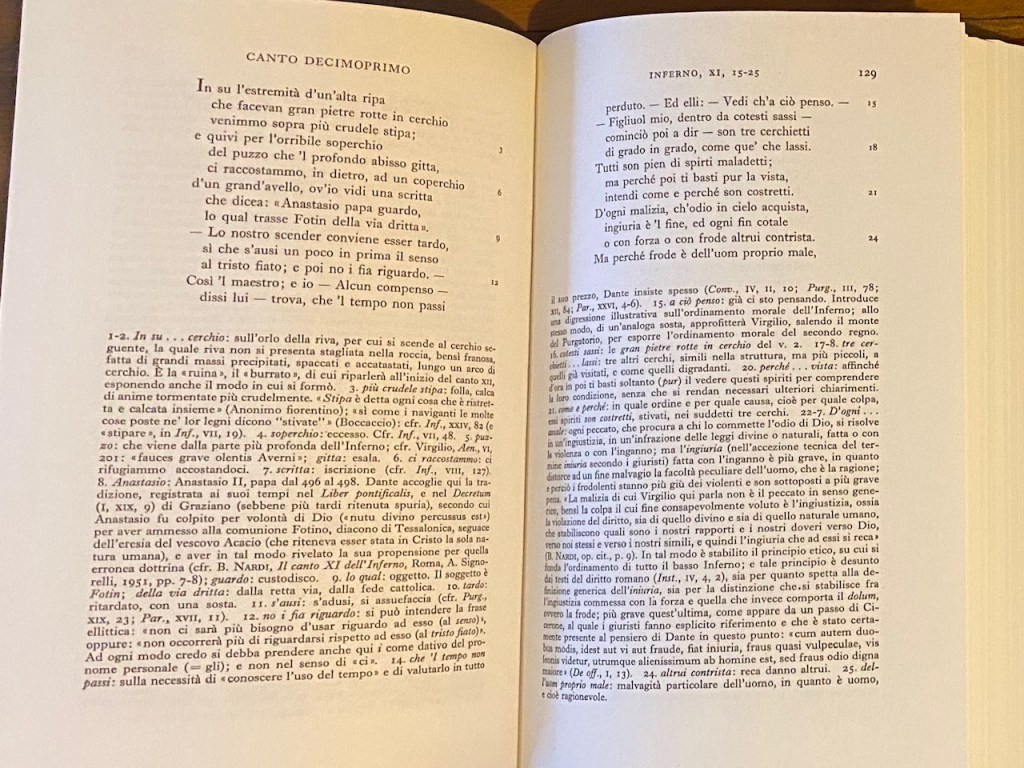
Ex Libris #3 – Enciclopedia Dantesca

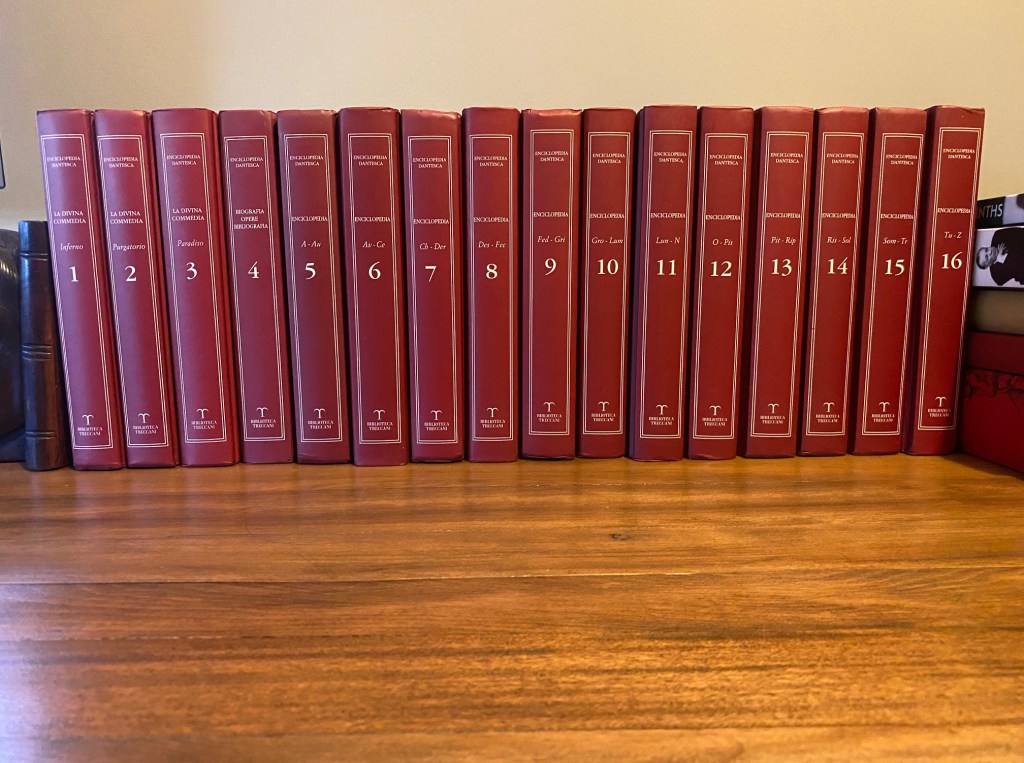
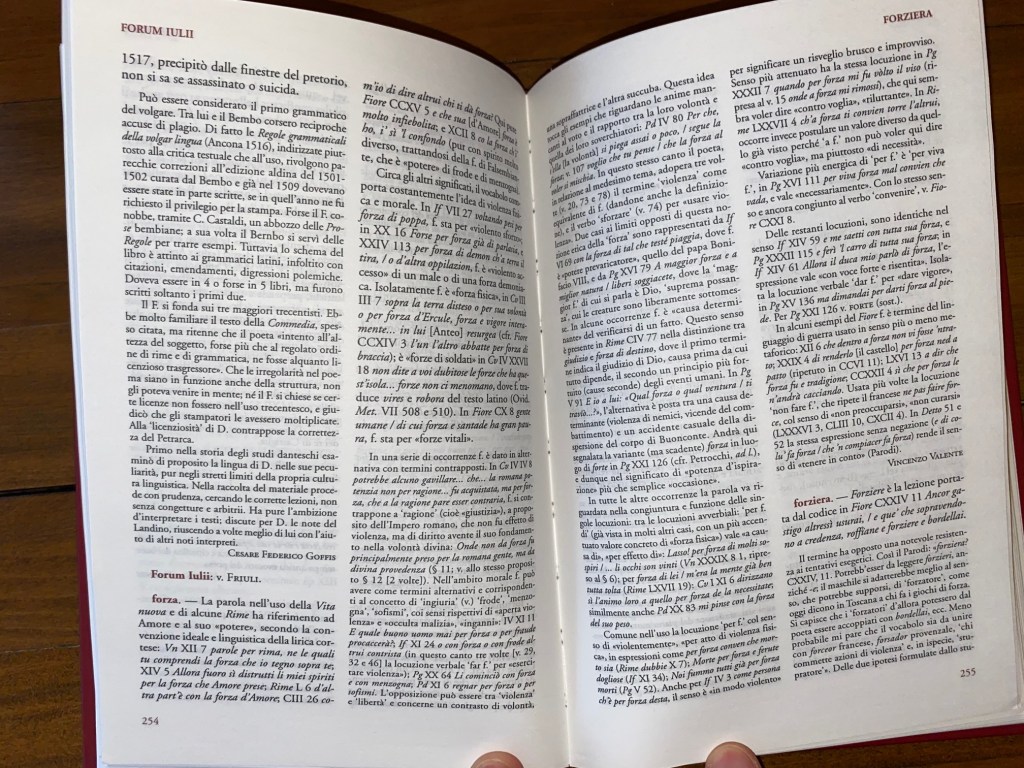
We all have dream books and this has long been one of mine. As I understand it, the notion of the current Enciclopedia Dantesca was born toward the end of the Second World War when the editor Umberto Bosco recognized the need for an update to the 1895 Enciclopedia Dantesca directed by Giovanni Andrea Scartazzini (digitized copies of which are available for view here). It took until 1965 – the 700th anniversary of Dante’s birth – for the project to gain enough interest to be put into production. Work then proceeded and between 1970 and 1977 six total volumes were published. These were revised and reprinted in 1984 (the revision seems mostly to have been an expanded bibliography), and that revision was itself reprinted in a limited run luxury edition in 1996 (which is the one I’ve had out from my library for 6? years). Then in 2005 the enciclopedia saw another revision, this time adding bibliography for 1985-2005 and at least retouching the biography (I don’t have the 1996 volume at hand to compare so I can’t be sure the extent). This latest printing, distributed across an impressive 16 volumes, is now in my personal library – though homeless until I shift about some other books. There is an online version here that includes everything but volumes 1-4 – the texts, commentary, biography, and bibliographies – but it’s not quite the same.

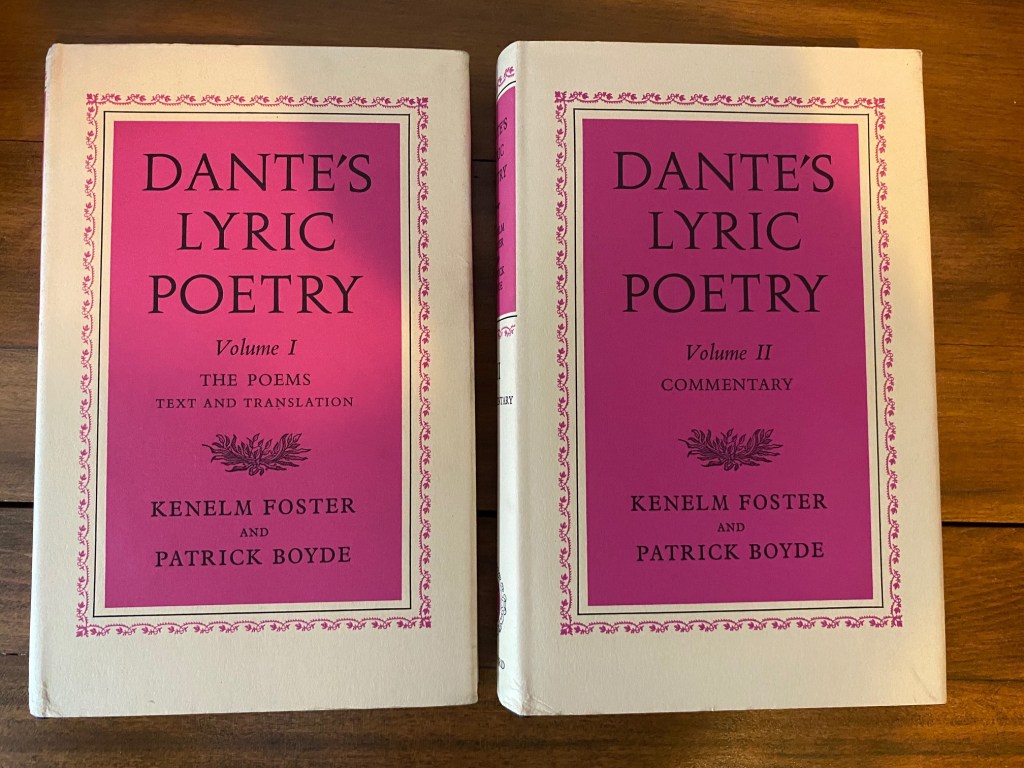
Ex Libris #2 – Dante’s Lyric Poetry

Dante’s lyrics – his Rime – haven’t received much attention in English. Although there is a wonderful recent treatment with overview essays and some commentary – the 2014 Dante’s Lyric Poetry: Poems of Youth and of the ‘Vita Nuova’ in the Univ. of Toronto Lorenzo Da Ponte Italian Library – the fullest edition remains the Foster and Boyde Dante’s Lyric Poetry first printed in 1967 and reprinted five years later. This set is now very scarce – doubly so if you don’t want ex-library copies – and almost invariably ugly in price. But I recently tripped into a bargain of a near new copy so once again I add to the lumber room.

Per altra via, che fu sì aspra e forte, che lo salire omai ne parrà gioco

Purgatory 2 60ish forward, English from Longfellow.

Da poppa stava il celestial nocchiero,
tal che faria beato pur descripto;
e più di cento spirti entro sediero.
“In exitu Isräel de Aegypto”
cantavan tutti insieme ad una voce
con quanto di quel salmo è poscia scripto.
Poi fece il segno lor di santa croce;
ond’ ei si gittar tutti in su la piaggia:
ed el sen gì, come venne, veloce.
La turba che rimase lì, selvaggia
parea del loco, rimirando intorno
come colui che nove cose assaggia.
Da tutte parti saettava il giorno
lo sol, ch’avea con le saette conte
di mezzo ‘l ciel cacciato Capricorno,
quando la nova gente alzò la fronte
ver’ noi, dicendo a noi: “Se voi sapete,
mostratene la via di gire al monte.”
E Virgilio rispuose: “Voi credete
forse che siamo esperti d’esto loco;
ma noi siam peregrin come voi siete.
Dianzi venimmo, innanzi a voi un poco,
per altra via, che fu sì aspra e forte,
che lo salire omai ne parrà gioco.”

Upon the stern stood the Celestial Pilot;
Beatitude seemed written in his face,
And more than a hundred spirits sat within.
“In exitu Israel de Aegypto!”
They chanted all together in one voice,
With whatso in that psalm is after written.
Then made he sign of holy rood upon them,
Whereat all cast themselves upon the shore,
And he departed swiftly as he came.
The throng which still remained there unfamiliar
Seemed with the place, all round about them gazing,
As one who in new matters makes essay.
On every side was darting forth the day.
The sun, who had with his resplendent shafts
From the mid-heaven chased forth the Capricorn,
When the new people lifted up their faces
Towards us, saying to us: “If ye know,
Show us the way to go unto the mountain.”
And answer made Virgilius: “Ye believe
Perchance that we have knowledge of this place,
But we are strangers even as yourselves.
Just now we came, a little while before you,
Another way, which was so rough and steep,
That mounting will henceforth seem sport to us.”


Io voglio un poco stare teco

A sonnet of Dante’s

Un di si venne a me Malinconia
e disse: ‘‘Io voglio un poco stare teco’’;
e parve a me ch’ella menasse seco
Dolore e Ira per sua compagnia.
E io le dissi: ‘‘Partiti, va via’’;
ed ella mi rispose come un greco:
e ragionando a grande agio meco,
guardai e vidi Amore, che venia
vestito di novo d’un drappo nero,
e nel suo capo portava un cappello;
E certo lacrimava pur di vero.
Ed io le dissi: ‘‘Che hai, cativello?’’.
Ed el rispose: Io ho guai e pensero,
che´ nostra donna mor, dolce fratello.’’


One day Melancholy came to me
and said: ‘‘I want to stay with you for a while’’;
and it seemed to me that she was bringing along
Pain and Sorrow as her companions.
And I said to her: ‘‘Move along, hence’’;
and she answered to me proudly:
and while she was reasoning with me at great leisure,
I looked and saw Love, who came
strangely dressed in a black cloth,
and he was wearing a hat on his head;
and for sure he truly wept.
And I said to him: ‘‘What ails you, unfortunate?’’
And he answered: ‘‘I am in trouble and pain,
because our lady is dying, sweet brother.’’