Forse tu non pensavi ch’io löico fossi!

From Inferno Canto 27.112-129 – the conclusion of Guido da Montefeltro’s story

Francesco venne poi com’ io fu’ morto,
per me; ma un d’i neri cherubini
li disse: “Non portar: non mi far torto.

Venir se ne dee giù tra ’ miei meschini
perché diede ’l consiglio frodolente,
dal quale in qua stato li sono a’ crini;

ch’assolver non si può chi non si pente,
né pentere e volere insieme puossi
per la contradizion che nol consente”.

Oh me dolente! come mi riscossi
quando mi prese dicendomi: “Forse
tu non pensavi ch’io löico fossi!”.

A Minòs mi portò; e quelli attorse
otto volte la coda al dosso duro;
e poi che per gran rabbia la si morse,

disse: “Questi è d’i rei del foco furo”;
per ch’io là dove vedi son perduto,
e sì vestito, andando, mi rancuro».
Francis came afterward, when I was dead,
For me; but one of the black Cherubim
Said to him: ‘ Take him not; do me no wrong;


He must come down among my servitors,
Because he gave the fraudulent advice
From which time forth I have been at his hair;

For who repents not cannot be absolved,
Nor can one both repent and will at once,
Because of the contradiction which consents not.

O miserable me ! how I did shudder
When he seized on me, saying: ‘ Peradventure
Thou didst not think that I was a logician ! ‘

He bore me unto Minos, who entwined
Eight times his tail about his stubborn back,
And after he had bitten it in great rage,

Said: ‘ Of the thievish fire a culprit this ;’
Wherefore, here where thou seest, am I lost,
And vested thus in going I bemoan me.”


S’eo mordo ‘l grasso, tu ne sugi ‘l lardo

Cecco Angiolieri, Sonnet CII, addressed to Dante:

Dante Alighier, s’i’ so bon begolardo,
tu mi tien’ bene la lancia a le reni,
s’eo desno con altrui, e tu vi ceni;
s’eo mordo ‘l grasso, tu ne sugi ‘l lardo;
s’eo cimo ‘l panno, e tu vi freghi ‘l cardo:
s’eo so discorso, e tu poco raffreni;
s’eo gentileggio, e tu misser t’avveni;
s’eo so fatto romano, e tu lombardo.

Sì che, laudato Deo, rimproverare
poco pò l’uno l’altro di noi due:
sventura o poco senno cel fa fare.
E se di questo vòi dicere piùe,
Dante Alighier, i’ t’averò a stancare;
ch’eo so lo pungiglion, e tu se’ ‘l bue.


Dante, if I’m a garrulous fool, I swear
You run a tilt against me quite as hard;
If I dine out with friends, you supper there,
And if I chew the fat, you suck the lard.
I shear the cloth, the nap is yours to raise;
And if I go too far, you’re much too free;
If I have noble, you have learned ways;
If I’m for Rome, well, you’re for Lombardy.
Then, thank the Lord, there’s little to be said
By one against the other as things stand:
From want of wit or luck we take our knocks.
And if you’ve more to say upon this head,
Dante, I’ll wear you down; just understand;
That I’m the gadfly now and you’re the ox.

The higher one goes the less it wearies.

Purgatorio Canto IV 88-96, Virgil to Dante pilgrim on their coming path.  The translation is Singleton’s – which one day I will spend hours here justifying against the verse versions more generally in favor but for now I leave it to a half oblique Tristram Shandy quote – “Now this I like;—when we cannot get at the very thing we wish—never to take up with the next best in degree to it:—no; that’s pitiful beyond description”

And he to me, “This mountain is such that ever at the beginning below it is toilsome, but the higher one goes the less it wearies.  Therefore, when it shall seem to you so pleasant that the going up is a s easy for you as going downstream in a boat, then will you be at the end of this path: hope there to rest your weariness; no more I answer, and this I know for true.

Ed elli a me: «Questa montagna è tale,
che sempre al cominciar di sotto è grave;
e quant’ om più va sù, e men fa male.

Però, quand’ ella ti parrà soave
tanto, che sù andar ti fia leggero
com’ a seconda giù andar per nave,

allor sarai al fin d’esto sentiero;
quivi di riposar l’affanno aspetta.
Più non rispondo, e questo so per vero».

William Blake in Purgatory

Two illustrations from William Blake’s series on the Divine Comedy, both from Canto 9 (76-114) of Purgatory.  I’ve had prints of both on my walls for years – though I just now realize they are less than appropriately mounted over my bar – but thanks to Taschen’s beautiful edition of this series I’m finally able to have everything at hand as visual accompaniment to reading.  If only someone would do the same for the Dali series.
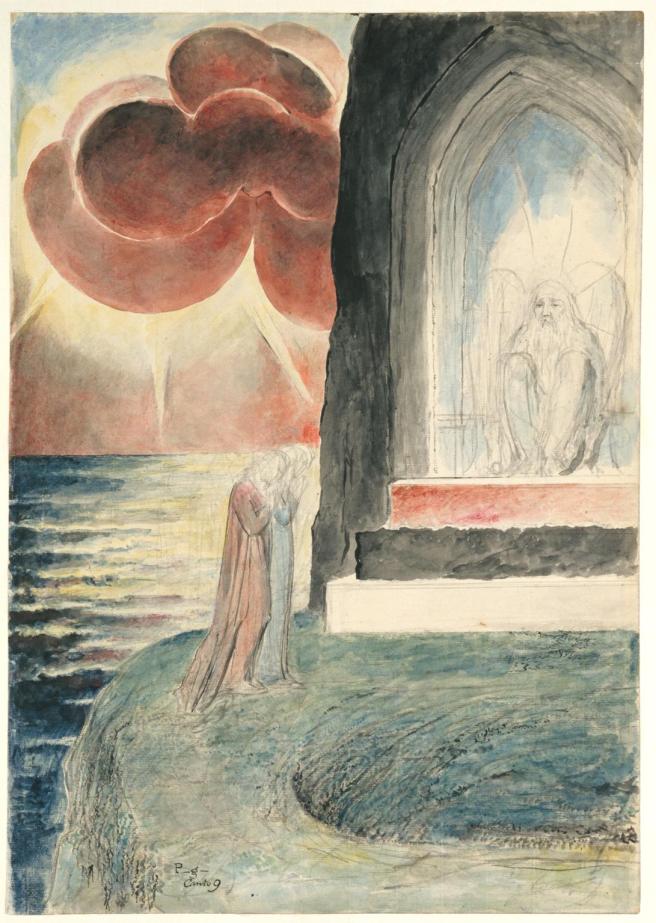
Dante and Virgil Approaching the Angel Who Guards the Entrance of Purgatory 1824-7 by William Blake 1757-1827I now made out a gate and, there below it,
three steps—their colors different—leading to it,
and a custodian who had not yet spoken.

As I looked more and more directly at him,
I saw him seated on the upper step—
his face so radiant, I could not bear it;

and in his hand he held a naked sword,
which so reflected rays toward us that I,
time and again, tried to sustain that sight

in vain. “Speak out from there; what are you seeking?”
so he began to speak. “Where is your escort?
Take care lest you be harmed by climbing here.”

My master answered him: “But just before,
a lady came from Heaven and, familiar
with these things, told us: ‘That’s the gate; go there.’”

“And may she speed you on your path of goodness!”
the gracious guardian of the gate began
again. “Come forward, therefore, to our stairs.”

There we approached, and the first step was white
marble, so polished and so clear that I
was mirrored there as I appear in life.

The second step, made out of crumbling rock,
rough—textured, scorched, with cracks that ran across
its length and width, was darker than deep purple.

The third, resting above more massively,
appeared to me to be of porphyry,
as flaming red as blood that spurts from veins.

And on this upper step, God’s angel—seated
upon the threshold, which appeared to me
to be of adamant—kept his feet planted.
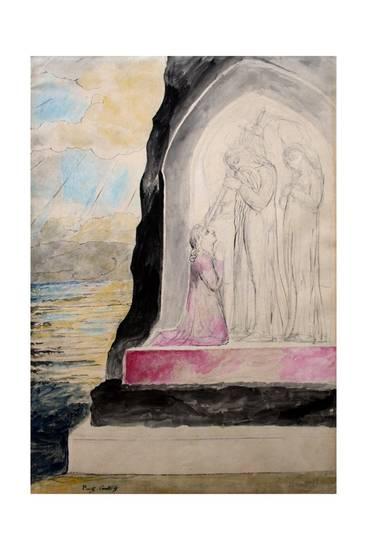
purgatory92

My guide, with much good will, had me ascend
by way of these three steps, enjoining me:
“Do ask him humbly to unbolt the gate.”

I threw myself devoutly at his holy
feet, asking him to open out of mercy;
but first I beat three times upon my breast.

Upon my forehead, he traced seven P’s
with his sword’s point and said: “When you have entered
within, take care to wash away these wounds.”

For the few di color che sanno:

vidi una porta, e tre gradi di sotto
per gire ad essa, di color diversi,
e un portier ch’ancor non facea motto.

E come l’occhio più e più v’apersi,
vidil seder sovra ’l grado sovrano,
tal ne la faccia ch’io non lo soffersi;

e una spada nuda avëa in mano,
che reflettëa i raggi sì ver’ noi,
ch’io drizzava spesso il viso in vano.

«Dite costinci: che volete voi?»,
cominciò elli a dire, «ov’ è la scorta?
Guardate che ’l venir sù non vi nòi».

«Donna del ciel, di queste cose accorta»,
rispuose ’l mio maestro a lui, «pur dianzi
ne disse: “Andate là: quivi è la porta”».

«Ed ella i passi vostri in bene avanzi»,
ricominciò il cortese portinaio:
«Venite dunque a’ nostri gradi innanzi».

Là ne venimmo; e lo scaglion primaio
bianco marmo era sì pulito e terso,
ch’io mi specchiai in esso qual io paio.

Era il secondo tinto più che perso,
d’una petrina ruvida e arsiccia,
crepata per lo lungo e per traverso.

Lo terzo, che di sopra s’ammassiccia,
porfido mi parea, sì fiammeggiante
come sangue che fuor di vena spiccia.

Sovra questo tenëa ambo le piante
l’angel di Dio, sedendo in su la soglia
che mi sembiava pietra di diamante.

Per li tre gradi sù di buona voglia
mi trasse il duca mio, dicendo: «Chiedi
umilemente che ’l serrame scioglia».

Divoto mi gittai a’ santi piedi;
misericordia chiesi e ch’el m’aprisse,
ma tre volte nel petto pria mi diedi.

Sette P ne la fronte mi descrisse
col punton de la spada, e «Fa che lavi,
quando se’ dentro, queste piaghe» disse.

Why do you hoard? Why do you squander?

From Inferno Canto 7 (19-35), on the avaricious and the prodigal.  I enjoy the Inferno least of the Commedia sections but I love this scene as – at least by my slightly warped application – a favorite image of head-pounding communication failure.  When I watch people in meetings exchange the same arguments on loop I chant to myself Perché tieni?” e “Perché burli? The text and translation are Singleton’s.

Ah, justice of God! who crams together so many new travails and penalties as I saw? And why does our guilt so waste us? As does the wave, there over Charybdis, breaking itself against the wave it meets, so must the folk here dance their round. Here I saw far more people than elsewhere, both on the one side and on the other, howling loudly, rolling weights, which they pushed with their chests; they clashed together, and then right there each wheeled round, rolling back his weight, shouting, “Why do you hoard?” and “Why do you squander?” Thus they returned along the gloomy circle on either hand to the opposite point, shouting at each other again their reproachful refrain; then, having reached that point, each turned back through his half-circle to the next joust.

Ahi giustizia di Dio! tante chi stipa
nove travaglie e pene quant’ io viddi?
e perché nostra colpa sì ne scipa?

Come fa l’onda là sovra Cariddi,
che si frange con quella in cui s’intoppa,
così convien che qui la gente riddi.

Qui vid’ i’ gente più ch’altrove troppa,
e d’una parte e d’altra, con grand’ urli,
voltando pesi per forza di poppa.

Percotëansi ‘ncontro; e poscia pur lì
si rivolgea ciascun, voltando a retro,
gridando: “Perché tieni?” e “Perché burli?”

Così tornavan per lo cerchio tetro
da ogne mano a l’opposito punto,
gridandosi anche loro ontoso metro;

poi si volgea ciascun, quand’ era giunto,
per lo suo mezzo cerchio a l’altra giostra.

Caught in the treadmill of their own maladies and eccentricities, their futile endeavours to escape serve only to actuate its mechanism

From Du côté de chez Swann (pg 166-167 of the new Pleiade).  The translation is Moncrieff’s, though I also give the same sentence in Lydia Davis’ immediately below since I think she does a better job of sticking to the precise imagery of engrenage and déclic (while still – as ever for me – missing Proust’s cadence).

Presently the course of the Vivonne became choked with water-plants. At first they appeared singly, a lily, for instance, which the current, across whose path it had unfortunately grown, would never leave at rest for a moment, so that, like a ferry-boat mechanically propelled, it would drift over to one bank only to return to the other, eternally repeating its double journey. Thrust towards the bank, its stalk would be straightened out, lengthened, strained almost to breaking-point until the current again caught it, its green moorings swung back over their anchorage and brought the unhappy plant to what might fitly be called its starting-point, since it was fated not to rest there a moment before moving off once again. I would still find it there, on one walk after another, always in the same helpless state, suggesting certain victims of neurasthenia, among whom my grandfather would have included my aunt Léonie, who present without modification, year after year, the spectacle of their odd and unaccountable habits, which they always imagine themselves to be on the point of shaking off, but which they always retain to the end; caught in the treadmill of their own maladies and eccentricities, their futile endeavours to escape serve only to actuate its mechanism, to keep in motion the clockwork of their strange, ineluctable, fatal daily round. Such as these was the water-lily, and also like one of those wretches whose peculiar torments, repeated indefinitely throughout eternity, aroused the curiosity of Dante, who would have inquired of them at greater length and in fuller detail from the victims themselves, had not Virgil, striding on ahead, obliged him to hasten after him at full speed, as I must hasten after my parents.

Davis (pg. 173) has:

I would find it again, walk after walk, always in the same situation, reminding me of certain neurasthenics among whose number my grandfather would count my aunt Leonie, who present year after year the unchanging spectacle of the bizarre habits they believe, each time, they are about to shake off and which they retain forever; caught in the machinery of their maladies and their manias, the efforts with which they struggle uselessly to abandon them only guarantee the functioning and activate the triggers of their strange, unavoidable, and morose regimes.

Bientôt le cours de la Vivonne s’obstrue de plantes d’eau. Il y en a d’abord d’isolées comme tel nénufar à qui le courant au travers duquel il était placé d’une façon malheureuse laissait si peu de repos que comme un bac actionné mécaniquement il n’abordait une rive que pour retourner à celle d’où il était venu, refaisant éternellement la double traversée. Poussé vers la rive, son pédoncule se dépliait, s’allongeait, filait, atteignait l’extrême limite de sa tension jusqu’au bord où le courant le reprenait, le vert cordage se repliait sur lui-même et ramenait la pauvre plante à ce qu’on peut d’autant mieux appeler son point de départ qu’elle n’y restait pas une seconde sans en repartir par une répétition de la même manœuvre. Je la retrouvais de promenade en promenade, toujours dans la même situation, faisant penser à certains neurasthéniques au nombre desquels mon grand-père comptait ma tante Léonie, qui nous offrent sans changement au cours des années le spectacle des habitudes bizarres qu’ils se croient chaque fois à la veille de secouer et qu’ils gardent toujours; pris dans l’engrenage de leurs malaises et de leurs manies, les efforts dans lesquels ils se débattent inutilement pour en sortir ne font qu’assurer le fonctionnement et faire jouer le déclic de leur diététique étrange, inéluctable et funeste. Tel était ce nénufar, pareil aussi à quelqu’un de ces malheureux dont le tourment singulier, qui se répète indéfiniment durant l’éternité, excitait la curiosité de Dante et dont il se serait fait raconter plus longuement les particularités et la cause par le supplicié lui-même, si Virgile, s’éloignant à grands pas, ne l’avait forcé à le rattraper au plus vite, comme moi mes parents.

Haste to the mountain to strip off the slough that lets not God be manifest to you

From Canto 2 of Dante’s Purgatorio (lines 115-133), as Dante meets a friend at the base of Mount Purgatory and the two enjoy some music together until Cato bursts in.  Below are both Longfellow’s verse and Charles Singleton’s prose renderings.  At bottom is the helpful note on line 122’s lo scoglio (slough) from Singleton’s accompanying commentary.

Singleton:

My master and I and that folk who were with him appeared content as if naught else touched the mind of any.  We were all rapt and attentive to his notes, when lo, the venerable old man, crying, “What is this, you laggard spirits?  What negligence, what stay is this?  Haste to the mountain to strip off the slough that lets not God be manifest to you.

As doves, when gathering wheat or tares, assembled all at their repast and quiet, without their usual show of pride, if something appears that frightens them, suddenly leave their food because they are assailed by a greater care; so I saw that new troop leave the song and hasten toward the hillside, like one who goes, but knows not where he may come forth; nor was our departure less quick.

Longfellow:

My Master, and myself, and all that people
Which with him were, appeared as satisfied
As if naught else might touch the mind of any.
We all of us were moveless and attentive
Unto his notes; and lo! the grave old man,
Exclaiming: “What is this, ye laggard spirits?
What negligence, what standing still is this?
Run to the mountain to strip off the slough,
That lets not God be manifest to you.
Even as when, collecting grain or tares,
The doves, together at their pasture met,
Quiet, nor showing their accustomed pride,
If aught appear of which they are afraid,
Upon a sudden leave their food alone,
Because they are assailed by greater care;
So that fresh company did I behold
The song relinquish, and go tow’rds the hill,
As one who goes, and knows not whitherward;
Nor was our own departure less in haste.

 Original:

Lo mio maestro e io e quella gente
ch’eran con lui parevan sì contenti,
come a nessun toccasse altro la mente.

Noi eravam tutti fissi e attenti
a le sue note; ed ecco il veglio onesto
gridando: «Che è ciò, spiriti lenti?

qual negligenza, quale stare è questo?
Correte al monte a spogliarvi lo scoglio
ch’esser non lascia a voi Dio manifesto».

Come quando, cogliendo biado o loglio,
li colombi adunati a la pastura,
queti, sanza mostrar l’usato orgoglio,

se cosa appare ond’ elli abbian paura,
subitamente lasciano star l’esca,
perch’ assaliti son da maggior cura;

così vid’ io quella masnada fresca
lasciar lo canto, e fuggir ver’ la costa,
com’ om che va, né sa dove rïesca;

né la nostra partita fu men tosta.

IMG_4347