Dino Buzzati’s Bogeyman

From Dino Buzzati’s The Bogeyman from the recent collection, The Bewitched Bourgeois (originally in Corriere della Sera as FINE DEL BABAU and later reprinted as Il Babau in Le Notti Difficili)

Thus it comes as no surprise that Paudi spoke of the matter [of being visited by the Bogeyman] to several colleagues at the next meeting of the city council. “How can we permit such a disgrace, worthy of the Dark Ages, to continue in a metropolis which boasts of being in the vanguard of contemporary culture? Doesn’t this situation demand decisive action to remedy the problem?”

At first there were brief discussions in the corridors, informal exchanges of opinion. Soon thereafter, the prestige Paudi enjoyed cleared every obstacle from his path. Within two months, the problem was brought before the city council. It stands to reason that in order to avoid ridicule, the agenda of the meeting didn’t contain a word about the Bogeyman. The fifth item mentioned only “a deplorable cause of disturbance that threatens the nocturnal peace of the city.”

Contrary to what Paudi expected, not only did everyone give the matter serious consideration, but his thesis, which might seem obvious, encountered lively opposition. Voices rose to defend a tradition that was as much picturesque as inoffensive yet disappearing in the mists of time. They then proceeded to underscore the utter innocuousness of the nocturnal monster, which was, among other things, entirely silent, and they stressed the educational benefits of that presence. There was one council member who even spoke of “an attack on the cultural heritage of the city” in the event that repressive measures were taken. His speech was greeted with a burst of applause.

In favor of Paudi’s proposal, however, there finally prevailed irresistible arguments which so-called progress always marshals to dismantle the last fortresses of mystery. The Bogeyman was accused of leaving an unhealthy imprint on children’s spirits, of sometimes causing nightmares contrary to the principles of correct pedagogy. Hygienic considerations were also raised: it is indeed true that the nocturnal giant didn’t dirty the city or leave any kind of excrement scattered about, but who could guarantee he wasn’t a carrier of germs and viruses? Nor was anything certain known about his political creed: How could one exclude the possibility that his suggestions, which appeared so simple, if not crude, might conceal subversive plots?

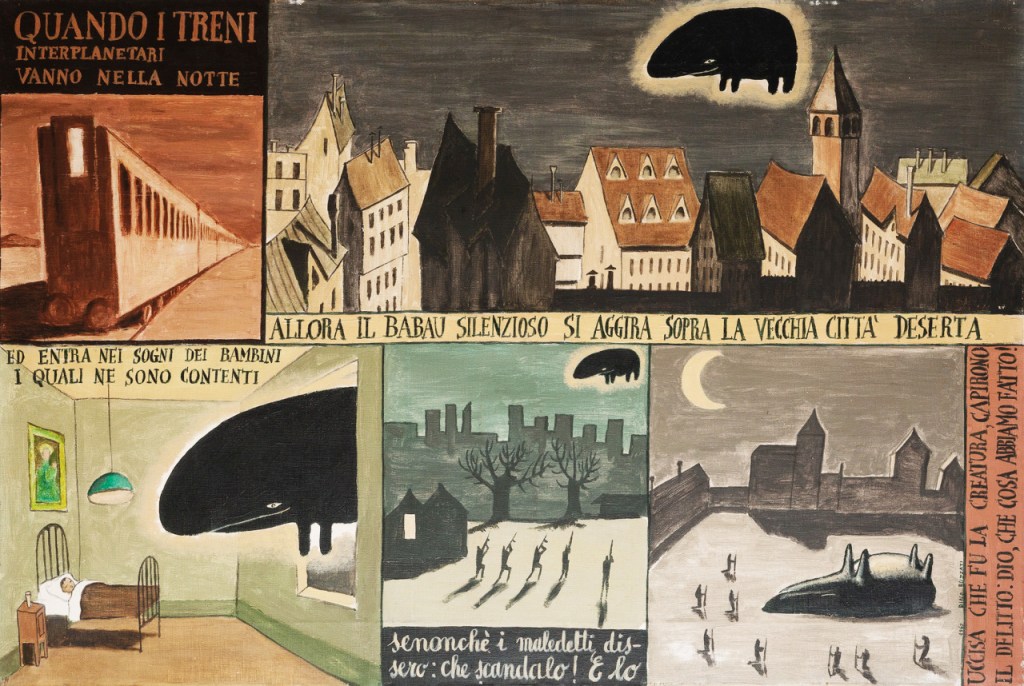
Buzzati did at least a few illustrations of the story sometime around when it was first published (Feb. 16, 1967), though it’s not easy to find firm dates for most of his art. Two of the below are clearly from the story while the third I take to be the babau in a happier day – or maybe it’s just classic cloud watching.

It’s interesting to note the difference between the story and the paintings in the police response to their ultimately slaying the bogeyman. The story has a simple “This is something I’d rather not see a second time” (Una cosa che preferirei non rivedere una seconda volta) while one painting has “God, what have we done!” (Dio, che cosa abbiamo fatto!) and the other the even more emphatic “God, my God, what have we done!” (Dio Dio Mio, che cosa abbiamo fatto!). I tried checked the Corriere archive – which is how I found the original title – to see if the text was different in the first version but was paywalled into continuing ignorance.
And perhaps if we showed a little more confidence they would become friendly

From Dino Buzzati’s The Bears’ Famous Invasion of Sicily, a childhood favorite that I find almost better as an adult thanks to how respectfully Buzzati speaks to his prime audience. He also offered endless subversion of tropes before subversion became itself the dullest of tropes.

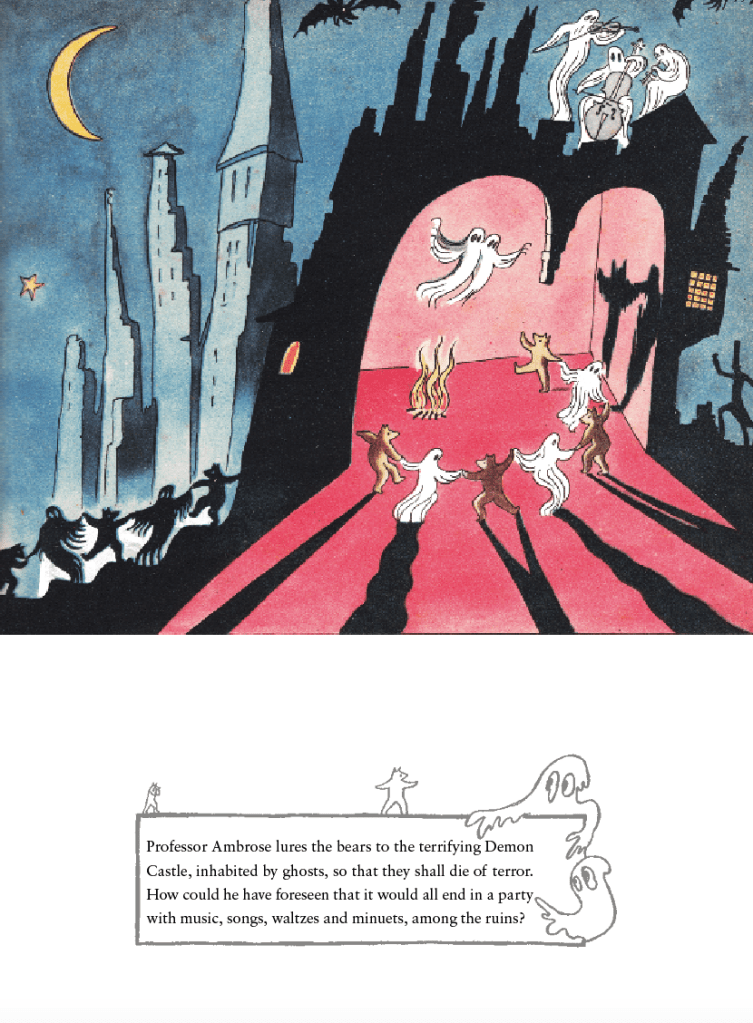
In the neighbourhood there was an old castle – in fact at that time there were many old castles, but the one we mean is Demon Castle, which was all in ruins and hideous, and full of wild beasts, but which was the most famous because it was inhabited by ghosts. As you very well know, all old castles are generally haunted by a ghost or, at most, by two or three. But in Demon Castle there were so many that you could not count them. There were hundreds of them, if not thousands, lying hidden by day: there were even ghosts in the keyholes.

There are some mothers who say: “I cannot imagine what pleasure people get out of telling children ghost stories: it terrifies them, and afterwards at night they start screaming if they hear a mouse.” Perhaps the mothers are right. Still, there are three things to remember. First of all, ghosts, always supposing they exist, have never done children any harm – in fact they have never done anyone any harm: it is simply that people insist on getting frightened. Ghosts and spirits, if they exist (and today they have almost vanished off the face of the earth), are natural and innocent things like the wind or the rain, or shadows of trees, or the voice of the cuckoo in the evening – and they are probably sad at having to live all by themselves in dreary, old, uninhabited houses – and they are probably afraid of people as they hardly ever see them, and perhaps if we showed a little more confidence they would become friendly and would enjoy playing with us at, say, hide-and-seek.

Secondly, Demon Castle does not exist any more, the Grand Duke’s city does not exist any more, there are no more bears in Sicily, and the whole story is now so remote that there is no cause for alarm.

Thirdly, that is how the story was, and we cannot alter it.

And Buzzati’s accompanying art (skipping a bit forward in the story)

And so, all of a sudden, you realize how alone we are in the world.

From a selection of Dino Buzzati’s short stories called Restless Nights

The Survivor’s Story

We arrive from distant countries, from wars, from cataclysms. As the speeding train hastens our return, we look forward to the joys of our native land. Among the greatest of these is the joy of telling stories. We could continue for days without stopping, we could deliver lectures, write huge volumes. The things we have seen were beautiful, bizarre, frightening. Just to be able to tell our friends about them would be worth the pain of so much effort. The train hurries us home, and we seem to be happy.

But how strange! No sooner do we enter our houses than the long tale dies in our breast. We relate two or three things, and then that’s it. Suddenly we stop, feeling that we no longer have anything important to say. Where have our romantic adventures gone? Where are the dangers, mysteries, encounters of which we were proud? Have they disappeared, then? Have all the days and months and years that we spent in faraway lands vanished into thin air? Does nothing remain? Oh no: every dawn, every sunset, every night lies within us one on top of the other, intact, with profound significance. The problem is that when we tell our stories—what a bitter surprise!—they now appear vague, strange, boring, and no one is willing to listen to them, not even our mothers.

“I remember,” we begin, “one morning just at the edge of the forest…”

“But tell me,” someone interrupts, “now that you’ve returned, what do you think you’ll do?”

“The worst encounter happened last March,” we begin, “when the order came to…”

“Excuse me,” another person says, “but I’m already late for an appointment. We can get together tomorrow, can’t we?”

“For two months,” we begin, “we slept in some sort of cave, but we had to make sure that…”

“What about women?” someone else interrupts. “How did you make out with the women down there?”

Then you begin to understand how so many memories, etched into the vital essence of our souls, now sustain our lives. For the others, for everyone else without exception, our memories are only empty phantasms, mere words. Yet they are the people who love us most, they are true friends, ready to sacrifice themselves for us. Nonetheless, they don’t give a damn about our stories, they don’t know what to make of our treasure. And so, all of a sudden, you realize how alone we are in the world.