
The finest second-rate Veronese around

From Goethe’s Italian Journey (October 6):

I visited the Pisani Moretta palace in order to see an exquisite painting by Paul Veronese: the women of Darius’s family are kneeling before Alexander and Hephaestion, the mother kneeling in front takes the latter to be the king, he denies it and points to the right one. According to legend, the artist was well received in this palace and worthily entertained there for some time; in return he secretly painted the picture as a gift, rolled it up, and shoved it under the bed. Truly, it deserves to have had a special origin, for it gives one an idea of this master’s whole worth. His great artistry in producing the most exquisite harmony, not by spreading a universal tone over the whole piece, but by skillfully distributing light and shadow, and equally wisely alternating the local colors, is very visible here, since we see the picture in a perfect state of preservation, as fresh as if done yesterday. For to be sure, when a picture of this kind has decayed, our enjoyment of it is immediately marred, without our knowing the reason.

If anyone wanted to remonstrate with the artist about the costuming, let him just tell himself that the painting is supposed to depict a story of the sixteenth century, and that will settle the whole matter. The gradation from the mother to the wife and daughters is very true and felicitous; the youngest princess, kneeling at the very end, is a pretty little mouse, with a pleasing, headstrong, defiant little face; she does not seem at all ready to accept her situation.
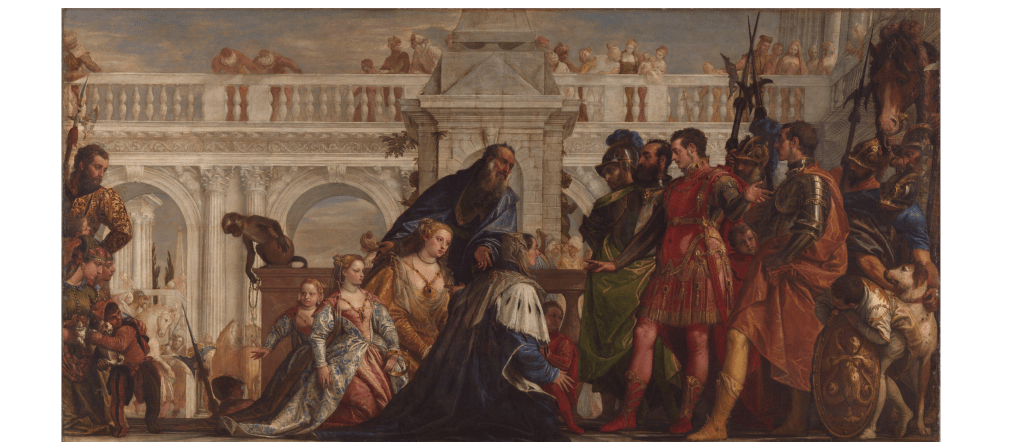
Zoomable full size here

I’d been curious before about the origin story, apocryphal as it of course feels, and found a good summing analysis in a Dec. 2009 Burlington Magazine review by Xavier Salomon. He combines arguments from the work reviewed – Claudia Terribile’s Del piacere della virtu. Paolo Verenese, Alessandro Magno e il patriziato veneziano – and from Nicholas Penny’s National Gallery catalog The Sixteenth-Century Italian Paintings: Volume II: Venice 1540-1600:

The story was a celebrated one and flourished with further embellishments. For Antoine Joseph Dezallier d’Argenville – the first to refer to the story – Veronese had taken refuge in the Palazzo Pisani at Este during a violent thunderstorm; for later writers the painter was recovering from a bad fall from a horse, or escaping the Inquisition. As unlikely as these events can seem, Gould was still dependent on them and his account of the painting was reasonably queried by Cocke. As Nicholas Penny has recently written, ‘it is unlikely that Veronese could have found a suitable canvas waiting for him, unlikely that he would have been able to work on such a large painting in secret, unlikely that he would have rolled it up while still wet, and very unlikely that any bed would have been large enough to conceal it’. Ridolfi mentioned the painting – in the Palazzo Pisani in Venice – in 1648 and, before that, in 1632, Giovanni Antonio Massani had written about it in a letter to Cardinal Francesco Barberini, in which he listed paintings by Veronese that he thought could be on the market. The Family of Darius was for Massani ‘a most beautiful thing, and worthy of a Prince’.

Following Gould’s and Cocke’s speculations regarding the canvas, Claudia Terribile’s impeccable research on the painting – already partly presented in an article – provides key pieces of evidence finally to understand for whom, when and why the Family of Darius was painted. Penny’s recent catalogue of the National Gallery’s Venetian paintings repeatedly cites Terribile’s arguments and pays homage to her archival discoveries. Both Penny and Terribile have produced exhaustive accounts of the painting, which will be of immense help for future studies on the picture and on Veronese. Terribile’s book expands on her previous article and looks at the Family of Darius comprehensively, and Penny’s catalogue entry is so detailed and thorough that it could be published as an independent booklet (much longer than Gould’s of 1978).

Terribile’s book is divided into two parts. The first deals with the original commission, context and history of the painting, while the second focuses on its iconography and meaning. By navigating through the family trees of various branches of the Pisani family, the author identified the patron of the canvas, Francesco Pisani (1514-67), and the painting’s original location, in the Palazzo Pisani at Montagnana, designed by Palladio. This had been tentatively suggested in the 1930s, but Terribile provides further proof to confirm it. When Francesco died, without children, he left his property to his cousin Zan Mattio, and through him to his heirs, whom he wished would assume the first name Francesco in his honour. In 1568 a lawsuit was underway between Zan Mattio and Francesco’s widow, Marietta Molin, who had been effectively disinherited. Zan Mattio complained that Marietta, in an attempt to regain her husband’s property, tried ‘even to remove the canvases and iron [fixtures] of the most precious picture of the story of Alexander the Great’, providing a terminus ante quem for Veronese’s painting. The picture is reasonably dated by Terribile (and by Penny) to the mid-1560s. Francesco must have been an important patron of both Palladio and Veronese, and the contract for Veronese’s early Transfiguration for the high altar of the cathedral of Montagnana was signed in Pisani’s house in 1555.

The post’s title, by the way, is how my grandfather called me over when introducing this painting. The phrase was curious enough to stick with me for thirty years until I finally realized today, thanks to a later portion of Salomon’s article, that it was another bit of his learned humor – the painting’s purchase in 1857 for the then monumental ~£13,500 prompting a parliamentary debate where someone called it a ‘second rate specimen.’ It took a while but the joke finally landed.

I call this a comedy

From early in Goethe’s Italian Journey (Oct. 3, Venice):

But today I saw a different sort of comedy [than the opera], which pleased me more. I heard a legal case being tried in public in the ducal palace; it was an important one and, luckily for me, undertaken during the council recess. One of the lawyers was everything any exaggerated buffo should be. Portly figure, short but agile, a monstrously aquiline profile, a voice of brass, and a vehemence implying that what he said was meant from the bottom of his heart. I call this a comedy, because no doubt everything is settled before these public presentations take place; the judges already know the verdict, and the litigants know what to expect. However, this method pleases me a great deal more than the way we crouch in small rooms and lawyers’ offices. And now I shall try to describe the circumstances and how agreeably, unpretentiously, and naturally everything proceeds.

In a spacious hall of the palace the judges sat at one side in a semicircle. Opposite them the lawyers for both parties, on a rostrum capable of holding several persons side by side, and on a bench directly in front of them, the plaintiff and defendant in person. The plaintiffs lawyer had stepped down from the rostrum, for today’s session was not scheduled to include any controversy. All the documents, pro and contra, although already printed, were to be read aloud.

A haggard clerk in a wretched black robe, a thick pad of paper in his hand, readied himself to perform the duty of reader. Moreover the hall was crowded with spectators and listeners. The legal question itself, as well as the persons it concerned, could not but seem significant to the Venetians.

Entailments are distinctly favored in this nation; once a possession is stamped with this character, it keeps it forever. Even if by some twist or circumstance it was sold several hundred years ago, and has passed through many hands, finally, when the case comes up, the descendants of the original family have the last word, and the estates must be handed over.

This time the lawsuit was extremely important, for the complaint was against the doge himself, or rather, against his wife, who accordingly, veiled by her zendale, was sitting there in person on the little bench, only a short distance away from the plaintiff. A lady of a certain age, noble figure, comely face, on which a serious, nay, if you will, somewhat irritated expression was to be seen. The Venetians were very proud of the fact that their sovereign lady had to appear before them and the court in her own palace.

The clerk began to read, and only now did I grasp the significance of a little man sitting on a low stool behind a small table in view of the judges, not far from the lawyers’ rostrum, and especially of the hourglass he had laid down in front of him. Namely, as long as the clerk reads, the sand does not run; but the lawyer, when he wants to comment, is generally allowed only a certain time period. The clerk reads, the hourglass is recumbent, the little man has his hand on it. When the lawyer opens his mouth, the hourglass is immediately set upright, but is lowered again the moment he is silent. The great skill here resides in interrupting the flow of reading, in making fleeting comments, in arousing and demanding attention. Now the little Saturn gets into the most embarrassing difficulties. He is required to change the horizontal and vertical positions of the hourglass every moment, he sees himself in the situation of the evil spirits in the puppet play, who, when the mischievous harlequin quickly alternates his “berlique! berloque!” do not know whether they should come or go.

Anyone who has heard lawyers collating documents in their chanceries can imagine this reading aloud—rapid, monotonous, but still enunciated with sufficient clarity. A skillful lawyer knows how to interrupt the tedium with jokes, and the audience shows its delight in them with most immoderate laughter. I must mention one joke, the most memorable among those I understood. The clerk was just reciting a document in which one of these owners deemed unlawful was disposing of the estates in question. The lawyer bade him read more slowly, and when he distinctly pronounced the word, “I give, I bequeath!” the orator vehemently attacked him, shouting, “What do you intend to give? bequeath what? You poor hungry devil! You know that nothing in this world belongs to you. But,” he continued, seeming to reflect on the matter, “that illustrious owner was in the very same situation, what he meant to give, to bequeath, belonged to him as little as to you.” There was a tremendous burst of laughter, but the hourglass immediately resumed its horizontal position. The reader hummed on, making an angry face at the lawyer; but those jests were all prearranged.

Goethe is always pithy

From Arthur Conan Doyle’s The Sign of the Four (and, in what I’m calling a minor Mandela Effect, there is apparently a definite article in front of ‘Four’ that I never before noticed):

“And I,” said Holmes, “shall see what I can learn from Mrs. Bernstone, and from the Indian servant, who, Mr. Thaddeus tell me, sleeps in the next garret. Then I shall study the great Jones’s methods and listen to his not too delicate sarcasms. ‘Wir sind gewohnt dass die Menschen verhoehnen was sie nicht verstehen.‘ Goethe is always pithy.”

The quote is from Faust part 1, scene 3 (around line 1200).  In (poorly rendered) fuller form it goes:

Wir sind gewohnt, daß die Menschen verhöhnen,
Was sie nicht verstehn,
Daß sie vor dem Guten und Schönen,
Das ihnen oft beschwerlich ist, murren;

We are used to seeing that men scorn
what they do not understand,
that before the good and the beautiful
that to them often seems wearisome, they grumble;

The universe is one great set of reference books from which he picks and chooses as his restless mind veers on

From Philip K Dick’s The Transmigration of Timothy Archer (somewhere in ch.9):

The son, his son, my husband, subordinated to an intellectual matter-I could never, myself, view it that way. This amounts to a depersonalization of Jeff Archer; he is converted into an instrument, a device for learning; why, he is converted into a talking book. Like all these books that Tim forever reaches for, especially in moments of crisis. Everything worth knowing can be found in a book; conversely, if Jeff is important he is important not as a person but as a book; it is books for books’ sakes then, not knowledge, even, for the sake of knowledge. The book is the reality. For Tim to love and appreciate his son, he must-as impossible as this may seem-he must regard him as a kind of book. The universe to Tim Archer is one great set of reference books from which he picks and chooses as his restless mind veers on, always seeking the new, always turning away from the old; it is the very opposite of that passage from Faust that he read; Tim has not found the moment where he says, “Stay”; it is still fleeing from him, still in motion.

A nice addition to Alberto Manguel’s ‘world as a book’ theme in Library At Night (or History of Reading?, I enjoy him but he re-uses the same material so much it’s hard to keep straight).  Though – to use Goethe against Dick’s Goethe – this restlessness itself feels much in the questing spirit of the angel’s

He who strives always to the utmost
Him we can redeem

Wer immer strebend sich bemüht,
Den können wir erlösen (11936-7)