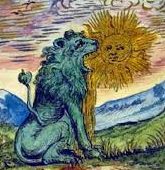
From Herman Hesse’s Steppenwolf. I find something a tad off in the puffed solemnity wrapping this message but I think it can be read as how the idea must first be preached to the protagonist, lost as he is at the novel’s beginning. By the end it is reduced to ‘… enough of pathos and death-dealing. It is time to come to your senses. You are to live and to learn to laugh. You are to learn to listen to the cursed radio music of life and to reverence the spirit behind it and to laugh at its distortions. So there you are. More will not be asked of you.’
If we now pause to test the soul of the Steppenwolf, we find him distinct from the bourgeois in the higher development of his individuality—for all extreme individuation turns against itself, intent upon its own destruction. We see that he had in him strong impulses both to be a saint and a profligate; and yet he could not, owing to some weakness or inertia, make the plunge into the untrammelled realms of space. The parent constellation of the bourgeoisie binds him with its spell. This is his place in the universe and this his bondage. Most intellectuals and most artists belong to the same type. Only the strongest of them force their way through the atmosphere of the bourgeois earth and attain to the cosmic. The others all resign themselves or make compromises. Despising the bourgeoisie, and yet belonging to it, they add to its strength and glory; for in the last resort they have to share their beliefs in order to live. The lives of these infinitely numerous persons make no claim to the tragic; but they live under an evil star in a quite considerable affliction; and in this hell their talents ripen and bear fruit. The few who break free seek their reward in the unconditioned and go down in splendor. They wear the thorn crown and their number is small. The others, however, who remain in the fold and from whose talents the bourgeoisie reaps much gain, have a third kingdom left open to them, an imaginary and yet a sovereign world, humor. The lone wolves who know no peace, these victims of unceasing pain to whom the urge for tragedy has been denied and who can never break through the starry space, who feel themselves summoned thither and yet cannot survive in its atmosphere—for them is reserved, provided suffering has made their spirits tough and elastic enough, a way of reconcilement and an escape into humor. Humor has always something bourgeois in it, although the true bourgeois is incapable of understanding it. In its imaginary realm the intricate and many-faceted ideal of all Steppenwolves finds its realisation. Here it is possible not only to extol the saint and the profligate in one breath and to make the poles meet, but to include the bourgeois, too, in the same affirmation. Now it is possible to be possessed by God and to affirm the sinner, and vice versa, but it is not possible for either saint or sinner (or for any other of the unconditioned) to affirm as well that lukewarm mean, the bourgeois. Humor alone, that magnificent discovery of those who are cut short in their calling to highest endeavor, those who falling short of tragedy are yet as rich in gifts as in affliction, humor alone (perhaps the most inborn and brilliant achievement of the spirit) attains to the impossible and brings every aspect of human existence within the rays of its prism. To live in the world as though it were not the world, to respect the law and yet to stand above it, to have possessions as though “one possessed nothing,” to renounce as though it were no renunciation, all these favorite and often formulated propositions of an exalted worldly wisdom, it is in the power of humor alone to make efficacious.
 Extracts