Wisdom and wilderness are here at poise

Two from Yvor Winters on Herman Melville:

To a Portrait of Melville in My Library

O face reserved, unmoved by praise or scorn!
O dreadful heart that won Socratic peace!
What was the purchase-price of thy release
What life was buried, ere thou rose reborn?
Rest here in quiet, now. Our strength is shorn.
Honor my books! Preserve this room from wrack!
Plato and Aristotle at thy back,
Above thy head this ancient powder-horn.

The lids droop coldly, and the face is still:
Wisdom and wilderness are here at poise,
Ocean and forest are the mind’s device,
But still I feel the presence of thy will:
The midnight trembles when I hear thy voice,
The moon’s immobile when I meet thine eyes.

And

To Herman Melville in 1951

Saint Herman, grant me this: that I may be
Saved from the worms who have infested thee.

I just could not put that hose and bra on the Son of God

On the excesses of symbolist readings by critics – from Dan McCall’s The Silence of Bartleby (pg24)

Years ago I read an essay suggesting that in The Sound and the Fury, when Jason enters his niece’s room on Easter Sunday and finds her underwear strewn about, we should remember Jesus’ burial clothes after the stone was rolled away from the Tomb.  I just could not put that hose and bra on the Son of God.

It was his soul that suffered, and his soul I could not reach

From Melville’s Bartleby the Scrivener:

Revolving all these things, and coupling them with the recently discovered fact that he made my office his constant abiding place and home, and not forgetful of his morbid moodiness; revolving all these things, a prudential feeling began to steal over me. My first emotions had been those of pure melancholy and sincerest pity; but just in proportion as the forlornness of Bartleby grew and grew to my imagination, did that same melancholy merge into fear, that pity into repulsion. So true it is, and so terrible too, that up to a certain point the thought or sight of misery enlists our best affections; but, in certain special cases, beyond that point it does not. They err who would assert that invariably this is owing to the inherent selfishness of the human heart. It rather proceeds from a certain hopelessness of remedying excessive and organic ill. To a sensitive being, pity is not seldom pain. And when at last it is perceived that such pity cannot lead to effectual succor, common sense bids the soul rid of it. What I saw that morning persuaded me that the scrivener was the victim of innate and incurable disorder. I might give alms to his body; but his body did not pain him; it was his soul that suffered, and his soul I could not reach.

I love all men who dive

From a letter of Herman Melville’s – March 3, 1849, pages depend on which edition of correspondence you pull from but it’s also heavily quoted elsewhere.

Now, there is a something about every man elevated above mediocrity, which is for the most part instantly perceptible … I love all men who dive.  Any fish can swim near the surface, but it takes a great whale to go down stairs file miles or more; and if he don’t attain the bottom, why, all the lead in Galena can’t fashion the plummit that will.  I’m not talking of Mr. Emerson now, but of the whole corps of thought-divers that have been diving and coming up again with blood-shot eyes since the world began.

Let him cheerfully allow himself to spend and be spent in that way

From ch.5 of Moby Dick – Ishmael’s morning-after response to what he terms the  innkeeper’s ‘skylarking … in the matter of my bedfellow.’

However, a good laugh is a mighty good thing, and rather too scarce a good thing; the more’s the pity. So, if any one man, in his own proper person, afford stuff for a good joke to anybody, let him not be backward, but let him cheerfully allow himself to spend and be spent in that way. And the man that has anything bountifully laughable about him, be sure there is more in that man than you perhaps think for.

Which accords nicely with Mr. Bennet’s lovely “For what do we live, but to make sport for our neighbours, and laugh at them in our turn?” from ch.57 of Pride and Prejudice.

And weary days they must have been to this friendless custom-house officer

From Melville’s Redburn: His First Voyage (ch.29) – only interesting as a personal prophecy given that several decades later Melville himself would work as a customs official for about twenty years.

During the many visits of Captain Riga to the ship, he always said something courteous to a gentlemanly, friendless custom-house officer, who staid on board of us nearly all the time we lay in the dock.

And weary days they must have been to this friendless custom-house officer; trying to kill time in the cabin with a newspaper; and rapping on the transom with his knuckles. He was kept on board to prevent smuggling; but he used to smuggle himself ashore very often, when, according to law, he should have been at his post on board ship. But no wonder; he seemed to be a man of fine feelings, altogether above his situation; a most inglorious one, indeed; worse than driving geese to water.

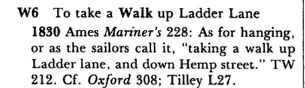
A walk up Ladder-lane, and down Hemp-street

From Herman Melville’s Redburn: His First Voyage (ch. 17)

Sailors have a great fancy for naming things that way on shipboard. When a man is hung at sea, which is always done from one of the lower yard-arms, they say he “takes a walk up Ladder-lane, and down Hemp-street.”

The phrase does actually appear in Bartlett Whiting’s Early American Proverbs and Proverbial Phrasings.

Capture

It is the image of the ungraspable phantom of life; and this is the key to it all

Reading Ovid’s version of the Narcissus story in the Metamorphoses made me wonder if Melville had it specifically in mind in the early chapters of Moby Dick.  I remember vaguely that he had bought a set of classics in translation in the the years (1849?) leading into the writing of the novel but can’t recall what beyond the tragedians and Homer were included there.  I only half-entertain the idea because the divide between Ahab and Ishmael can, by one obviously reductionist view, be collapsed to the former being unable to recognize the whale as ‘shadow of a reflected form with no substance of its own’ and his accordingly being incapable of letting it go.

And still deeper the meaning of that story of Narcissus, who because he could not grasp the tormenting, mild image he saw in the fountain, plunged into it and was drowned. But that same image, we ourselves see in all rivers and oceans. It is the image of the ungraspable phantom of life; and this is the key to it all (Moby Dick ch 1)

What [Narcissus] sees he knows not; but that which he sees he burns for, and the same delusion mocks and allures his eyes.  O fondly foolish boy, why vainly seek to clasp a fleeting image? What you seek is nowhere; but turn yourself away and the object of your love will be no more.  That which you behold is but the shadow of a reflected form and has no substance of its own.  With you it comes, with you it stays, and it will go with you – if you can go. (Loeb edition translated by Frank Justus Miller, pg 155)


Quid videat, nescit: sed quod videt, uritur illo,
atque oculos idem, qui decipit, incitat error.
430Credule, quid frusta simulacra fugacia captas?
quod petis, est nusquam; quod amas, avertere, perdes.
Ista repercussae, quam cernis, imaginis umbra est:
nil habet ista sui; tecum venitque manetque,
tecum discedet, si tu discedere possis. (Metamorphoses 3.428-434)

The grapes that are to give us the champagne hereafter

From a letter to Nathaniel Hawthorne, dating June 1 (?) 1851 as Melville worked to finish Moby Dick:

It is a rainy morning; so I am indoors, and all work suspended. I feel cheerfully disposed, and therefore I write a little bluely. Would the Gin were here! If ever, my dear Hawthorne, in the eternal times that are to come, you and I shall sit down in Paradise, in some little shady corner by ourselves; and if we shall by any means be able to smuggle a basket of champagne there (I won’t believe in a Temperance Heaven), and if we shall then cross our celestial legs in the celestial grass that is forever tropical, and strike our glasses and our heads together, till both musically ring in concert, — then, O my dear fellow-mortal, how shall we pleasantly discourse of all the things manifold which now so distress us, — when all the earth shall be but a reminiscence, yea, its final dissolution an antiquity. Then shall songs be composed as when wars are over; humorous, comic songs, — “Oh, when I lived in that queer little hole called the world,” or, “Oh, when I toiled and sweated below,” or, “Oh, when I knocked and was knocked in the fight” — yes, let us look forward to such things. Let us swear that, though now we sweat, yet it is because of the dry heat which is indispensable to the nourishment of the vine which is to bear the grapes that are to give us the champagne hereafter.

It needs a Delian diver

Two anecdotes from Diogenes Laertius on the difficulty of Heraclitus:

They say that Euripides, giving him [Socrates] a work of Heraclitus to read, asked him what he thought of it, and he replied: ‘The part I understand is excellent, and so too is, I dare say, the part I do not understand; but it needs a Delian diver to get to the bottom of it (2.22).

….

The story told by Ariston of Socrates, and his remarks when he came upon the book of Heraclitus, which Euripides brought him, I have mentioned in my Life of Socrates. However, Seleucus the grammarian says that a certain Croton relates in his book called The Diver that he said work of Heraclitus was first brought into Greece by one Crates, who further said it required a Delian diver not to be drowned on it (9.12)

Delian diver seemed a curiously specific image, especially since the Greek ( Δηλίου γέ τινος δεῖται κολυμβητοῦ) lacks the pleasant alliteration of the English.  In a casual search I found something of an overly ingenious interpretation for the phrase offered by one scholar.  The overwrought summation is as follows:

In conclusion, the expression attributed to Socrates that a Delian diver was required
to comprehend the book by Heraclitus must be understood in a mocking and
metaphorical sense. Thus, and according to this interpretation, not only is a diver
required to reach its depths, but he must necessarily be Delian. This means that he must be someone versed in the arcane oracles of the god Apollo to be able to move freely in the sibylline depths of Heraclitean thought. This explains why an answer that was supposed to be witty and ingenious, put in Socrates’ mouth  with the intention of producing a comical effect, had resource to the island of Delos, ‘the transparent’, ‘The clear’, to refer to the deep water diver. The superficial and literal sense of a Delian diver alluding to an actual pearl or sponge fisherman form that island does not fit with the comical context in which it was expressed, nor with Socrates’ incisive irony, nor, obviously, with the enigmatic and pretentious Heraclitean style. If, conversely, the notion of a Delian diver is understood not as a reference to a true diver from that island, but a metaphorical locution to describe the difficulty to manage the enigmatic and sibylline depths of Heraclitean thought, the hidden meaning of that expression is disclosed. And paraphrasing Diogenes Laertius’ epigram again, only with the aid of the Delian diver, the deep Delian waters become clearer and brighter than sunlight.

I’m somewhat simpler a person and find the sponge diving process a convincing enough metaphor by itself, without recourse to torturing out a pun on Delos.  Wikipedia gives me the following:

When sponge diving, the crew went out into the Mediterranean Sea in a small boat, and used a cylindrical object with a glass bottom to search the sea floor for sponges. When one was found, a diver went overboard to get it. Free diving, he was usually naked and carried a 15 kilograms (33 lb) skandalopetra, a rounded stone tied on a rope to the boat, to take him down to the bottom quickly. The diver then cut the sponge loose from the bottom and put a special net around it. Depth and bottom time depended on the diver’s lung capacity. They often went down about 30 metres (100 ft) for up to 5 minutes