
Intricate as a Heap of Vermicelli

From the back half of Melville’s Journal Up the Straits, as he makes it to Padua:

Wednesday April 1st. Rainy day. To the famous caffe of Pedrocci. Worth of its fame, being of great size and well furnished. Got a grave dark guide & started with great-coat &umbrella to see the sights – To the town hall. Wonderful roof (India) To the ….. palace to see the “Satan & his host.” Fine attitude of Satan. Intricate as heap of Vermicelli.  Church of St. Antony & Shrine. Superb. Crutches & pictures. Bronze bas-reliefs. Goliath & David. &c. Promenade. – The Brenta flowing round it. Pleasant aspect of Brenta winding through town. To Giotto’s chapel. – The Virtues and Vice. Capital. The Scriptural pictures. – The Arena

The editor of my edition notes of “Satan and his host” that Melville is “pretty certainly referring to Giotto’s Last Judgment” and seems to assume he misidentified the Scrovegni chapel as an unknown palazzo, even though he later accurately identifies both it and its contents.  And at first glance I could just possibly see describing Giotto’s Satan as “intricate as a heap of Vermicelli,” if only for the writhing limbs of the damned.
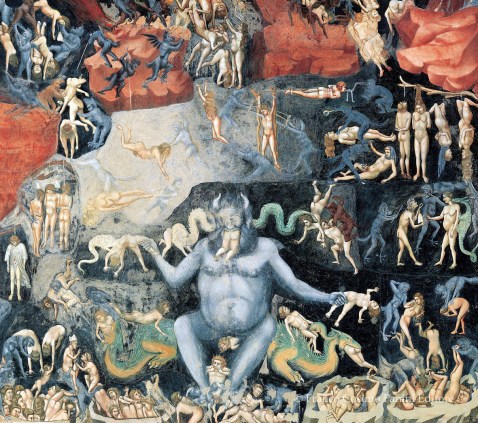
giotto-il-giudizio-universale
Giotto’s Last Judgment
1462230-heap-of-dry-vermicelli-ingredient-italian-food
A heap of vermicelli

But I dug about some and found a better explanation in a work called Savage Eye: Melville and the Visual Arts, where the author identifies the unnamed palace as Palazzo Papafava and the work mentioned as Agostino Fasolato’s ~1750 La Caduta degli Angeli Ribelli (The Fall of the Rebel Angels).  Not only does the title match better (who ever refers to the damned as part of Satan’s host?) and the identification salvage Melville from confused redundancy but the work itself far more resembles a heap of vermicelli.

14
A larger heap of vermicelli

The work  – with a fuller description and history here – now resides in nearby Vicenza at the Gallerie di Palazzo Leoni Montanari.


From Melville’s Journal Up the Straits

Early in his 1856-7 trip through Europe and the Holy Land, Melville, then in Constantinople, records the following scene:

-Saw a burial.  Armenian. Juggling & incantations of the priests – making signs &c. – Nearby, saw a woman over a new grave – no grass on it yet. Such abandonment of misery! Called to the dead, put her head down as close to it as possible; as if calling down a hatchway a cellar; besought – “Why don’t you speak to me? My God! – It is I! Ah, – speak – but one word!” – All deaf. – So much for consolation. – This woman & her cries haunt me horribly. (29)

Compare with his mindset as described by Hawthorne a few weeks earlier on their meeting in England:

Melville has not been well, of late; … and no doubt has suffered from too constant literary occupation, pursued without much success, latterly; and his writings, for a long while past, have indicated a morbid state of mind…. Melville, as he always does, began to reason of Providence and futurity, and of everything that lies beyond human ken, and informed me that he had “pretty much made up his mind to be annihilated”; but still he does not seem to rest in that anticipation; and, I think, will never rest until he gets hold of a definite belief. It is strange how he persists — and has persisted ever since I knew him, and probably long before — in wondering to-and-fro over these deserts, as dismal and monotonous as the sand hills amid which we were sitting.  He can neither believe, nor be comfortable in his unbelief; and he is too honest and courageous not to try to do one or the other. If he were a religious man, he would be one of the most truly religious and reverential; he has a very high and noble nature, and better worth immortality than most of us.

Since Melville didn’t seem to have a guide with him at the time of the graveyard scene – he generally notes the rare instances where he hires a local guide -and I can’t imagine his understanding her cries, I have to think the actual words and, in consequence, some of the emotion of the scene were his own invention.  From there I can’t help but connect their effect on him and his existing preoccupations with the revelation about Bartleby’s earlier work at the end of Bartleby the Scrivener.

There would seem little need for proceeding further in this history. Imagination will readily supply the meager recital of poor Bartleby’s interment. But ere parting with the reader, let me say, that if this little narrative has sufficiently interested him, to awaken curiosity as to who Bartleby was, and what manner of life he led prior to the present narrator’s making his acquaintance, I can only reply, that in such curiosity I fully share, but am wholly unable to gratify it. Yet here I hardly know whether I should divulge one little item of rumor, which came to my ear a few months after the scrivener’s decease. Upon what basis it rested, I could never ascertain; and hence, how true it is I cannot now tell. But inasmuch as this vague report has not been without certain strange suggestive interest to me, however sad, it may prove the same with some others; and so I will briefly mention it. The report was this: that Bartleby had been a subordinate clerk in the Dead Letter Office at Washington, from which he had been suddenly removed by a change in the administration. When I think over this rumor, I cannot adequately express the emotions which seize me. Dead letters! does it not sound like dead men? Conceive a man by nature and misfortune prone to a pallid hopelessness, can any business seem more fitted to heighten it than that of continually handling these dead letters, and assorting them for the flames? For by the cart-load they are annually burned. Sometimes from out the folded paper the pale clerk takes a ring:—the finger it was meant for, perhaps, moulders in the grave; a bank-note sent in swiftest charity:—he whom it would relieve, nor eats nor hungers any more; pardon for those who died despairing; hope for those who died unhoping; good tidings for those who died stifled by unrelieved calamities. On errands of life, these letters speed to death.


In this light, Bartleby’s dead letters duties and the strain they cause him are the same as Melville’s own feelings in the graveyard, only infinitely multiplied (and bureaucratized) through a Danaides touch.


post