The opening third of a fragment from book 3 of Leontion by the Hellenistic poet Hermesianax. The full passage is nearly 100 lines long and only survives thanks to Athenaeus’ quoting it at Deipnosophistae 13.597 (though this text and translation are from the Loeb Hellenistic Collection). This book of the work is what Athenaeus describes as a κατάλογον … ἐρωτικῶν – a catalogue of love affairs. Some of these will be sillier to ponder than others.
Such as Oeagrus’ dear son [Orpheus] summoned back
From Hades, furnished with his lyre: Agriope [= Eurydice]
Of Thrace. He sailed to that implacable, harsh place
Where Charon draws into his public craft
Departed souls, and cries across the lake
That pours its stream through beds of lofty reed.
That lone musician Orpheus suffered much
Beside the wave, but won the various gods;
Lawless Cocytus with his menacing scowl
And the dread regard of Cerberus he withstood,
His voice sharpened in fire, in fire his cruel eye,
On triple rank of heads freighted with fear.
With song he won the underworld’s great lords,
For Agriope to regain the gentle breath of life.
Nor did the Graces’ master, Mene’s son,
Musaeus, leave Antiope unsung,
Who, to the adepts by Eleusis’ strand,
Expressed glad cries from secret oracles,
Leading Demeter’s Rarian celebrant
With ordered step; in Hades still she’s known.
And I say that even Boeotian Hesiod
Lord of all knowledge, left his home and came,
In love, to Ascra, Heliconian town;
And, wooing Eoie, Ascraean maid,
He suffered much, composed whole catalogues
In homage, with the girl heading the list.
The very bard, whom Zeus’ fate upholds
Sweetest divinity of all versed in song,
The godlike Homer set mean Ithaca
To verse for love of wise Penelope.
Smarting for her, he settled in a tiny isle,
Leaving his own broad homeland far behind;
And hymned Icarius’ race, Amyclas’ town
And Sparta, touching on his own distress.
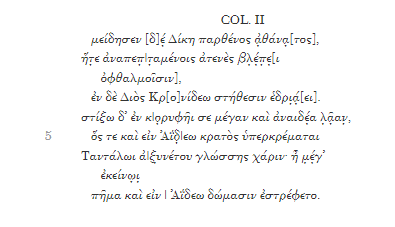
οἵην μὲν φίλος υἱὸς ἀνήγαγεν Οἰάγροιο
Ἀγριόπην Θρῇσσαν στειλάμενος κιθάρην
Ἁιδόθεν· ἔπλευσεν δὲ κακὸν καὶ ἀπειθέα χῶρον,
ἔνθα Χάρων κοινὴν ἕλκεται εἰς ἄκατον
ψυχὰς οἰχομένων, λίμνης δ᾿ ἐπὶ μακρὸν ἀυτεῖ
ῥεῦμα διὲκ μεγάλων χευομένης δονάκων.
πόλλ᾿ ἔτλη παρὰ κῦμα μονόζωστος κιθαρίζων
Ὀρφεύς, παντοίους δ᾿ ἐξανέπεισε θεούς·
Κωκυτόν τ᾿ ἀθέμιστον ὑπ᾿ ὀφρύσι μηνίσαντα
ἠδὲ καὶ αἰνοτάτου βλέμμ᾿ ὑπέμεινε κυνός,
ἐν πυρὶ μὲν φωνὴν τεθοωμένου, ἐν πυρὶ δ᾿ ὄμμα
σκληρὸν, τριστοίχοις δεῖμα φέρον κεφαλαῖς.
ἔνθεν ἀοιδιάων μεγάλους ἀνέπεισεν ἄνακτας
Ἀγριόπην μαλακοῦ πνεῦμα λαβεῖν βιότου.
οὐ μὴν οὐδ᾿ υἱὸς Μήνης ἀγέραστον ἔθηκεν
Μουσαῖος, Χαρίτων ἤρανος, Ἀντιόπην·
ἥ τε πολὺν μύστῃσιν Ἐλευσῖνος παρὰ πέζαν
εὐασμὸν κρυφίων ἐξεφόρει λογίων,
Ῥάριον ὀργειῶνα νόμῳ διαπομπεύουσα
Δημήτρᾳ· γνωστὴ δ᾿ ἐστὶ καὶ εἰν Ἀίδῃ.
φημὶ δὲ καὶ Βοιωτὸν ἀποπρολιπόντα μέλαθρα
Ἡσίοδον, πάσης ἤρανον ἱστορίης,
Ἀσκραίων ἐσικέσθαι ἐρῶνθ᾿ Ἑλικωνίδα κώμην·
ἔνθεν ὅ γ᾿ Ἠοίην μνώμενος Ἀσκραϊκὴν
πόλλ᾿ ἔπαθεν, πάσας δὲ λόγων ἀνεγράψατο βίβλους
ὑμνῶν, ἐκ πρώτης παιδὸς ἀνερχόμενος.
αὐτὸς δ᾿ οὗτος ἀοιδός, ὃν ἐκ Διὸς αἶσα φυλάσσει
ἥδιστον πάντων δαίμονα μουσοπόλων,
λεπτὴν ᾗς Ἰθάκην ἐνετείνατο θεῖος Ὅμηρος
ᾠδῇσιν πινυτῆς εἵνεκα Πηνελόπης·
ἣν διὰ πολλὰ παθὼν ὀλίγην ἐσενάσσατο νῆσον,
πολλὸν ἀπ᾿ εὐρείης λειπόμενος πατρίδος·
ἔκλεε δ᾿ Ἰκαρίου τε γένος καὶ δῆμον Ἀμύκλου
καὶ Σπάρτην, ἰδίων ἁπτόμενος παθέων.
 Extracts