Serendipity, a very expressive word

From Horace Walpole’s January 28, 1754 letter to Horace Mann, describing the background of a heraldry-related discovery. This passage is the first instance of the word serendipity.

This discovery I made by a talisman, which Mr. Chute calls the sortes Walpolianae, by which I find everything I want, a pointe nommee [at the very moment], wherever I dip for it. This discovery, indeed, is almost of that kind which I call Serendipity, a very expressive word, which, as I have nothing better to tell you, I shall endeavour to explain to you: you will understand it better by the derivation than by the definition. I once read a silly fairy tale, called the three Princes of Serendip: as their Highnesses travelled, they were always making discoveries, by accidents and sagacity, of things which they were not in quest of: for instance, one of them discovered that a mule blind of the right eye had travelled the same road lately, because the grass was eaten only on the left side, where it was worse than on the right—now do you understand Serendipity? One of the most remarkable instances of this accidental sagacity (for you must observe that no discovery of a thing you are looking for comes under this description) was of my Lord Shaftsbury, who happening to dine at Lord Chancellor Clarendon’s, found out the marriage of the Duke of York and Mrs. Hyde, by the respect with which her mother treated her at table.

I’m reading Robert Merton (of On the Shoulders of Giants fame) and Elinor Barber’s The Travels and Adventures of Serendipity: A Study in Sociological Semantics and the Sociology of Science and the most (personally) interesting aspect of the word’s history is its early adoption in bibliophilic circles for the feel of small but vital delight when you unexpectedly meet a work you’d earlier sought but hadn’t found or, for me, one you hadn’t even realized you’d been wanting.
A kind of bastard infallibility

From Leslie Stephen’s essay on Horace Walpole in Hours in a Library.  I just like the phrasing.

In truth Walpole has no pretensions whatever to be regarded as a great original creator, or even as one of the few infallible critics. The only man of his time who had some claim to that last title was his friend Gray, who shared his Gothic tastes with greatly superior knowledge. But he was indefinitely superior to the great mass of commonplace writers, who attain a kind of bastard infallibility by always accepting the average verdict of the time; which, on the principle of the vox populi, is more often right than that of any dissenter.

The very air is laden with discordant howls and thick with oaths and ribald songs

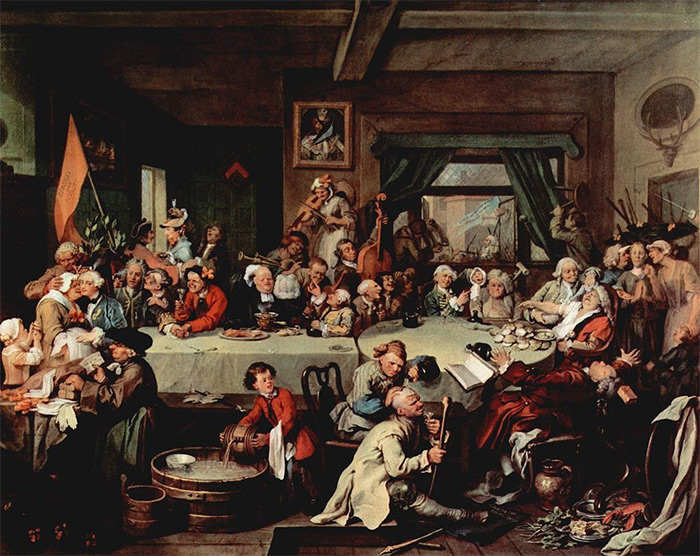
Leslie Stephen from his essay on Horace Walpole in Hours in a Library – imagining the dandy Walpole’s visits to his constituents, with reference to William Hogarth’s An Election Entertainment pictured below:

hogarth_election

 Yet we can fancy Walpole’s occasional visit to his constituents, and imagine him forced to preside at one of those election feasts which still survive on Hogarth’s canvas. Substitute him for the luckless fine gentleman in a laced coat, who represents the successful candidate in the first picture of the series. A drunken voter is dropping lighted pipe ashes upon his wig; a hideous old hag is picking his pockets; a boy is brewing oceans of punch in a mash-tub; a man is blowing bagpipes in his ear; a fat parson close by is gorging the remains of a haunch of venison; a butcher is pouring gin on his neighbour’s broken head; an alderman—a very mountain of roast beef—is sinking back in a fit, whilst a barber is trying to bleed him; brickbats are flying in at the windows; the room reeks with the stale smell of heavy viands and the fresh vapours of punch and gin, whilst the very air is laden with discordant howls and thick with oaths and ribald songs.

This also reminded me of a metro ride I took the other day.  Always better off walking the extra stops.