Bad books as food wrappings, part 2

A while back I made a post about bad books as food wrappings. A reference in John Webster’s To the Reader in his The White Devil reminded me that I’ve since found several other examples of the same idea.

Martial, Epigrams 4.86. Webster includes the Latin of the first two bolded lines in his address. The ‘tiresome tunic’ (tunica molesta) was a shirt smeared with pitch or some other highly flammable material that those condemned to execution by fire were forced to wear.

If you wish to be approved by Attic ears, little book, I urge and admonish you to please learned Apollinaris. None more meticulous and erudite, but none more benevolent and kind. If he holds you in his heart and on his lips, you will not fear the sneers of the ill-disposed nor supply mackerel with “tiresome tunics.” If he damns you, you may as well run straight to the bookcases of the saltfishmongers, fit for schoolboys to plough your backside.


Si vis auribus Atticis probari,
exhortor moneoque te, libelle,
ut docto placeas Apollinari.
nil exactius eruditiusque est,
sed nec candidius benigniusque.
si te pectore, si tenebit ore,
nec rhonchos metues maligniorum,
nec scombris tunicas dabis molestas.

si damnaverit, ad salariorum
curras scrinia protinus licebit,
inversa pueris arande charta

An earlier instance from Martial, 3.2

Whose present do you wish to be, little book? Hurry to find yourself a protector, lest hustled off to a sooty kitchen you wrap sprats in your sodden papyrus or become a cowl for incense or pepper. Do you fly to Faustinus’ bosom? You are wise. Now you may walk oiled with cedar, your twin brows handsomely adorned, 2 luxuriating in your painted bosses, clothed in dainty purple, your proud title blushing scarlet. With him to protect you, have no fear of Probus himself.


Cuius vis fieri, libelle, munus?
festina tibi vindicem parare,
ne nigram cito raptus in culinam
cordylas madida tegas papyro
vel turis piperisve sis cucullus.

Faustini fugis in sinum? sapisti.
cedro nunc licet ambules perunctus
et frontis gemino decens honore
pictis luxurieris umbilicis,
et te purpura delicata velet,
et cocco rubeat superbus index.
illo vindice nec Probum timeto.

And a later, more indirect version from 6.61 (citing only the relevant lines here):

How many good poets are food for moths and bookworms, and only cooks buy their accomplished verses!

quam multi tineas pascunt blattasque diserti,
et redimunt soli carmina docta coci!

And my last find, from Statius’ Silvae 4.9 (citing only the opening lines here):

JESTING HENDECASYLLABICS TO PLOTIUS GRYPUS
A joke on your part, to be sure, Grypus, to send me a little book in return for a little book! But it can be thought amusing only if you were to send me a follow-up. For if you go on jesting, Grypus, it’s no jest! Look, let’s reckon up. Mine is purple, fresh paper, with a pair of handsome bosses.1 Besides myself,2 it cost me a ten-as piece. But yours! Moth eaten and moldering, like the sheets that soak up Libyan olives or keep Nile incense or pepper or cook Byzantine tunny.


HENDECASYLLABI IOCOSI AD PLOTIUM GRYPUM
Est sane iocus iste, quod libellum
misisti mihi, Grype, pro libello.
urbanum tamen hoc potest videri
si post hoc aliquid mihi remittas.
5nam si ludere, Grype, perseveras,
non ludis. licet ecce computemus.
noster purpureus novusque charta
et binis decoratus umbilicis
praeter me mihi constitit decussis:
tu rosum tineis situque putrem,
quales aut Libycis madent olivis
aut tus Niliacum piperve servant
aut Byzantiacos cocunt lacerto
s,

He uses his folly like a stalking-horse

From Shakespeare’s As You Like It (5.4.104-05):

He uses his folly like a stalking-horse, and under the
presentation of that he shoots his wit.

I had a vague sense of stalking-horse from its still-extant extended use in bankruptcy settlements – the stalking horse offer being one designed as a sort of reserve on the assets up for auction, a means of guaranteeing a minimum value they will go for. There’s also apparently another still-extant sense – closer to the original – used in business and politics, an explanation of which can be read here.

But the original use and definition is much more picturesque. It’s also unwieldy so here’s the OED’s refinement first:

1. A horse trained to allow a fowler to conceal himself behind it or under its coverings in order to get within easy range of the game without alarming it. Hence, a portable screen of canvas or other light material, made in the figure of a horse (or sometimes of other animals), similarly used for concealment in pursuing game.

More fun is Gervase Markham’s from his 1621 treatise Hungers Preuention: or The Whole Art of Fowling By Water and Land (online here but requiring some textual restoration as read):

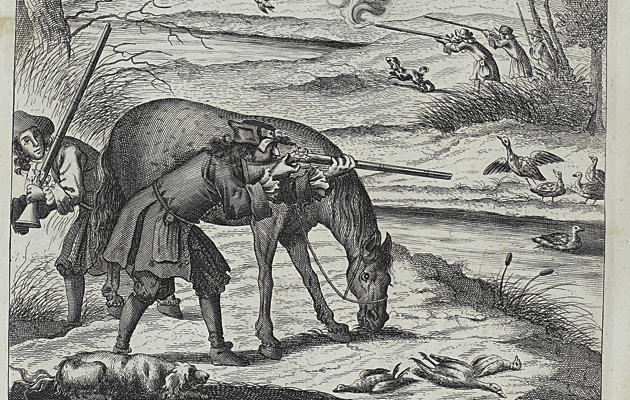
Now forasmuch as these shelters or couerts are after a way then found, and that Fowle doe many times lye so farre remoued within the water, that vnlesse a man doe goe into it where no shelter at all is, more then a man bringeth with him, he cannot possibly compasse a shoote; so that of necessity a man must haue some moouing shaddow or shelter to walke by him; In this case there is nothing better then the stalking Horse, which is any old Iade trayned vp for that vse, which being stript naked and hauing nothing but a string without the neather chappe, of two or three yards longe, will gently and as you giue ocation to vrge him, walke vp and downe in the water which way you will haue him; flodding and eating vpon the grasse or other stuffe that growes there-in; and then being hardy & stoute without taking any affright at the report of the Peice, you shall shelter your selfe and your Peice behind his fore shoulder, bending your body downe low by his side, and keeping his body still full betweene you and the Fowle; Then haueing (as was before shewed) chosen your marke, you shall take your leuell from before the fore part of the Horse, shooting as it were betweene the Horses knees and the water, which is more safe and further then taking the leuell vnder the Horses belly, and much lesser to be perceaued; the shoulder of the Horse covering the body of the man, and the Horse’s legges shaddowing the legges of the man also: and as thus you stalke vpon the greate blanke waters, so you may stalk also along the bankes of Brookes in great Riuers, by little and little winning the Fowle to as neare a station as can be desired, and thus you may doe also vpon the firme ground, whether it be on moor, Heath, or other rotten earth, or else up the tylthe where greene Corne groweth; or generally, in any other haunt where Fowle are accustomably vsde to feede or abide.

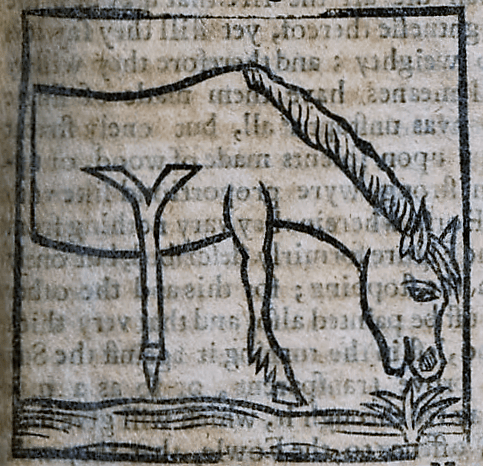
Now forasmuch as these Stalking horse, or Horses to stalke withall, are not euer in readinesse, and at the best aske a good expence of time to bee brought to their best perfection: as also, in that euery poore man or other which taketh delight in this exercise, is either not master of a Horse, or if hee had one yet wanteth fit meanes to keepe him: and yet neuerthelesse this practise of Fowling must or should bee the greatest part of his mantenance. In this case he may take any pieces of oulde Canuasse, and hauing made it in the shape or proportion of a Horse with the head bending downeward, as if hee grased, and stoping it with dry Strawe, Mosse, Flocks, or any other light matter, let it be painted as neere the colour of a Horse as you can deuise; of which the Browne is the best, and in the midst let it be fixt to a Staffe with a picke of Iron in it to sticke downe in the ground at your pleasure, and stand fast whilest you chuse your marke, as also to turne and winde any way you please, either for your aduantage of the winde, or for the better taking of your leuell, and it must be made so portable that you may beare it easily with one hand, mooving and wagging it in such wise that it may seeme to mooue and graze as it goeth; nether must this in any wise exceed the ordinary stature or proportion of a common Horse, for to bee too low or little will not couer the man, and to be two big and huge will be both monstrous & troublesome, and giue affright to the Fowle, therefore the meane in this is the best measure, and only worth the obseruation.

This sort of thing lends itself to illustrations. Here’s the stuffed canvass stalking-horse from Markham’s text:

From Nicholas Cox’s 1686 The Gentleman’s Recreation (where he also makes mention of a stalking-cow, a search for which produced this modern equivalent):

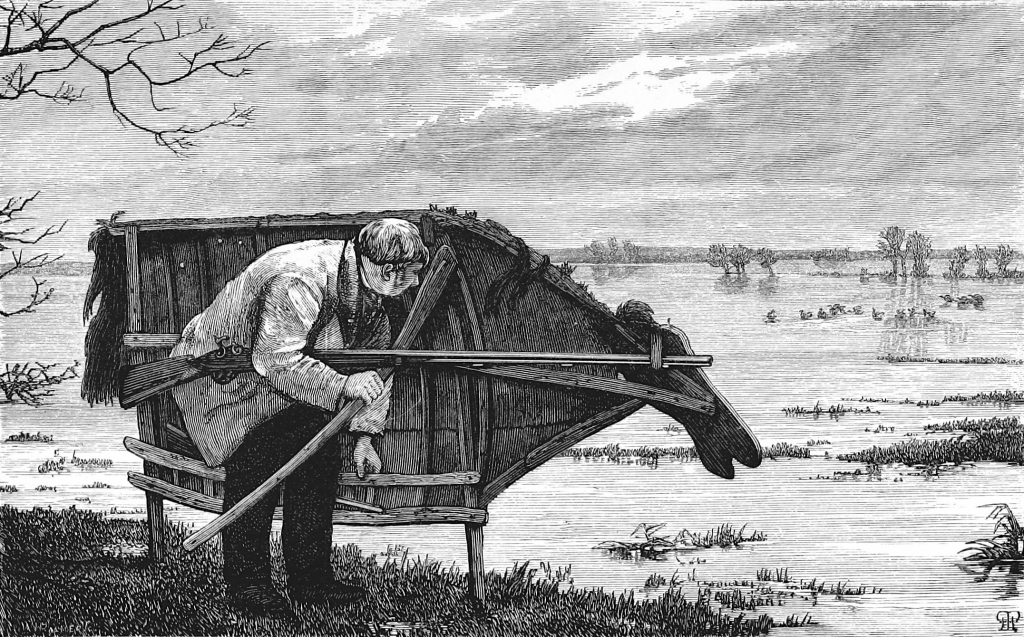
One I can’t identify the origin of but Wikipedia dates as 1875:

It’s easy to see how the term shifts into the figurative uses given by the OED (A person whose agency or participation in a proceeding is made use of to prevent its real design from being suspected and An underhand means or expedient for making an attack or attaining some sinister object; usually, a pretext put forward for this purpose). In drama alone we see the above lines from Shakespeare in 1599. Then John Marston in The Malcontent (4.3.126) in 1603:

Yea, provident: beware an hypocrite;
A churchman once corrupted, O, avoid!
A fellow that makes religion his stalking-horse,
He breeds a plague: thou shalt poison him.

And John Webster in The White Devil (3.1.34-38) in 1612:

Oh, my unfortunate sister!
I would my dagger’s point had cleft her heart
When she first saw Bracciano. You, ’tis said,
Were made his engine and his stalking-horse
To undo my sister