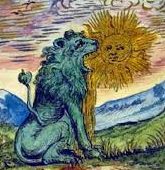
From Ludwig Tieck’s The Fair-Haired Eckbert (as Thomas Carlyle renders Der Blonde Eckbert). Tieck is one of those chance treasures that literary nomadism occasionally yields and while I’m not surprised he’s today out of fashion – at least with English readers – I am surprised Borges either never read him or never (that I can find) found occasion to comment on him. Just count the Borgesian preoccupations below.
This passage is from near the end of the tale. It’s not a direct spoiler but it would likely color a first reading. The full English is here and German here.
He set out, without prescribing to himself any certain route; indeed, he took small heed of the country he was passing through. Having hastened on some days at the quickest pace of his horse, he, on a sudden, found himself entangled in a labyrinth of rocks, from which he could discover no outlet. At length he met an old peasant, who took him by a path leading past a waterfall: he offered him some coins for his guidance, but the peasant would not have them. “What use is it?” said Eckbert. “I could believe that this man, too, was none but Walther.” He looked round once more, and it was none but Walther. Eckbert spurred his horse as fast as it could gallop, over meads and forests, till it sank exhausted to the earth. Regardless of this, he hastened forward on foot.
In a dreamy mood he mounted a hill: he fancied he caught the sound of lively barking at a little distance; the birch-trees whispered in the intervals, and in the strangest notes he heard this song:
Alone in wood so gay,
Once more I stay;
None dare me slay,
The evil far away:
Ah, here I stay,
Alone in wood so gay.The sense, the consciousness of Eckbert had departed; it was a riddle which he could not solve, whether he was dreaming now, or had before dreamed of a wife and friend. The marvellous was mingled with the common: the world around him seemed enchanted, and he himself was incapable of thought or recollection.
Er zog fort, ohne sich einen bestimmten Weg vorzusetzen, ja er betrachtete die Gegenden nur wenig, die vor ihm lagen. Als er im stärksten Trabe seines Pferdes einige Tage so fortgeeilt war, sah er sich plötzlich in einem Gewinde von Felsen verirrt, in denen sich nirgend ein Ausweg entdecken ließ. Endlich traf er auf einen alten Bauer, der ihm einen Pfad, einem Wasserfall vorüber, zeigte: er wollte ihm zur Danksagung einige Münzen geben, der Bauer aber schlug sie aus. – »Was gilt’s«, sagte Eckbert zu sich selber, »ich könnte mir wieder einbilden, daß dies niemand anders als Walther sei.« – Und indem sah er sich noch einmal um, und es war niemand anders als Walther. – Eckbert spornte sein Roß so schnell es nur laufen konnte, durch Wiesen und Wälder, bis es erschöpft unter ihm zusammenstürzte. – Unbekümmert darüber setzte er nun seine Reise zu Fuß fort.
Er stieg träumend einen Hügel hinan; es war, als wenn er ein nahes munteres Bellen vernahm, Birken säuselten dazwischen, und er hörte mit wunderlichen Tönen ein Lied singen:
»Waldeinsamkeit
Mich wieder freut,
Mir geschieht kein Leid,
Hier wohnt kein Neid,
Von neuem mich freut
Waldeinsamkeit.«
Jetzt war es um das Bewußtsein, um die Sinne Eckberts geschehn; er konnte sich nicht aus dem Rätsel herausfinden, ob er jetzt träume, oder ehemals von einem Weibe Bertha geträumt habe; das Wunderbarste vermischte sich mit dem Gewöhnlichsten, die Welt um ihn her war verzaubert, und er keines Gedankens, keiner Erinnerung mächtig.
Incidentally, the concept of Waldeinsamkeit – wald (forest) + einsamkeit (solitude/isolation/loneliness) – has a lengthy history in later Romanticism and beyond.
 Extracts