Curse dolls

From Ovid’s Amores 3.7.27-30, memorable primarily as his impotence poem.

Is my body limp, cursed by Thessalian poison? Are incantations and herbs doing me harm,
or has some sorceress bewitched my name with crimson wax and driven sharp needles into my liver?

Num mea Thessalico languent devota veneno
corpora? num misero carmen et herba nocent,
sagave poenicea defixit nomina cera
et medium tenuis in iecur egit acus?

There’s a very similar passage at Heroides 6.91 – only the purpose there is the more traditional securing of the target’s love.

Among sepulchres she stalks, ungirded, with hair flowing loose, and gathers from the yet warm funeral pyre the appointed bones. She vows to their doom the absent, fashions the waxen image, and into its wretched heart drives the slender needle

per tumulos errat passis discincta capillis
certaque de tepidis colligit ossa rogis.
devovet absentis simulacraque cerea figit
et miserum tenuis in iecur urget acus

The practice of piercing a doll to work some manner of magic on a target it represents is well documented in scholarship – Daniel Ogden’s Magic, Witchcraft, and Ghosts in the Greek and Roman World: A Source Book has a full chapter of translated examples like the partial extract below (pg 248, PGM IV.296–466):

Take some wax or some clay from a potter’s wheel and mold two figures, male and female. Arm the male one like Ares, brandishing a sword in his left hand and striking the female’s neck on her right side. Put the female doll’s hands behind her back and make her kneel. You will fasten the stuff [ousia] on her head or on her neck. Inscribe the doll of the woman being attracted: on her head, “ISEÊ IAÔ ITHI OUNE BRIDÔ LÔTHIÔN NEBOUTOSOUALÊTH”; on her right ear, “OUER MÊCHAN”; on her left ear, “LIBABA ÔIMATHOTHO”; on her face, “AMOUNABREÔ”; over her right eye, “ÔRORMOTHIO AÊTH”; over the other one, “CHOBOUE”; on her right collarbone, “ADETA MEROU”; on her right arm, “ENE PSA ENESGAPH”; on the other one, “MELCHIOU MELCHIEDIA”; on her hands, “MELCHAMELCHOU AÊL”; on her breast, the name of the woman being attracted, with her metronymic; over her heart, “BALAMIN THÔOUTH”; under her stomach, “AOBÊS AÔBAR”; on her vulva, “BLICHIANEOI OUÔIA”; on her bottom, “PISSADARA”; on the soles of her feet, on the right one, “ELÔ”; on the other one, “ELÔAIOE.”

Take thirteen bronze needles and insert one of them into the brain while saying, “I pierce your brain (insert her name)”; insert two into her ears, two more into her eyes, one into her mouth, two below her rib cage, one into her hands, two into her vulva and anus, and two into the soles of her feet, while on each occasion saying once, “I pierce the (insert name of part) of (insert her name), so that she may think of no one, except me alone, (insert your name).” Take a lead tablet, inscribe the same spell on it, and say it through. Bind the tablet to the figures with the warp from a loom, in which you have made 365 knots while saying, as you know how to, “Abrasax, constrain her.”

Lay it as the sun sets beside the grave of one untimely dead or dead by violence, and lay flowers of the season there with it The inscribed and recited spell is this:

“I deposit with you this binding-curse [katadesmos], chthonic gods and Pluto; UESEMIGADON; Maiden Persephone Ereschigal and Adonis the BARBARITHA; underworld Hermes THÔOUTH PHÔKENTAZEPSEU AERCHTHATHOU MISONKTAI KALBANACHAMBRÊ; powerful Anubis PSIRINTH, holder of the keys to Hades; gods and demons of the underworld; untimely dead, male and female; lads and maidens; year on year, month on month, day on day, hour on hour. I adjure all demons in this place to assist this demon. Rouse yourself for me, whoever you are, whether male or female, and take yourself off to every district, every block, and every house. Bring her and bind her. Bring her (insert her name), the daughter of (insert her mother’s name), whose stuff you have, in love with me, (insert your name), whom (insert your mother’s name) bore. Let her not fornicate, let her not be buggered, and let her not do anything that brings pleasure with another man, unless with me alone, (insert your name), so that (insert her name) is not able either to drink or to eat, or hold out, or to endure it, or be calm, so that (insert her name) is not able to find sleep without me, (insert your name), because I adjure you in the name that inspires fear and trembling, the name at the sound of which the earth will be opened up, the name at the sound of which the frightening demons will be frightened, the name at the sound of which the rocks are shattered…..

There’s also a fascinating assemblage of items at the louvre – doll, curse tablet, storage vase – that give a better sense of at least the physical aspects of the cursing process. They’re off display for the moment but there are photos and a lovely writeup here – with additional curse examples.
Thunder looses beds of eels

From Shakespeare’s Pericles, Prince of Tyre (4.2, the firmly Shakespearean portion of the play beginning at act 3):

I warrant you, mistress, thunder
shall not so awake the beds of eels as my giving
out her beauty stir up the lewdly-inclined.

The clear phallic play aside, the Arden note adds:

If not a proverb – Dent questions (?T276) ‘Thunder looses beds of eels’ – this was certainly a common zoological belief, appearing in Marston’s Scourge of Villainy (1598) and George Wither’s Abuses Stripped and Whipped (1613).

Dent in both Shakespeare’s Proverbial Language and the more catchingly titled Proverbial Language in English Drama Exclusive of Shakespeare, 1495–1616 is cagey about asserting the proverb despite compiling four other instances of the belief. In the former he cites:

1598 Marston Satire 7.78 – They are naught but Eeles, that never will appeare, / Till that tempestuous winds or thunder teare / Their slimie beds.

1613 G. Wither Abuses ed. 1863 168: Let loose, like beds of eels by thunder.

cl620 (1647) Fletcher & Massinger, False One 4.2.200f.: I’ll break like thunder / Amongst these beds of slimy Eeeles.

And in the latter adds:

1615 S.S. Honest Lawyer II C3v: Shall we cling, like a couple of Eeles, not to bee dissolv’d but by Thunder?

None of this addresses the question of the origin of the idea of eels fearing/stirred up by thunder, which is what I mainly cared about. I don’t have a definite answer, but I do have a logical chain. We begin with Pliny, as anyone seeking answers on odd beliefs about animals should do (Natural History 9.38):

Eels live eight years. They can even last five or six days at a time out of water if a north wind is blowing, but not so long with a south wind. But the same fish cannot endure winter in shallow nor in rough water; consequently they are chiefly caught at the Pleiads, as the rivers are then specially rough. They feed at night. They are the only fish that do not float on the surface when dead. There is a lake called Garda in the territory of Verona through which flows the river Mincio, at the outflow of which on a yearly occasion, about the month of October, when the lake is made rough evidently by the autumn star, they are massed together by the waves and rolled in such a marvellous shoal that masses of fish, a thousand in each, are found in the receptacles constructed in the river for the purpose.

I’ve edited the above to translate circa verginias as ‘at the Pleaids’ rather than ‘at the rising of the Pleaids’ since I think this confuses the issue.

The Pleiades were associated in the ancient world with storms at both their rise in Spring (April-ish) and especially their setting in Fall (Oct-Nov). So Hesiod in Works and Days (615-622):

 When the Pleiades and Hyades and the strength of Orion set [in October], that is the time to be mindful of plowing in good season. May the whole year be well-fitting in the earth. But if desire for storm-tossed seafaring seize you: when the Pleiades, fleeing Orion’s mighty strength, fall into the murky sea, at that time [in November] blasts of all sorts of winds rage; do not keep your boat any longer in the wine-dark sea at that time

Later Ovid in Heroides (18.187):

What when the seas have been assailed by the Pleiad, and the guardian of the Bear, and the Goat of Olenos? Either I know not how rash I am, or even then a love not cautious will send me forth on the deep

And a last instance in Statius’ Silvae (3.2.71):

Hence raging winds and indignant tempests and a roaring sky and more lightning for the Thunderer. Before ships were, the sea lay plunged in torpid slumber, Thetis did not joy to foam nor billows to splash the clouds. Waves swelled at sight of ships and tempest rose against man. ’Twas then that Pleiad and Olenian Goat were clouded and Orion worse than his wont.

It doesn’t seem a far leap to take that Pliny’s reported pattern of eel behavior and eel hunting season, whether scientifically accurate or not, was understood as connected to the rising or setting of the Pleiades and so to the stormy season. Hence by shorthand approximation to thunder generally. And so eels, unable to deal with storms or the rough water that follow, were viewable as loosed from bed by thunder.

To all this my vanity adds a much later reference in the opening of Robert Browning’s Old Pictures in Florence. I was proud of this as altogether my own but in due diligence checking the most recent edition of John Marston’s poetry (The Poems of John Marston ed. Arnold Davenport) I found a previous editor of the same (Bullen) had also pointed out the quote, taking it as Browning reporting a piece of ‘Italian folk-lore’:

The morn when first it thunders in March,
The eel in the pond gives a leap

I sometimes feel bad about doing these things on work time but I work for a university so it should all wash out as research.

One of those smiles which might be supposed to have come from the dimpled cheeks of the august Tisiphone

An easily overlooked masterpiece from Henry Fielding in bk.1 ch.8 of Tom Jones. Tisiphone, along with Alecto and Megaera, is one of the three Furies. Her appearance in Ovid’s Metamorphoses (bk. 4 starting at ~470) is given at bottom to better fill out the visual. And as good as this line is, another right after it – ‘a voice sweet as the evening breeze of Boreas in the pleasant month of November’ – is almost equally memorable.

When Mr Allworthy had retired to his study with Jenny Jones, as hath been seen, Mrs Bridget, with the good housekeeper, had betaken themselves to a post next adjoining to the said study; whence, through the conveyance of a keyhole, they sucked in at their ears the instructive lecture delivered by Mr Allworthy, together with the answers of Jenny, and indeed every other particular which passed in the last chapter.

This hole in her brother’s study-door was indeed as well known to Mrs Bridget, and had been as frequently applied to by her, as the famous hole in the wall was by Thisbe of old. This served to many good purposes. For by such means Mrs Bridget became often acquainted with her brother’s inclinations, without giving him the trouble of repeating them to her. It is true, some inconveniences attended this intercourse, and she had sometimes reason to cry out with Thisbe, in Shakspeare, “O, wicked, wicked wall!” For as Mr Allworthy was a justice of peace, certain things occurred in examinations concerning bastards, and such like, which are apt to give great offence to the chaste ears of virgins, especially when they approach the age of forty, as was the case of Mrs Bridget. However, she had, on such occasions, the advantage of concealing her blushes from the eyes of men; and De non apparentibus, et non existentibus eadem est ratio—in English, “When a woman is not seen to blush, she doth not blush at all.”

Both the good women kept strict silence during the whole scene between Mr Allworthy and the girl; but as soon as it was ended, and that gentleman was out of hearing, Mrs Deborah could not help exclaiming against the clemency of her master, and especially against his suffering her to conceal the father of the child, which she swore she would have out of her before the sun set.

At these words Mrs Bridget discomposed her features with a smile (a thing very unusual to her). Not that I would have my reader imagine, that this was one of those wanton smiles which Homer would have you conceive came from Venus, when he calls her the laughter-loving goddess; nor was it one of those smiles which Lady Seraphina shoots from the stage-box, and which Venus would quit her immortality to be able to equal. No, this was rather one of those smiles which might be supposed to have come from the dimpled cheeks of the august Tisiphone, or from one of the misses, her sisters.

With such a smile then, and with a voice sweet as the evening breeze of Boreas in the pleasant month of November, Mrs Bridget gently reproved the curiosity of Mrs Deborah; a vice with which it seems the latter was too much tainted, and which the former inveighed against with great bitterness, adding, “That, among all her faults, she thanked Heaven her enemies could not accuse her of prying into the affairs of other people.”

And Ovid (Loeb translation):

And [Juno] explains the causes of her hatred and of her journey hither, and what she wants. What she wanted was that the house of Cadmus should fall, and that the Fury-sisters should drive Athamas to madness. Commands, promises, prayers she poured out all in one, and begged the goddesses to aid her. When Juno had done, Tisiphone, just as she was, shook her tangled grey locks, tossed back the straggling snakes from her face, and said: “There is no need of long explanations; consider done all that you ask. Leave this unlovely realm and go back to the sweeter airs of your native skies.” Juno went back rejoicing; and as she was entering heaven, Iris, the daughter of Thaumus, sprinkled her o’er with purifying water.

Straightway the fell Tisiphone seized a torch which had been steeped in gore, put on a robe red with dripping blood, girt round her waist a writhing snake, and started forth. Grief went along with her, Terror and Dread and Madness, too, with quivering face. She stood upon the doomed threshold. They say the very door-posts of the house of Aeolus shrank away from her; the polished oaken doors grew dim and the sun hid his face. Ino was filled with terror at the monstrous sight, and her husband, Athamas, was filled with terror, too. They made to leave their palace, but the baleful Fury stood in their way and blocked their exit. And stretching her arms, wreathed with vipers, she shook out her locks: disturbed, the serpents hissed horribly. A part lay on her shoulders, part twined round her breast, hissing, vomiting venomous gore, and darting out their tongues. Then she tears away two serpents from the midst of her tresses, and with deadly aim hurls them at her victims. The snakes go gliding over the breasts of Ino and of Athamas and breathe upon them their pestilential breath. No wounds their bodies suffer; ’tis their minds that feel the deadly stroke. The Fury, not content with this, had brought horrid poisons too—froth of Cerberus’ jaws, the venom of the Hydra, strange hallucinations and utter forgetfulness, crime and tears, mad love of slaughter, all mixed together with fresh blood, brewed in a brazen cauldron and stirred with a green hemlock-stalk. And while they stood quaking there, over the breasts of both she poured this maddening poison brew, and made it sink to their being’s core.

Then, catching up her torch, she whirled it rapidly round and round and kindled fire by the swiftly moving fire. So, her task accomplished and her victory won, she retraced her way to the unsubstantial realm of mighty Dis, and there laid off the serpents she had worn.

How now, you secret, black, and midnight hags!

From Macbeth (4.1.47-60):

MACBETH
How now, you secret, black, and midnight hags!
What is’t you do?
ALL [WITCHES]
A deed without a name.
MACBETH
I conjure you, by that which you profess,
Howe’er you come to know it, answer me:
Though you untie the winds and let them fight
Against the churches; though the yesty waves
Confound and swallow navigation up;
Though bladed corn be lodged and trees blown down;
Though castles topple on their warders’ heads;
Though palaces and pyramids do slope
Their heads to their foundations; though the treasure
Of nature’s germens tumble all together,
Even till destruction sicken; answer me
To what I ask you.

And some contextualizing remarks from Witches and Jesuits: Shakespeare’s Macbeth by Gary Wills (pg63-65).

When Macbeth sets out consciously to “know, by the worst means, the worst” from the witches (3.4.133-34), he is exposing himself to the same laws that made Sir Edward Kelley (in real life) and the Duchess of Gloucester (in Shakespeare’s play) guilty of necromancy—i.e., of witchcraft. He appeals to the witches in the name of their art, of their dark knowledge, no matter what its source (4.1.50-51):

I conjure you, by that which you profess,
How e’er you come to know it, answer me.


He has addressed them in terms of their office:

How now you secret, black, and midnight hags.


This is the way Ovid’s Medea begins to conjure Night: “Oh, Night,
you secret-keeper!”

Nox, ait, arcanis fidissima . . .

This is not an accidental resemblance. The model for Macbeth’s conjuring speech is the classical speech of Medea best known to Shakespeare in Ovid’s and in Seneca’s versions of it. It has long been recognized that Shakespeare based Prospero’s description of his magic on Ovid’s Medea; but Macbeth’s speech is just as close to that model.

Macbeth asks for knowledge on the basis of witches’ power to wrest, from an unwilling nature, compelled submission. To emphasize this he lists the classical adynata (feats beyond natural causation) that make up the canonical list of witches’ boasts. Medea, like other classical witches, says she can draw down the moon, move crops around, invert the seasons, reverse river currents, turn everything topsyturvy. Here is Macbeth’s use of that classical witch-catalogue (4.1.52-59):

[see quoted passage at top]

This kind of speech, often imitated from the classical sources, is almost always put into the mouth of a witch or the queen of witches. Ben Jonson [in The Masque of Queens], for instance, has Hecate say:

When we have set the elements at wars,
Made midnight see the sun, and day the stars;
When the winged lightning in its course hath stay’d,
And swiftest rivers have run back, afraid
To see the corn remove, the graves to range
While places alter and the seas do change;
When the pale moon, at the first voice, down fell
Poison’d, and durst not stay the second spell


Although Macbeth’s adynata, like Jonson’s, are classical, there is one Christian touch in Shakespeare that makes its “modern” witchcraft more explicit. Macbeth not only says he will set the winds at war—a typical feature of witch-boasting—but that he will make them war against the churches. That is an extra touch of malice that Doctor Faustus shares with Macbeth. Faustus says that he will “make my spirit pull his churches down” (Az.3.98).

And the Golding translation (what Shakespeare would have known) of the passage in Ovid (7.190-210ish):

…… O trustie time of night
Most faithfull unto privities, O golden starres whose light
Doth jointly with the Moone succeede the beames that blaze by day
And thou three headed Hecate who knowest best the way
To compasse this our great attempt and art our chiefest stay:
Ye Charmes and Witchcrafts, and thou Earth which both with herbe and weed
Of mightie working furnishest the Wizardes at their neede:
Ye Ayres and windes: ye Elves of Hilles, of Brookes, of Woods alone,
Of standing Lakes, and of the Night approche ye everychone.
Through helpe of whom (the crooked bankes much wondring at the thing)
I have compelled streames to run cleane backward to their spring.
By charmes I make the calme Seas rough, and make the rough Seas plaine,
And cover all the Skie with Cloudes and chase them thence againe.
By charmes I raise and lay the windes, and burst the Vipers jaw.
And from the bowels of the Earth both stones and trees doe draw.
Whole woods and Forestes I remove: I make the Mountaines shake,
And even the Earth it selfe to grone and fearfully to quake.
I call up dead men from their graves: and thee lightsome Moone
I darken oft, though beaten brasse abate thy perill soone.
Our Sorcerie dimmes the Morning faire, and darkes the Sun at Noone.

Lucan’s Erichtho may also be relevant, though the Pharsalia doesn’t seem to have been translated in full until over a decade after the play.

Why vainly seek to clasp a fleeting image

I’ve always assumed Melville’s reference to Narcissus (below) was of a very general sort – serving only as a means to activate a connection to his concluding ‘ungraspable phantom of life’ – but thinking on it a bit while reading Ovid’s version this morning it does seem an easy argument to push for a deeper connection. For instance, Ovid’s

quid frustra simulacra fugacia captas? (why vainly seek to clasp a fleeting image) is a more than suitable reply to Ahab’s All visible objects, man, are but as pasteboard masks speech in The Quarter-Deck. But the argument makes itself for anyone who cares so here are the passages side by side.

From ch. 1 (Loomings) of Moby Dick:


And still deeper the meaning of that story of Narcissus, who because he could not grasp the tormenting, mild image he saw in the fountain, plunged into it and was drowned. But that same image, we ourselves see in all rivers and oceans. It is the image of the ungraspable phantom of life; and this is the key to it all.

From Ovid’s Metamorphoses 3.430, in the Loeb translation:

What he sees he knows not; but that which he sees he burns for, and the same delusion mocks and allures his eyes. O fondly foolish boy, why vainly seek to clasp a fleeting image? What you seek is nowhere; but turn yourself away, and the object of your love will be no more. That which you behold is but the shadow of a reflected form and has no substance of its own. With you it comes, with you it stays, and it will go with you—if you can go.

quid videat, nescit; sed quod videt, uritur illo,
atque oculos idem, qui decipit, incitat error.
credule, quid frustra simulacra fugacia captas?
quod petis, est nusquam; quod amas, avertere, perdes!
ista repercussae, quam cernis, imaginis umbra est:
nil habet ista sui; tecum venitque manetque;
tecum discedet, si tu discedere possis!

According to Melville’s Marginalia Melville’s personal copy of Ovid no longer survives but there is a digitized copy of (a different printing) of that edition online at Hathitrust. Here’s the passage (pg 85, lines 495-500 of bk. 3, translated by Addison).

Nor knows he who it is his arms pursue
With eager clasps, but loves he knows not who.
What could, found youth, this helpless passion move?
What kindled in thee this unpitied love?
They own warm blush within the water glows,
With thee the color’d shadow comes and goes,
Its empty being on thyself relies;
Step thou aside and the frail charmer dies.

One would hope he also had access to the classic Arthur Golding edition – since it does a far better job of capturing the elements he’d want for Moby Dick:

He knowes not what it was he sawe. And yet the foolish elfe
Doth burne in ardent love thereof. The verie selfsame thing
That doth bewitch and blinde his eyes, encreaseth all his sting.
Thou fondling thou, why doest thou raught the fickle image so?
The thing thou seekest is not there. And if aside thou go,
The thing thou lovest straight is gone. It is none other matter
That thou doest see, than of thy selfe the shadow in the water.
The thing is nothing of it selfe: with thee it doth abide,
With thee it would departe if thou withdrew thy selfe aside.

A final note of passing interest- the Melville’s Marginalia site does preserve one bit of Melville’s engagement with Ovid – a marginal checkmark in Warton’s History of English Poetry next to the sentence which begins ‘The Elegies of Ovid, which convey the obscenities of the brothel in elegant language….’.

Such is the confidence of beauty.

From Ovid’s Metamorphoses 2.725 – Mercury flying over Attica falls for Herse, daughter of Cecrops.

The son of Jove was astounded at her beauty, and hanging in mid-air he caught the flames of love; as when a leaden bullet is thrown by a Balearic sling, it flies along, is heated by its motion, and finds heat in the clouds which it had not before. Mercury now turns his course, leaves the air and flies to earth, nor seeks to disguise himself; such is the confidence of beauty. Yet though that trust be lawful, he assists it none the less with pains; he smooths his hair, arranges his robe so that it may hang neatly and so that all the golden border will show. He takes care to have in his right hand his smooth wand with which he brings on sleep or drives it away, and to have his winged sandals glittering on his trim feet. In a retired part of the house were three chambers, richly adorned with ivory and tortoise-shell. The right-hand room of these Pandrosos occupied, Aglauros the left, and Herse the room between. Aglauros first saw the approaching god and made so bold as to ask his name and the cause of his visit. He, grandson of Atlas and Pleione, replied: “I am he who carry my father’s messages through the air. My father is Jove himself. Nor will I conceal why I am here. Only do you consent to be true to your sister, and to be called the aunt of my offspring. I have come here for Herse’s sake. I pray you favour a lover’s suit.” Aglauros looked at him with the same covetous eyes with which she had lately peeped at the secret of the golden-haired Minerva, and demanded a mighty weight of gold as the price of her service; meantime, she compelled him to leave the palace.

obstipuit forma Iove natus et aethere pendens
non secus exarsit, quam cum Balearica plumbum
funda iacit: volat illud et incandescit eundo
et, quos non habuit, sub nubibus invenit ignes.
vertit iter caeloque petit terrena relicto
nec se dissimulat: tanta est fiducia formae.
quae quamquam iusta est, cura tamen adiuvat illam
permulcetque comas chlamydemque, ut pendeat apte,
collocat, ut limbus totumque adpareat aurum,
ut teres in dextra, qua somnos ducit et arcet,
virga sit, ut tersis niteant talaria plantis.
Pars secreta domus ebore et testudine cultos
tres habuit thalamos, quorum tu, Pandrose, dextrum,
Aglauros laevum, medium possederat Herse.
quae tenuit laevum, venientem prima notavit
Mercurium nomenque dei scitarier ausa est
et causam adventus; cui sic respondit Atlantis
Pleïonesque nepos “ego sum, qui iussa per auras
verba patris porto; pater est mihi Iuppiter ipse.
nec fingam causas, tu tantum fida sorori
esse velis prolisque meae matertera dici:
Herse causa viae; faveas oramus amanti.”
adspicit hunc oculis isdem, quibus abdita nuper
viderat Aglauros flavae secreta Minervae,
proque ministerio magni sibi ponderis aurum
postulat: interea tectis excedere cogit.

Jokes are of course less funny when you have to explain them but I feel the charm here is worth it.

Premise: Mercury does not “seek to disguise himself; such is the confidence of beauty

Refutations of this principle:

1) He nevertheless smooths his hair, positions his robe (I can’t help but think of Porthos with his baldric), gathers his wand, and shines his sandals

2) His introduction of himself amounts to ‘my dad’s a big deal’

3) His suit is met with a demand for gold.

4) He’s forced to leave until he pays.

τρέε δ’ Ἀίδης ἐνέροισι καταφθιμένοισιν ἀνάσσων

Related to part of a scene from Ovid a few days ago (And the light, penetrating to the lower world, strikes terror into the infernal king and his consort) – I found in Hesiod the other day a connected image. During the fight between Zeus and Typhoeus (starting at 820 of the Theogony) – the whole of which feels a part model for the Phaethon tale – we get this sequence (844-850):

The violet-dark sea was enveloped by a conflagration from both of them—of thunder and lightning, and fire from that monster of tornadoes and winds, and the blazing thunderbolt. And all the earth seethed, and the sky and sea; and long waves raged around the shores, around and about, under the rush of the immortals, and an inextinguishable shuddering arose. And Hades, who rules over the dead below, was afraid

καῦμα δ’ ὑπ’ ἀμφοτέρων κάτεχεν ἰοειδέα πόντον
βροντῆς τε στεροπῆς τε πυρός τ’ ἀπὸ τοῖο πελώρου
πρηστήρων ἀνέμων τε κεραυνοῦ τε φλεγέθοντος·
ἔζεε δὲ χθὼν πᾶσα καὶ οὐρανὸς ἠδὲ θάλασσα·
θυῖε δ’ ἄρ’ ἀμφ’ ἀκτὰς περί τ’ ἀμφί τε κύματα μακρὰ
ῥιπῇ ὕπ’ ἀθανάτων, ἔνοσις δ’ ἄσβεστος ὀρώρει·
τρέε δ’ Ἀίδης ἐνέροισι καταφθιμένοισιν ἀνάσσων

That, combined with something like 758-760, can lead to Ovid’s scene:

That [Tartarus] is where the children of dark Night have their houses, Sleep and Death, terrible gods; never does the bright Sun look upon them with his rays when he goes

ἔνθα δὲ Νυκτὸς παῖδες ἐρεμνῆς οἰκί’ ἔχουσιν,
Ὕπνος καὶ Θάνατος, δεινοὶ θεοί· οὐδέ ποτ’ αὐτοὺς
Ἠέλιος φαέθων ἐπιδέρκεται ἀκτίνεσσιν

But now I’m curious whether there are any other instances in Greek or Latin literature of Hades growing frightened.

And the light, penetrating to the lower world, strikes terror into the infernal king and his consort

Ovid shares with the others writers I most love a quality I can only think of as the literary equivalent of Lila. He cannot deny himself the joy of creative play – however it might break the seemingly required tone of a passage – because that joy is his necessary essence. At least until the exile days. Here are a few such bits from his story of Phaethon in Book 2 of The Metamorphoses, a story that in his hands combines global and historic catastrophe with comic montage. The whole tale is too long to give here (though easily found online) so here’s a small primer of his sober narration, as Phaethon’s failed piloting of the sun’s chariot begins its damage:


Great cities perish with their walls, and the vast conflagration reduces whole nations to ashes. The woods are ablaze with the mountains; Athos is ablaze, Cilician Taurus, and Tmolus, and Oete, and Ida, dry at last, but hitherto covered with springs, and Helicon, haunt of the Muses

 magnae pereunt cum moenibus urbes,
cumque suis totas populis incendia gentis
in cinerem vertunt; silvae cum montibus ardent;
ardet Athos Taurusque Cilix et Tmolus et Oete
et tum sicca, prius creberrima fontibus, Ide
virgineusque Helicon

And now some of the play:

176-177 – A constellation flees in terror from the out of control chariot

They say that you also, Boötes, fled in terror, slow though you were, and held back by your clumsy ox-cart.

te quoque turbatum memorant fugisse, Boote,quamvis tardus eras et te tua plaustra tenebant.


208-209 – the moon taken by surprise

The Moon in amazement sees her brother’s horses running below her own

inferiusque suis fraternos currere Luna
admiratur equos


252-253 – those poor swans

and the swans, which had been wont to throng the Maeonian streams in tuneful company, are scorched in mid Caÿster.

quae Maeonias celebrabant carmine ripas
flumineae volucres, medio caluere Caystro;


254-255 – the Nile’s hidden source explained

The Nile fled in terror to the ends of the earth, and hid its head, and it is hidden yet

Nilus in extremum fugit perterritus orbem
occuluitque caput, quod adhuc latet


260-261 – my favorite, the terror of sunlight in Hades

Great cracks yawn everywhere, and the light, penetrating to the lower world, strikes terror into the infernal king and his consort

dissilit omne solum, penetratque in Tartara rimis
lumen et infernum terret cum coniuge regem;


267-268 – those poor seals

 The dead bodies of sea-calves float, with upturned belly, on the water’s top

corpora phocarum summo resupina profundo
exanimata natant


And the crown, Earth’s speech (272-300). Earth, it should be noted can scarcely speak at 282 (vix equidem fauces haec ipsa in verba resolvo) but still manages nearly another 20 lines of top quality Roman rhetorical bombast.


Not so all-fostering Earth, who, encircled as she was by sea, amid the waters of the deep, amid her fast-contracting streams which had crowded into her dark bowels and hidden there, though parched by heat, heaved up her smothered face as far as the neck. Raising her shielding hand to her brow and causing all things to shake with her mighty trembling, she sank back a little lower than her wonted place, and then in broken tones she spoke: “If this is thy will, and I have deserved all this, why, O king of all the gods, are thy lightnings idle? If I must die by fire, oh, let me perish by thy fire and lighten my suffering by thought of him who sent it. I scarce can open my lips to speak these words”—the hot smoke was choking her—“See my singed hair and all ashes in my eyes, all ashes over my face. Is this the return, this the reward thou payest of my fertility and dutifulness? that I bear the wounds of the crooked plow and mattock, tormented year in, year out? that I provide kindly pasturage for the flocks, grain for mankind, incense for the altars of the gods? But, grant that I have deserved destruction, what has the sea, what has thy brother done? Why are the waters which fell to him by the third lot so shrunken, and so much further from thy sky? But if no consideration for thy brother nor yet for me has weight with thee, at least have pity on thy own heavens. Look around: the heavens are smoking from pole to pole. If the fire shall weaken these, the homes of the gods will fall in ruins. See, Atlas himself is troubled and can scarce bear up the white-hot vault upon his shoulders. If the sea perish and the land and the realms of the sky, then are we hurled back to primeval chaos. Save from the flames whatever yet remains and take thought for the safety of the universe.”

Alma tamen Tellus, ut erat circumdata ponto,
inter aquas pelagi contractosque undique fontes,
qui se condiderant in opacae viscera matris,
sustulit oppressos collo tenus arida vultus
opposuitque manum fronti magnoque tremore
omnia concutiens paulum subsedit et infra,
quam solet esse, fuit fractaque ita voce locuta est:
“si placet hoc meruique, quid o tua fulmina cessant,
summe deum? liceat periturae viribus ignis
igne perire tuo clademque auctore levare!
vix equidem fauces haec ipsa in verba resolvo”;
(presserat ora vapor) “tostos en adspice crines
inque oculis tantum, tantum super ora favillae!
hosne mihi fructus, hunc fertilitatis honorem
officiique refers, quod adunci vulnera aratri
rastrorumque fero totoque exerceor anno,
quod pecori frondes alimentaque mitia, fruges
humano generi, vobis quoque tura ministro?
sed tamen exitium fac me meruisse: quid undae,
quid meruit frater? cur illi tradita sorte
aequora decrescunt et ab aethere longius absunt?
quodsi nec fratris nec te mea gratia tangit,
at caeli miserere tui! circumspice utrumque:
fumat uterque polus! quos si vitiaverit ignis,
atria vestra ruent! Atlas en ipse laborat
vixque suis umeris candentem sustinet axem!
si freta, si terrae pereunt, si regia caeli,
in chaos antiquum confundimur! eripe flammis,
si quid adhuc superest, et rerum consule summae!”

Forth flies the South-wind with dripping wings

Ovid’s portrait of Notus at Metamorphoses 1.265, for an always rainy March (though I think Notus is technically for the storms of late summer into aututmn):

Forth flies the South-wind with dripping wings, his awful face shrouded in pitchy darkness. His beard is heavy with rain; water flows in streams down his hoary locks; dark clouds rest upon his brow; while his wings and garments drip with dew. And, when he presses the low-hanging clouds with his broad hands, a crashing sound goes forth; and next the dense clouds pour forth their rain.

madidis Notus evolat alis,
terribilem picea tectus caligine vultum;
barba gravis nimbis, canis fluit unda capillis;
fronte sedent nebulae, rorant pennaeque sinusque.
utque manu lata pendentia nubila pressit,
fit fragor: hinc densi funduntur ab aethere nimbi;

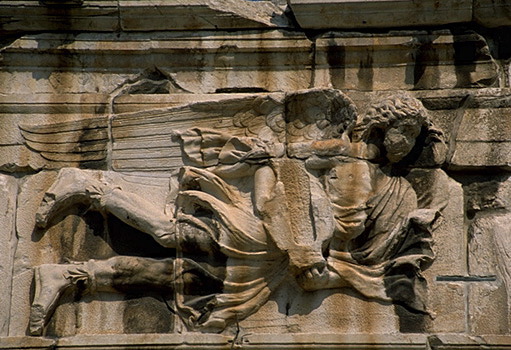
And a bonus – Notos on the Tower of the Winds in Athens. He is holding a water jar for the downpours he brings.

Onions, hair, and fish – a conversation with Jupiter.

From Plutarch’s life of Numa (ch. 15, pg. 358 of the Loeb vol. 1 of Lives) and below another version from Ovid’s Fasti (3.330, also in the Loeb edition). Found via a side remark in George Dumezil’s Mitra-Varuna.

But nothing can be so strange as what is told about [Numa’s] conversation with Jupiter … Some, however, say that it was not the imps themselves who imparted the charm [of onions, hair, and little fish against thunder and lightning], but that they called Jupiter down from heaven by their magic, and that this deity angrily told Numa that he must charm thunder and lightning with “heads.” “Of onions?” asked Numa, filling out the phrase. “Of men,” said Jupiter. Thereupon Numa, trying once more to avert the horror of the prescription, asked, “with hair?” “Nay,” answered Jupiter, “with living—” “fish?” added Numa, as he had been taught by Egeria to say. Then the god returned to heaven in a gracious mood,—“hileos,” as the Greeks say,—and the place was called Ilicium from this circumstance; and that is the way the charm was perfected.

πᾶσαν δὲ ὑπερβέβληκεν ἀτοπίαν τὸ ὑπὲρ τῆς τοῦ Διὸς ὁμιλίας ἱστορούμενον. μυθολογοῦσι γὰρ εἰς τὸν Ἀβεντῖνον λόφον οὔπω μέρος ὄντα τῆς πόλεως οὐδὲ συνοικούμενον, ἀλλ᾿ ἔχοντα πηγάς τε δαψιλεῖς ἐν αὑτῷ καὶ νάπας σκιεράς, φοιτᾶν δύο δαίμονας, Πῖκον καὶ Φαῦνον· οὓς τὰ μὲν ἄλλα Σατύρων ἄν τις ἢ Πανῶν γένει προσεικάσειε, δυνάμει δὲ φαρμάκων καὶ δεινότητι τῆς περὶ τὰ θεῖα γοητείας λέγονται ταὐτὰ τοῖς … ἔνιοι δὲ οὐ τοὺς δαίμονάς φασιν ὑποθέσθαι τὸν καθαρμόν, ἀλλ᾿ ἐκείνους μὲν καταγαγεῖν τὸν Δία μαγεύσαντας, τὸν δὲ θεὸν ὀργιζόμενον τῷ Νομᾷ προστάσσειν ὡς χρὴ γενέσθαι τὸν καθαρμὸν κεφαλαῖς· ὑπολαβόντος δὲ τοῦ Νομᾶ, “κρομμύων;” εἰπεῖν, “ἀνθρώπων·” τὸν δὲ αὖθις ἐκτρέποντα τὸ τοῦ προστάγματος δεινὸν ἐπερέσθαι, “θριξίν;” ἀποκριναμένου δὲ τοῦ Διός, “ἐμψύχοις,” ἐπαγαγεῖν τὸν Νομᾶν, “μαινίσι;” ταῦτα λέγειν ὑπὸ τῆς Ἠγερίας δεδιδαγμένον. καὶ τὸν μὲν θεὸν ἀπελθεῖν ἵλεω γενόμενον, τὸν δὲ τόπον Ἰλίκιον ἀπ᾿ ἐκείνου προσαγορευθῆναι καὶ τὸν καθαρμὸν οὕτω συντελεῖσθαι.

And Ovid:

Sure it is the tops of the Aventine trees did quiver, and the earth sank down under the weight of Jupiter. The king’s heart throbbed, the blood shrank from his whole body, and his bristling hair stood stiff. When he came to himself, “King and father of the high gods,” he said, “vouchsafe expiations sure for thunderbolts, if with pure hands we have touched thine offerings, and if for that which now we ask a pious tongue doth pray.” The god granted his prayer, but hid the truth in sayings dark and tortuous, and alarmed the man by an ambiguous utterance. “Cut off the head,” said he.a The king answered him, “We will obey. We’ll cut an onion, dug up in my garden.” The god added, “A man’s.” “Thou shalt get,” said the other, “his hair.” The god demanded a life, and Numa answered him, “A fish’s life.” The god laughed and said, “See to it that by these things thou dost expiate my bolts, Ο man whom none may keep from converse with the gods!

constat Aventinae tremuisse cacumina silvae,
terraque subsedit pondere pressa Iovis.
corda micant regis, totoque e corpore sanguis
fugit, et hirsutae deriguere comae.
ut rediit animus, “da certa piamina” dixit
“fulminis, altorum rexque paterque deum,
si tua contigimus manibus donaria puris,
hoc quoque, quod petitur, si pia lingua rogat.”
adnuit oranti, sed verum ambage remota
abdidit et dubio terruit ore virum.
“caede caput” dixit: cui rex “parebimus,” inquit
“caedenda est hortis eruta cepa meis.”
addidit hic “hominis”: “sumes” ait ille “capillos.”
postulat hic animam, cui Numa “piscis” ait.
risit et “his” inquit “facito mea tela procures,
o vir conloquio non abigende deum.