Too independent to be bound by pretense

From Red Pine’s translation of the poetry of Tao Yuanming, Choosing To Be Simple. I’ve had this title since its release last October but held it with patience as an end of academic year treat as Red Pine’s choices never disappoint.

The intro to this poem reads: “Written in the eleventh month of 405 [CE] near Shangjingli. Yuan-ming was forty-one. According to Confucius, a man should be free of doubts at forty (Lunyu 2.4). Yuanming moved to Pengze at the beginning of autumn to assume the post of magistrate – a post he quit eighty days later. The poem begins with the boat trip home —wonderfully depicted by the Song artist Li Gonglin in Returning Home. During the Jin, Pengze was located on the east shore of Poyang Lake. Yuanming’s home was across the Pengze Channel, fifty kilometers to the west.”

We were poor and couldn’t support ourselves by farming. With our house filled with children, and the rice bins empty of reserves, we didn’t have the means to go on. Friends and relatives had been urging me to serve as an official, and I finally considered such an unlikely path. It sometimes happened that I had things to do in the area, and the local notables thought me a considerate person. Knowing I was poor, an uncle found me a job in a small town. Conditions there were unsettled at the time, and I was worried about serving so far away—Pengze was a hundred li. But since the salary from government fields was sufficient to supply me with wine, I accepted. However, it didn’t take long before I thought about going home. Why? Because my nature is simply too independent to be bound by pretense. Despite the pain from hunger and cold, that from disobeying myself was even worse. Whenever I have engaged in worldly affairs, it has involved working for my mouth and stomach. Reflecting on my lifelong principles, I felt depressed and ashamed. Still, I hoped at the end of the year I could pack my clothes and leave at night. Then it happened that my sister, who had married into the Cheng family, died in Wuchang, Hence, I gave up my position voluntarily and hurried there. Between autumn and winter, I spent over eighty days in office. Since things worked out as I had hoped, I have entitled this piece “Returning Home” and dated the preface “the eleventh month of the year 405.”

I’m returning home
the garden would be all weeds if I didn’t
since enslaving my heart to my body
how depressed and miserable I have been
I realized I couldn’t restore the past
but I could make up for it in the future
I hadn’t gone too far astray
I was wrong yesterday but right today
my boat rocked in the lightest of winds
a gust blew open my robe
I asked a traveler about the way ahead
annoyed the dawn was so dim.
Seeing my roofline
I was so happy I ran
our houseboy was there to greet me
my children were waiting at the door
the paths around the yard were overgrown
but the pines and chrysanthemums were still there
I led my children into the house
a pitcher of wine was waiting.
I lifted it up and poured
looking out the south window I felt relieved
glad to see the fruit trees outside
it was so easy to be content with so little
I walked around the garden all day entranced
the gate was there but closed as usual
with the help of a cane I found my favorite spots
looking up I gazed into the distance
at mindless clouds rising from the peaks
at weary birds knowing to fly home
as the light began to fade
I touched a lone pine and stood there.
I’ve returned home
I’ve cut my ties and ended my missions
the world and I never got along
why keep traveling and searching
when I’m happy with the heartfelt talk of friends
and my care-dispelling books and zither
the neighbors say spring is nearly here
work in the west fields will start soon
instead of calling for a covered cart
I’ll be rowing my little boat
following secluded waterways
hiking in the higher hills
trees are budding and beginning to bloom
springs are bubbling and starting to flow
I admire how creatures adjust to the seasons
but I feel my life is coming to an end.
It’s over
so I won’t be staying in this world much longer
why not let my heart go if it wants
why am I worried where I’ll end up.
What I hope for isn’t wealth or fame
nor the realm of the gods
but to go somewhere on a sunny day alone
or put aside my cane and plow
or climb the east hills and drone
or write a poem by a stream
ride my transformation to my final home
enjoy the will of Heaven free of doubts.

Today when I met Lao-tzu, it was like meeting a dragon

From Red Pine’s introduction to his edition of the Taoteching.  Something like a Chinese version of Solon and Croesus, only with better thinkers and more likely to be true.

In the same year [516BC], the Keeper of the Royal Archives, which were still in
Wangcheng, received a visitor from the state of Lu. The visitor was a young
man named Kung Fu-tzu, or Confucius. Confucius was interested in ritual
and asked Lao-tzu about the ceremonies of the ancient kings.

According to Ssu-ma Ch’ien, Lao-tzu responded with this advice: “The ancients you admire have been in the ground a long time. Their bones have
turned to dust. Only their words remain. Those among them who were wise
rode in carriages when times were good and slipped quietly away when times
were bad. I have heard that the clever merchant hides his wealth so his store
looks empty and that the superior man acts dumb so he can avoid calling
attention to himself. I advise you to get rid of your excessive pride and
ambition. They won’t do you any good. This is all I have to say to you.” Afterwards, Confucius told his disciples, “Today when I met Lao-tzu, it was like
meeting a dragon.”

… invariably end up as bear food

From Written in Exile: The Poetry of Liu Tsung-Yuan, translated by Red Pine

II. THE BEAR
Deer are afraid of wildcats, wildcats are afraid of tigers, and tigers are afraid of bears. Covered with long shaggy hair and able to stand upright, bears possess exceptional strength and are capable of killing people. In the south of Ch’u there once was a hunter who could make all kinds of animal calls with his flute. One day he took his bow and arrows and his firepot into the mountains, and he made a call to attract deer. He waited, and when a deer appeared, he started a fire, then he shot the deer. But when a wildcat heard the deer call, it came too. The hunter was terrified and pretended to be a tiger to frighten it. But when the wildcat ran off, a tiger appeared. The man was even more terrified and pretended to be a bear. The tiger disappeared. But a bear heard the call and came looking for a mate. When it saw the man, it grabbed him and tore him apart and ate him. It turns out that those who rely on external aids instead of developing what they have within themselves invariably end up as bear food.

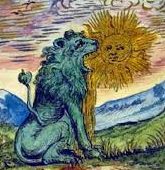
Using a pet tiger as a naptime pillow

bukan
by Kanō Tan’yū

From Red Pine’s introduction to his Collected Songs of Cold Mountain:

Despite Kuoching’s famous philosopher monks, whenever Cold Mountain visited, he preferred the company of Big Stick (Feng-kan) and Pickup (Shih-te), two men equally cloaked in obscurity.  According to the few early accounts we have of him, Big Stick Suddenly appeared on day riding through the temple’s front gate on the back of a tiger.  He was over six feet tall.  And unlike other monks, he didn’t shave his head but let his hair hang down to his eyebrows.  He took up residence in a room behind the temple library and came and went as he liked.  Whenever anyone asked him about Buddhism, all he would say was, “Whatever.” Otherwise, he hulled rice during the day and chanted hymns at night.

In James Sanford’s introduction to Shi-shu in The Clouds Should Know Me By Now: Buddhist Poet Monks of China we get this extra image:

[Cold Mountain’s collected songs] also contain … two poems attributed to their somewhat reclusive fellow traveler, the Zen monk Feng-kan (perhaps best known for his habit of using a pet tiger as a naptime pillow)


How many times will you still sleep / with a jug of wine by your bed

By Kao Shih, from Red Pine’s translation of Poems of the [Thousand] Masters:

To Chang Hsu after Drinking

The world is full of fickle people
you old friend aren’t one
inspired you write like a god
drunk you’re crazier still
enjoying white hair and idle days
blue clouds now rise before you
how many times will you still sleep
with a jug of wine by your bed

And Red Pine’s endearingly unique commentary:

Chang Hsu (fl. 750) was one of China’s greatest calligraphers and was famous for his cursive script, which became more inspired as he drank.  When I was first living in Taiwan, whenever I had to go to Hong Kong to renew my visa I asked my calligraphy teacher (Chuang Yen, curator of the Palace Museum’s Calligraphy and Painting Collection) if I could bring him back brushes or ink, as people in Taiwan were still forbidden to travel to China. But all he ever asked for was Tachu White Lightning. He said he did his best work before dawn, after a cup or two. Chang also loved to drink and was ranked among the Eight Immortals of Wine. It’s said he kept a jug beside his bed so he could drink as soon as he woke up. Blue clouds represent high position and refer to his new post as court calligrapher, which required earlier hours than he was used to. Kao Shih 716-765 uses two of Chang’s nicknames here: ts’ao-sheng (god of shorthand) and tien (crazy).

Let others become buddha or immortals

From Red Pine’s translation of Stonehouse’s (Shiwu) Mountain Poems – poem 142.

Parched wheat and pine pollen make a fine meal
vine flowers and salted bamboo make a tasty dish
when I’m exhausted I think of nothing else
let others become buddha or immortals

I also very much enjoy Red Pine’s commentary and chose this poem out of a handful of similar ones mainly for his sideline contribution.  He is entirely non-traditional – at least for western philology – but utterly charming.

Pine pollen is collected in late spring or early summer.  “Vine flowers” refers to wisteria blossoms, which are removed individually from each raceme and stir-fried.  At the monastery in Taiwan where I lived for several years, we dined through the summer on stir-fried daylily blossoms, picked a day or two before they were due to open.  Among the mountain-dwelling Aini in Yunnan province, I also enjoyed stir-fried bauhinia flowers.