Wheezes out law-phrase, whiffles Latin forth

A masterful portrait of an attorney from Book 1 of Robert Browning’s The Ring and the Book (1124-1161), this being the public defender for the man (and colleagues) accursed of murdering his wife. The notes are adapted from v.7 of the Oxford edition.

One lawyer shall admit us to behold
The manner of the making out a case,
First fashion of a speech; the chick in egg,
The masterpiece law’s bosom incubates.
How Don Giacinto of the Arcangeli,
Called Procurator of the Poor at Rome,
Now advocate for Guido and his mates,—
The jolly learned man of middle age,
Cheek and jowl all in laps with fat and law,
Mirthful as mighty, yet, as great hearts use,
Despite the name and fame that tempt our flesh,
Constant to that devotion of the hearth,
Still captive in those dear domestic ties!—
How he,—having a cause to triumph with,
All kind of interests to keep intact,
More than one efficacious* personage
To tranquillize, conciliate and secure,
And above all, public anxiety
To quiet, show its Guido in good hands,—
Also, as if such burdens were too light,
A certain family-feast to claim his care,
The birthday-banquet for the only son—
Paternity at smiling strife with law—
How he brings both to buckle in one bond;
And, thick at throat, with waterish under-eye,
Turns to his task and settles in his seat
And puts his utmost means in practice now:
Wheezes out law-phrase, whiffles** Latin forth,
And, just as though roast lamb would never be,
Makes logic levigate*** the big crime small:
Rubs palm on palm, rakes foot with itchy foot,
Conceives and inchoates**** the argument,
Sprinkling each flower appropriate to the time,
—Ovidian quip or Ciceronian crank,
A-bubble in the larynx while he laughs,
As he had fritters deep down frying there.
How he turns, twists, and tries the oily thing
Shall be—first speech for Guido ‘gainst the Fisc.

* – A Browning-ism – as ‘influential’
** – speaks in a whistling, breathy way. The description makes great play with Arcangeli being fat and rheumy.
*** – break down (into fragments), rub or grind (to a fine powder) from Med. L levigabilis
**** – begins, commences, from L. incohare or inchoare. This self-consciously Latinate word, like ‘levigate‘ before, is a comic suggestion of Arcangeli’s obsession with Latinity and his rhetorical pomp. OED records uses by Donne and Henry More, two of Browning’s favourite writers.

Julius Caesar and the Pied Piper

Returning to my earlier difficulty with these lines in Robert Browning’s Pied Piper of Hamelin:

Save one who, stout as Julius Caesar,
Swam across and lived to carry
(As he the manuscript he cherished)
To Rat-land home his commentary,

The short of it is that someone is confused, though it’s impossible to say whether it is Browning, his possible source, his recent editors, or me. The trouble is Browning’s choice of words – manuscript for what Caesar carries and commentary for what the rat to which he is compared carries. This choice encourages – but does not require – understanding an equivalency between the two words (i.e. Caesar’s manuscript was a commentary) and recent editors seem to take this possibility as a given.

Accordingly the editors of the OET Poetical Works of Robert Browning (v.3, pg. 286) comment on this passage:

as Lemprière records, the Commentaries on the Gallic wars were ‘nearly lost; and when Caesar saved his life in the bay of Alexandria, he was obliged to swim from his ship, with his arms in one hand and his commentaries in the other’. The story is likely to have been familiar to Willie Macready [the boy for whom the poem was written], since selections from Caesar are often read by beginners at Latin.

The source referenced is John Lemprière’s 1788 Bibliotheca Classica: or, A classical dictionary. In his entry on Caesar Lemprière has:

The learning of Cæsar deserves commendation, as well as his military character. He reformed the calendar. He wrote his commentaries on the Gallic wars, on the spot where he fought his battles; and the composition has been admired for the elegance as well as the correctness of its style. This valuable book was nearly lost; and when Cæsar saved his life in the bay of Alexandria, he was obliged to swim from his ship, with his arms in one hand and his commentaries in the other.

The Brownings owned at least two copies of this work so it’s not unreasonable to surmise that Browning’s account derived from the source, as (I think, though it’s been a while) is demonstrable with some other references.

The Longman editors follow suit but relate the saving of the manuscript as simple historical fact:

When Caesar’s ship was captured at Alexandria, he swam ashore carrying the MS of his historical memoir De Gallico Belli [=De Bello Gallico]; such texts were known as ‘commentarii.’ Oxford notes that Willie Macready probably knew the story, ‘since selections from Caesar are often read by beginners at Latin.’

The problem here is that none of the major classical sources mention what specifically Caesar saved. Here are Suetonius, Plutarch, and Cassius Dio.

At Alexandria, while assaulting a bridge, he was forced by a sudden sally of the enemy to take to a small skiff; when many others threw themselves into the same boat, he plunged into the sea, and after swimming for two hundred paces, got away to the nearest ship, holding up his left hand all the way, so as not to wet some papers (ne libelli quos tenebat madefierent) which he was carrying, and dragging his cloak after him with his teeth, to keep the enemy from getting it as a trophy

Suetonius Caesar 64

when a battle arose at Pharos, he sprang from the mole into a small boat and tried to go to the aid of his men in their struggle, but the Egyptians sailed up against him from every side, so that he threw himself into the sea and with great difficulty escaped by swimming. At this time, too, it is said that he was holding many papers in his hand ( ὅτε καὶ λέγεται βιβλίδια κρατῶν πολλὰ) and would not let them go, though missiles were flying at him and he was immersed in the sea, but held them above water with one hand and swam with the other;

Plutarch Caesar 49

While the fugitives were forcing their way into these in crowds anywhere they could, Caesar and many others fell into the sea. He would have perished miserably, being weighted down by his robes and pelted by the Egyptians (for his garments, being of purple, offered a good mark), had he not thrown off his clothing and then succeeded in swimming out to where a skiff lay, which he boarded. In this way he was saved, and that, too, without wetting one of the documents of which he held up a large number in his left hand as he swam (μηδὲν τῶν γραμμάτων βρέξας ἃ πολλὰ ἐν τῇ ἀριστερᾷ χειρὶ ἀνέχων ἐνήξατο).

Dio Cassius 42.40

The vocabulary of these sources is all very general:

  • libellus – a little book, pamphlet, manuscript, writing
  • βιβλίδια – a rare diminuitive of βιβλίον (just as libellus is of liber) – with the same range of meanings as above
  • γραμμάτων – plural of γράμμα – letter of the alphabet in singular; papers, documents, writings in the plural

Browning’s word choices ‘manuscript’ and ‘commentary’ are in line with any of the sources (the linked definitions provide the full range of offerings, though you sometimes need to use the non-English dictionaries to see them) so it’s not necessary to posit Lemprière as intermediary, especially if you allow for the possibility that Browning’s classical education would have naturally led him to associate Caesar with commentaries anyway. With a bit of either memory haziness or intentional poetic fudging he could reasonably have assumed or invented the equivalency on his own. He could equally well have intended no equivalency between ‘manuscript’ and ‘commentary’ and simply have been furthering the comparison of Caesar (author of commentaries) with the surviving rat (who delivers a commentary).

And then we have what started this sinkhole, the question of timeline. The tale of Caesar saving his libelli/βιβλίδια/γραμμάτα takes place in 47BCE. Modern scholarly consensus holds that Caesar’s commentaries on the Gallic wars, whether published annually or in a batch, would have been available by probably 50BCE (this is in no way my area of interest so see Kurt Raaflaub’s chapter in The Cambridge Companion to Julius Caesar for a brief summary and direction to fuller bibliography). I have no idea what late 18th century scholarship thought on this topic but I can’t help finding it very odd that Lemprière would have insisted Caesar saved his De Bello Gallico rather than the unfinished Commentarii de Bello Civile (covering years 49-48 BCE) he would’ve been more likely been working on at the time.

So all of this leaves us with the following list of possibilities:

  • Lemprière follows a (for my purposes) unknown predecessor in asserting the ‘papers’ Caesar saved were his De Bello Gallico and Browning then follows him.
  • Lemprière independently concludes the papers Caesar saved were his De Bello Gallico, disregarding an accepted publication timeline. Browning again follows him.
  • A non-Lemprière source misleads Browning in either of the above ways.
  • Browning arrives at his lines independently and mistakenly remembers the saved papers as the Gallic war commentaries.
  • Browning arrives at his lines independently and implicitly presents the saved papers as the Gallic war commentaries just because the boy for whom the poem was written would have known that work over others.
  • Browning arrives at his lines independently and intends the boy for whom the poem was written to understand ‘Civil War commentaries’ since he would have known that work. Modern editors lack classical education and miss the reference.
  • Browning arrives at his lines independently and, a better classical scholar than his editors believed, assumed the papers were Caesar’s never-completed commentaries on the civil war. The boy’s presumed knowledge does not factor into it.
  • Browning arrives at his lines independently and intends no comparison between ‘manuscript’ and ‘commentary’, just between Caesar and the surviving rat.
  • This has driven me mad.

I like the last.

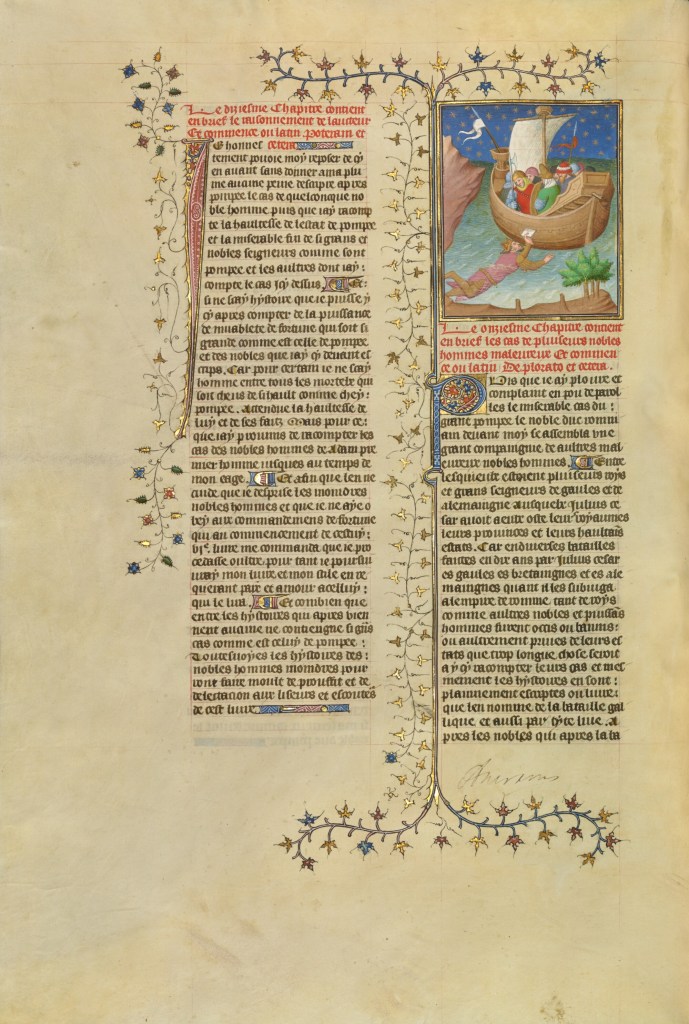
Here’s a 15th century image from the Getty of Caesar saving what a three-drink dinner encourages me to regard as a new possibility equally supported by the primary sources – a cocktail menu.

Into the street the Piper stept

From Robert Browning’s The Pied Piper of Hamelin (scroll down a bit if you follow the link).

Into the street the Piper stept,
Smiling first a little smile,
As if he knew what magic slept
In his quiet pipe the while;
Then, like a musical adept,
To blow the pipe his lips he wrinkled,
And green and blue his sharp eyes twinkled,
Like a candle-flame where salt is sprinkled;
And ere three shrill notes the pipe uttered,
You heard as if an army muttered;
And the muttering grew to a grumbling;
And the grumbling grew to a mighty rumbling;
And out of the houses the rats came tumbling.
Great rats, small rats, lean rats, brawny rats,
Brown rats, black rats, grey rats, tawny rats,
Grave old plodders, gay young friskers,
Fathers, mothers, uncles, cousins,
Cocking tails and pricking whiskers,
Families by tens and dozens,
Brothers, sisters, husbands, wives —
Followed the Piper for their lives.
From street to street he piped advancing,
And step for step they followed dancing,
Until they came to the river Weser
Wherein all plunged and perished
— Save one who, stout as Julius Caesar,
Swam across and lived to carry
(As he the manuscript he cherished)
To Rat-land home his commentary,
Which was, At the first shrill notes of the pipe,
I heard a sound as of scraping tripe,
And putting apples, wondrous ripe,
Into a cider-press’s gripe:
And a moving away of pickle-tub-boards,
And a leaving ajar of conserve-cupboards,
And a drawing the corks of train-oil-flasks,
And a breaking the hoops of butter-casks;
And it seemed as if a voice
(Sweeter than by harp or by psaltery
Is breathed) called out, Oh rats, rejoice!
The world is grown to one vast drysaltery!
‘So munch on, crunch on, take your nuncheon,
‘Breakfast, supper, dinner, luncheon!
And just as one bulky sugar-puncheon,
Ready staved, like a great sun shone
Glorious scarce an inch before me,
Just as methought it said, Come, bore me!
— I found the Weser rolling o’er me.

Since it is off the topic at hand I will make another post (The other post!) later on the reference to Julius Caesar saving his commentary. The standard explanation across the Longman, Ohio, and Oxford editions of Browning’s poems is to the effect that – quoting the Longman – ‘when Caesar’s ship was captured at Alexandria, he swam ashore carrying the MS of his historical memoir, De Gallico Belli (my Latin conscience has to correct that to De Bello Gallico).’ There are problems with this.

Thunder looses beds of eels

From Shakespeare’s Pericles, Prince of Tyre (4.2, the firmly Shakespearean portion of the play beginning at act 3):

I warrant you, mistress, thunder
shall not so awake the beds of eels as my giving
out her beauty stir up the lewdly-inclined.

The clear phallic play aside, the Arden note adds:

If not a proverb – Dent questions (?T276) ‘Thunder looses beds of eels’ – this was certainly a common zoological belief, appearing in Marston’s Scourge of Villainy (1598) and George Wither’s Abuses Stripped and Whipped (1613).

Dent in both Shakespeare’s Proverbial Language and the more catchingly titled Proverbial Language in English Drama Exclusive of Shakespeare, 1495–1616 is cagey about asserting the proverb despite compiling four other instances of the belief. In the former he cites:

1598 Marston Satire 7.78 – They are naught but Eeles, that never will appeare, / Till that tempestuous winds or thunder teare / Their slimie beds.

1613 G. Wither Abuses ed. 1863 168: Let loose, like beds of eels by thunder.

cl620 (1647) Fletcher & Massinger, False One 4.2.200f.: I’ll break like thunder / Amongst these beds of slimy Eeeles.

And in the latter adds:

1615 S.S. Honest Lawyer II C3v: Shall we cling, like a couple of Eeles, not to bee dissolv’d but by Thunder?

None of this addresses the question of the origin of the idea of eels fearing/stirred up by thunder, which is what I mainly cared about. I don’t have a definite answer, but I do have a logical chain. We begin with Pliny, as anyone seeking answers on odd beliefs about animals should do (Natural History 9.38):

Eels live eight years. They can even last five or six days at a time out of water if a north wind is blowing, but not so long with a south wind. But the same fish cannot endure winter in shallow nor in rough water; consequently they are chiefly caught at the Pleiads, as the rivers are then specially rough. They feed at night. They are the only fish that do not float on the surface when dead. There is a lake called Garda in the territory of Verona through which flows the river Mincio, at the outflow of which on a yearly occasion, about the month of October, when the lake is made rough evidently by the autumn star, they are massed together by the waves and rolled in such a marvellous shoal that masses of fish, a thousand in each, are found in the receptacles constructed in the river for the purpose.

I’ve edited the above to translate circa verginias as ‘at the Pleaids’ rather than ‘at the rising of the Pleaids’ since I think this confuses the issue.

The Pleiades were associated in the ancient world with storms at both their rise in Spring (April-ish) and especially their setting in Fall (Oct-Nov). So Hesiod in Works and Days (615-622):

 When the Pleiades and Hyades and the strength of Orion set [in October], that is the time to be mindful of plowing in good season. May the whole year be well-fitting in the earth. But if desire for storm-tossed seafaring seize you: when the Pleiades, fleeing Orion’s mighty strength, fall into the murky sea, at that time [in November] blasts of all sorts of winds rage; do not keep your boat any longer in the wine-dark sea at that time

Later Ovid in Heroides (18.187):

What when the seas have been assailed by the Pleiad, and the guardian of the Bear, and the Goat of Olenos? Either I know not how rash I am, or even then a love not cautious will send me forth on the deep

And a last instance in Statius’ Silvae (3.2.71):

Hence raging winds and indignant tempests and a roaring sky and more lightning for the Thunderer. Before ships were, the sea lay plunged in torpid slumber, Thetis did not joy to foam nor billows to splash the clouds. Waves swelled at sight of ships and tempest rose against man. ’Twas then that Pleiad and Olenian Goat were clouded and Orion worse than his wont.

It doesn’t seem a far leap to take that Pliny’s reported pattern of eel behavior and eel hunting season, whether scientifically accurate or not, was understood as connected to the rising or setting of the Pleiades and so to the stormy season. Hence by shorthand approximation to thunder generally. And so eels, unable to deal with storms or the rough water that follow, were viewable as loosed from bed by thunder.

To all this my vanity adds a much later reference in the opening of Robert Browning’s Old Pictures in Florence. I was proud of this as altogether my own but in due diligence checking the most recent edition of John Marston’s poetry (The Poems of John Marston ed. Arnold Davenport) I found a previous editor of the same (Bullen) had also pointed out the quote, taking it as Browning reporting a piece of ‘Italian folk-lore’:

The morn when first it thunders in March,
The eel in the pond gives a leap

I sometimes feel bad about doing these things on work time but I work for a university so it should all wash out as research.

Fancy with fact is just one fact the more

From Robert Browning’s The Ring and The Book (1.451-526), the narrator responding to an imagined reader’s question about the nature of the poem’s tale.

“A pretty piece of narrative enough,
“Which scarce ought so to drop out, one would think,
“From the more curious annals of our kind.
“Do you tell the story, now, in off-hand style,
“Straight from the book? Or simply here and there,
“(The while you vault it through the loose and large)
“Hang to a hint? Or is there book at all,
“And don’t you deal in poetry, make-believe,
“And the white lies it sounds like?”

Yes and no!
From the book, yes; thence bit by bit I dug
The lingot truth, that memorable day,
Assayed and knew my piecemeal gain was gold,—
Yes; but from something else surpassing that,
Something of mine which, mixed up with the mass,
Made it bear hammer and be firm to file.
Fancy with fact is just one fact the more;
To-wit, that fancy has informed, transpierced,
Thridded and so thrown fast the facts else free,
As right through ring and ring runs the djereed
And binds the loose, one bar without a break.
I fused my live soul and that inert stuff,
Before attempting smithcraft, on the night
After the day when,—truth thus grasped and gained,—
The book was shut and done with and laid by
On the cream-coloured massive agate, broad
‘Neath the twin cherubs in the tarnished frame
O’ the mirror, tall thence to the ceiling-top.
And from the reading, and that slab I leant
My elbow on, the while I read and read,
I turned, to free myself and find the world,
And stepped out on the narrow terrace, built
Over the street and opposite the church,
And paced its lozenge-brickwork sprinkled cool;
Because Felice-church-side stretched, a-glow
Through each square window fringed for festival,
Whence came the clear voice of the cloistered ones
Chanting a chant made for midsummer nights—
I know not what particular praise of God,
It always came and went with June. Beneath
I’ the street, quick shown by openings of the sky
When flame fell silently from cloud to cloud,
Richer than that gold snow Jove rained on Rhodes,
The townsmen walked by twos and threes, and talked,
Drinking the blackness in default of air—
A busy human sense beneath my feet:
While in and out the terrace-plants, and round
One branch of tall datura, waxed and waned
The lamp-fly lured there, wanting the white flower.
Over the roof o’ the lighted church I looked
A bowshot to the street’s end, north away
Out of the Roman gate to the Roman road
By the river, till I felt the Apennine.
And there would lie Arezzo, the man’s town,
The woman’s trap and cage and torture-place,
Also the stage where the priest played his part,
A spectacle for angels,—ay, indeed,
There lay Arezzo! Farther then I fared,
Feeling my way on through the hot and dense,
Romeward, until I found the wayside inn
By Castelnuovo’s few mean hut-like homes
Huddled together on the hill-foot bleak,
Bare, broken only by that tree or two
Against the sudden bloody splendour poured
Cursewise in day’s departure by the sun
O’er the low house-roof of that squalid inn
Where they three, for the first time and the last,
Husband and wife and priest, met face to face.
Whence I went on again, the end was near,
Step by step, missing none and marking all,
Till Rome itself, the ghastly goal, I reached.
Why, all the while,—how could it otherwise?—
The life in me abolished the death of things,
Deep calling unto deep: as then and there
Acted itself over again once more
The tragic piece. I saw with my own eyes
In Florence as I trod the terrace, breathed
The beauty and the fearfulness of night,
How it had run, this round from Rome to Rome—

And she turned from the picture at night to scheme of tearing it out for herself next sun.

From Robert Browning’s The Statue and The Bust (142-153), online in full here.

Meantime, worse fates than a lover’s fate,
Who daily may ride and pass and look
Where his lady watches behind the grate!

And she — she watched the square like a book
Holding one picture and only one,
Which daily to find she undertook:

When the picture was reached the book was done,
And she turned from the picture at night to scheme
Of tearing it out for herself next sun.

So weeks grew months, years; gleam by gleam
The glory dropped from their youth and love,
And both perceived they had dreamed a dream;

I give four stanzas for more stable context but it’s really only the image in the second and third that I’m especially struck by. Browning was always tinkering with his work and this one had a couple of small but possibly significant tweaks along the way. The 1855 proofs of Men and Women read:

When the picture came the book was done,
And she turned from it all night to scheme
Of tearing it out for herself next sun.

And an 1863 Selections alters the second line above to:

And she turned from the picture all night

I somewhat like the 1855 proof version more than the final. The picture is of course the Duke Ferdinand and his actively riding by is what puts an end to the unnamed lady’s ‘reading’ each day (since the picture can’t ‘be reached’ without his ‘coming’). Then ‘all night’ over ‘at night’ seems better to hit the lady’s subjective sense of their separation’s painful duration .

But if the final reading loses something inside the image, it seems better to blend with the poem overall. The grammatical passivity of ‘was reached’ can be aligned with the moral failing of characters who continue waiting for a resolution to ‘be presented’ to them. ‘Was reached’ then contributes to what feels a meaningful splitting of verbs throughout the stanza – two passives (was reached, was done) and one active with a negative value (turn from). Given the nature of the characters, it is appropriate both that passivity would dominate and that the single action actively taken would move not towards resolution but a resetting and perpetuation of the situation. That line of reasoning pushes further if you include the negative values of the nonfinite verbals ‘to scheme’ and ‘tearing it out.’ Finally, ‘at night’ over ‘all night’ I take as emphasizing the iterative element – that by the time of narration the action is a routine one that has somewhere lost the pain and become so sadly – because simply accepted – neutral.

Nor hope rekindling at the end descried, so much as gladness that some end might be

The second, third, and fourth stanzas of Robert Browning’s Childe Roland to the Dark Tower Came, after Roland encounters the ‘hoary cripple, with malicious eye’ who points the way to the tower:

What else should he be set for, with his staff?
What, save to waylay with his lies, ensnare
All travellers who might find him posted there,
And ask the road? I guess’d what skull-like laugh
Would break, what crutch ’gin write my epitaph
For pastime in the dusty thoroughfare,

If at his counsel I should turn aside
Into that ominous tract which, all agree,
Hides the Dark Tower. Yet acquiescingly
I did turn as he pointed: neither pride
Nor hope rekindling at the end descried,
So much as gladness that some end might be.

For, what with my whole world-wide wandering,
What with my search drawn out thro’ years, my hope
Dwindled into a ghost not fit to cope
With that obstreperous joy success would bring,—
I hardly tried now to rebuke the spring
My heart made, finding failure in its scope.

Louise Macneice – who did a radio play adaptation of the poem in the mid 40s – said of its meaning:

‘a work which does not admit of a completely rational analysis and [one which] still less adds up to any clear moral or message. This poem has the solidity of a dream; the writer of such a poem, though he may be aware of the “meanings” implicit in his dream, must not take the dream to pieces, … must allow the story to persist as a story and not dwindle into a diagram.

Several decades later Harold Bloom – who, in my experience, never refused his intellect the delight of diagramming – had this opening to his article How to Read a Poem: Browning’s Childe Rolande (Georgia Review 28.3):

The reader, like Browning’s belated quester, might wish to separate origins like from Browning’s aims, but the price of internalization in poetic as in human romance, is that aims wander back towards origins. A study of misprision allows the reader to see that interpretation of Browning’s great poem is mocked by the poem itself, since Roland’s monologue is his sublime and grotesque exercise of the will-to-power over the interpretation of his own text. Roland rides with us as interpreter; his every interpretation is a powerful misreading; and yet the union of those misreadings enables him to accept destruction in the triumphant realization that his ordeal, his trial by landscape, has provided us with one of the most powerful of texts that any hero-villain since Milton’s Satan has given us.

The poem’s opening swerve is marked rhetorically by the trope of irony, imagistically by an interplay of presence and absence, and psychologically by Roland’s reaction-formation against his own destructive impulses. All this is as might be expected, but Browning’s enormous skill at substitution is evident as his poem gets underway, for the strong poet shows his saving difference from himself as well as others even in his initial phrases. Roland says one thing and means another, and both the saying and the meaning seek to void a now intolerable presence. For a Post-Enlightment poem to begin, it must know and demonstrate that nothing is in its right place. Displacement affects at once the precursor and the poet’s own earlier or idealized self, as these were a near-identity. But the precursor, like the idealized self, does not locate only in the superego or ego ideal. For a poet, both the youth he was and his imaginative father reside also in the poetic equivalent of the id. In Romantic quest or internalized romance, an object of desire or even a sublimated devotion to an abstract idea cannot replace the precursor-element in the id, but it does replace the ego ideal, as Freud posited. For Roland, the Dark Tower has been put in the place of the ego ideal of traditional quest, but the obsessed Childe remains haunted by precursor-forces and traces of his own former self in the id. Against these forces, his psyche has defended itself by the cramping reaction-the formation of his will-to-fail, his perverse and negative stance that begins the poem.

Heaven opened to a soul while yet on earth, Earth forced on a soul’s use while seeing heaven

From Robert Browning’s An Epistle Containing the Strange Medical Experience of Karshish, The Arab Physician, in his Men and Women. The full poem – an outsider’s account of encountering Lazarus long after his resurrection – is online here.

Not terribly related but John Ruskin made amusing mention of this one in a letter to Browning about the collection – “I can’t say I have really made out any one yet … except the epistle from the Arabian physician, which I like immensely.”

This grown man eyes the world now like a child.
Some elders of his tribe, I should premise,
Led in their friend, obedient as a sheep,
To bear my inquisition. While they spoke, 120
Now sharply, now with sorrow, told the case,
He listened not except I spoke to him,
But folded his two hands and let them talk,
Watching the flies that buzzed: and yet no fool.
And that’s a sample how his years must go.
Look, if a beggar, in fixed middle-life,
Should find a treasure, can he use the same
With straitened habits and with tastes starved small,
And take at once to his impoverished brain
The sudden element that changes things, 130
That sets the undreamed-of rapture at his hand
And puts the cheap old joy in the scorned dust?
Is he not such an one as moves to mirth—
Warily parsimonious, when no need,
Wasteful as drunkenness at undue times?
All prudent counsel as to what befits
The golden mean, is lost on such an one:
The man’s fantastic will is the man’s law.
So here—we call the treasure knowledge, say,
Increased beyond the fleshly faculty— 140
Heaven opened to a soul while yet on earth,
Earth forced on a soul’s use while seeing heaven:
The man is witless of the size, the sum,
The value in proportion of all things,
Or whether it be little or be much.
Discourse to him of prodigious armaments
Assembled to besiege his city now,
And of the passing of a mule with gourds—
‘T is one! Then take it on the other side,
Speak of some trifling fact, he will gaze rapt 150
With stupor at its very littleness,
(Far as I see) as if in that indeed
He caught prodigious import, whole results;
And so will turn to us the bystanders
In ever the same stupor (note this point)
That we too see not with his opened eyes.
Wonder and doubt come wrongly into play,
Preposterously, at cross purposes.
Should his child sicken unto death, why, look
For scarce abatement of his cheerfulness, 160
Or pretermission of the daily craft!
While a word, gesture, glance from that same child
At play or in the school or laid asleep,
Will startle him to an agony of fear,
Exasperation, just as like. Demand
The reason why—”‘t is but a word,” object—
“A gesture”—he regards thee as our lord
Who lived there in the pyramid alone,
Looked at us (dost thou mind?) when, being young,
We both would unadvisedly recite 170
Some charm’s beginning, from that book of his,
Able to bid the sun throb wide and burst
All into stars, as suns grown old are wont.
Thou and the child have each a veil alike
Thrown o’er your heads, from under which ye both
Stretch your blind hands and trifle with a match
Over a mine of Greek fire, did ye know!
He holds on firmly to some thread of life—
(It is the life to lead perforcedly)
Which runs across some vast distracting orb 180
Of glory on either side that meagre thread,
Which, conscious of, he must not enter yet—
The spiritual life around the earthly life:
The law of that is known to him as this,
His heart and brain move there, his feet stay here.
So is the man perplext with impulses
Sudden to start off crosswise, not straight on,
Proclaiming what is right and wrong across,
And not along, this black thread through the blaze—
“It should be” balked by “here it cannot be.” 190
And oft the man’s soul springs into his face
As if he saw again and heard again
His sage that bade him “Rise” and he did rise.
Something, a word, a tick o’ the blood within
Admonishes: then back he sinks at once
To ashes, who was very fire before,
In sedulous recurrence to his trade
Whereby he earneth him the daily bread;
And studiously the humbler for that pride,
Professedly the faultier that he knows 200
God’s secret, while he holds the thread of life.

And the whole is well worth thinking o’er when autumn comes

Robert Browning’s By the Fire-Side. It is very long but somehow not easily found online and deserves to be.

A useless personal aside – the premise of this one also reminds me a bit of a hike my wife and I did from Montalcino to the Abbey of Sant’Antimo – using a combination of a 30 year old guidebook and 15 year old forum posts, both of which I somehow thought would not have fallen out of date. There are some new roads in the Val d’Orcia and many old landmarks have disappeared.

BY THE FIRESIDE

How well I know what I mean to do
When the long dark autumn evenings come;
And where, my soul, is thy pleasant hue?
With the music of all thy voices, dumb
In life’s November too!

I shall be found by the fire, suppose,
O’er a great wise book as beseemeth age,
While the shutters flap as the cross-wind blows,
And I turn the page, and I turn the page,
Not verse now, only prose!

Till the young ones whisper, finger on lip,
“There he is at it, deep in Greek:
Now then, or never, out we slip
To cut from the hazels by the creek
A mainmast for our ship!”

I shall be at it indeed, my friends!
Greek puts already on either side
Such a branch-work forth as soon extends
To a vista opening far and wide,
And I pass out where it ends.

The outside-frame, like your hazel-trees—
But the inside-archway widens fast,
And a rarer sort succeeds to these,
And we slope to Italy at last
And youth, by green degrees.

I follow wherever I am led,
Knowing so well the leader’s hand:
Oh woman-country, wooed not wed,
Loved all the more by earth’s male-lands,
Laid to their hearts instead!

Look at the ruined chapel again
Half-way up in the Alpine gorge!
Is that a tower, I point you plain,
Or is it a mill, or an iron forge
Breaks solitude in vain?

A turn, and we stand in the heart of things;
The woods are round us, heaped and dim;
From slab to slab how it slips and springs,
The thread of water single and slim,
Through the ravage some torrent brings!

Does it feed the little lake below?
That speck of white just on its marge
Is Pella; see, in the evening-glow,
How sharp the silver spear-heads charge
When Alp meets heaven in snow!

On our other side is the straight-up rock;
And a path is kept ‘twixt the gorge and it
By boulder-stones where lichens mock
The marks on a moth, and small ferns fit
Their teeth to the polished block.

Oh the sense of the yellow mountain-flowers,
And thorny halls, each three in one,
The chestnuts throw on our path in showers!
For the drop of the woodland fruit’s begun,
These early November hours,

That crimson the creeper’s leaf across
Like a splash of blood, intense, abrupt,
O’er a shield else gold from rim to boss,
And lay it for show on the fairy-cupped
Elf-needled mat of moss,

By the rose-flesh mushrooms, undivulged
Last evening—nay, in to-day’s first dew
Yon sudden coral nipple bulged,
Where a freaked fawn-colored flaky crew
Of toad-stools peep indulged.

And yonder, at foot of the fronting ridge
That takes the turn to a range beyond,
Is the chapel reached by the one-arched bridge
Where the water is stopped in a stagnant pond
Danced over by the midge.

The chapel and bridge are of stone alike,
Blackish-gray and mostly wet;
Cut hemp-stalks steep in the narrow dyke.
See here again, how the lichens fret
And the roots of the ivy strike!

Poor little place, where its one priest comes
On a festa-day, if he comes at all,
To the dozen folk from their scattered homes,
Gathered within that precinct small
By the dozen ways one roams—

To drop from the charcoal-burners’ huts,
Or climb from the hemp-dressers’ low shed,
Leave the grange where the woodman stores his nuts,
Or the wattled cote where the fowlers spread
Their gear on the rock’s bare juts.

It has some pretension too, this front,
With its bit of fresco half-moon-wise
Set over the porch, Art’s early wont:
‘T is John in the Desert, I surmise,
But has borne the weather’s brunt—

Not from the fault of the builder, though,
For a pent-house properly projects
Where three carved beams make a certain show,
Dating—good thought of our architect’s—
‘Five, six, nine, he lets you know.

And all day long a bird sings there,
And a stray sheep drinks at the pond at times;
The place is silent and aware;
It has had its scenes, its joys and crimes,
But that is its own affair.

My perfect wife, my Leonor,
Oh heart, my own, oh eyes, mine too,
Whom else could I dare look backward for,
With whom beside should I dare pursue
The path gray heads abhor?

For it leads to a crag’s sheer edge with them;
Youth, flowery all the way, there stops—
Not they; age threatens and they contemn,
Till they reach the gulf wherein youth drops,
One inch from life’s safe hem!

With me, youth led … I will speak now,
No longer watch you as you sit
Reading by fire-light, that great brow
And the spirit-small hand propping it,
Mutely, my heart knows how—

When, if I think but deep enough,
You are wont to answer, prompt as rhyme;
And you, too, find without rebuff
Response your soul seeks many a time
Piercing its fine flesh-stuff.

My own, confirm me! If I tread
This path back, is it not in pride
To think how little I dreamed it led
To an age so blest that, by its side,
Youth seems the waste instead?

My own, see where the years conduct!
At first, ‘t was something our two souls
Should mix as mists do; each is sucked
In each now: on, the new stream rolls,
Whatever rocks obstruct.

Think, when our one soul understands
The great Word which makes all things new.
When earth breaks up and heaven expands,
How will the change strike me and you
In the house not made with hands?

Oh, I must feel your brain prompt mine,
Your heart anticipate my heart,
You must be just before, in fine,
See and make me see, for your part,
New depths of the divine!

But who could have expected this
When we two drew together first
Just for the obvious human bliss,
To satisfy life’s daily thirst
With a thing men seldom miss?

Come back with me to the first of all,
Let us lean and love it over again,
Let us now forget and now recall,
Break the rosary in a pearly rain
And gather what we let fall!

What did I say?—that a small bird sings
All day long, save when a brown pair
Of hawks from the wood float with wide wings
Strained to a bell: ‘gainst noonday glare
You count the streaks and rings.

But at afternoon or almost eve
‘T is better; then the silence grows
To that degree, you half believe
It must get rid of what it knows,
Its bosom does so heave.

Hither we walked then, side by side,
Arm in arm and cheek to cheek,
And still I questioned or replied,
While my heart, convulsed to really speak,
Lay choking in its pride.

Silent the crumbling bridge we cross,
And pity and praise the chapel sweet,
And care about the fresco’s loss,
And wish for our souls a like retreat,
And wonder at the moss.

Stoop and kneel on the settle under,
Look through the window’s grated square:
Nothing to see! For fear of plunder,
The cross is down and the altar bare,
As if thieves don’t fear thunder.

We stoop and look in through the grate,
See the little porch and rustic door,
Read duly the dead builder’s date;
Then cross the bridge that we crossed before,
Take the path again—but wait!

Oh moment, one and infinite!
The water slips o’er stock and stone;
The West is tender, hardly bright:
How gray at once is the evening grown—
One star, its chrysolite!

We two stood there with never a third,
But each by each, as each knew well:
The sights we saw and the sounds we heard,
The lights and the shades made up a spell
Till the trouble grew and stirred.

Oh, the little more, and how much it is!
And the little less, and what worlds away!
How a sound shall quicken content to bliss,
Or a breath suspend the blood’s best play,
And life be a proof of this!

Had she willed it, still had stood the screen
So slight, so sure, ‘twixt my love and her:
I could fix her face with a guard between,
And find her soul as when friends confer,
Friends—lovers that might have been.

For my heart had a touch of the woodland-time,
Wanting to sleep now over its best.
Shake the whole tree in the summer-prime,
But bring to the last leaf no such test!
“Hold the last fast!” runs the rhyme.

For a chance to make your little much,
To gain a lover and lose a friend,
Venture the tree and a myriad such,
When nothing you mar but the year can mend:
But a last leaf—fear to touch!

Yet should it unfasten itself and fall
Eddying down till it find your face
At some slight wind—best chance of all!
Be your heart henceforth its dwelling-place
You trembled to forestall!

Worth how well, those dark gray eyes,
That hair so dark and dear, how worth
That a man should strive and agonize,
And taste a veriest hell on earth
For the hope of such a prize!

You might have turned and tried a man,
Set him a space to weary and wear,
And prove which suited more your plan,
His best of hope or his worst despair,
Yet end as he began.

But you spared me this, like the heart you are,
And filled my empty heart at a word.
If two lives join, there is oft a scar,
They are one and one, with a shadowy third;
One near one is too far.

A moment after, and hands unseen
Were hanging the night around us fast;
But we knew that a bar was broken between
Life and life: we were mixed at last
In spite of the mortal screen.

The forests had done it; there they stood;
We caught for a moment the powers at play;
They had mingled us so, for once and good,
Their work was done—we might go or stay,
They relapsed to their ancient mood.

How the world is made for each of us!
How all we perceive and know in it
Tends to some moment’s product thus,
When a soul declares itself—to wit,
By its fruit, the thing it does!

Be hate that fruit or love that fruit,
It forwards the general deed of man,
And each of the Many helps to recruit
The life of the race by a general plan;
Each living his own, to boot.

I am named and known by that moment’s feat;
There took my station and degree;
So grew my own small life complete,
As nature obtained her best of me—
One born to love you, sweet!

And to watch you sink by the fireside now
Back again, as you mutely sit
Musing by fire-light, that great brow
And the spirit-small hand propping it,
Yonder, my heart knows how!

So, earth has gained by one man the more,
And the gain of earth must be heaven’s gain too;
And the whole is well worth thinking o’er
When autumn comes: which I mean to do
One day, as I said before.

This world’s no blot for us, nor blank; it means intensely, and means good: To find its meaning is my meat and drink.

From Robert Browning’s Fra Lippo Lippi – with the full text here

You speak no Latin more than I, belike;
However, you’re my man, you’ve seen the world
—The beauty and the wonder and the power,
The shapes of things, their colours, lights and shades,
Changes, surprises,—and God made it all!
—For what? Do you feel thankful, ay or no,
For this fair town’s face, yonder river’s line,
The mountain round it and the sky above,
Much more the figures of man, woman, child,
These are the frame to? What’s it all about?
To be passed over, despised? or dwelt upon,
Wondered at? oh, this last of course!—you say.
But why not do as well as say,—paint these
Just as they are, careless what comes of it?
God’s works—paint any one, and count it crime
To let a truth slip. Don’t object, “His works
Are here already; nature is complete:
Suppose you reproduce her—(which you can’t)
There’s no advantage! you must beat her, then.”
For, don’t you mark? we’re made so that we love
First when we see them painted, things we have passed
Perhaps a hundred times nor cared to see;
And so they are better, painted—better to us,
Which is the same thing. Art was given for that;
God uses us to help each other so,
Lending our minds out. Have you noticed, now,
Your cullion’s hanging face? A bit of chalk,
And trust me but you should, though! How much more,
If I drew higher things with the same truth!
That were to take the Prior’s pulpit-place,
Interpret God to all of you! Oh, oh,
It makes me mad to see what men shall do
And we in our graves! This world’s no blot for us,
Nor blank; it means intensely, and means good:
To find its meaning is my meat and drink.
“Ay, but you don’t so instigate to prayer!”
Strikes in the Prior: “when your meaning’s plain
It does not say to folk—remember matins,
Or, mind you fast next Friday!” Why, for this
What need of art at all? A skull and bones,
Two bits of stick nailed crosswise, or, what’s best,
A bell to chime the hour with, does as well.
I painted a Saint Laurence six months since
At Prato, splashed the fresco in fine style:
“How looks my painting, now the scaffold’s down?”
I ask a brother: “Hugely,” he returns—
“Already not one phiz of your three slaves
Who turn the Deacon off his toasted side,
But’s scratched and prodded to our heart’s content,
The pious people have so eased their own
With coming to say prayers there in a rage:
We get on fast to see the bricks beneath.
Expect another job this time next year,
For pity and religion grow i’ the crowd—
Your painting serves its purpose!” Hang the fools!