Like a whale on ground

From Henry IV, Part 2 (4.3.43-45), Henry advising Clarence on how to deal with Prince Hal. I’m looking into having a small sign of this made for my study door on dim days.

But, being moody, give him time and scope
Till that his passions, like a whale on ground,
Confound themselves with working.

Like rats that ravin down their proper bane

I went to a university performance of Measure for Measure the other night – the first time I’d seen the play in person actually – and noticed anew the violence of a few early lines (1.2.117):

LUCIO
Why, how now, Claudio! whence comes this restraint?
CLAUDIO
From too much liberty, my Lucio. Liberty,
As surfeit, is the father of much fast,
So every scope by the immoderate use
Turns to restraint. Our natures do pursue,
Like rats that ravin down their proper bane,
A thirsty evil; and when we drink, we die.

Some editions alter the opening sense a bit by punctuating Claudio’s first lines differently (From too much liberty, my Lucio, liberty. / As surfeit is the father …) but the rest of the text is secure.

Proper bane would seem to have two tiers of meaning. One is general and follows the metaphor where we are the rats each pursuing our own (=proper) source of harm (=bane). One is particular and connects rats to ratsbane, to what is more literally their own poison. Ratsbane/Ratbane/Rat’s Bane was first attested in 1488 and is used three times elsewhere by Shakespeare.

As best I can tell from the little time I have to give to the question, ratsbane even in the 16th/17th century was typically an arsenic compound (arsenic trioxide), one of whose symptoms was increased thirst. This makes the transferred epithet of thirsty evil both appropriate and all the darker.

I was also curious here about ravin, a variant spelling of (the verb) raven and, past the obvious motivating alliteration, found an interesting suggestion in a recent Notes & Queries article (Sejanus, Measure for Measure, and Rats Bane by Adrien Streete, https://doi.org/10.1093/notesj/gjx218)

This unusual image bears close comparison with Arruntius’ response to Silius’ speech [in Ben Jonson’s Sejanus]:

We that know the evil
Should hunt the palace-rats, or give them bane;
Fright hence these worse than ravens, that devour
The quick, where they but prey upon the dead. (I.426–429)

Tiberius’ followers are likened to rats whom those of Arruntius’ faction should poison because they support a ruler who inhibits liberty. Shakespeare reworks this conceit in Claudio’s speech: too much liberty has corrupted his nature which is likened to a rat that greedily devours poison. There may even be a small intertextual in-joke here. Jonson’s noun ‘ravens’, who eat both the living and the dead, are transformed by Shakespeare into the verb ‘ravin’ which, as the OED notes, means ‘the action or practice of seizing and devouring prey or food; predation’, such as a Raven would perform. It is an apt linguistic transformation and shows Shakespeare reworking a striking passage in Jonson’s play in typically imaginative fashion.

Streete also adds a footnote – The image of the rats, thirst, and poison does not appear to be proverbial. The Variorum edition of Measure for Measure quotes an example from 1605, after both plays were written—A New Variorum Edition of Shakespeare: Measure for Measure, ed. Mark Eccles (New York, 1980), 33. I don’t have access to this edition but would be curious to see the example.

Thunder looses beds of eels

From Shakespeare’s Pericles, Prince of Tyre (4.2, the firmly Shakespearean portion of the play beginning at act 3):

I warrant you, mistress, thunder
shall not so awake the beds of eels as my giving
out her beauty stir up the lewdly-inclined.

The clear phallic play aside, the Arden note adds:

If not a proverb – Dent questions (?T276) ‘Thunder looses beds of eels’ – this was certainly a common zoological belief, appearing in Marston’s Scourge of Villainy (1598) and George Wither’s Abuses Stripped and Whipped (1613).

Dent in both Shakespeare’s Proverbial Language and the more catchingly titled Proverbial Language in English Drama Exclusive of Shakespeare, 1495–1616 is cagey about asserting the proverb despite compiling four other instances of the belief. In the former he cites:

1598 Marston Satire 7.78 – They are naught but Eeles, that never will appeare, / Till that tempestuous winds or thunder teare / Their slimie beds.

1613 G. Wither Abuses ed. 1863 168: Let loose, like beds of eels by thunder.

cl620 (1647) Fletcher & Massinger, False One 4.2.200f.: I’ll break like thunder / Amongst these beds of slimy Eeeles.

And in the latter adds:

1615 S.S. Honest Lawyer II C3v: Shall we cling, like a couple of Eeles, not to bee dissolv’d but by Thunder?

None of this addresses the question of the origin of the idea of eels fearing/stirred up by thunder, which is what I mainly cared about. I don’t have a definite answer, but I do have a logical chain. We begin with Pliny, as anyone seeking answers on odd beliefs about animals should do (Natural History 9.38):

Eels live eight years. They can even last five or six days at a time out of water if a north wind is blowing, but not so long with a south wind. But the same fish cannot endure winter in shallow nor in rough water; consequently they are chiefly caught at the Pleiads, as the rivers are then specially rough. They feed at night. They are the only fish that do not float on the surface when dead. There is a lake called Garda in the territory of Verona through which flows the river Mincio, at the outflow of which on a yearly occasion, about the month of October, when the lake is made rough evidently by the autumn star, they are massed together by the waves and rolled in such a marvellous shoal that masses of fish, a thousand in each, are found in the receptacles constructed in the river for the purpose.

I’ve edited the above to translate circa verginias as ‘at the Pleaids’ rather than ‘at the rising of the Pleaids’ since I think this confuses the issue.

The Pleiades were associated in the ancient world with storms at both their rise in Spring (April-ish) and especially their setting in Fall (Oct-Nov). So Hesiod in Works and Days (615-622):

 When the Pleiades and Hyades and the strength of Orion set [in October], that is the time to be mindful of plowing in good season. May the whole year be well-fitting in the earth. But if desire for storm-tossed seafaring seize you: when the Pleiades, fleeing Orion’s mighty strength, fall into the murky sea, at that time [in November] blasts of all sorts of winds rage; do not keep your boat any longer in the wine-dark sea at that time

Later Ovid in Heroides (18.187):

What when the seas have been assailed by the Pleiad, and the guardian of the Bear, and the Goat of Olenos? Either I know not how rash I am, or even then a love not cautious will send me forth on the deep

And a last instance in Statius’ Silvae (3.2.71):

Hence raging winds and indignant tempests and a roaring sky and more lightning for the Thunderer. Before ships were, the sea lay plunged in torpid slumber, Thetis did not joy to foam nor billows to splash the clouds. Waves swelled at sight of ships and tempest rose against man. ’Twas then that Pleiad and Olenian Goat were clouded and Orion worse than his wont.

It doesn’t seem a far leap to take that Pliny’s reported pattern of eel behavior and eel hunting season, whether scientifically accurate or not, was understood as connected to the rising or setting of the Pleiades and so to the stormy season. Hence by shorthand approximation to thunder generally. And so eels, unable to deal with storms or the rough water that follow, were viewable as loosed from bed by thunder.

To all this my vanity adds a much later reference in the opening of Robert Browning’s Old Pictures in Florence. I was proud of this as altogether my own but in due diligence checking the most recent edition of John Marston’s poetry (The Poems of John Marston ed. Arnold Davenport) I found a previous editor of the same (Bullen) had also pointed out the quote, taking it as Browning reporting a piece of ‘Italian folk-lore’:

The morn when first it thunders in March,
The eel in the pond gives a leap

I sometimes feel bad about doing these things on work time but I work for a university so it should all wash out as research.
The bellows blows up sin

From Shakespeare’s (and George Wilkins‘) Pericles, Prince of Tyre (1.2.276):

For flattery is the bellows blows up sin;
The thing the which is flatter’d, but a spark,
To which that wind gives heat and stronger glowing;

The italicized ‘wind’ is the subject of a number of editorial conjectures. The original (often corrupt) quarto text has ‘sparke‘ which cannot be right (spark then being object in the first instance and separate agent in the second). Other readings beside the one adopted here are ‘breath’, ‘blast’, and ‘spur.’ I rather like ‘blast’ for picking back up the ‘bellows blows’ bl repetition but I stick with the Arden.

Anyway, I liked the image and it struck me that it that I couldn’t think of another such use. That felt surprising since the metaphor feels an obvious one. It turns out there’s only one other use in Shakespeare, at the beginning of Antony and Cleopatra (1.1.9)

Nay, but this dotage of our general’s
O’erflows the measure: those his goodly eyes,
That o’er the files and musters of the war
Have glow’d like plated Mars, now bend, now turn,
The office and devotion of their view
Upon a tawny front: his captain’s heart,
Which in the scuffles of great fights hath burst
The buckles on his breast, reneges all temper,
And is become the bellows and the fan
To cool a gipsy’s lust.

I think I’ve always unreflectively misread this line by taking ‘bellows’ and ‘fan’ as synonyms both governing ‘cool’. But, following the OED’s figurative use definition – ‘applied to that which blows up or fans the fire of passion, discord, etc’ – there must be a contrast between the two and an implied verb for ‘bellows’ like ‘the bellows [to arouse] and the fan to cool.

Speaking of the OED, their entry provides Chaucer’s Parson’s Tale a few centuries earlier as the first figurative use:

Now shal ye understonde in what manere that sinne waxeth and encresseth in man. The firste thing is thilke norisshing of sinne of which I spak biforn, thilke flesshly concupiscence. And after that comth the subjeccioun of the devel – this is to ayn, the develes bely, with which he blowth in man the fir of flesshly concupiscence.

Now shall you understand in what manner that sin waxes or increases in man. The first thing is this nourishing of sin of which I spoke before, this fleshly concupiscence. And after that comes the subjection of the devil — this is to say, the devils bellows, with which he blows in man the fire of fleshly concupiscence.

To which I’d add, more by way of associative thinking than argument for connection, one of the Old English Exeter Book riddles (37, translation source here):

I saw these things—their belly was behind them,
swollen-up splendor. Its servant followed,
a powerfully eager man, and a great deal
had it endured what it experienced—
flying through its eye.

One doesn’t always die, when one must give up
what’s inside to another, but it comes soon,
a benefit to his bosom, its fruiting fulfilled—
he engenders his son, but is his own father as well.

Bellows is the generally proposed solution.

A director and an actor who are monsters of consciousness

From Harold Bloom’s Hamlet: Poem Unlimited, one of his six(?) book-length essays on individual characters – the others being dedicated to Cleopatra, Falstaff, Iago, Lear, and Macbeth. Bloom throughout his Shakespeare-centered works always complains about performance quality – and modern performances especially – so I appreciate finding that he somewhere gave an indication of what he’d wish.

A “poem unlimited” should be the greatest of entertainments, but I have yet to see Hamlet performed, on screen or stage, as extravagantly as it should be done. I hasten to stammer, “No! I don’t mean Hamlet the musical!” What is wanted is a director and an actor who are monsters of consciousness, and who can keep up with that true combat of mighty opposites, Hamlet and Shakespeare. In such a death duel, I would want the actor to side with Shakespeare, and the director to favor Hamlet. Let the actor underplay, even as he is overdirected.

As audience, we thus will confront a protagonist and a director in dubious battle, but that should help emphasize that everything in the play that is not Hamlet himself is peculiarly archaic. The actor will imply continuously that he has been dropped into the wrong play, yet feels it will do as badly, or as well, as any other, while the director will maintain pressure to evidence that Hamlet is far too good for this antique vehicle, which could wheeze along with just a commonplace hero (or hero-villain) at the center.

She may

From Richard III 1.3.90-102

QUEEN ELIZABETH
By Him that raised me to this careful height
From that contented hap which I enjoy’d,
I never did incense his majesty
Against the Duke of Clarence, but have been
An earnest advocate to plead for him.
My lord, you do me shameful injury,
Falsely to draw me in these vile suspects.
GLOUCESTER
You may deny that you were not the cause
Of my Lord Hastings’ late imprisonment.
RIVERS
She may, my lord, for–
GLOUCESTER
She may, Lord Rivers! why, who knows not so?
She may do more, sir, than denying that:
She may help you to many fair preferments,
And then deny her aiding hand therein,
And lay those honours on your high deserts.
What may she not? She may, yea, marry, may she–
RIVERS
What, marry, may she?
GLOUCESTER
What, marry, may she! marry with a king,
A bachelor, a handsome stripling too:
I wis your grandam had a worser match.

And some exuberant commentary from Russ McDonald’s ‘Richard III and the Tropes of Treachery‘ (Phil. Quart 68.4):

Richard’s virtuoso performance is a function of his aural gifts, his awareness of sonic variation and, above all, of amphibology. To begin with, the extravagant repetition creates a musical effect that first teases the ear with the most fundamental sort of rhyme and then becomes so insistent as to be disorienting: “she may” or its inversion “may she” is heard nine times in nine lines. More than that, his lines are so charged with the effects of anaphora, internal rhyme, consonance, and other sonic amusements that soon it hardly matters what is being contested, for sound has come to overwhelm sense. Characteristically, Richard toys with his opponents, making delightful measures out of their feeble attempts at resistance, and this trouncing exposes the vulnerability of the linguistically innocent: whereas Rivers earnestly looks past the signifier towards the signified, Richard knowingly capers on the slick surface of language.

Peter Sellers’ A Hard Day’s Night

I was trying to find whether the Laurence Olivier Richard III cut or just cut down a certain early exchange and the Youtube algorithm blessed me with something far better – Peter Sellers monologuing A Hard Day’s Night as Laurence Olivier’s Richard III. The video is from a TV special called The Music of Lennon & McCartney. According to this nice history of Sellers’ relationship with The Beatles, he apparently also released this rendition as a single and made it to 14 on the charts in December 1965.

And for a refresher of what he’s parodying, here’s Laurence Olivier’s opening monologue:

Henry Wotton and the burning of The Globe

From a July 2 1613 letter of Henry Wotton to his nephew Edmund Bacon, found through Frances Yates’ Shakespeare’s Last Plays (and widely quoted elsewhere) but originally from Reliquiae Wottonianae. It somehow never hit home until today that this Wotton is the same ambassador to Venice who so constantly pops up in the accounts of early English travelers to Italy. But for such an interesting figure in so rich a time there’s curiously little written about him. When I went looking a few years back, all I could find were an excellent brief life by his contemporary and good friend Izaak Walton (who also quotes him frequently in his Compleat Angler), two turn of the century biographies (Sir Henry Wotton: A Biographical Sketch by Adolphus Ward and The life and letters of Sir Henry Wotton by Logan Pearsall Smith), and a more recent overview in Harold Acton’s Three extraordinary ambassadors

The King’s players had a new play, called All is True, representing some principal pieces of the reign of Henry VIII, which was set forth with many extraordinary circumstances of pomp and majesty, even to the matting of the stage; the Knights of the Order with their Georges and garters, the Guards with their embroidered coats, and the like: sufficient in truth within a while to make greatness very familiar, if not ridiculous. Now, King Henry making a masque at the Cardinal Wolsey’s house, and certain cannons being shot off at his entry, some of the paper, or other stuff, wherewith one of them was stopped, did light on the thatch, where being thought at first but an idle smoke, and their eyes more attentive to the show, it kindled inwardly, and ran round like a train, consuming within less than an hour the whole house to the very ground.

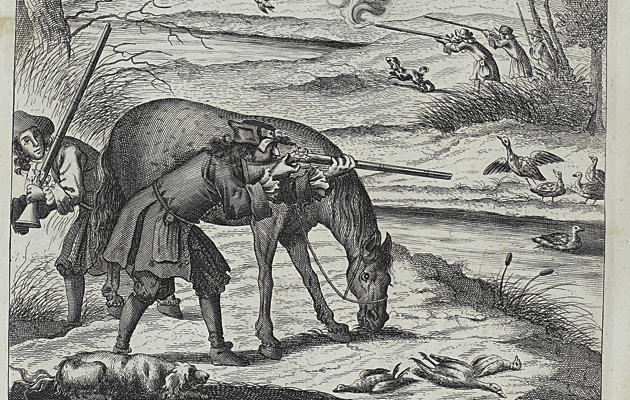
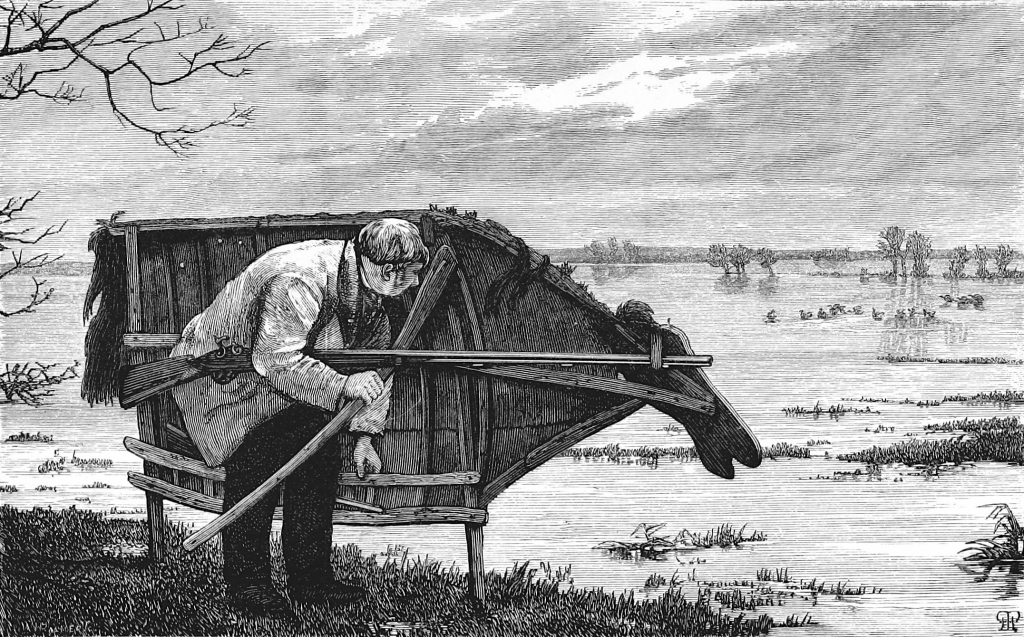
He uses his folly like a stalking-horse

From Shakespeare’s As You Like It (5.4.104-05):

He uses his folly like a stalking-horse, and under the
presentation of that he shoots his wit.

I had a vague sense of stalking-horse from its still-extant extended use in bankruptcy settlements – the stalking horse offer being one designed as a sort of reserve on the assets up for auction, a means of guaranteeing a minimum value they will go for. There’s also apparently another still-extant sense – closer to the original – used in business and politics, an explanation of which can be read here.

But the original use and definition is much more picturesque. It’s also unwieldy so here’s the OED’s refinement first:

1. A horse trained to allow a fowler to conceal himself behind it or under its coverings in order to get within easy range of the game without alarming it. Hence, a portable screen of canvas or other light material, made in the figure of a horse (or sometimes of other animals), similarly used for concealment in pursuing game.

More fun is Gervase Markham’s from his 1621 treatise Hungers Preuention: or The Whole Art of Fowling By Water and Land (online here but requiring some textual restoration as read):

Now forasmuch as these shelters or couerts are after a way then found, and that Fowle doe many times lye so farre remoued within the water, that vnlesse a man doe goe into it where no shelter at all is, more then a man bringeth with him, he cannot possibly compasse a shoote; so that of necessity a man must haue some moouing shaddow or shelter to walke by him; In this case there is nothing better then the stalking Horse, which is any old Iade trayned vp for that vse, which being stript naked and hauing nothing but a string without the neather chappe, of two or three yards longe, will gently and as you giue ocation to vrge him, walke vp and downe in the water which way you will haue him; flodding and eating vpon the grasse or other stuffe that growes there-in; and then being hardy & stoute without taking any affright at the report of the Peice, you shall shelter your selfe and your Peice behind his fore shoulder, bending your body downe low by his side, and keeping his body still full betweene you and the Fowle; Then haueing (as was before shewed) chosen your marke, you shall take your leuell from before the fore part of the Horse, shooting as it were betweene the Horses knees and the water, which is more safe and further then taking the leuell vnder the Horses belly, and much lesser to be perceaued; the shoulder of the Horse covering the body of the man, and the Horse’s legges shaddowing the legges of the man also: and as thus you stalke vpon the greate blanke waters, so you may stalk also along the bankes of Brookes in great Riuers, by little and little winning the Fowle to as neare a station as can be desired, and thus you may doe also vpon the firme ground, whether it be on moor, Heath, or other rotten earth, or else up the tylthe where greene Corne groweth; or generally, in any other haunt where Fowle are accustomably vsde to feede or abide.

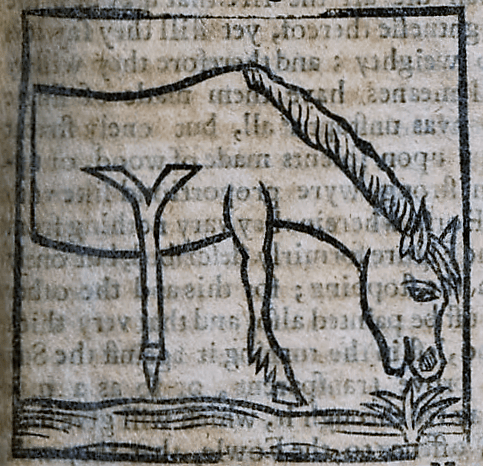
Now forasmuch as these Stalking horse, or Horses to stalke withall, are not euer in readinesse, and at the best aske a good expence of time to bee brought to their best perfection: as also, in that euery poore man or other which taketh delight in this exercise, is either not master of a Horse, or if hee had one yet wanteth fit meanes to keepe him: and yet neuerthelesse this practise of Fowling must or should bee the greatest part of his mantenance. In this case he may take any pieces of oulde Canuasse, and hauing made it in the shape or proportion of a Horse with the head bending downeward, as if hee grased, and stoping it with dry Strawe, Mosse, Flocks, or any other light matter, let it be painted as neere the colour of a Horse as you can deuise; of which the Browne is the best, and in the midst let it be fixt to a Staffe with a picke of Iron in it to sticke downe in the ground at your pleasure, and stand fast whilest you chuse your marke, as also to turne and winde any way you please, either for your aduantage of the winde, or for the better taking of your leuell, and it must be made so portable that you may beare it easily with one hand, mooving and wagging it in such wise that it may seeme to mooue and graze as it goeth; nether must this in any wise exceed the ordinary stature or proportion of a common Horse, for to bee too low or little will not couer the man, and to be two big and huge will be both monstrous & troublesome, and giue affright to the Fowle, therefore the meane in this is the best measure, and only worth the obseruation.

This sort of thing lends itself to illustrations. Here’s the stuffed canvass stalking-horse from Markham’s text:

From Nicholas Cox’s 1686 The Gentleman’s Recreation (where he also makes mention of a stalking-cow, a search for which produced this modern equivalent):

One I can’t identify the origin of but Wikipedia dates as 1875:

It’s easy to see how the term shifts into the figurative uses given by the OED (A person whose agency or participation in a proceeding is made use of to prevent its real design from being suspected and An underhand means or expedient for making an attack or attaining some sinister object; usually, a pretext put forward for this purpose). In drama alone we see the above lines from Shakespeare in 1599. Then John Marston in The Malcontent (4.3.126) in 1603:

Yea, provident: beware an hypocrite;
A churchman once corrupted, O, avoid!
A fellow that makes religion his stalking-horse,
He breeds a plague: thou shalt poison him.

And John Webster in The White Devil (3.1.34-38) in 1612:

Oh, my unfortunate sister!
I would my dagger’s point had cleft her heart
When she first saw Bracciano. You, ’tis said,
Were made his engine and his stalking-horse
To undo my sister

From the smoke into the smother

From Shakespeare’s As You Like It (1.2.276), Orlando speaking.

Thus must I from the smoke into the smother;
From tyrant Duke unto a tyrant brother.

I had this phrase marked from a past reading as something to look into, expecting to find several parallels elsewhere. It turns out there are none (at least none easily found). It also turns out that its interpretation feels shakier than most commentaries suggest in equating it to ‘out of the frying-pan into the fire.’ The short version of everything below – and it is far more than I wished when I started writing – is that the surrounding context, line structure, and wording do allow the sense of ‘out of the frying-pan…’ but don’t require it. They also allow a second interpretation that is closer to ‘from one trouble to another [equivalent trouble].’ I tend to prefer this second reading.

The commentaries that make the phrase equivalent to ‘out of the frying-pan into the fire’ point for support to Dent’s Shakespeare’s Proverbial Language, the standard reference for exactly what the title suggests. Dent, however, is himself a middleman here and simply lists the proverb in connection to entry S570 from Wilson’s The Oxford Dictionary of English Proverbs (pg. 574):

Smoke, shunning the | they fall into the fire. Cf. Frying pan.

[Erasm. Adag. 184c: Fumum fugiens, in ignem incidi].

c. 1530 Lucian Necromantia – As the comen proverb is of every man Out of the smoke into the fyre I ran

1535 T. Lupset Exhort Young Men ed. Gee 256 – What faute so ever you may do, let it not be defended with a flase tale: for that were to fle out of the smoke in to the fire.

1549. H. Bullinger Treatise or Sermon B4 – Magistrates had nede of much … fear of god, in takyng vp or in laying downe their warres, les perchaunse in flying the smoke thei fall into the fyre

1576 Pettie ii. 89 – Thinking to quench the coals of his desire, he fell into hot flames of burning fire.

1599 Shakes. A.Y. I.ii.266 – Thus must I from the smoke into the smother.

1666 Torriano It. Prov. 96 no. 22 – Many an one flies the smoke, who afterward falls into the fire.

The structure of the proverb in all given examples is ‘purposefully attempting to evade threat A, a person falls into greater threat B’. So Erasmus’ original ‘fleeing the smoke, I fall into the fire’. So also all senses of the related ‘out of the frying-pan into the fire.’ The current version of that proverb has lost any verb of motion but the two earliest examples from the entry in Wilson’s English Proverbs (pg 292) show that it was originally there – 1530 Barclay Eclog. – ‘out of the water thou leapest into the fyre’ and 1528 More – ‘Lepe they lyke a flounder out of a frying-panne into the fyre’. See also the decent entry for the proverb’s history on wikipedia.

This structure can be mapped onto Shakespeare’s line if you assume a condensed phrasing where ‘Thus must I from the smoke into the smother‘ is in conception something closer to ‘Thus must I [in attempting to flee from] the smoke [fall] into the smother.’ The smoke here would be Duke Frederick – La Beau has just warned Orlando at 1.2.250-256 to ‘leave this place‘ because the Duke ‘misconstrues all that you have done.’ And the smother would be Orlando’s brother Oliver – whom we’ve already learned (1.1) has mistreated Orlando throughout his life and, as we soon will learn (2.3), intends to get rid of him by (almost too appropriately) burning him alive. Orlando is then using this scene-end couplet to announce his sense that in turning from the Duke he only returns to a more threatening situation with his brother.

There are issues with this reading though. First is that Orlando at the moment of speaking has no knowledge of his brother’s plot against him. Rather, his sense of his standing with his brother must match Oliver’s concluding remarks from their earlier encounter (1.1.72-74) – ‘Well, sir, get you in. I will not long be troubled with you; you shall have some part of your will. I pray you leave me.‘ ‘Will’ here is a pun that captures both ‘your wish’ and ‘your inheritance.’ It can be given a sinister turn by the audience but it’s clear from Orlando’s response (75-76) – ‘I will no further offend you than becomes me for my good‘ – that he doesn’t himself take it that way. Accordingly, it’s not obvious to me that he’d be conceiving of the turn from Frederick to Oliver as a movement from a bad situation to a worse.

A second issue is with smother. This is Shakespeare’s only use of the noun – though he uses the verb nine times elsewhere – so we have to rely for meaning on the OED. It gives smother as ‘Dense, suffocating, or stifling smoke, such as is produced by combustion without flame. (Frequently coupled with smoke.).’ I’m not convinced that either this definition or the usage examples on which it is based (provided in full below) justify treating smoke … smother as parallel to smoke … fire in the sense of the latter element representing an increased danger. Instead – and especially given the OED’s note of smother’s frequent coupling with smoke – they seem to point more to treating smoke … smother as functional synonyms.

In this reading Orlando is saying no more than ‘I am now moving from one threatening situation to another.’ You don’t have to supply a sense of ‘trying to avoid bad Frederick, I fall into the worse Oliver’ and you don’t have to understand ‘smother‘ as heightened in danger over smoke. You can instead treat the choice of smoke…smother as dictated by two complementary desires – the wish for parallel internal sound repetitions each line of a rhyming couplet (italics below) and the need for line-end rhymes in that couple (bold below):

Thus must I from the smoke into the smother;
From tyrant Duke unto a tyrant brother.

This blew right through the work day.


Below is the OED definition of smother and list of uses.

a. Dense, suffocating, or stifling smoke, such as is produced by combustion without flame. (Frequently coupled with smoke.)
α.
c1175 Lamb. Hom. 43 Þet þridde [was] fur,..þe siste smorðer.
?c1225 (▸?a1200) Ancrene Riwle (Cleo. C.vi) (1972) 199 Þe deofles chef. þet nis nocht bute to helle smorðere.
1393 W. Langland Piers Plowman C. xx. 303 When smoke and smorþre smyt in hus eyen.
c1540 (▸?a1400) Destr. Troy 11796 Hit fest was on fyre, & flappit out onone, Vnto smorther & smoke.
β., γ.
a1300 Body & Soul in Map’s Poems (Camden) 339 Þe erþe it openede anon, smoke and smoþer op it wal.
a1400 Adultery 87 in Herrig Archiv LXXIX. 420 Smoþer & smoke þer come owte wylde.
a1400 Stockh. Medical MS. ii. 598 in Anglia XVIII. 322 Ȝif vnder nethyn þer hennys sate Of hennebane a smoþer thou make.
a1470 Dives & Pauper (1496) vi. xxii. 270/2 There shall be brennynge fyre and smoder without ende.
a1618 J. Sylvester Urania lxxxii A thick, dark, pitchy Cloud of smoak, That round-about a kindling Fire suppresses With waving smother.
1657 P. Henry Diaries & Lett. (1882) 33 When a fire is first kindled there’s a great deale of smoke and smother.
1748 B. Robins & R. Walter Voy. round World by Anson iii. viii. 381 The great smother and smoke of the oakum.
1789 G. White Nat. Hist. Selborne 20 Nothing is to be seen but smother and desolation.
1828 J. R. Planché Desc. Danube i. 25 The distant dome of Saint Paul’s rising above the smother of our huge metropolis.
1882 R. D. Blackmore Christowell l Filled with blue sulphureous fog, and smother of bitumen.
proverbial.
a1616 W. Shakespeare As you like It (1623) i. ii. 277 Thus must I from the smoake into the smother .
1890 Daily News 25 June 5/1 They had gone from the smoke into the smother.
figurative.
1565 J. Jewel Replie Hardinges Answeare Concl. sig. IIi3v Now the Sonne is vp: your Smooder is scattered.
1654 T. Gataker Disc. Apol. 12 A great smother of foggie fumes, raised by slanderous tongues.
1695 J. Collier Misc. upon Moral Subj. 2 Why else do they..spend their Taper in smoke and smother?
1809 B. H. Malkin tr. A. R. Le Sage Adventures Gil Blas IV. x. i. 20 The mad blockhead was so suffocated by the smother of authorship.
1975 N. Nicholson Wednesday Early Closing ix. 176 A dull smother of hopelessness hung over the town like the smutch from a smoking rubbish dump.