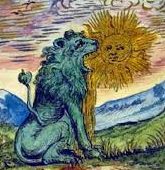
When didst thou see me heave up my leg and make water against a gentlewoman’s farthingale?

From Shakespeare’s Two Gentlemen of Verona (4.4)

Enter LAUNCE, with his his Dog
LAUNCE
When a man’s servant shall play the cur with him,
look you, it goes hard: one that I brought up of a
puppy; one that I saved from drowning, when three or
four of his blind brothers and sisters went to it.
I have taught him, even as one would say precisely,
‘thus I would teach a dog.’ I was sent to deliver
him as a present to Mistress Silvia from my master;
and I came no sooner into the dining-chamber but he
steps me to her trencher and steals her capon’s leg:
O, ’tis a foul thing when a cur cannot keep himself
in all companies! I would have, as one should say,
one that takes upon him to be a dog indeed, to be,
as it were, a dog at all things. If I had not had
more wit than he, to take a fault upon me that he did,
I think verily he had been hanged for’t; sure as I
live, he had suffered for’t; you shall judge. He
thrusts me himself into the company of three or four
gentlemanlike dogs under the duke’s table: he had
not been there–bless the mark!–a pissing while, but
all the chamber smelt him. ‘Out with the dog!’ says
one: ‘What cur is that?’ says another: ‘Whip him
out’ says the third: ‘Hang him up’ says the duke.
I, having been acquainted with the smell before,
knew it was Crab, and goes me to the fellow that
whips the dogs: ‘Friend,’ quoth I, ‘you mean to whip
the dog?’ ‘Ay, marry, do I,’ quoth he. ‘You do him
the more wrong,’ quoth I; ”twas I did the thing you
wot of.’ He makes me no more ado, but whips me out
of the chamber. How many masters would do this for
his servant? Nay, I’ll be sworn, I have sat in the
stocks for puddings he hath stolen, otherwise he had
been executed; I have stood on the pillory for geese
he hath killed, otherwise he had suffered for’t.
Thou thinkest not of this now. Nay, I remember the
trick you served me when I took my leave of Madam
Silvia: did not I bid thee still mark me and do as I
do? when didst thou see me heave up my leg and make
water against a gentlewoman’s farthingale? didst
thou ever see me do such a trick?

With Harold Goddard’s commentary on Lance from his classic The Meaning of Shakespeare (v. 1)

But how about Launce? someone will ask. How did such a masterpiece of characterization get into this early play? It is a question that must be confronted, unless we adopt the improbable hypothesis that he is a later interpolation. Launce—or rather Launce-and-his-dog-Crab, for the two are inseparable—is stamped with Shakespeare’s genius. He could walk into any play the author ever wrote and not jar us with any sense of immaturity in either conception or execution. Perhaps in this paradox we may find a clue to how Shakespeare wanted his play taken, how so apprentice-like a piece could have been produced so close chronologically to works that so utterly surpass it.

Launce has more sense, humor, and intelligence in his little finger than all the other men in the play have in their so-called brains combined, and it happens that in the course of it he gives his opinion of each of the two gentlemen of Verona. Proteus, his master, he tells us, is “a land of a knave,” and Valentine, the other gentleman, “a notable lubber.” Now it happens that the play confirms these judgments to the hilt. Indeed, Proteus’ treatment, in succession, of Julia, Valentine, and Silvia makes the name “knave” quite too good for him, as Silvia recognizes when she calls him a “subtle, perjur’d, false, disloyal man,” or when she declares that she would rather be eaten by a lion than rescued by such an abject creature. We have his own word for it that he is a sly trickster, and the story proves him to have been not only that but a perfidious friend, a liar, a coward, a slanderer, and a ruffian and would-be ravisher of the woman for whom he had deserted his first love. And this, forsooth, is the man whom his friend Valentine describes as having spent his youth in putting on an “angel-like perfection” of judgment and experience, until

He is complete in feature and in mind
With all good grace to grace a gentleman.

Valentine, it is true, is a paragon of virtue compared with such a bounder as Proteus, but his estimate of his friend does little credit to his intelligence and is enough in itself to justify the label “lubber” that Launce puts on him. But if Launce’s say-so is not enough, proof is afforded to an almost supernatural degree by the “ladder scene.” How any man could act more inanely than Valentine does on that occasion it would be hard to imagine, if we did not have the final incredible scene of the play in which the same man outdoes himself.

Now if Launce had reached the same conclusions about these two gentlemen that the action of the play forces on us independently, it is hard to believe that Shakespeare himself was not in the secret. It sets us wondering just what he meant by his title, The Two Gentlemen of Verona, and how far he may have written the play with his tongue in his cheek. If there is anything in this suggestion, we may have to revise our opinion of its juvenility and consider whether some of its apparent flaws are not consciously contrived ironical effects. This is the second of the two possible ways of taking the play.

The expense of spirit in a waste of shame

Shakespeare’s Sonnet 129, one of the better known ones but here rather for its thematic connection to a previously posted poem of Petronius and Ben Jonson’s translation of it.

The expense of spirit in a waste of shame
Is lust in action: and till action, lust
Is perjured, murderous, bloody, full of blame,
Savage, extreme, rude, cruel, not to trust;
Enjoyed no sooner but despised straight;
Past reason hunted; and no sooner had,
Past reason hated, as a swallowed bait,
On purpose laid to make the taker mad.
Mad in pursuit and in possession so;
Had, having, and in quest to have extreme;
A bliss in proof, and proved, a very woe;
Before, a joy proposed; behind a dream.
All this the world well knows; yet none knows well
To shun the heaven that leads men to this hell.

But, by all above, these blenches gave my heart another youth

Shakespeare’s Sonnet 110 followed by a survey of ‘blench’ that I started on to satisfy an intuition about the multivalence of its use here – that it is first read as a condensed repetition of ‘I have looked on truth askance and strangely’ (definition 2 of the noun below) but then acquires from the line that follows (‘and worse essays’) a second sense close to definition 1, ‘the deception/trickery of philandering.’ This morphing sense allows the central lines 7-8 to better pivot from start to end focus. I don’t think I really got there – largely for lack of commitment to sifting Shakespeare’s uses of the verb form – but it was a nice autumn stroll and something was learned regardless.

Alas, ’tis true, I have gone here and there,
And made my self a motley to the view,
Gored mine own thoughts, sold cheap what is most dear,
Made old offences of affections new.
Most true it is that I have looked on truth 5
Askance and strangely; but, by all above,
These blenches gave my heart another youth,
And worse essays proved thee my best of love.
Now all is done, have what shall have no end:
Mine appetite I never more will grind 10
On newer proof, to try an older friend,
A god in love, to whom I am confined.
Then give me welcome, next my heaven the best,
Even to thy pure and most most loving breast.

Blench is a curious word. Shakespeare uses the verb from which it is derived five times but this noun form only here. The OED gives two definitions for the noun – 1)A trick, stratagem (with examples dating from 1250-1400) and 2)A turning of the eyes aside, a side glance (with this passage as the single attestation). More is said of the verb but the paragraph etymology concludes with humility – that ‘little can be done at present except to exhibit the senses actually found in use.’:

Etymology: A word or series of words of very obscure history. Sense 1 is evidently < Old English blęncan to deceive, cheat = Old Norse blekkja ( < blenkja ) to impose upon, which point to a Germanic type *blankjan , assumed to be the causative of a strong *blinkan blink v.; but, as no trace of the latter occurs in early times, the origin of blęncan is thus left uncertain. The northern form was blenk v. The sense-development is involved, from confusion of blenk and blink , of blench and blanch , probably also of the past tense blent with blent , past tense of blend v.1, and other causes: little can be done at present except to exhibit the senses actually found in use.

6 sense are then proposed

1. transitive. To deceive, cheat. Obsolete.
a1000—c1175
2.
a. intransitive. To start aside, so as to elude anything; to swerve, ‘shy’; to flinch, shrink, give way. a1250—1876
†b. Of a ship: To turn or heel over. Obsolete. a1300—a1300
3. transitive. To elude, avoid, shirk; to flinch from; to blink. a1663—1822
†4. transitive. To turn aside or away (the eyes). Obsolete. c1400—c1400
†5. transitive. To disconcert, foil, put out, turn aside. Cf. blenk v. 4. Obsolete. 1485—a1640
6. intransitive. Of the eyes: To lose firmness of glance, to flinch, quail.

Shakespeares other uses:

Hamlet 2.2
For murther, though it have no tongue, will speak
With most miraculous organ, I’ll have these Players
Play something like the murther of my father
Before mine uncle. I’ll observe his looks;
I’ll tent him to the quick. If he but blench,
I know my course.

Measure for Measure 4.5 (cited by the OED for 2a) –
The matter being afoot, keep your instruction,
And hold you ever to our special drift;
Though sometimes you do blench from this to that,
As cause doth minister.

Troilus and Cressida 1.1 –
Pandarus. Ay, to the leavening; but here’s yet in the word
‘hereafter’ the kneading, the making of the cake, the
heating of the oven and the baking; nay, you must
stay the cooling too, or you may chance to burn your lips.

Troilus. Patience herself, what goddess e’er she be,
Doth lesser blench at sufferance than I do.
At Priam’s royal table do I sit;

Troilus and Cressida 2.2 –
I take to-day a wife, and my election
Is led on in the conduct of my will;
My will enkindled by mine eyes and ears,
Two traded pilots ‘twixt the dangerous shores
Of will and judgment: how may I avoid,
Although my will distaste what it elected,
The wife I chose? there can be no evasion
To blench from this and to stand firm by honour:

A Winter’s Tale 1.2 –
Dost think I am so muddy, so unsettled,
To appoint myself in this vexation, sully
The purity and whiteness of my sheets,
Which to preserve is sleep, which being spotted
Is goads, thorns, nettles, tails of wasps,
Give scandal to the blood o’ the prince my son,
Who I do think is mine and love as mine,
Without ripe moving to’t? Would I do this?
Could man so blench?


And beauty making beautiful old rhyme

Shakespeare’s Sonnet 106:

When in the chronicle of wasted time
I see descriptions of the fairest wights,
And beauty making beautiful old rhyme,
In praise of ladies dead and lovely knights,
Then, in the blazon of sweet beauty’s best,
Of hand, of foot, of lip, of eye, of brow,
I see their antique pen would have expressed
Even such a beauty as you master now.
So all their praises are but prophecies
Of this our time, all you prefiguring;
And for they looked but with divining eyes,
They had not skill enough your worth to sing:
For we, which now behold these present days,
Have eyes to wonder, but lack tongues to praise.

Multiple editors note similarities with Samuel Daniel‘s sonnet 46 but past the surface alignment of the openings I don’t much see it. And even the opening seems to move in two different directions – Daniel using a light priamel to launch a future-looking perspective, Shakespeare staying with the past and imagining how it looks forward to its future/his present.

Let others sing of knights and paladins
In aged accents and untimely words;
Paint shadows in imaginary lines
Which well the reach of their high wits records:
But I must sing of thee, and those fair eyes
Authentic shall my verse in time to come,
When yet th’ unborn shall say, “Lo where she lies
Whose beauty made him speak that else was dumb.”
These are the arks, the trophies I erect,
That fortify thy name against old age;
And these thy sacred virtues must protect
Against the dark, and time’s consuming rage.
Though th’ error of my youth they shall discover,
Suffice they show I liv’d and was thy lover.

O fearful meditation!

Shakespeare’s sonnet 65:

Since brass, nor stone, nor earth, nor boundless sea
But sad mortality o’er-sways their power,
How with this rage shall beauty hold a plea,
Whose action is no stronger than a flower?
O, how shall summer’s honey breath hold out
Against the wrackful siege of batt’ring days,
When rocks impregnable are not so stout,
Nor gates of steel so strong, but time decays?
O fearful meditation! where, alack,
Shall time’s best jewel from time’s chest lie hid?
Or what strong hand can hold his swift foot back?
Or who his spoil of beauty can forbid?
O, none, unless this miracle have might,
That in black ink my love may still shine bright.

The lining of his coffers shall make coats to deck our soldiers for these Irish wars.

From Richard II. I feel I’ve read/seen this exchange over a dozen times without ever fully taking in the coldness. There is, by the way, an OED definition of coffer as coffin. The last attestation they provide is 1550 but it’s close enough in time to suggest that the associative flow is dictated by more than just sound.

BUSHY

Old John of Gaunt is grievous sick, my lord,

Suddenly taken; and hath sent post haste

To entreat your majesty to visit him.

KING RICHARD II

Where lies he?

BUSHY

At Ely House.

KING RICHARD II

Now put it, God, in the physician’s mind

To help him to his grave immediately!

The lining of his coffers shall make coats

To deck our soldiers for these Irish wars.

Come, gentlemen, let’s all go visit him:

Pray God we may make haste, and come too late

I must have liberty withal, as large a charter as the wind, to blow on whom I please

A part of a speech of Jacques in As You Like It (2.7):

I must have liberty
Withal, as large a charter as the wind,
To blow on whom I please; for so fools have;
And they that are most galled with my folly,
They most must laugh. And why, sir, must they so?
The ‘why’ is plain as way to parish church:
He that a fool doth very wisely hit
Doth very foolishly, although he smart,
Not to seem senseless of the bob: if not,
The wise man’s folly is anatomized
Even by the squandering glances of the fool.
Invest me in my motley; give me leave
To speak my mind, and I will through and through
Cleanse the foul body of the infected world,
If they will patiently receive my medicine.

Because the syntax grows squishy around the middle, here’s the Arden gloss on He that…: He who is wounded by the fool’s well-aimed blow behaves very stupidly if he does not pretend – even while he is smarting under the wound – that the shaft has missed its mark.

There’s a possible echo of this image in a near-contemporary play I happen also to be reading, John Marston’s The Malcontent (1.3):

See, here he come. Now shall you hear the extremity of a malcontent: he is as free as air; he blows over every man.

Sit up late till it be early, drink drunk till I am sober, sink down dead in a Tavern, and rise in a Tobacco shop

From Thomas Middleton’s A Mad World, My Masters. The comedy is mostly in the action so the whole is stronger in performance than in reading but the character portraits have some gold in them. This one did get a recent reworked adaptation by the RSC but it looks like critics found it generally too strong a departure from the original.

Dick Follywit’s self-assessment in 1.1, clearly echoing some of Falstaff’s in Henry IV part 1, 3.3:

Hang you, you have bewitch’d me among you. I was as well given till I fell to be wicked, my Grandsire had hope of me, I went all in black, swore but o’ Sundays, never came home drunk, but upon fasting nights to cleanse my stomach; ‘slid now I’m quite altered, blown into light colours, let out oaths by th’ minute, sit up late till it be early, drink drunk till I am sober, sink down dead in a Tavern, and rise in a Tobacco shop. Here’s a transformation: I was wont yet to pity the simple, and leave ’em some money; ‘slid, now I gull ’em without conscience; I go without order, swear without number, gull without mercy, and drink without measure.

Falstaff’s for comparison:

O, thou hast damnable iteration and art indeed able
to corrupt a saint. Thou hast done much harm upon
me, Hal; God forgive thee for it! Before I knew
thee, Hal, I knew nothing; and now am I, if a man
should speak truly, little better than one of the
wicked. I must give over this life, and I will give
it over: by the Lord, and I do not, I am a villain:
I’ll be damned for never a king’s son in
Christendom.

And later in the same scene an expansion by another character, Master Penitent Brothel

Here’s a mad-brain o’the’ first, whose pranks scorn to have precedents, to be second to any, or walk beneath any mad-cap’s inventions; h’as play’d more tricks than the cards can allow a man, and of the last stamp, too; hating imitation, a fellow whose only glory is to be prime of the company, to be sure of which he maintains all the rest. He’s the carrion, and they the kites that gorge upon him. But why in others do I check wild passions, and retain deadly follies in myself? I tax his youth of common receiv’d riot, Time’s comic flashes, and the fruits of blood; And in myself soothe up adulterous motions, and such an appetite that I know damns me, yet willingly embrace it.

All this beforehand counsel comprehends. But will is deaf and hears no heedful friends

From Shakespeare’s The Rape of Lucrece (491-504), Tarquin’s all too self-aware self-justification – though I think he here acts as most of us (in milder situations, of course) and summons argument enough to crest into momentary self-delusion but not so much as to free him from later reflection. So feels the sense of the narrator’s ‘Drunken Desire must vomit his receipt / Ere he can see his own abomination’ in the aftermath (703-4).

“I see what crosses my attempt will bring;
I know what thorns the growing rose defends;
I think the honey guarded with a sting;
All this beforehand counsel comprehends.
But will is deaf and hears no heedful friends;
Only he hath an eye to gaze on beauty
And dotes on what he looks, ’gainst law or duty.

“I have debated, even in my soul,
What wrong, what shame, what sorrow I shall breed,
But nothing can affection’s course control
Or stop the headlong fury of his speed.
I know repentant tears ensue the deed,
Reproach, disdain, and deadly enmity,
Yet strive I to embrace mine infamy.”

These forceless flowers like sturdy trees support me; Two strengthless doves will draw me through the sky

From Shakespeare’s Venus and Adonis lines 165-176, a portion of Venus’ attempted seduction. I feel there’s a classical parallel to the images of Venus’ weightlessness (‘These forceless flowers …”) but I can’t right now conjure anything from Ovid or the other likelies and the commentaries don’t help.

‘Bid me discourse, I will enchant thine ear,
Or, like a fairy, trip upon the green,
Or, like a nymph, with long dishevell’d hair,
Dance on the sands, and yet no footing seen:
Love is a spirit all compact of fire,
Not gross to sink, but light, and will aspire.

‘Witness this primrose bank whereon I lie;
These forceless flowers like sturdy trees support me;
Two strengthless doves will draw me through the sky,
From morn till night, even where I list to sport me:
Is love so light, sweet boy, and may it be
That thou shouldst think it heavy unto thee?

The slippage of meaning in ‘light’ (weightless vs. wanton) is easy to spot. A bit below the surface is the flavor of ‘primrose’ – Shakespeare twice later uses it in ‘dangers of pleasure’ contexts.

Ophelia to Laertes in Hamlet 1.3:

I shall th’ effect of this good lesson keep
As watchman to my heart. But, good my brother,
Do not as some ungracious pastors do,
Show me the steep and thorny way to heaven,
Whiles, like a puff’d and reckless libertine,
Himself the primrose path of dalliance treads
And recks not his own rede.

And the Porter in Macbeth 2.3:

Knock,
knock; never at quiet! What are you? But
this place is too cold for hell. I’ll devil-porter
it no further: I had thought to have let in
some of all professions that go the primrose
way to the everlasting bonfire
.
[Knocking within]
Anon, anon! I pray you, remember the porter.