
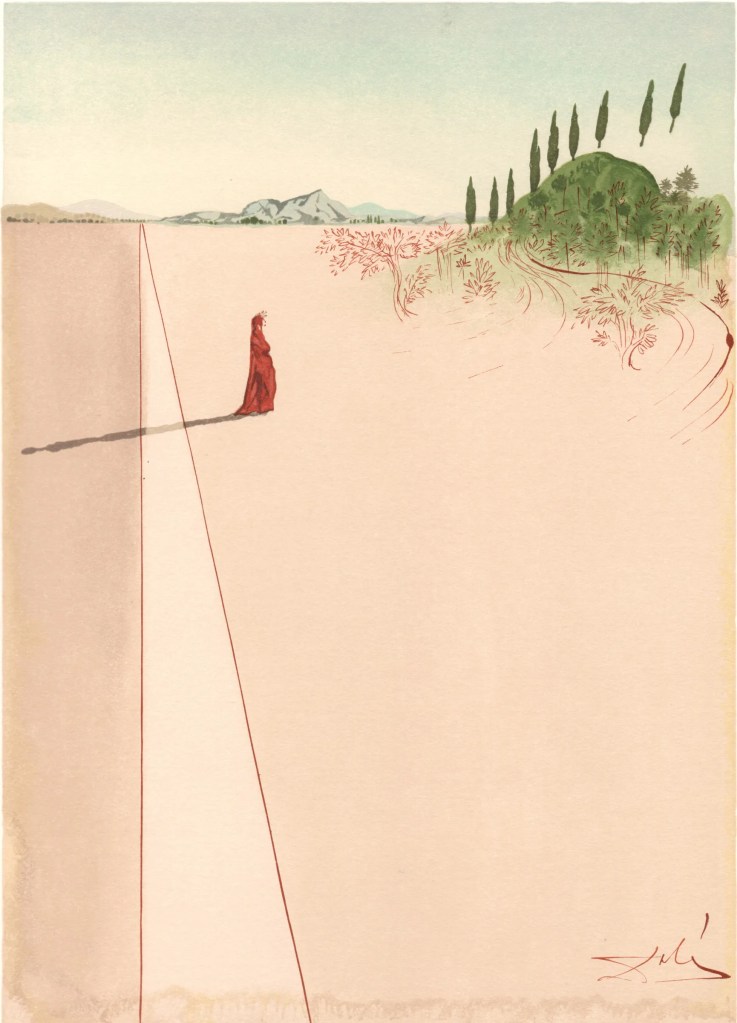
Salvador Dali’s illustration for the first canto of the Inferno, properly titled Départ pour le grand voyage.
I found a copy for a steal recently and have been looking into the production process, the description of which I now pilfer from this good intro:
Translating Dalí’s 100 watercolours for The Divine Comedy into wood engravings for printing was a daunting undertaking. Master engraver Raymond Jacquet and his assistants Jean Taricco and Paul Bassin were commissioned by Jean Estrade, the Artistic Director of Les Heures Claires, to work with Dalí to create the engraved interpretations of his watercolours. This involved deconstructing each image into separate colours and the carving of a single block for each colour. Each of these colour proofs is known as a ‘decomposition’ and each watercolour would require more than 30 of these decompositions to create the completed engraved translation.
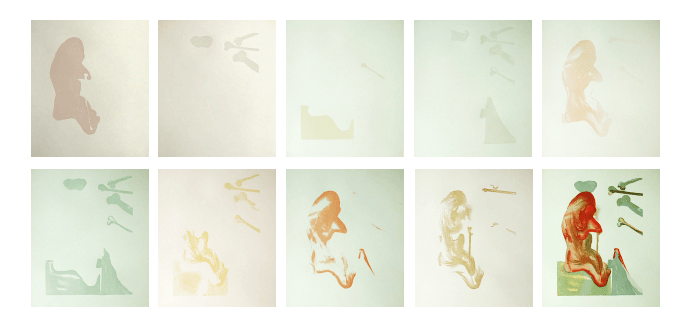
The process of engraving the blocks would start with the drawing of a perfect negative of the original watercolour on to the block with carbon or lithographic pencil. The design would then be incised into the block using a burin (engraving tool). Painstaking care was needed to ensure that the thickness of the incised line would translate the colour of the watercolour correctly and so Dalí’s constant attention and supervision was required throughout the four years it took to produce the engraved proofs.
In total 3,500 engraved blocks were needed to complete The Divine Comedy and importantly, Jacquet decided to print different colours from the same block, meaning that each block was permanently altered during the printing process. This not only meant that there was simply no margin for error in the printing of the edition but also ensured that the integrity of the edition was preserved as subsequent unauthorised printings or forgeries made from the blocks would not be possible. Another feature of the publication that demonstrated Jacquet’s commitment to the highest of standards was his decision to use resin blocks. Traditionally, wood engraving was executed on sections of box wood, however Jacquet’s preference for harder, more durable resin blocks allowed for finer detail to be achieved in the engraving of the blocks and richer quality in the final printing. This was crucial in ensuring that all impressions across both the French and Italian editions were printed to a consistent, high standard.
The same gallery also has one of the better sources for seeing the full series.
 Extracts
excellent find. Excellent workers.
LikeLike