Lancelot and the Sword Bridge

From the Burton Raffel translation of Chretien de Troyes’ Lancelot, The Knight of the Cart, Lancelot’s crossing of the sword bridge. An edition of the original text can be found here (~lines 3000-3125 given here). I can’t find a good collection of images online but this article plus a quick google image search will point to how iconic the scene became – though to me some of the representations (like the one below) take an accidental Boschian aspect from the artist’s realization that all you really need is a knight on a large knife (compare from Hell in Earthly Delights and the center panel in the Bruges Last Judgment).
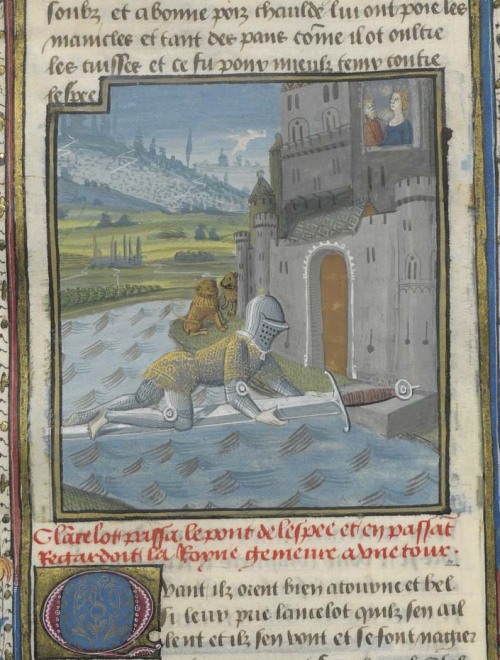
Following the most direct
Route, just as the light
Was fading, about nine
That night, they saw the Sword Bridge.
They stopped and dismounted at the foot
Of the terrifying structure, looking
Down at the treacherous water,
Black and boiling, swift
And harsh, as horribly evil
As if it flowed from the devil
Himself, deep and dangerous
Like nothing else in this world:
Whoever fell in would sink
Like a rock in the salty sea.
And the bridge that spanned it was just
As different from other bridges;
Believe me, nothing lie it
Had ever existed, or ever
Would, neither as huge
Or as wickedly built-a single
Gleaming sword-blade crossing
That ice-cold water, stiff
And strong, as wide as a pair
Of spears, and attached at either
End to massive tree-trunk
Stumps. No one would worry
About it bending or breaking:
It would clearly stand, no matter
What weight it was asked to bear.
But those who’d come with our knight
Were most concerned at seeing,
Or thinking they saw, a pair
Of lions, or perhaps they were leopards,
Chained to a boulder on the far
Side of the bridge. The water,
The bridge, and the two great beasts
Gave them such a shock
That from head to foot they trembled
With fear: “My lord, allow us
To advise you, seeing what we see,
For advice is what you need.
This bridge is wickedly built,
Evilly put together.
Change your mind nowOr else you’ll lose the chance.
A man must think both long
And hard before he acts.
Suppose you get acrossBut it isn’t going to happen:
No one can hold back the wind
And stop it from blowing, or forbid
Birds to open their beaks
And sing, and keep them silent,
Or climb into a mother’s
Womb and be born again:
All these things are just as
Impossible as draining the sea.
How can you expect
Those furious lions, chained up
Over there, not
To kill you, and drink the blood
From your veins, and swallow your flesh,
And finish by gnawing your bones?
My nerves are strong, but I
Can barely allow my eyes
To see them. If you’re not careful,
They’ll surely kill you, I know it,
They’ll rip you right apart
And tear off your arms and legs.
Expect no mercy: they have none.
So take pity on yourself.
Stay here with us! Don’t
Commit so grave a sin
Against yourself, aware
Of mortal risk, yet seeking it
Out.” He replied, laughing,
“Gentlemen, I’m deeply grateful
That you care so much for my welfare:
You’re good and generous friends.
I know quite well you wish me
To come to no harm. But my faith
In God, my trust in Him,
Compels me to believe Hell protect me.
Neither bridge nor water
Nor this harsh world can worry
Me. I intend to cross,
Whatever the risk. I’d rather
Die than turn and go back!”
There was nothing more to be said,
But pity and sorrow wrung them
Both with bitter tears.
And our knight made ready, as best
He could, to cross the gulf,
Preparing, in the strangest way,
By removing the armor from his hands
And feet, as if making sure
He could not arrive uninjured!
Then he held tight to the sword-blade
Bridge, as sharp as a razor,
Hands and feet both bare
For he’d left himself no covering,
Neither shoes nor stockings
Not fearing sharp edges slicing
Away at his flesh, much
Preferring bloody wounds
To falling into that icy
Water from which he would never
Emerge. Accepting the immense
Pain and suffering, he crossed,
Hands and knees and feet
Bleeding. But Love, who had led him
There, helped him as he went,
And turned his pain to pleasure.
When he came to the other side
None of his wounds were hurting.
And then he recalled the pair
Of lions he’d seen, or thought
He’d seen, before he crossed,
But looking here and there
All he could see was a lizard,
And nothing there that could harm him
Raising his hand to his face
He stared at his ring, and knew
At once the pair of lions
Were imagined, and nowhere in sight,
But conjured out of magic.
The symbols of the divine show up in our world initially at the trash stratum

From Philip K. Dick’s Valis (ch 14). Something the other day reminded me of this passage – which is a concise phrasing of an idea that appears throughout Dick’s later writings – and a bit of reflection today led to connecting it to what Stanislaw Lem had written about Dick as the only American sci-fi writer whose work he could respect.

Seated before my TV set I watched and waited for another message, I, one of the members of the little Rhipidon Society which still, in my mind, existed. Like the satellite in miniature in the film Valis, the microform of it run over by the taxi as if it were an empty beer can in the gutter, the symbols of the divine show up in our world initially at the trash stratum. Or so I told myself. Kevin had expressed this thought. The divine intrudes where you least expect it.

And now from Stanislaw Lem’s Philip K. Dick: A Visionary Among the Charlatans (online here)

Dick employs the same materials and theatrical props as other American writers. From the warehouse which has long since become their common property, he takes the whole threadbare lot of telepaths, cosmic wars, parallel worlds, and time travel.
….
The peculiarities of Dick’s worlds arise especially from the fact that in them it is waking reality which undergoes profound dissociation and duplication. Sometimes the dissociating agency consists in chemical substances (of the hallucinogenic type—thus in The Three Stigmata of Palmer Eldritch); sometimes in “cold-sleep technique” (as precisely in Ubik); sometimes (as in Now Wait for Last Year) in a combination of narcotics and “parallel worlds.” The end-effect is always the same: distinguishing between waking reality and visions proves to be impossible. The technical aspect of this phenomenon is fairly inessential—it does not matter whether the splitting of reality is brought about by a new technology of chemical manipulation of the mind or, as in Ubik, by one of surgical operations. The essential point is that a world equipped with the means of splitting perceived reality into indistinguishable likenesses of itself creates practical dilemmas that are known only to the theoretical speculations of philosophy. This is a world in which, so to speak, this philosophy goes out into the street and becomes for every ordinary mortal no less of a burning question than is for us the threatened destruction of the biosphere.

And understood not that a grateful mind by owing owes not

From Book IV of Milton’s Paradise Lost, Satan’s speech:

O thou that with surpassing Glory crownd,
Look’st from thy sole Dominion like the God
Of this new World; at whose sight all the Starrs
Hide thir diminisht heads; to thee I call, [ 35 ]
But with no friendly voice, and add thy name
O Sun, to tell thee how I hate thy beams
That bring to my remembrance from what state
I fell, how glorious once above thy Spheare;
Till Pride and worse Ambition threw me down [ 40 ]
Warring in Heav’n against Heav’ns matchless King:
Ah wherefore! he deservd no such return
From me, whom he created what I was
In that bright eminence, and with his good
Upbraided none; nor was his service hard. [ 45 ]
What could be less then to afford him praise,
The easiest recompence, and pay him thanks,
How due! yet all his good prov’d ill in me,
And wrought but malice; lifted up so high
I sdeind subjection, and thought one step higher [ 50 ]
Would set me highest, and in a moment quit
The debt immense of endless gratitude,
So burthensome, still paying, still to ow;
Forgetful what from him I still receivd,
And understood not that a grateful mind [ 55 ]
By owing owes not, but still pays, at once
Indebted and dischargd; what burden then?
O had his powerful Destiny ordaind
Me some inferiour Angel, I had stood
Then happie; no unbounded hope had rais’d [ 60 ]
Ambition. Yet why not? som other Power
As great might have aspir’d, and me though mean
Drawn to his part; but other Powers as great
Fell not, but stand unshak’n, from within
Or from without, to all temptations arm’d. [ 65 ]
Hadst thou the same free Will and Power to stand?
Thou hadst: whom hast thou then or what to accuse,
But Heav’ns free Love dealt equally to all?
Be then his Love accurst, since love or hate,
To me alike, it deals eternal woe. [ 70 ]
Nay curs’d be thou; since against his thy will
Chose freely what it now so justly rues.
Me miserable! which way shall I flie
Infinite wrauth, and infinite despaire?
Which way I flie is Hell; my self am Hell; [ 75 ]
And in the lowest deep a lower deep
Still threatning to devour me opens wide,
To which the Hell I suffer seems a Heav’n.
O then at last relent: is there no place
Left for Repentance, none for Pardon left? [ 80 ]
None left but by submission; and that word
Disdain forbids me, and my dread of shame
Among the Spirits beneath, whom I seduc’d
With other promises and other vaunts
Then to submit, boasting I could subdue [ 85 ]
Th’ Omnipotent. Ay me, they little know
How dearly I abide that boast so vaine,
Under what torments inwardly I groane:
While they adore me on the Throne of Hell,
With Diadem and Sceptre high advanc’d [ 90 ]
The lower still I fall, onely Supream
In miserie; such joy Ambition findes.
But say I could repent and could obtaine
By Act of Grace my former state; how soon
Would higth recall high thoughts, how soon unsay [ 95 ]
What feign’d submission swore: ease would recant
Vows made in pain, as violent and void.
For never can true reconcilement grow
Where wounds of deadly hate have peirc’d so deep:
Which would but lead me to a worse relapse [ 100 ]
And heavier fall: so should I purchase deare
Short intermission bought with double smart.
This knows my punisher; therefore as farr
From granting hee, as I from begging peace:
All hope excluded thus, behold in stead [ 105 ]
Of us out-cast, exil’d, his new delight,
Mankind created, and for him this World.
So farewel Hope, and with Hope farewel Fear,
Farewel Remorse: all Good to me is lost;
Evil be thou my Good; by thee at least [ 110 ]
Divided Empire with Heav’ns King I hold
By thee, and more then half perhaps will reigne;
As Man ere long, and this new World shall know.

A thousand Demy-Gods on golden seats, frequent and full

The concluding lines of Book 1 of Milton’s Paradise Lost (online here with a few annotations). Except for L’Allegro and Il Penseroso I haven’t thought to read Milton in a decade, but all Machen’s talk of ecstasy brought this poem more to mind than any other.

Mean while the winged Haralds by command
Of Sovran power, with awful Ceremony
And Trumpets sound throughout the Host proclaim
A solemn Councel forthwith to be held [ 755 ]
At Pandæmonium, the high Capital
Of Satan and his Peers: thir summons call’d
From every Band and squared Regiment
By place or choice the worthiest; they anon
With hunderds and with thousands trooping came [ 760 ]
Attended: all access was throng’d, the Gates
And Porches wide, but chief the spacious Hall
(Though like a cover’d field, where Champions bold
Wont ride in arm’d, and at the Soldans chair
Defi’d the best of Paynim chivalry [ 765 ]
To mortal combat or carreer with Lance)
Thick swarm’d, both on the ground and in the air,
Brusht with the hiss of russling wings. As Bees
In spring time, when the Sun with Taurus rides,
Pour forth thir populous youth about the Hive [ 770 ]
In clusters; they among fresh dews and flowers
Flie to and fro, or on the smoothed Plank,
The suburb of thir Straw-built Cittadel,
New rub’d with Baum, expatiate and confer
Thir State affairs. So thick the aerie crowd [ 775 ]
Swarm’d and were straitn’d; till the Signal giv’n.
Behold a wonder! they but now who seemd
In bigness to surpass Earths Giant Sons
Now less then smallest Dwarfs, in narrow room
Throng numberless, like that Pigmean Race [ 780 ]
Beyond the Indian Mount, or Faerie Elves,
Whose midnight Revels, by a Forrest side
Or Fountain some belated Peasant sees,
Or dreams he sees, while over-head the Moon
Sits Arbitress, and neerer to the Earth [ 785 ]
Wheels her pale course, they on thir mirth and dance
Intent, with jocond Music charm his ear;
At once with joy and fear his heart rebounds.
Thus incorporeal Spirits to smallest forms
Reduc’d thir shapes immense, and were at large, [ 790 ]
Though without number still amidst the Hall
Of that infernal Court. But far within
And in thir own dimensions like themselves
The great Seraphic Lords and Cherubim
In close recess and secret conclave sat [ 795 ]
A thousand Demy-Gods on golden seats,
Frequent and full. After short silence then
And summons read, the great consult began.

But one means worship and the other means washing, and that is the distinction

From Arthur Machen’s Hieroglyphics: A Note Upon Ecstasy in Literature (full text here), a pseudo-dialogue in six parts structured in imitation of Coleridge’s ‘cyclical mode of discoursing’ – argumentation through amplifying and refining repetition – and attempting to define how to distinguish ‘fine literature’ from everything else.

I am glad it strikes you as a big question: to me it seems the question, the question which covers the final dogma of literary criticism. Of course after we have answered this prerogative riddle, there will be other questions, almost without end, classes, and sub-classes of infinite analysis. But this will be detail; while the question I have propounded is the question of first principles; it marks the parting of two ways, and in a manner, it asks itself not only of literature, but of life, but of philosophy, but of religion. What is the line, then; the mark of division which is to separate spoken, or written, or printed thought into two great genera?

Well, as you may have guessed, I have my solution, and I like it none the less, because the word of the enigma seems to me actually but a single word. Yes, for me the answer comes with the one word, Ecstasy. If ecstasy be present, then I say there is fine literature, if it be absent, then, in spite of all the cleverness, all the talents, all the workmanship and observation and dexterity you may show me, then, I think, we have a product (possibly a very interesting one), which is not fine literature.

Of course you will allow me to contradict myself, or rather, to amplify myself before we begin to discuss the matter fully. I said my answer was the word, ecstasy; I still say so, but I may remark that I have chosen this word as the representative of many. Substitute, if you like, rapture, beauty, adoration, wonder, awe, mystery, sense of the unknown, desire for the unknown. All and each will convey what I mean; for some particular case one term may be more appropriate than another, but in every case there will be that withdrawal from the common life and the common consciousness which justifies my choice of “ecstasy” as the best symbol of my meaning. I claim, then, that here we have the touchstone which will infallibly separate the higher from the lower in literature, which will range the innumerable multitude of books in two great divisions, which can be applied with equal justice to a Greek drama, an eighteenth century novelist, and a modern poet, to an epic in twelve books, and to a lyric in twelve lines.

….

 “Here is a temple, here is a tub,” we may suppose a child to say, learning from a picture-alphabet; but the temple may be a miserably designed structure, in ruinous condition, and the tub is, perhaps, a miracle of excellent workmanship. But one means worship and the other means washing, and that is the distinction.


And continuing the thought in section 3:


This, then, is the fourfold work of literature, and if you want to be perfect you must be perfect in each part. Art must inspire and shape each and all, but only the first, the Idea, is pure art; with Plot, and Construction, and Style there is an alloy of artifice. If then any given book can be shown to proceed from an Idea, it is to be placed in the class of literature, in the shelf of the “Odyssey” as I think I once expressed it. It may be placed very high in the class; the more it have of rapture in its every part, the higher it will be: or, it may be placed very low, because, for example, having once admired the Conception, the dream that came to the author from the other world, we are forced to admit that the Story or Plot was feebly imagined, that the Construction was clumsily carried out, that the Style is, æsthetically, non-existent. You will notice that I am never afraid of blaming my favourites, of finding fault with the books which I most adore. I can do so freely and without fear of consequences, since having once applied my test, and having found that “Pickwick,” for example, is literature, I am not in the least afraid that I shall be compelled to eat my words if flaws in plot and style and construction are afterwards made apparent. The statue is gold; we have settled that much, and we need not fear that it will turn into lead, if we find that the graving and carving is poor enough. Once be sure that your temple is a temple, and I will warrant you against it being suddenly transmuted into a tub, through the discovery of scamped workmanship.

I like Machen’s theory more than some of his application of it – as when it leads to dismissing Austen and George Eliot. He doesn’t pretend to a fixed definition of ecstasy, but we do get a firm sense of what he thinks it isn’t. And from that it feels like he doesn’t allow for its relativity (or that of its various stand-in semi-synonyms). More critically, you could also point out that all he does is shift the argument up a layer of abstraction – from ‘is this fine literature?’ to ‘does this contain elements of ecstasy?’

A Tantalus of letters

From Miguel de Cervantes’ Novel of the Glass Lawyer (Novela del licenciado Vidriera):

In the crowded circle of people who, as we have said, were always listening to him, was an acquaintance of his in a lawyer’s cassock and cloak whom someone called Señor Licentiate. And since Vidriera knew that the man did not even have a bachelor’s degree, he said to him:

“Be careful, compadre, that the friars who redeem captives don’t find your diploma, because they’ll take it from you as common property.”

To which his friend responded:

“Let us treat each other nicely, Señor Vidriera, for you already know I am a man of high and profound letters.”

Vidriera replied:

“I know you are a Tantalus of letters, because some get away from you because they are too high and you cannot reach the profound ones.”


En la rueda de la mucha gente que, como se ha dicho, siempre le estaba oyendo, estaba un conocido suyo en hábito de letrado, al cual otro le llamóSeñor Licenciado; y, sabiendo Vidriera que el tal a quien llamaron licenciado no tenía ni aun título de bachiller, le dijo:

-Guardaos, compadre, no encuentren con vuestro título los frailes de la redempción de cautivos, que os le llevarán por mostrenco.

A lo cual dijo el amigo:

-Tratémonos bien, señor Vidriera, pues ya sabéis vos que soy hombre de altas y de profundas letras.

Respondióle Vidriera:

-Ya yo sé que sois un Tántalo en ellas, porque se os van por altas y no las alcanzáis de profundas.

Day of deep students, most contentful night

From Hymnus in Noctem in George Chapman’s The Shadow of Night. This excerpt is from an old edition edited by Charles Algernon Swinburne (available here, poem beginning on page 89). There’s also a more recent Poems of George Chapman by Phyllis Bartlett.

And as when hosts of stars attend thy flight,
Day of deep students, most contentful night,
The morning (mounted on the Muses’ steed)
Ushers the sun from Vulcan’s golden bed,
And then from forth their sundry roofs of rest,
All sorts of men, to sorted tasks address’d,
Spread this inferior element, and yield
Labour his due : the soldier to the field,
Statesmen to council, judges to their pleas.
Merchants to commerce, mariners to seas :
All beasts, and birds, the groves and forests range,
To fill all corners of this round Exchange,
Till thou (dear Night, O goddess of most worth)
Lett’st thy sweet seas of golden humour forth ;
And eagle-like dost with thy starry wings
Beat in the fowls and beasts to Somnus lodgings
And haughty Day to the infernal deep,
Proclaiming silence, study, ease, and sleep.
All things before thy forces put in rout.
Retiring where the morning fired them out.

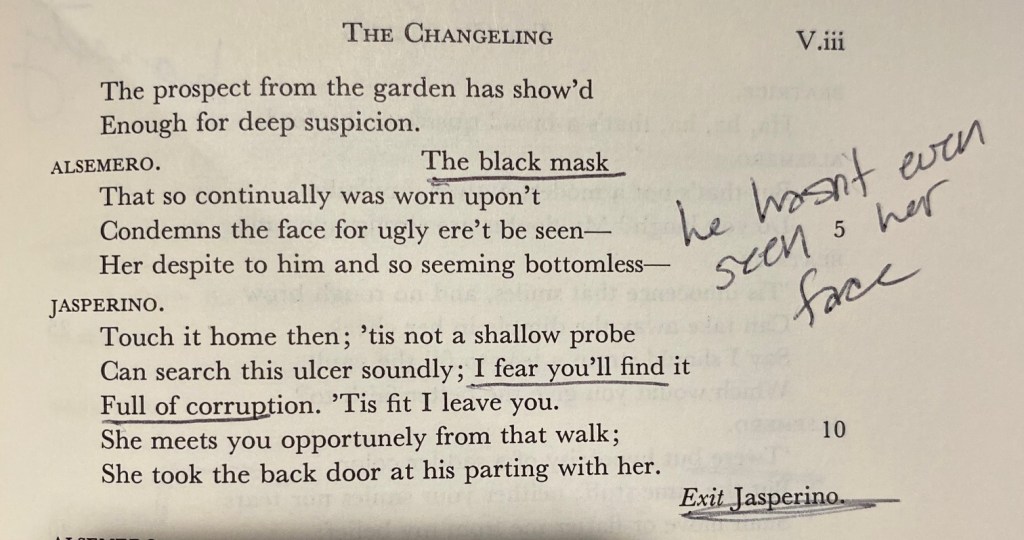
He hasn’t even seen her face

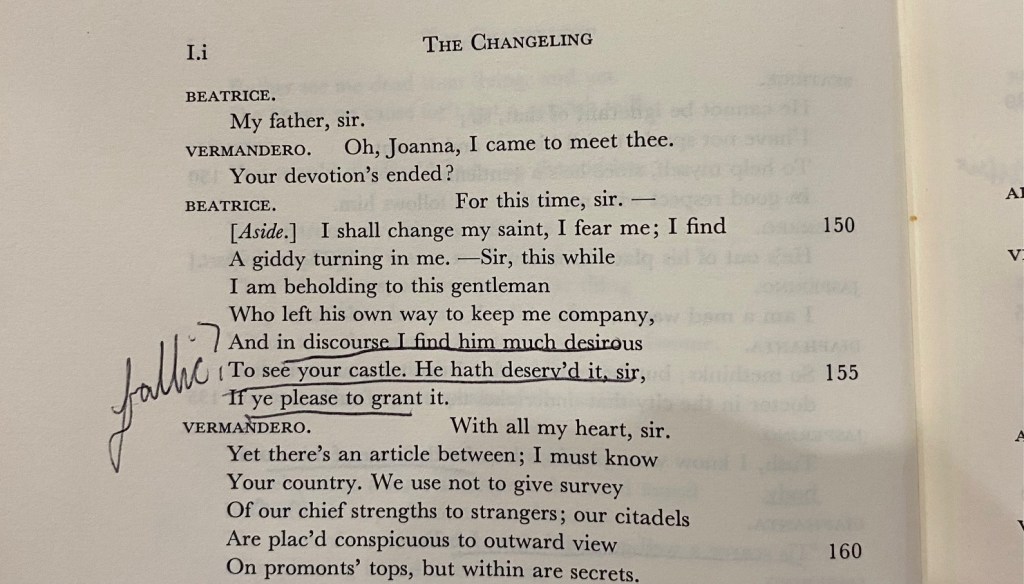
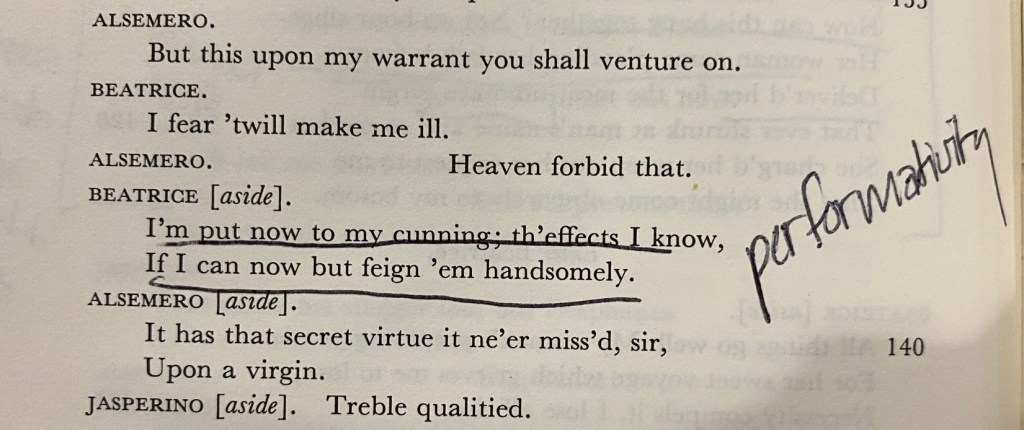
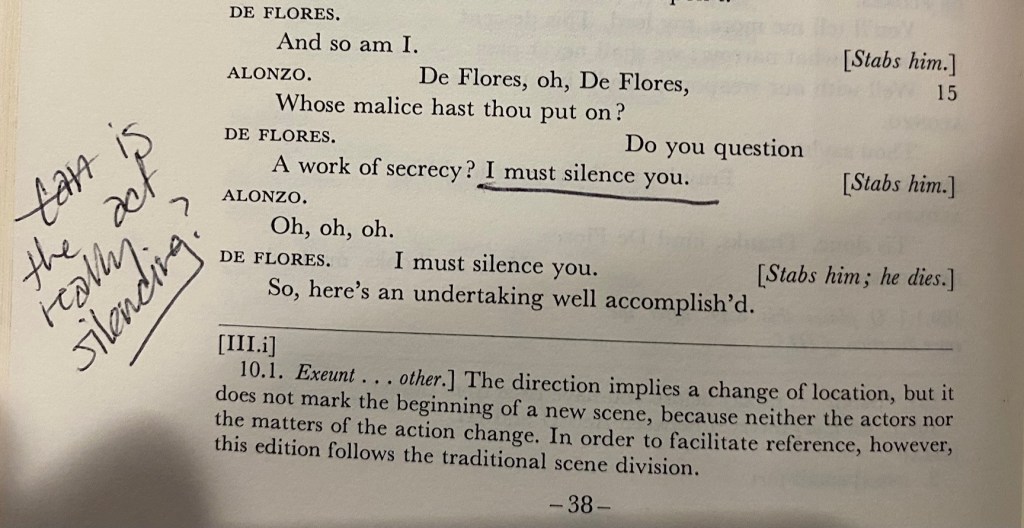
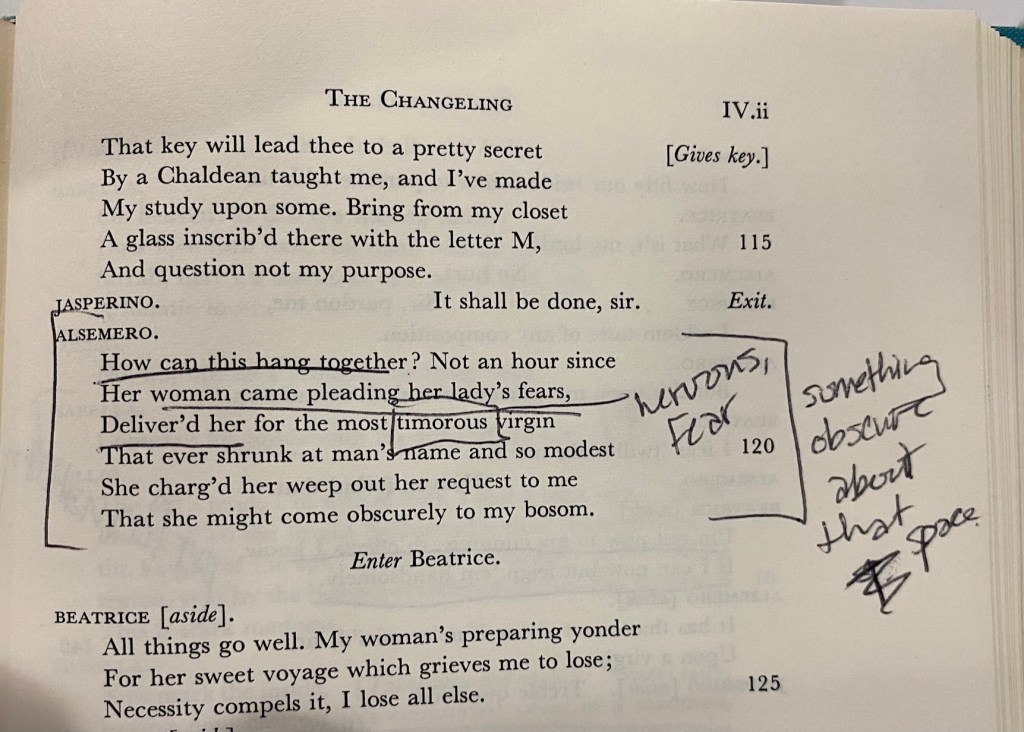
I was reading Carlo Ginzburg’s The Cheese and the Worms last week and was struck throughout by the main subject’s unconscious insistence on literalizing as his main reading/interpretational strategy. Today I’ve been reading my university’s copy of Thomas Middleton and William Rowley’s The Changeling and find that I’ve been preceded by someone with an almost equally strong literalizing tendency. Their marginal commentary was kept up throughout and by the end passed from annoying to accidental Mystery Science Theater. Here are some highlights:

Act 3, Quieting Dead Metaphors

Act IV, The Spatial Poetics of Obscurity

Act V, Unmasking Metaphors: Reading Radical Literalism in Jacobean Tragedy

And two bonuses – because no modern academic reading is complete without finding ‘fallic’ (sic) imagery or pointing out performativity.

Mundus vult decipi

From Jame Branch Cabell’s Figures of Earth, the first (narrative) volume of Cabell’s Biography of the Life of Manuel series.

Thereafter the florid young Count of Poictesme rode east, on a tall dappled horse, and a retinue of six lackeys in silver and black liveries came cantering after him, and the two foremost lackeys carried in knapsacks, marked with a gold coronet, the images which Dom Manuel had made. A third lackey carried Dom Manuel’s shield, upon which were emblazoned the arms of Poictesme. The black shield displayed a silver stallion which was rampant in every member and was bridled with gold, but the ancient arms had been given a new motto.

“What means this Greek?” Dom Manuel had asked.

Mundus decipit, Count,” they told him, “is the old pious motto of Poictesme: it signifies that the affairs of this world are a vain fleeting show, and that terrestrial appearances are nowhere of any particular importance.”

“Then your motto is green inexperience,” said Manuel, “and for me to bear it would be black ingratitude.”

So the writing had been changed in accordance with his instructions, and it now read Mundus vult decipi.

The change to the Latin is from ‘the world deceives/beguiles’ to ‘the world wishes to be deceived/beguiled.’

That infinity of mental excitement which quiet observation can afford

From Edgar Allan Poe’s The Murders in the Rue Morgue

It was a freak of fancy in my friend (for what else shall I call it?) to be enamored of the night for her own sake; and into this bizarrerie, as into all his others, I quietly fell; giving myself up to his wild whims with a perfect abandon. The sable divinity would not herself dwell with us always; but we could counterfeit her presence. At the first dawn of the morning we closed all the messy shutters of our old building; lighting a couple of tapers which, strongly perfumed, threw out only the ghastliest and feeblest of rays. By the aid of these we then busied our souls in dreams—reading, writing, or conversing, until warned by the clock of the advent of the true Darkness. Then we sallied forth into the streets arm in arm, continuing the topics of the day, or roaming far and wide until a late hour, seeking, amid the wild lights and shadows of the populous city, that infinity of mental excitement which quiet observation can afford.