A director and an actor who are monsters of consciousness

From Harold Bloom’s Hamlet: Poem Unlimited, one of his six(?) book-length essays on individual characters – the others being dedicated to Cleopatra, Falstaff, Iago, Lear, and Macbeth. Bloom throughout his Shakespeare-centered works always complains about performance quality – and modern performances especially – so I appreciate finding that he somewhere gave an indication of what he’d wish.

A “poem unlimited” should be the greatest of entertainments, but I have yet to see Hamlet performed, on screen or stage, as extravagantly as it should be done. I hasten to stammer, “No! I don’t mean Hamlet the musical!” What is wanted is a director and an actor who are monsters of consciousness, and who can keep up with that true combat of mighty opposites, Hamlet and Shakespeare. In such a death duel, I would want the actor to side with Shakespeare, and the director to favor Hamlet. Let the actor underplay, even as he is overdirected.

As audience, we thus will confront a protagonist and a director in dubious battle, but that should help emphasize that everything in the play that is not Hamlet himself is peculiarly archaic. The actor will imply continuously that he has been dropped into the wrong play, yet feels it will do as badly, or as well, as any other, while the director will maintain pressure to evidence that Hamlet is far too good for this antique vehicle, which could wheeze along with just a commonplace hero (or hero-villain) at the center.

This, allegedly, is bliss

The author’s foreword in Ermanno Cavazzoni’s Brief Lives of Idiots:

What follows is one calendar month. Each day holds the life of a kind of saint, who experiences agony and ecstasy the way traditional saints do. Then our month ends, because everything in this world must end, even our brief idiot lives.

What month comes after, no one knows for sure; whether, for example, it will bring us laughter or tears, solitude or companionship. There is only conjecture. Some of it quite remarkable.

Some maintain that the month after never ends; this is a wild idea, it makes one tired just thinking about it.

Others say that we start over and over again, perhaps on another planet; yet each time humanity becomes a degree more idiotic. Until, in a slow progression, from planet to planet, complete and total idiocy is reached, and no one remembers a thing, not even the most basic, such as, for example, feeling any different from a rock or a meteorite. This, allegedly, is bliss.

It has been called a state very much like that of lead.

Past and present

From Antal Szerb’s Journey by Moonlight:

Past and present always played special games inside Mihály, lending each other colour and flavour. He loved to relocate himself in his past, at one precise point, and from that perspective re-assemble his present life: for example, “What would I have made of Florence if I had come here at sixteen?” and this reordering would always give the present moment a richer charge of feeling. But it could also be done the other way round, converting the present into a past: “What fine memories will I have, ten years from now, of once having been in Florence with Erzsi … what will such memories hold, what associations of feeling, which I cannot guess at at this moment?”

Six decades of progress

From Richard Hofstadter’s The Paranoid Style in American Politics, written sixty years ago in 1963:

If we now take the long jump [from the nineteenth century] to the contemporary right wing, we find some rather important differences from the nineteenth-century movements. The spokesman of those earlier movements felt that they stood for causes and personal types that were still in possession of their country—that they were fending off threats to a still well-established way of life in which they played an important part. But the modern right wing, as Daniel Bell has put it, feels dispossessed: America has been largely taken away from them and their kind, though they are determined to try to repossess it and to prevent the final destructive act of subversion. The old American virtues have already been eaten away by cosmopolitans and intellectuals; the old competitive capitalism has been gradually undermined by socialist and communist schemers; the old national security and independence have been destroyed by treasonous plots, having as their most powerful agents not merely outsiders and foreigners but major statesmen seated at the very centers of American power. Their predecessors discovered foreign conspiracies; the modern radical right finds that conspiracy also embraces betrayal at home.

Important changes may be traced to the effects of the mass media. The villains of the modern right are much more vivid than those of their paranoid predecessors, much better known to the public; the contemporary literature of the paranoid style is by the same token richer and more circumstantial in personal description and personal invective. For the vaguely delineated villains of the anti-Masons, for the obscure and disguised Jesuit agents, the little-known papal delegates of the anti-Catholics, for the shadowy international bankers of the monetary conspiracies, we may now substitute eminent public figures like Presidents Roosevelt, Truman, and Eisenhower, Secretaries of State like Marshall, Acheson, and Dulles, justices of the Supreme Court like Frankfurter and Warren, and the whole battery of lesser but still famous and vivid conspirators headed by Alger Hiss.

Events since 1939 have given the contemporary right-wing paranoid a vast theater for his imagination, full of rich and proliferating detail, replete with realistic clues and undeniable proofs of the validity of his views. The theater of action is now the entire world, and he can draw on not only the events of the Second World War but those of the Korean War and the cold war. Any historian of warfare knows that it is in good part a comedy of errors and a museum of incompetence; but if for every error and every act of incompetence one can substitute an act of treason, we can see how many points of fascinating interpretation are open to the paranoid imagination: treason in high places can be found at almost every turning—and in the end the real mystery, for one who reads the primary works of paranoid scholarship, is not how the United States has been brought to its present dangerous position, but how it has managed to survive at all.

The basic elements of contemporary right-wing thought can be reduced to three: First, there has been the now familiar sustained conspiracy, running over more than a generation, and reaching its climax in Roosevelt’s New Deal, to undermine free capitalism, to bring the economy under the direction of the federal government, and to pave the way for socialism or communism. Details might be open to argument among right-wingers, but many would agree with Frank Chodorov, the author of The Income Tax: The Root of All Evil, that this campaign began with the passage of the income tax amendment to the Constitution in 1913.

The second contention is that top government officialdom has been so infiltrated by Communists that American policy, at least since the days leading up to Pearl Harbor, has been dominated by sinister men who were shrewdly and consistently selling out American national interests.

The final contention is that the country is infused with a network of Communist agents, just as in the old days it was infiltrated by Jesuit agents, so that the whole apparatus of education, religion, the press, and the mass media are engaged in a common effort to paralyze the resistance of loyal Americans.
The crowning attainment of historical study

From L.B Namier’s essay History in Fritz Stern’s The Varieties of History:

A dilettante is one who takes himself more seriously than his work; and doctrinaires enamoured of their theories or ingenious ideas are dilettanti in public affairs. On the contrary, the historical approach is intellectually humble; the aim is to comprehend situations, to study trends, to discover how things work: and the crowning attainment of historical study is a historical sense – an intuitive understanding of how things do not happen.

The “tremendously interesting” in the seen bit or caught moment

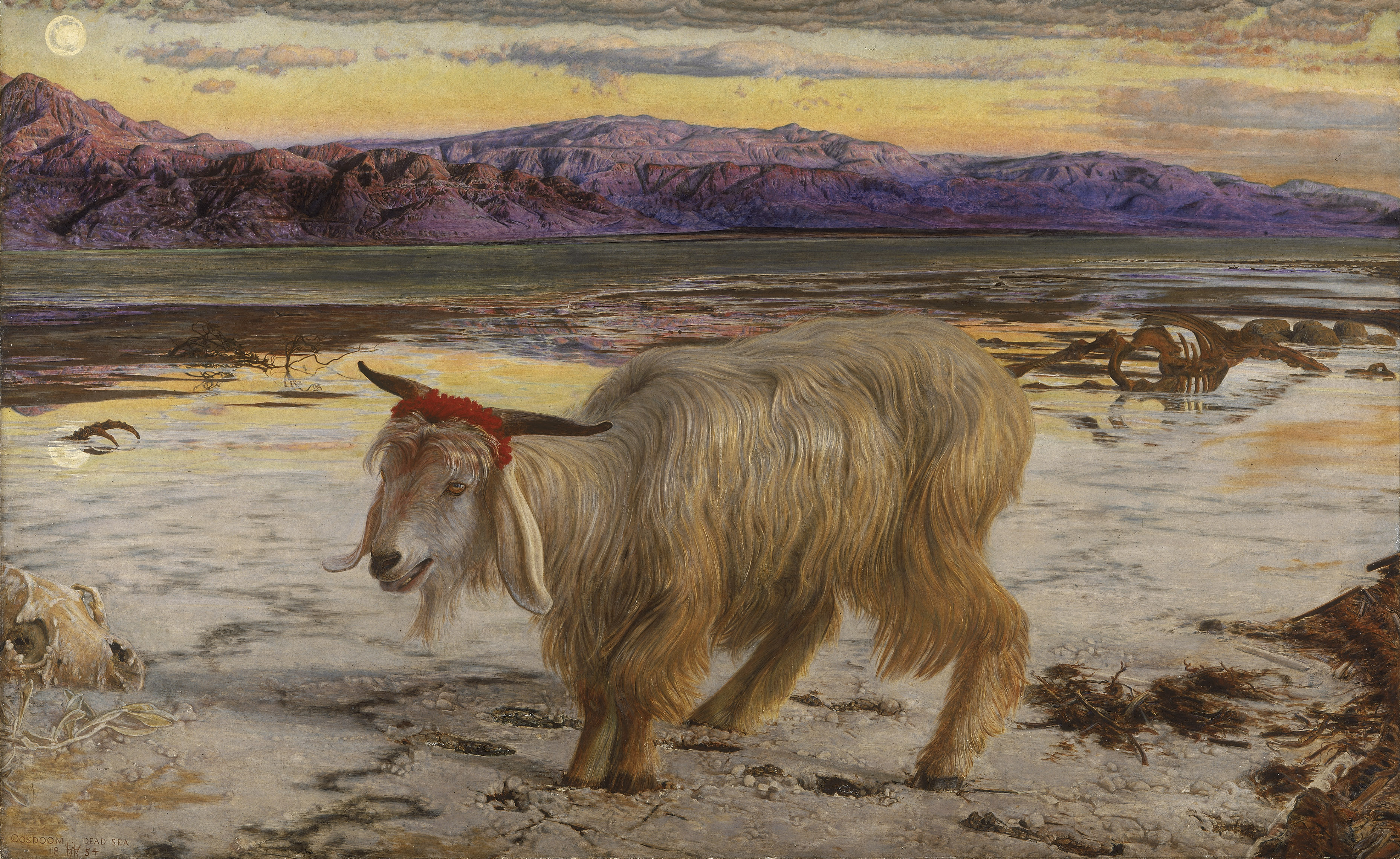
From Henry James’ Notes of a Son and Brother, a description of the pre-Raphaelite artist William Holman Hunt‘s way of seeing and speaking. James had met Hunt as a teenager in the late 1850s during two family trips abroad to England. Although the two had no close relationship, Hunt and his work seem to have stuck uniquely in James’ head. The memory of his painting The Scapegoat is thought to be a prime influence behind James’ 1905 novel The Golden Bowl and the description below from the 1910 autobiography feels a perfect sketch of what James himself aspired to as writer.

William Hunt [had] a manner and range of gesture and broken form of discourse that was like a restless reference to a palette and that seemed to take for granted, all about, canvases and models and charming, amusing things, the “tremendously interesting” in the seen bit or caught moment, and the general unsayability, in comparison, of anything else.

And the painting (which really should have been the cover for René Girard’s work of the same name)

And, also domb as any stoon, Thou sittest at another book

From Chaucer’s House of Fame (647-660), a supposed biographical sketch of the poet that I’d rather be wrong in believing than right in deconstructing. The translation is borrowed from the apparently inexhaustible A.S. Kline (here)

And noght oonly fro fer contree
That ther no tydynge cometh to thee,
But of thy verray neyghebores,
That duellen almost at thy dores,
Thou herist neyther that ne this;
For when thy labour doon al ys,
And hast mad alle thy rekenynges,
In stede of reste and newe thynges
Thou goost hom to thy hous anoon,
And, also domb as any stoon,
Thou sittest at another book
Tyl fully daswed ys thy look;
And lyvest thus as an heremyte,
Although thyn abstynence ys lyte.


And not only that from far country
No tidings ever come to thee,
But of your very own neighbours
That dwell almost at your doors,
You hear neither that nor this;
For when your labours finish,
And you’ve made your reckoning,
Instead of rest and new things,
You go home to your house anon;
And, as dumb as any stone,
You sit down to another book
Till full dazed is your look,
And live thus like a hermit,
Though abstaining never a bit.

It moves my spleen to see these things in books’ clothing perched upon shelves

From Charles Lamb’s Detached Thoughts on Books and Reading:

In this catalogue of books which are no books—biblia abiblia—I reckon Court Calendars, Directories, Pocket Books, Draught Boards bound and lettered at the back, Scientific Treatises, Almanacks, Statutes at Large; the works of Hume, Gibbon, Robertson, Beattie, Soame Jenyns, and, generally, all those volumes which “no gentleman’s library should be without:” the Histories of Flavius Josephus (that learned Jew), and Paley’s Moral Philosophy. With these exceptions, I can read almost any thing. I bless my stars for a taste so catholic, so unexcluding.

I confess that it moves my spleen to see these things in books’ clothing perched upon shelves, like false saints, usurpers of true shrines, intruders into the sanctuary, thrusting out the legitimate occupants. To reach down a well-bound semblance of a volume, and hope it is some kind-hearted play-book, then, opening what “seem its leaves,” to come bolt upon a withering Population Essay. To expect a Steele, or a Farquhar, and find—Adam Smith. To view a well-arranged assortment of blockheaded Encyclopædias (Anglicanas or Metropolitanas) set out in an array of Russia, or Morocco, when a tithe of that good leather would comfortably re-clothe my shivering folios; would renovate Paracelsus himself, and enable old Raymund Lully to look like himself again in the world. I never see these impostors, but I long to strip them, to warm my ragged veterans in their spoils.

I’ve linked to my best guess at the forgotten authors mentioned (the Penguin edition editor conveniently fails to identify them). Lamb is of course having half – or better – a joke but it’s fitting that two centuries on no one reads any of the authors mentioned except fragments of Hume and Gibbon. And for Hume no one is reading the work that context argues he’s being cited for here – his History of England.

The writer feels everything to be so interesting in itself that there is no need for him to make it so

From the conclusion of C.S. Lewis’ The Discarded Image: An Introduction to Medieval and Renaissance Literature:

Every particular fact and story became more interesting and more pleasurable if, by being properly fitted in, it carried one’s mind back to the Model [of the universe and man’s place in it] as a whole.

If I am right, the man of genius then found himself in a situation very different from that of his modern successor. Such a man today often, perhaps usually, feels himself confronted with a reality whose significance he cannot know, or a reality that has no significance; or even a reality such that the very question whether it has a meaning is itself a meaningless question. It is for him, by his own sensibility, to discover a meaning, or, out of his own subjectivity, to give a meaning—or at least a shape—to what in itself had neither. But the Model universe of our ancestors had a built-in significance. And that in two senses; as having ‘significant form’ (it is an admirable design) and as a manifestation of the wisdom and goodness that created it. There was no question of waking it into beauty or life. Ours, most emphatically, was not the wedding garment, nor the shroud. The achieved perfection was already there. The only difficulty was to make an adequate response.

This, if accepted, will perhaps go far to explain some characteristics of medieval literature.

It may, for example, explain both its most typical vice and its most typical virtue. The typical vice, as we all know, is dulness; sheer, unabashed, prolonged dulness, where the author does not seem to be even trying to interest us. The South English Legendary or Ormulum or parts of Hoccleve are good examples. One sees how the belief in a world of built-in significance encourages this. The writer feels everything to be so interesting in itself that there is no need for him to make it so. The story, however badly told, will still be worth telling; the truths, however badly stated, still worth stating. He expects the subject to do for him nearly everything he ought to do himself. Outside literature we can still see this state of mind at work. On the lowest intellectual level, people who find any one subject entirely engrossing are apt to think that any reference to it, of whatever quality, must have some value. Pious people on that level appear to think that the quotation of any scriptural text, or any line from a hymn, or even any noise made by a harmonium, is an edifying sermon or a cogent apologetic. Less pious people on the same level, dull clowns, seem to think that they have achieved either a voluptuous or a comic effect—I am not sure which is intended—by chalking up a single indecent word on a wall. The presence of a Model whose significance is ‘given’ is likewise no unmixed blessing.

And yet, I believe, it is also connected with the characteristic virtue of good medieval work. What this is, anyone can feel if he turns from the narrative verse of, say, Chapman or Keats to the best parts of Marie de France or Gower. What will strike him at once is the absence of strain. In the Elizabethan or Romantic examples we feel that the poet has done a great deal of work; in the medieval, we are at first hardly aware of a poet at all. The writing is so limpid and effortless that the story seems to be telling itself. You would think, till you tried, that anyone could do the like. But in reality no story tells itself. Art is at work. But it is the art of people who, no less than the bad medieval authors, have a complete confidence in the intrinsic value of their matter. The telling is for the sake of the tale; in Chapman or Keats we feel that the tale is valued only as an opportunity for the lavish and highly individual treatment. We feel the same difference on turning from Sidney’s Arcadia to Malory’s Morte, or from a battle in Drayton to one in LaƷamon. I am not suggesting a preference, for both ways of writing can be good; I am only underlining a difference.

The liar platonic

From Henry James’ short story The Liar – I often forget the straight comic vein that runs through early-to-mid Jamesian character sketches.

The observation of these three days showed him that if Capadose was an abundant he was not a malignant liar and that his fine faculty exercised itself mainly on subjects of small direct importance. ‘He is the liar platonic,’ he said to himself; ‘he is disinterested, he doesn’t operate with a hope of gain or with a desire to injure. It is art for art and he is prompted by the love of beauty. He has an inner vision of what might have been, of what ought to be, and he helps on the good cause by the simple substitution of a nuance. He paints, as it were, and so do I!’ His manifestations had a considerable variety, but a family likeness ran through them, which consisted mainly of their singular futility. It was this that made them offensive; they encumbered the field of conversation, took up valuable space, converted it into a sort of brilliant sun-shot fog. For a fib told under pressure a convenient place can usually be found, as for a person who presents himself with an author’s order at the first night of a play. But the supererogatory lie is the gentleman without a voucher or a ticket who accommodates himself with a stool in the passage.

In one particular Lyon acquitted his successful rival; it had puzzled him that irrepressible as he was he had not got into a mess in the service. But he perceived that he respected the service—that august institution was sacred from his depredations. Moreover though there was a great deal of swagger in his talk it was, oddly enough, rarely swagger about his military exploits. He had a passion for the chase, he had followed it in far countries and some of his finest flowers were reminiscences of lonely danger and escape. The more solitary the scene the bigger of course the flower. A new acquaintance, with the Colonel, always received the tribute of a bouquet: that generalisation Lyon very promptly made. And this extraordinary man had inconsistencies and unexpected lapses—lapses into flat veracity. Lyon recognised what Sir David had told him, that his aberrations came in fits or periods—that he would sometimes keep the truce of God for a month at a time. The muse breathed upon him at her pleasure; she often left him alone. He would neglect the finest openings and then set sail in the teeth of the breeze. As a general thing he affirmed the false rather than denied the true; yet this proportion was sometimes strikingly reversed. Very often he joined in the laugh against himself—he admitted that he was trying it on and that a good many of his anecdotes had an experimental character. Still he never completely retracted nor retreated—he dived and came up in another place.