Patch grief with proverbs, make misfortune drunk with candle-wasters

From Much Ado About Nothing, Leonato’s speech following the accusation against Hero (5.1.3-31). The play’s text is generally unproblematic but one line in this passage has apparently forced a lot of discussion over the centuries.

I pray thee cease thy counsel,
Which falls into mine ears as profitless
As water in a sieve. Give not me counsel;
Nor let no comforter delight mine ear
But such a one whose wrongs do suit with mine.
Bring me a father that so loved his child,
Whose joy of her is overwhelmed like mine,
And bid him speak of patience;
Measure his woe the length and breadth of mine
And let it answer every strain for strain,
As thus for thus, and such a grief for such,
In every lineament, branch, shape, and form:
If such a one will smile and stroke his beard,
And sorrow; wag, cry ‘hem!’ when he should groan,
Patch grief with proverbs, make misfortune drunk
With candle-wasters; bring him yet to me,
And I of him will gather patience.
But there is no such man: for, brother, men
Can counsel and speak comfort to that grief
Which they themselves not feel; but tasting it,
Their counsel turns to passion which before
Would give preceptial medicine to rage,
Fetter strong madness in a silken thread,
Charm ache with air and agony with words:
No, no; ’tis all men’s office to speak patience
To those that wring under the load of sorrow,
But no man’s virtue nor sufficiency
To be so moral when he shall endure
The like himself. Therefore give me no counsel:
My griefs cry louder than advertisement.

Alternate readings include but are far from limited to:

Quarto – And sorrow, wagge, crie hem
3rd Folio – And hallow, wag, cry hem
4th Folio – And Hollow, wag, cry hem
Theobald – And Sorrow wage; cry, hem
Hanmer – And sorrow waive, cry hem
Halliwell – And sorrowing, cry ‘hem’
Johnson – And, Sorrow wag! cry; hem
Cappell – Bid sorrow, wag; cry, hem
(conjecture from an Arden note) – And, sorry wag, cry hem

The main debte here is whether ‘sorrow’ should be taken as a verb (parallel to the preceding line’s ‘stroke his beard’) or an object of the verb ‘wag’ – used under OED’s definition 7A ‘To go, depart, be off. Now colloquial’. The OED, following Cappell’s emendation, cites this passage as one of only a few instances of that sense (“And sorrow, wagge [read Bid sorrow wagge], crie hem”), and this emendation has now generally won out except where editors prefer to follow the Quarto text, as in the 2nd ed. of the Cambridge Shakespeare and, using that edition’s proposal, the new Arden I’ve given here. Those punctuate to keep ‘sorrow’ and ‘wag’ as separate verbs, relying for the latter on the second definition of the noun ‘wag’ (‘Any one ludicrously mischievous; a merry droll’ – Johnson) and supplying an implied sense of ‘play the wag’ (= pretend to be light-hearted). ‘Cry ‘hem” is taken as covering the suppressed emotion with a cough and fits either of the above readings. So we get two options:

If such a one will smile and stroke his beard,
And bid sorrow be off; cover his emotion with a cough when he should groan,

and

If such a one will smile and stroke his beard,
And inwardly sorrow; play light-hearted, cover his emotion with a cough when he should groan,

Both are workable, but I tend to favor the second since it better connects with a second element of what made this crux so difficult for so long – a now-resolved debate over the meaning of the extremely rare ‘candle-wasters’ a few lines later:

Patch grief with proverbs, make misfortune drunk
With candle-wasters

Some 19th century editors (following one named Staunton) took the word to mean ‘revellers’ or something like ‘those who burn down candles by staying up too late [drinking]’. The line of thought seems to have been literalizing the metaphorical ‘make misfortune drunk’ into something like ‘drink enough to forget your misfortune’ and then taking ‘with candle-wasters’ as a phrase of accompaniment rather than instrument. But fortunately there is a contemporary use from Ben Jonson’s Cynthia’s Revels (3.2.2 – the only other instance recorded by the OED) that snuffs the argument:

HEDON. Heart, was there ever so prosperous an invention thus
unluckily perverted and spoiled, by a whoreson book-worm, a
candle-waster?

ANA. Fough! he smells all lamp-oil with studying by candle-light.

‘Candle-waster’ can only be a dismissive term for a scholar (who wastes candles by studying all night) and ‘make misfortune drunk with candle-wasters’ must be largely parallel to the sentiment of the preceding ‘patch grief with proverbs.’ It is reminiscent of a favorite line of Melville’s from early in Moby Dick – ‘requires a strong decoction of Seneca and the Stoics to enable you to grin and bear it.’

Sixpence in earnest of the bearward

Beatrice, from Much Ado About Nothing (2.1.~30-35):

He that hath a beard is more than a youth, and he that hath
no beard is less than a man: and he that is more than
a youth is not for me, and he that is less than a man,
I am not for him: therefore, I will even take sixpence in
earnest of the bearward, and lead his apes into hell.

‘Bearward’ – and its variants ‘berrord’ in the Quarto text and ‘bearherd’ in Folio 3 – are the sorts of dead words I enjoy looking into. Here the OED gives a surprising multiplicity of forms:

α. Middle English barrewarde, Middle English berewarde, Middle English–1500s barwarde, Middle English–1500s bereward, Middle English–1500s berward, Middle English–1500s berwarde, 1500s bearwarde, 1500s–1600s beareward, 1600s– bearward.

β. 1500s–1600s bearard, 1600s bearerd, 1600s berard, 1600s berod, 1600s berrord, 1800s berrod (English regional).

and takes Folio 3’s ‘bearherd’ as a later synonym with a different second root element (out of curiosity I checked ‘shepherd’ and found that it had the same change in reverse in the early 17th century – breaking off into a soon-defunct ‘sheepward’).

The definition of bearward is given as:

In Britain: a person who takes care of bears, bulls, apes, or other animals, training and managing them for displays of public entertainment, such as baiting and dancing. Now historical.

The expansion to animals beyond bears feels a bit odd at first and might seem a Shakespearean innovation if there weren’t an example from 1551 ( in John Bale’s The first two parts of the Actes, or vnchast examples of the Englysh votaryes) that confirms the earlier broader application:

They played with those worldly rulers..as the bearwardes ded with their apes and their beares.

But even with its wider scope, ‘bearward’ didn’t displace more the particular terms. For apes alone I quickly found ‘ape-bearer’, ‘ape-keeper’, ‘ape-leader’, and (predictably) ‘ape-ward’. The first of these is used by Shakespeare twenty years later in A Winters Tale (4.3.94 – “I know this man well, he hath bene since an Ape-bearer.”) and, except for ‘ape-ward’ (with a single citation from Piers Plowman in 1362), the rest show continued life into the 17th century.

So why bearward here instead of an ape-word? Because it – along with variants ‘berrord’ and ‘bearherd’ – would have been a near homophone for ‘beard’ that Beatrice uses twice at the start of the quoted lines and the bard can’t turn down a sound similarity, especially when it so deftly smooths the transition to a proverb that I’ll make a post about shortly.

Hoping to twig from what we are not what we might be next

W.H. Auden’s Good-Bye to the Mezzogiorno. The mezzogiorno – literally midday – is the name for southern Italy taken altogether.

Out of a gothic North, the pallid children
Of a potato, beer-or-whisky
Guilt culture, we behave like our fathers and come
Southward into a sunburnt otherwhere

Of vineyards, baroque, la bella figura,
To these feminine townships where men
Are males, and siblings untrained in a ruthless
Verbal in-fighting as it is taught

In Protestant rectories upon drizzling
Sunday afternoons no more as unwashed
Barbarians out for gold, nor as profiteers
Hot for Old Masters, but for plunder

Nevertheless some believing amore
Is better down South and much cheaper
(Which is doubtful), some persuaded exposure
To strong sunlight is lethal to germs

(Which is patently false) and others, like me,
In middle-age hoping to twig from
What we are not what we might be next, a question
The South seems never to raise. Perhaps

A tongue in which Nestor and Apemantus,
Don Ottavio and Don Giovanni make
Equally beautiful sounds is unequipped
To frame it, or perhaps in this heat

It is nonsense: the Myth of an Open Road
Which runs past the orchard gate and beckons
Three brothers in turn to set out over the hills
And far away, is an invention

Of a climate where it is a pleasure to walk
And a landscape less populated
Than this one. Even so, to us it looks very odd
Never to see an only child engrossed

In a game it has made up, a pair of friends
Making fun in a private lingo,
Or a body sauntering by himself who is not
Wanting, even as it perplexes

Our ears when cats are called Cat and dogs either
Lupo, Nero or Bobby. Their dining
Puts us to shame: we can only envy a people
So frugal by nature it costs them

No effort not to guzzle and swill Yet (if I
Read their faces rightly after ten years)
They are without hope. The Greeks used to call the Sun
He-who-smites-from-afar, and from here, where

Shadows are dagger-edged, the daily ocean blue,
I can see what they meant: his unwinking
Outrageous eye laughs to scorn any notion
Of change or escape, and a silent

Ex-volcano, without a stream or a bird,
Echoes that laugh. This could be a reason
Why they take the silencers off their Vespas,
Turn their radios up to full volume,

And a minim saint can expect rocket’s noise
As a counter-magic, a way of saying
Book to the Three Sisters: “Mortal we may be,
But we are still here!” might cause them to hanker

After proximities – in streets packed solid
With human flesh, their souls feel immune
To all metaphysical threats. We are rather shocked,
But we need shocking: to accept space, to own

That surfaces need not be superficial
Nor gestures vulgar, cannot really
Be taught within earshot of running water
Or in sight of a cloud. As pupils

We are not bad, but hopeless as tutors: Goethe,
Tapping homeric hexameters
On the shoulder-blade of a Roman girl, is
(I wish it were someone else) the figure

Of all our stamp: no doubt he treated her well,
But one would draw the line at calling
The Helena begotten on that occasion,
Queen of his Second Walpurgisnacht,

Her baby: between those who mean by a life a
Bildungsroman and those to whom living
Means to-be-visible-now, there yawns a gulf
Embraces cannot bridge. If we try

To go southern, we spoil in no time, we grow
Flabby, dingily lecherous, and
Forget to pay bills: that no one has heard of them
Taking the Pledge or turning to Yoga

Is a comforting thought in that case, for all
The spiritual loot we tuck away,
We do them no harm – and entitles us, I think
To one little scream at A piacere,

Not two. Go I must, but I go grateful (even
To a certain Monte) and invoking
My sacred meridian names, Vico, Verga,
Pirandello, Bernini, Bellini,

To bless this region, its vendages, and those
Who call it home: though one cannot always
Remember exactly why one has been happy,
There is no forgetting that one was.

Helen’s phantom

A myth variant I’ve always found interesting, originally from a fragment of Stesichorus reported by Plato (Phaedrus 243a):

For those who have sinned in their telling of myths there is an ancient purification, known not to Homer but to Stesichorus: when he was blinded because of his slander of Helen he was not unaware of the reason like Homer, but being devoted to the Muses recognised the cause and immediately wrote:

That story is not true, and you did not go on the well-benched ships and you did not reach the citadel of Troy;

and having composed all the Palinode, as it is called, he at once regained his sight.


ἐστὶν δὲ τοῖς ἁμαρτάνουσι περὶ μυθολογίαν καθαρμὸς ἀρχαῖος, ὃν Ὅμηρος μὲν οὐκ ᾔσθετο, Στησίχορος δέ· τῶν γὰρ ὀμμάτων στερηθεὶς διὰ τὴν Ἑλένης κακηγορίαν οὐκ ἠγνόησεν ὥσπερ Ὅμηρος, ἀλλ᾿ ἅτε μουσικὸς ὢν ἔγνω τὴν αἰτίαν καὶ ποιεῖ εὐθύς·

οὐκ ἔστ᾿ ἔτυμος λόγος οὗτος,
οὐδ᾿ ἔβας ἐν νηυσὶν ἐϋσσέλμοις
οὐδ᾿ ἵκεο πέργαμα Τροίας,

καὶ ποιήσας δὴ πᾶσαν τὴν καλουμένην Παλινῳδίαν παραχρῆμα ἀνέβλεψεν.

Some other references to the same story:

Isocrates, Helen (64):

She (Helen) displayed her power to the poet Stesichorus also: for when at the beginning of his song he uttered a blasphemy against her, he stood up deprived of his sight; but when he had realised the cause of his plight and had composed the Palinode, as it is called, she restored him to his original condition.

Plato, Republic (9.586c)

. . . just as Helen’s phantom, according to Stesichorus, was fought over by the warriors at Troy in ignorance of the truth.

Aelius Aristides, Orations (1.128)

. . . just as some of the poets say Alexander took Helen’s phantom but was unable to take her.

Scholiast: Stesichorus in his poetry tells that when Alexander had seized Helen and was making his way through Pharos1 he was robbed of her by Proteus and received from him her portrait painted on a panel, so that he could assuage his passion by looking at it.

Aelius Aristides, Orations (2.234)

. . . just like the Trojans of Stesichorus, who have Helen’s phantom, believing it to be Helen herself.

Dio Chrysostom, Discourses (11.40s)

These men, he said, have had such a ridiculous effect on you Greeks that you say that another poet who was persuaded by Homer and gave in full the same account of Helen—Stesichorus, I believe—was blinded by Helen for telling lies and got his sight back when he told the opposite story . . . Stesichorus, you allege, said in his later song that Helen never sailed anywhere, whereas others say that Helen was carried off by Alexander but came here to us in Egypt.

Papyrus commentary on lyric poets (2nd c. a.d.,  P.Oxy. 2506 fr. 26 col. i)

. . . (in one Palinode) he blames Homer because he put Helen in Troy, not her phantom; and in the other he blames Hesiod: for there are two different Palinodes, and the beginning of one is

Hither again, goddess, lover of song and dance,

and of the other

Golden-winged maiden,

as Chamaeleon wrote. Stesichorus himself says that the phantom went to Troy while Helen remained with Proteus.

He made such innovations in his stories that he says that Demophon, son of Theseus, was brought to Egypt with the Thestiadae in the homecoming from Troy, and that Demophon was Theseus’ son by lope, daughter of Iphicles, Acamas his son by Phaedra, Hippolytus by the Amazon . . . Helen . . . Agamemnon . . . Amphilochus. . .

Euripides uses essentially the same version but Herodotus adds another (2.113-120):

And the priests told me, when I inquired, that the things concerning Helen happened thus:—Alexander having carried off Helen was sailing away from Sparta to his own land, and when he had come to the Egean Sea contrary winds drove him from his course to the Sea of Egypt; and after that, since the blasts did not cease to blow, he came to Egypt itself, and in Egypt to that which is now named the Canobic mouth of the Nile and to Taricheiai. Now there was upon the shore, as still there is now, a temple of Heracles, in which if any man’s slave take refuge and have the sacred marks set upon him, giving himself over to the god, it is not lawful to lay hands upon him; and this custom has continued still unchanged from the beginning down to my own time. Accordingly the attendants of Alexander, having heard of the custom which existed about the temple, ran away from him, and sitting down as suppliants of the god, accused Alexander, because they desired to do him hurt, telling the whole tale how things were about Helen and about the wrong done to Menelaos; and this accusation they made not only to the priests but also to the warden of this river-mouth, whose name was Thonis.

Thonis then having heard their tale sent forthwith a message to Proteus at Memphis, which said as follows: “There hath come a stranger, a Teucrian by race, who hath done in Hellas an unholy deed; for he hath deceived the wife of his own host, and is come hither bringing with him this woman herself and very much wealth, having been carried out of his way by winds to thy land. 95 Shall we then allow him to sail out unharmed, or shall we first take away from him that which he brought with him?” In reply to this Proteus sent back a messenger who said thus: “Seize this man, whosoever he may be, who has done impiety to his own host, and bring him away into my presence, that I may know what he will find to say.”

Hearing this, Thonis seized Alexander and detained his ships, and after that he brought the man himself up to Memphis and with him Helen and the wealth he had, and also in addition to them the suppliants. So when all had been conveyed up thither, Proteus began to ask Alexander who he was and from whence he was voyaging; and he both recounted to him his descent and told him the name of his native land, and moreover related of his voyage, from whence he was sailing. After this Proteus asked him whence he had taken Helen; and when Alexander went astray in his account and did not speak the truth, those who had become suppliants convicted him of falsehood, relating in full the whole tale of the wrong done. At length Proteus declared to them this sentence, saying, “Were it not that I count it a matter of great moment not to slay any of those strangers who being driven from their course by winds have come to my land hitherto, I should have taken vengeance on thee on behalf of the man of Hellas, seeing that thou, most base of men, having received from him hospitality, didst work against him a most impious deed. For thou didst go in to the wife of thine own host; and even this was not enough for thee, but thou didst stir her up with desire and hast gone away with her like a thief. Moreover not even this by itself was enough for thee, but thou art come hither with plunder taken from the house of thy host. Now therefore depart, seeing that I have counted it of great moment not to be a slayer of strangers. This woman indeed and the wealth which thou hast I will not allow thee to carry away, but I shall keep them safe for the Hellene who was thy host, until he come himself and desire to carry them off to his home; to thyself however and thy fellow-voyagers I proclaim that ye depart from your anchoring within three days and go from my land to some other; and if not, that ye will be dealt with as enemies.”

This the priests said was the manner of Helen’s coming to Proteus; and I suppose that Homer also had heard this story, but since it was not so suitable to the composition of his poem as the other which he followed, he dismissed it finally, making it clear at the same time that he was acquainted with that story also: and according to the manner in which he described the wanderings of Alexander in the Iliad (nor did he elsewhere retract that which he had said) it is clear that when he brought Helen he was carried out of his course, wandering to various lands, and that he came among other places to Sidon in Phenicia. Of this the poet has made mention in the “prowess of Diomede,” and the verses run this:

“There she had robes many-coloured, the works of women of Sidon,
Those whom her son himself the god-like of form Alexander
Carried from Sidon, what time the broad sea-path he sailed over
Bringing back Helene home, of a noble father begotten.”
And in the Odyssey also he has made mention of it in these verses: 99 “Such had the daughter of Zeus, such drugs of exquisite cunning,
Good, which to her the wife of Thon, Polydamna, had given,
Dwelling in Egypt, the land where the bountiful meadow produces
Drugs more than all lands else, many good being mixed, many evil.”

And thus too Menelaos says to Telemachos:

“Still the gods stayed me in Egypt, to come back hither desiring,
Stayed me from voyaging home, since sacrifice was due I performed not.”
In these lines he makes it clear that he knew of the wandering of Alexander to Egypt, for Syria borders upon Egypt and the Phoenicians, of whom is Sidon, dwell in Syria.”

By these lines and by this passage it is also most clearly shown that the “Cyprian Epic” was not written by Homer but by some other man: for in this it is said that on the third day after leaving Sparta Alexander came to Ilion bringing with him Helen, having had a “gently-blowing wind and a smooth sea,” whereas in the Iliad it says that he wandered from his course when he brought her.

Let us now leave Homer and the “Cyprian” Epic; but this I will say, namely that I asked the priests whether it is but an idle tale which the Hellenes tell of that which they say happened about Ilion; and they answered me thus, saying that they had their knowledge by inquiries from Menelaos himself. After the rape of Helen there came indeed, they said, to the Teucrian land a large army of Hellenes to help Menelaos; and when the army had come out of the ships to land and had pitched its camp there, they sent messengers to Ilion, with whom went also Menelaos himself; and when these entered within the wall they demanded back Helen and the wealth which Alexander had stolen from Menelaos and had taken away; and moreover they demanded satisfaction for the wrongs done: and the Teucrians told the same tale then and afterwards, both with oath and without oath, namely that in deed and in truth they had not Helen nor the wealth for which demand was made, but that both were in Egypt; and that they could not justly be compelled to give satisfaction for that which Proteus the king of Egypt had. The Hellenes however thought that they were being mocked by them and besieged the city, until at last they took it; and when they had taken the wall and did not find Helen, but heard the same tale as before, then they believed the former tale and sent Menelaos himself to Proteus.

And Menelaos having come to Egypt and having sailed up to Memphis, told the truth of these matters, and not only found great entertainment, but also received Helen unhurt, and all his own wealth besides. Then however, after he had been thus dealt with, Menelaos showed himself ungrateful to the Egyptians; for when he set forth to sail away, contrary winds detained him, and as this condition of things lasted long, he devised an impious deed; for he took two children of natives and made sacrifice of them. After this, when it was known that he had done so, he became abhorred, and being pursued he escaped and got away in his ships to Libya; but whither he went besides after this, the Egyptians were not able to tell. Of these things they said that they found out part by inquiries, and the rest, namely that which happened in their own land, they related from sure and certain knowledge.

Thus the priests of the Egyptians told me; and I myself also agree with the story which was told of Helen, adding this consideration, namely that if Helen had been in Ilion she would have been given up to the Hellenes, whether Alexander consented or no; for Priam assuredly was not so mad, nor yet the others of his house, that they were desirous to run risk of ruin for themselves and their children and their city, in order that Alexander might have Helen as his wife: and even supposing that during the first part of the time they had been so inclined, yet when many others of the Trojans besides were losing their lives as often as they fought with the Hellenes, and of the sons of Priam himself always two or three or even more were slain when a battle took place (if one may trust at all to the Epic poets),—when, I say, things were coming thus to pass, I consider that even if Priam himself had had Helen as his wife, he would have given her back to the Achaians, if at least by so doing he might be freed from the evils which oppressed him. Nor even was the kingdom coming to Alexander next, so that when Priam was old the government was in his hands; but Hector, who was both older and more of a man than he, would have received it after the death of Priam; and him it behoved not to allow his brother to go on with his wrong-doing, considering that great evils were coming to pass on his account both to himself privately and in general to the other Trojans. In truth however they lacked the power to give Helen back; and the Hellenes did not believe them, though they spoke the truth; because, as I declare my opinion, the divine power was purposing to cause them utterly to perish, and so make it evident to men that for great wrongs great also are the chastisements which come from the gods. And thus have I delivered my opinion concerning these matters.


The transitive property – semblance of my soul

Portia, from The Merchant of Venice (3.4.10-23). If Antonio = Bassanio and Bassanio = Portia then Antonio = Portia. I wish I’d made notes on or could remember other instances of this logic in Shakespeare. My casual sense is that it’s pretty rare and usually limited to abstract qualities so extending it to people might be a unique use – though maybe less bold a reach if you take ‘soul’ as essentially an abstract.

I never did repent for doing good,
Nor shall not now: for in companions
That do converse and waste the time together,
Whose souls do bear an equal yoke of love,
There must be needs a like proportion
Of lineaments, of manners and of spirit;
Which makes me think that this Antonio,
Being the bosom lover of my lord,
Must needs be like my lord. If it be so,
How little is the cost I have bestow’d
In purchasing the semblance of my soul
From out the state of hellish misery!
This comes too near the praising of myself;
Therefore no more of it:

You will agree with me that a Tallemant des Reaux in Soviet Russia is more interesting than an official Thucydides

From the opening of Curzio Malaparte’s The Kremlin Ball, a section titled Moscow Society is the Mirror Image of European Society but Dominated by Fear. The novel was left unfinished at the time of the author’s death and this English translation from NYRB is the product of a recent Italian critical edition (that I don’t have access to, unfortunately). The premise – best summed up in the line I’ve used here for title, said to the narrator late in the novel – is fascinating but the novel itself generally feels too unfinished to pull through on it in more than a few moments.

In this novel, a faithful portrait of the USSR’s Marxist nobility, of Moscow’s communist high society, of their haute société, everything is true: the people, the events, the things, the places. The characters did not originate in the author’s imagination, but were drawn from life, each with his own name, face, words, and actions: Stalin, who watched the famous ballerina Semyonova prance about the stage every night at the Bolshoi Theater of Moscow; Karakhan (the same Karakhan Stalin later had killed), with whom Stalin was apparently competing for Semyonova; the celebrated beauties of the Marxist nobility, the Bs, Gs, and Ls with their lovers, intrigues, and scandals, their eager and restless faces basking in the ephemeral rose-tinted glow of glory, riches, and power; the extraordinary Florinsky, Chief of Protocol of the People’s Commissariat for Foreign Affairs, who paraded through the streets of Moscow in his horse-drawn carriage; the fearful and resigned Madame Kameneva, Trotsky’s sister; all of these merveilleuses, these lions, these parvenus, these ephebes are not invented but living people, real human creatures. What differentiates this novel, however, from a “court chronicle” catering to seventeenth-century French taste, or from a mémoire such as the one by Saint-Simon, or from a book of moralités like Montaigne’s, and makes it a novel in the Proustian sense (not so much in style, but in its keen sense of désintéressement, or disinterestedness, so essential to the novels and characters created by Marcel Proust), is the fact that the characters, events, and episodes in this “court chronicle” are bound by a fatality propelling them all toward one end, toward a novelistic denouement. The protagonist, the hero of this novel, is not an individual, not a man or woman, but a social entity: the communist aristocracy that replaced the Russian aristocracy of the ancien régime, and in many ways resembled the revolutionary nobility that arose after the French Revolution, those who gathered around Barras during the Directory regime. Similarly, the protagonist of Proust’s novels is no individual, no man or woman, not Baron Charlus or Swann, not Madame de Guermantes, Odette, or Langeron, but rather the French nobility, the Parisian nobility, the monde de Paris, in other words, a social entity, society itself. The author of this novel, however, has no intention of being a moralist—as in the “plan de désintéressement” or “framework of disinterestedness” Albert Thibaudet discusses in regard to Proust in which Proust infuses morality into his psychological analysis. This author emphatically declares that he is absolutely indifferent to the fate of his characters. As for their morality, whether they are on the side of the good or the bad, he’s interested only up to a point. This author, instead, addresses disinterestedness not in terms of psychological analysis but in terms of how disinterestedness is infused in the social drama of politics and political unrest of his protagonists, ranging from Stalin to the young Marika. The most striking aspect of a Marxist society is not that it is Marxistically organized like Hitler’s Germany (which the author defines as “feudal communism”), but how Marxist morality is dominated by fatalism. That historical materialism would lead to fatalism is odd. In reality, Marxism does not lead the individual to a collective sentiment but to the most absolute fatalism, to a total dedication to fatality—which is, of course, the sign of a society in decline. If the novel contains a moral it is this: Marxist society in the USSR is already in decline. And not only the Trotskyite nobility of 1929, but the Marxist nobility and the entire Marxist society are in decline. A distinct and dreadful sign of this decline is the fatalism that is the private rationale of every Russian man, even if disguised by activity and fanatic belief—these being characteristics of a Marxist society indifferent to its own destiny. Another factor is this: Russians suffer for others. The inducement to suffer for others is a form of fatalism. Only those who suffer for themselves take part in history, participate in the thrust of history, are the subject, not merely the object, of history. The destiny of any noble revolutionary is to wind up against the wall. This destiny is assured for a noble revolutionary in a Marxist society in which mankind, human life, has no value. A new Marxist nobility, which replaced the Trotskyite nobility exterminated in 1936, has been forming in these past few years around Stalin. It, too, will wind up against the wall if it doesn’t succeed in imposing its morality, corruption, and ambition upon the entire Russian population, if it doesn’t succeed in debasing all Russians.

Incidentally, Malaparte may be better known to the Anglo world for his villa on Capri, Casa Malaparte (dated but good photos are here and another below). There was an exhibit on the villa’s furniture in London a couple of years ago.

What he failed to understand was the emotional rather than statistical nature of the discussion

From Giuseppe Tomasi di Lampedusa’s short story The Blind Kittens (I gattini ciechi), some Sicilian nobles ostensibly discussing the rise and fortune of a newly blossomed peasant family. I read somewhere that Lampedusa had intended this tale as the opening chapter of a sort of followup novel to The Leopard (Il Gattopardo).

It was for these reasons for malice mixed with fear that, when the poker game broke up, the conversation turned again to the topic of the Ibbas. A group of ten members had gathered on the club’s terrace, which overlooked a peaceful courtyard and was shaded by a tall tree that rained down lilac petals on the mostly elderly gentlemen. Servants in red and blue brought drinks and cups of gelato. From the depths of a wicker armchair came the unfailingly irascible voice of Santa Giulia.

“Honestly, now, can anyone say how much land this wretched Ibba really has?”

“We can, and I do. Thirty-five thousand four hundred acres,” San Carlo answered coolly.

“That’s all? I thought it was more.”

“Thirty-five thousand? Rubbish! According to people who’ve been there, it can’t be less than fifty thousand acres, that’s dead certain, and all of it prime farmland.”

General Làscari, who appeared immersed in his reading of the Tribuna, abruptly lowered the newspaper and showed his liverish face, lined with yellow wrinkles, in which stood out, severe and slightly sinister, the extremely bright whites of the eyes, like those of certain Greek bronzes.

“The figure is seventy thousand acres, not one more and not one less. My nephew, whose cousin is the wife of Ibba’s prefect, told me so. That’s the way it is, and so be it; there’s no point in discussing it further.”

Pippo Follonica, a visiting Roman envoy, began to laugh. “Honestly, if you’re so interested, why not send someone to look at the cadastral register? It’s easy to find out the truth, this truth at least.”

The rationality of the proposal was but indifferently received. What Follonica failed to understand was the emotional rather than statistical nature of the discussion: These gentlemen were exchanging envies, grudges, fears, all things that cadastral documents would not suffice to sooth.

The general fumed. “When I tell you something, there is no need for cadasters, nor counter-cadasters.” His good manners then mellowed him toward the guest. “Dear Prince, you do not know what the cadaster is like in our parts! The transfer deeds are never registered, which means you’ll still find individuals listed as owners who have sold everything and moved into the poorhouse.”

Confronted with a refutation so rich in local detail, Follonica tried another tack. “Let us concede that the total number of acres remains obscure, but the value of the property in the hands of this boor, who arouses so much passion in you, must be known!”

“This we know very well: eight million net.”

“Rubbish!” Thus did every sentence out of Santa Giulia’s mouth begin. “Rubbish! Not one cent less than ten!”

“What world are you living in? You don’t know anything about anything! He’s got twenty-five million in land alone. Then there’s the rents, the capital he’s loaned out and not yet turned into property, the value of the livestock. That makes at least another fifteen million.”

The general had laid down his newspaper and was clearly distressed. The imperiousness of his manner had for years been a source of irritation to the entire club—each of whose members wished to be the only one making incontrovertible statements—such that there immediately formed against this opinion a coalition of renewed antipathies and, without reference to the greater or lesser truth of the facts, the appraised value of the Ibba properties fell precipitously.

“This is all fantasy. Claims about money, like those about saintliness, ought to be taken with a grain of salt. If Batassano Ibba has ten million, all included, that’s already a lot.”

The figure had been distilled from nothing, that is, out of polemical necessity; but when it was spoken, corresponding as it did to the desire of each man, it calmed everyone down, with the exception of the general, who gesticulated from the depths of his armchair, powerless against his nine adversaries.

A waiter entered carrying a long wooden pole, at its tip a burning bit of spirit-infused flock. The gentle glow of sunset gave way to the harsher light of a gas lamp. The Roman was rather enjoying himself. It was his first time in Sicily, and during his five-day stay in Palermo he’d been received in several houses and begun to change his mind about the supposed provincialism of Palermitan society: the dinners had been well served, the reception rooms beautifully appointed, the ladies elegant and full of grace. But now, this impassioned discussion about the fortune of an individual whom none of the disputants knew nor wished to know, this blatant exaggeration, this hysterical gesticulation over nothing, caused him to reconsider anew. It all reminded him a bit too much of the conversations he would hear in Fondi or in Palestrina, when he went to attend to his estates, and perhaps also of the Bésuquet pharmacy, a memory that, ever since he’d read Daudet’s Tartarin, never failed to make him smile. And so he laid in a supply of anecdotes to tell his friends a week later when he would be back in Rome. But he was mistaken. He was too much a man of the world to be accustomed to plunging his investigation below the most superficial appearances, and what appeared to him the humorous exhibition of provincialism was anything but comic; it was the tragic convulsions of a class that saw its own primacy as large landowners—that is, its own raison d’être and the source of its social continuity—slipping away, and that sought in arbitrary exaggerations and contrived reductions outlets for its anger, relief for its fears.


Fu per queste ragioni di rancore misto a timore che, quando il “pokerino” ebbe termine, la conversazione cadde di nuovo sull’argomento Ibba. La diecina di soci presenti si era installata sulla terrazza del Circolo, che sovrasta un placido cortile ed era ombreggiata da un alto albero che faceva piovere petali di lillà su quei signori per lo più anziani. Servi in rosso e bleu portavano in giro gelati e bibite. Dal fondo di una poltrona di vimini giungeva sempre collerica la voce di Santa Giulia. “Ma insomma si può sapere quante terre ha questo benedetto Ibba?”

“Si può sapere, si sa. Quattordici mila trecento venticinque ettari,” rispose freddo San Carlo.

“Solamente? Io credevo di più.”

“Quattordicimila un corno! Secondo persone che sono state sul posto non possono essere meno di ventimila ettari, sicuro come la Morte; e tutti semineri di prima scelta.”

Il generale Làscari, che sembrava immerso nella lettura della Tribuna, abbassò bruscamente il giornale e mostrò la faccia sua di fegatoso, ricamata di rughe gialle nelle quali la cornea bianchissima risaltava dura e un po’ sinistra, come gli occhi di certi bronzi greci. “Sono ventotto mila, né uno di più né uno di meno; me lo ha detto mio nipote che è cugino della moglie del suo Prefetto. È così, e basta; ed è inutile discuterne più a lungo.”

Pippo Follonica, un inviato romano di passaggio, si mise a ridere: “Ma insomma se vi interessa tanto perché non mandate qualcheduno al Catasto; è facile sapere la verità, questa verità per lo meno.”

La razionalità della proposta fu accolta con freddezza. Follonica non capiva la natura passionale, non statistica, della discussione: quei signori palleggiavano fra loro invidie, rancori, timori, cose tutte che i certificati catastali non bastavano a sedare.

Il generale si inviperì: “Quando una cosa la dico io non occorrono catasti né controcatasti.” Poi la cortesia verso l’ospite lo raddolcì. “Caro Principe, Lei non sa che cosa è il catasto da noi! Le volture non sono mai fatte e vi figurano come proprietari ancora quelli che hanno venduto e che adesso sono all’Ospizio di Mendicità.”

Di fronte a una smentita tanto circostanziata, Follonica cambiò tattica. “Ammettiamo che l’ettaraggio rimanga ignoto; ma il valore del patrimonio di questo buzzurro che vi appassiona si saprà!”

“Questo si sa benissimo: otto milioni netti netti.”

“Un corno!” Era questo l’immancabile inizio di ogni frase di Santa Giulia. “Un corno! Non un centesimo meno di dodici!”

“Ma in che mondo vivete! Non siete informati di niente! Sono venticinque milioni soltanto in terreni. In più vi sono i canoni, i capitali prestati e non ancora trasformati in proprietà, il valore del bestiame. Almeno altri quindici milioni.” Il generale aveva posato il giornale, si agitava. La perentorietà dei suoi modi aveva da anni irritato tutto il Circolo, ciascun socio del quale desiderava essere il solo a fare affermazioni incontrovertibili; così che contro l’opinione di lui si formò immediatamente una coalizione di antipatie risvegliate e, senza riferimento alla verità maggiore o minore dei fatti, la stima del patrimonio Ibba calò a precipizio. “Queste sono poesie; denari e santità metà della metà. Se Baldassare Ibba ha dieci milioni, tutto compreso, è molto.” La cifra era stata distillata dal nulla, cioè, per necessità polemica; ma quando fu detta, poiché rispondeva al desiderio d’ognuno, li calmò tutti, eccetto il generale che gesticolava dal fondo della sua poltrona, impotente, contro i suoi nove avversari.

Un cameriere entrò con una lunga asta di legno che portava in cima un batuffolo con spirito acceso. Alla mite luce del tramonto si sostituì quella rigida del lampadario a gas. Il romano si divertiva assai: era la prima volta che veniva in Sicilia, e nei suoi cinque giorni di permanenza a Palermo era stato ricevuto in parecchie case ed aveva cominciato a ricredersi sul presunto provincialismo dei palermitani: i pranzi erano stati ben serviti, i saloni belli, le signore aggraziate. Ma adesso questa discussione appassionata sulla fortuna di un individuo che nessuno dei contendenti conosceva né voleva conoscere, queste esagerazioni patenti, questo gesticolare convulso per niente, gli facevano di nuovo far macchina indietro, gli ricordavano un po’ troppo le conversazioni che sentiva a Fondi o a Palestrina, quando doveva andarvi per badare alle sue terre, e magari la farmacia Bésuquet, della quale dal tempo della sua lettura del Tartarin conservava un ricordo sorridente; e faceva provvista di storielle da raccontare agli amici quando fra una settimana sarebbe ritornato a Roma. Ma aveva torto: era troppo uomo di mondo per essere avvezzo a tuffare l’indagine sua al di sotto delle più evidenti apparenze, e ciò che gli appariva come umoristica esibizione di provincialismo era tutt’altro che comico: erano i tragici soprassalti di una classe che vedeva sfuggire il proprio primato latifondistico, cioè la propria ragion d’essere e la propria continuità sociale, e che cercava nelle artate esagerazioni, e nelle artificiali diminuzioni, sfoghi alla sua ira, sollievo alla sua paura.

For shame!—to feed on someone else’s grass?

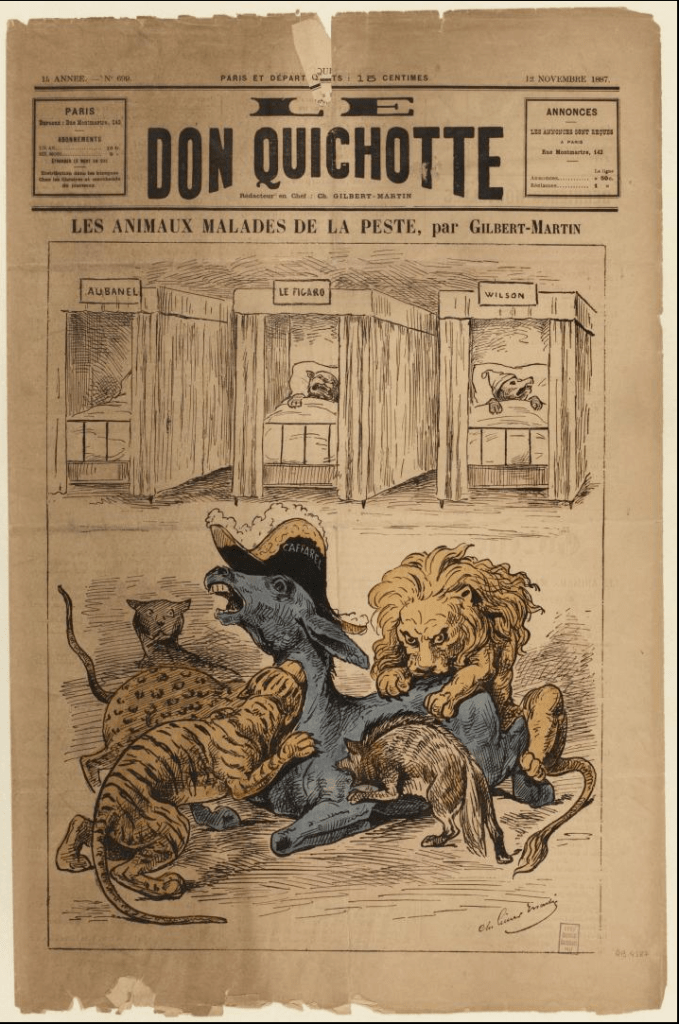
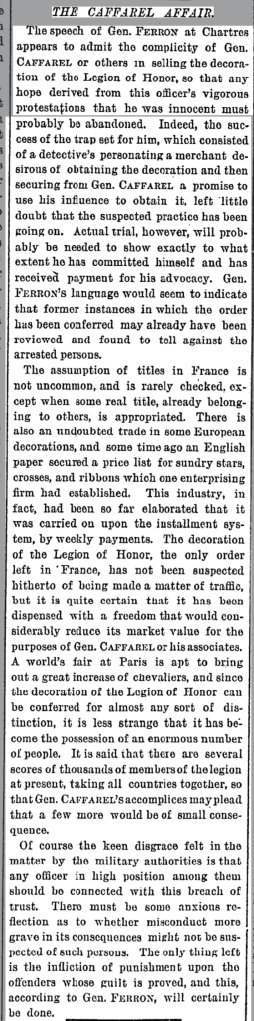
From La Fontaine’s Fables (7.1). Since some of the delight of these comes from the illustrations I’ve included a few beneath the tale – one straight version by Grandville (illustrator of my childhood edition) followed by two of what I guess would be called applied references – by Bouzou from Charlie Hebdo at some point in the past decade and by Charles Gilbert-Martin about a little known corruption scandal from France in the late 1880s.

THE ANIMALS SICK OF THE PLAGUE
An evil that induces dread,
a scourge that Heaven in its wrath devised
that crimes on earth should not go unchastised,
the plague (would that its name were never said!),
which in a day makes rich the Stygian shore,
attacked the animals as if in war.
Not all were dying; none remained exempt.
They could not make the effort to obtain
the means to nourish and sustain
a life now fading, which no food could tempt.
Nor wolf nor fox would lie in wait to slay
the innocent and gentle prey.
In solitude lived every turtle-dove;
there was no joy because there was no love.
The lion called them to his council. ‘Friends,’
he said, ‘these woes that Heaven has permitted
are due, no doubt, to sins we have committed.
So let us sacrifice, to make amends,
the guiltiest among us. His reward,
perhaps, is that our health will be restored.
From history we learn that immolation
often occurs in such a situation.
So therefore let us all examine here
our consciences; and let us be severe.
Myself, in appetite, I’ve been a glutton:
I have consumed a large amount of mutton,
although, against myself, I knew
those sheep had not committed any crimes.
It’s also happened that I’ve had, at times,
the shepherd too.
I’ll be your sacrifice, then, if I must,
but each, I think, should do the same as I,
and say how he has sinned; for it is just
that he who bears the greatest guilt should die.’
The fox said: ‘Sir, you are too good a king,
Your Majesty; in all that you confess
you take your scruples to excess.
To eat a sheep, a slavish, stupid thing,
is that a sin? Of course not; sheep should feel
much honoured to be taken for your meal.
As for the shepherd, let it be observed
that he received no more than he deserved,
like all his kind, who baselessly declare
that they should rule, while we obey their laws.’
Thus spoke the fox, receiving much applause
from all the flatterers. They did not dare
to scrutinize too deeply any deed,
however bad, committed by some breed
such as the tiger or the bear,
or any of the greater powers there;
the creatures of the more pugnacious sort,
down to the mastiff dogs, were one and all
as pure as saints, they said around the court.
The donkey’s turn arrived. ‘I chanced to pass’,
he said, ‘an abbey meadow; I recall
that with my hunger, and the tender grass,
the opportunity, and, it may be,
some devil also tempting me,
I couldn’t help but take a little bite.
I must admit I didn’t have the right.’
His words at once provoked a hue and cry.
A wolf with claims to learning spoke, and said
this mangy, scurvy brute, from whom had spread
the dire disease, accursed beast, must die.
His peccadillo was, they all agreed,
a capital offence. For shame!—to feed
on someone else’s grass? A wicked deed:
only his death could make it good.
They made quite sure he understood.

At court, if you are weak, you’re in the wrong;
you’re always right, at court, if you are strong.


LES ANIMAUX MALADES DE LA PESTE
Un mal qui répand la terreur,
Mal que le Ciel en sa fureur
Inventa pour punir les crimes de la terre
La Peste (puisqu’il faut l’appeler par son nom)
Capable d’enrichir en un jour l’Achéron,
Faisait aux animaux la guerre.
Ils ne mouraient pas tous, mais tous étaient frappés :
On n’en voyait point d’occupés
A chercher le soutien d’une mourante vie ;
Nul mets n’excitait leur envie ;
Ni Loups ni Renards n’épiaient
La douce et l’innocente proie.
Les Tourterelles se fuyaient ;
Plus d’amour, partant plus de joie.
Le Lion tint conseil, et dit : Mes chers amis,
Je crois que le Ciel a permis
Pour nos péchés cette infortune ;
Que le plus coupable de nous
Se sacrifie aux traits du céleste courroux ;
Peut-être il obtiendra la guérison commune.
L’histoire nous apprend qu’en de tels accidents
On fait de pareils dévouements :
Ne nous flattons donc point ; voyons sans indulgence
L’état de notre conscience.
Pour moi, satisfaisant mes appétits gloutons
J’ai dévoré force moutons ;
Que m’avaient-ils fait ? Nulle offense:
Même il m’est arrivé quelquefois de manger
Le Berger.
Je me dévouerai donc, s’il le faut ; mais je pense
Qu’il est bon que chacun s’accuse ainsi que moi
Car on doit souhaiter selon toute justice
Que le plus coupable périsse.
Sire, dit le Renard, vous êtes trop bon Roi ;
Vos scrupules font voir trop de délicatesse ;
Et bien, manger moutons, canaille, sotte espèce.
Est-ce un péché ? Non non. Vous leur fîtes, Seigneur,
En les croquant beaucoup d’honneur;
Et quant au Berger, l’on peut dire
Qu’il était digne de tous maux,
Etant de ces gens-là qui sur les animaux
Se font un chimérique empire.
Ainsi dit le Renard, et flatteurs d’applaudir.
On n’osa trop approfondir
Du Tigre, ni de l’Ours, ni des autres puissances
Les moins pardonnables offenses.
Tous les gens querelleurs, jusqu’aux simples Mâtins,
Au dire de chacun, étaient de petits saints.
L’Âne vint à son tour, et dit : J’ai souvenance
Qu’en un pré de Moines passant,
La faim, l’occasion, l’herbe tendre, et je pense
Quelque diable aussi me poussant,
Je tondis de ce pré la largeur de ma langue.
Je n’en avais nul droit, puisqu’il faut parler net.
A ces mots on cria haro sur le Baudet.
Un Loup quelque peu clerc prouva par sa harangue
Qu’il fallait dévouer ce maudit Animal,
Ce pelé, ce galeux, d’où venait tout leur mal.
Sa peccadille fut jugée un cas pendable.
Manger l’herbe d’autrui ! quel crime abominable !
Rien que la mort n’était capable
D’expier son forfait : on le lui fit bien voir.
Selon que vous serez puissant ou misérable,
Les jugements de Cour vous rendront blanc ou noir.

Grandville
Bouzou
Charles Gilbert-Martin

And, because I was curious, the best summary of the scandal I can find – from the NYT archive. Aside from Le Figaro (a newspaper), I have no idea the people referenced with the sleeping animals in the top of the image.

Don’t believe the stories about us. We don’t kill anyone, we only love.

Meeting a siren, from Giuseppe Tomasi di Lampedusa’s The Professor and the Siren (La Sirena). The introduction to the NYRB edition mentions an audio recording of Lampedusa reading the story where ‘at this moment on the tape, his rapid, witty rendering comes to a pause with a slight intake of breath, a sigh that reveals the author’s awe before the intense presence of his own creation.’ The recording was included on CD with a 2014 edition of the story (publisher’s site) but copies are no longer available anywhere and I’ve had no luck finding an upload.

The heat was violent in Augusta too, but, no longer reflected back by walls, it produced not dreadful prostration but a sort of submissive euphoria; the sun, shedding its executioner’s grimace, was content to be a smiling if brutal giver of energy, and also a sorcerer setting mobile diamonds in the sea’s slightest ripple. Study ceased to be toil: Gently rocked by the boat in which I spent hours on end, each book seemed no longer an obstacle to be overcome but rather a key offering me passage into a world, a world I already had before my eyes in one of its most enchanting aspects. I often happened to recite the verses of poets aloud, and thus the names of those gods, which most people have forgotten or never knew, again skimmed the surface of the sea that would have once, at their mere mention, risen up in turmoil or subsided into dead calm.
….
“This came to pass on the morning of August 5, at six o’clock. I hadn’t been up for long before I was in the boat; a few strokes of the oars took me away from the pebbled shore. I’d stopped at the base of a large rock whose shadow might protect me from a sun that was already climbing, swollen with dazzling fury and turning the whiteness of the auroral sea gold and blue. As I declaimed I sensed that the side of the boat, to my right and behind me, had abruptly been lowered, as if someone had grabbed on to climb up. I turned and saw her: The smooth face of a sixteen-year-old emerged from the sea; two small hands gripped the gunwale. The adolescent smiled, a slight displacement of her pale lips that revealed small, sharp white teeth, like dogs’. This, however, was not a smile like those to be seen among your sort, always debased with an accessory expression of benevolence or irony, of compassion, cruelty, or whatever the case may be; it expressed nothing but itself: an almost bestial delight in existing, a joy almost divine. This smile was the first of her charms that would affect me, revealing paradises of forgotten serenity. From her disordered hair, which was the color of the sun, seawater dripped into her exceedingly open green eyes, over features of infantile purity.

“Our suspicious reason, howsoever predisposed, loses its bearings in the face of the marvelous, and when it perceives it, tries to rely on the memory of banal phenomena. Like anyone else would have, I supposed that I’d met a swimmer. Moving cautiously, I pulled myself up to her level, leaned toward her, and held out my hands to help her aboard. Instead she rose with astonishing strength straight out of the water to her waist, encircled my neck with her arms, wrapping me in a never before experienced perfume, and allowed herself to be pulled into the boat. Her body below the groin, below the buttocks, was that of a fish, covered with tiny pearly blue scales and ending in a forked tail that slapped gently against the bottom of the boat. She was a Siren.

“She lay back, resting her head on interlaced fingers, displaying with serene immodesty the delicate little hairs of her armpits, her splayed breasts, her perfect stomach. She exuded what I have clumsily referred to as a perfume, a magical smell of the sea, of decidedly youthful sensuality. We were in the shade but twenty yards from us the seashore reveled in the sun and quivered with pleasure. My near-complete nudity ill concealed my own emotion.

“She spoke and thus was I overwhelmed, after her smile and smell, by the third and greatest of her charms: her voice. It was a bit guttural, husky, resounding with countless harmonics; behind the words could be discerned the sluggish undertow of summer seas, the whisper of receding beach foam, the wind passing over lunar tides. The song of the Sirens, Corbera, does not exist; the music that cannot be escaped is their voice alone.

“She spoke Greek and I struggled to understand her. ‘I heard you speaking to yourself in a language similar to my own. I like you: take me. I am Lighea, daughter of Calliope. Don’t believe the stories about us. We don’t kill anyone, we only love.’


Il caldo era violento anche ad Augusta ma, non più riverberato da mura, produceva non più una prostrazione bestiale ma una sorta di sommessa euforia, ed il sole, smessa la grinta sua di carnefice, si accontentava di essere un ridente se pur brutale donatore di energie, ed anche un mago che incastonava diamanti mobili in ogni più lieve increspatura del mare. Lo studio aveva cessato di essere una fatica: al dondolio leggero della barca nella quale restavo lunghe ore, ogni libro sembrava non più un ostacolo da superare ma anzi una chiave che mi aprisse il passaggio ad un mondo del quale avevo già sotto gli occhi uno degli aspetti più maliosi. Spesso mi capitava di scandire ad alta voce versi dei poeti e i nomi di quegli Dei dimenticati, ignorati dai più, sfioravano di nuovo la superficie di quel mare che un tempo, al solo udirli, si sollevava in tumulto o placava in bonaccia.

“Questo venne a compiersi la mattina del cinque Agosto, alle sei. Mi ero svegliato da poco ed ero subito salito in barca; pochi colpi di remo mi avevano allontanato dai ciottoli della spiaggia e mi ero fermato sotto un roccione la cui ombra mi avrebbe protetto dal sole che già saliva, gonfio di bella furia, e mutava in oro e azzurro il candore del mare aurorale. Declamavo, quando sentii un brusco abbassamento dell’orlo della barca, a destra, dietro di me, come se qualcheduno vi si fosse aggrappato per salire. Mi voltai e la vidi: il volto liscio di una sedicenne emergeva dal mare, due piccole mani stringevano il fasciame. Quell’adolescente sorrideva, una leggera piega scostava le labbra pallide e lasciava intravedere dentini aguzzi e bianchi, come quelli dei cani. Non era però uno di quei sorrisi come se ne vedono fra voialtri, sempre imbastarditi da un’espressione accessoria, di benevolenza o d’ironia, di pietà, crudeltà o quel che sia; esso esprimeva soltanto se stesso, cioè una quasi bestiale gioia di esistere, una quasi divina letizia. Questo sorriso fu il primo dei sortilegi che agisse su di me rivelandomi paradisi di dimenticate serenità. Dai disordinati capelli color di sole l’acqua del mare colava sugli occhi verdi apertissimi, sui lineamenti d’infantile purezza.

“La nostra ombrosa ragione, per quanto predisposta, s’inalbera dinanzi al prodigio e quando ne avverte uno cerca di appoggiarsi al ricordo di fenomeni banali; come chiunque altro volli credere di aver incontrato una bagnante e, muovendomi con precauzione, mi portai all’altezza di lei, mi curvai, le tesi le mani per farla salire. Ma essa, con stupefacente vigoria emerse diritta dall’acqua sino alla cintola, mi cinse il collo con le braccia, mi avvolse in un profumo mai sentito, si lasciò scivolare nella barca: sotto l’inguine, sotto i glutei il suo corpo era quello di un pesce, rivestito di minutissime squame madreperlacee e azzurre, e terminava in una coda biforcuta che batteva lenta il fondo della barca. Era una Sirena.

“Riversa poggiava la testa sulle mani incrociate, mostrava con tranquilla impudicizia i delicati peluzzi sotto le ascelle, i seni divaricati, il ventre perfetto; da lei saliva quel che ho mal chiamato un profumo, un odore magico di mare, di voluttà giovanissima. Eravamo in ombra ma a venti metri da noi la marina si abbandonava al sole e fremeva di piacere. La mia nudità quasi totale nascondeva male la propria emozione.

“Parlava e così fui sommerso, dopo quello del sorriso e dell’odore, dal terzo, maggiore sortilegio, quello della voce. Essa era un po’ gutturale, velata, risuonante di armonici innumerevoli; come sfondo alle parole in essa si avvertivano le risacche impigrite dei mari estivi, il fruscio delle ultime spume sulle spiagge, il passaggio dei venti sulle onde lunari. Il canto delle Sirene, Corbèra, non esiste: la musica cui non si sfugge è quella sola della loro voce.

“Parlava greco e stentavo molto a capirlo. ‘Ti sentivo parlare da solo in una lingua simile alla mia; mi piaci, prendimi. Sono Lighea, sono figlia di Calliope. Non credere alle favole inventate su di noi: non uccidiamo nessuno, amiamo soltanto.’

Like Shakespeare says, some damn thing about sticking a mere pin in through the armor, and goodbye king

The line is from Phillip K. Dick’s The Three Stigmata of Palmer Eldritch:

What we have here, he realized, is not an invasion of Earth by Proxmen, beings from another system. Not an invasion by the legions of a pseudo human race. No. It’s Palmer Eldritch who’s everywhere, growing and growing like a mad weed. Is there a point where he’ll burst, grow too much? All the manifestations of Eldritch, all over Terra and Luna and Mars, Palmer puffing up and bursting–pop, pop, POP! Like Shakespeare says, some damn thing about sticking a mere pin in through the armor, and goodbye king.

The Shakespeare passage referenced is one of Richard’s more famous speeches in Richard II (3.2):

No matter where; of comfort no man speak:
Let’s talk of graves, of worms, and epitaphs;
Make dust our paper and with rainy eyes
Write sorrow on the bosom of the earth,
Let’s choose executors and talk of wills:
And yet not so, for what can we bequeath
Save our deposed bodies to the ground?
Our lands, our lives and all are Bolingbroke’s,
And nothing can we call our own but death
And that small model of the barren earth
Which serves as paste and cover to our bones.
For God’s sake, let us sit upon the ground
And tell sad stories of the death of kings;
How some have been deposed; some slain in war,
Some haunted by the ghosts they have deposed;
Some poison’d by their wives: some sleeping kill’d;
All murder’d: for within the hollow crown
That rounds the mortal temples of a king
Keeps Death his court and there the antic sits,
Scoffing his state and grinning at his pomp,
Allowing him a breath, a little scene,
To monarchize, be fear’d and kill with looks,
Infusing him with self and vain conceit,
As if this flesh which walls about our life,
Were brass impregnable, and humour’d thus
Comes at the last and with a little pin
Bores through his castle wall, and farewell king!

Cover your heads and mock not flesh and blood
With solemn reverence: throw away respect,
Tradition, form and ceremonious duty,
For you have but mistook me all this while:
I live with bread like you, feel want,
Taste grief, need friends: subjected thus,
How can you say to me, I am a king?