A Dream or No

By Thomas Hardy, from Satires of Circumstance. There is a biographical core here related to Hardy’s recently deceased wife, his guilt over his treatment of her, and his first return to where they had met long before (St. Juliot) but I only know that in vague outline and find the poem powerful enough by itself.

A Dream or No

Why go to Saint-Juliot? What’s Juliot to me?
I’ve been but made fancy
By some necromancy
That much of my life claims the spot as its key.

Yes. I have had dreams of that place in the West,
And a maiden abiding
Thereat as in hiding;
Fair-eyed and white-shouldered, broad-browed and brown-tressed.

And of how, coastward bound on a night long ago,
There lonely I found her,
The sea-birds around her,
And other than nigh things uncaring to know.

So sweet her life there (in my thought has it seemed)
That quickly she drew me
To take her unto me,
And lodge her long years with me. Such have I dreamed.

But nought of that maid from Saint-Juliot I see;
Can she ever have been here,
And shed her life’s sheen here,
The woman I thought a long housemate with me?

Does there even a place like Saint-Juliot exist?
Or a Vallency Valley
With stream and leafed alley,
Or Beeny, or Bos with its flounce flinging mist?

And if the song is sung truly

From The Selected Poems of Osip Mandlestam (NYRB edition translated by Clarence Brown and W.S. Merwin, no.54 of the selection from Stone):

Poison in the bread, the air drunk dry.
Hard to doctor the wounds.
Joseph sold into Egypt
greived no more bitterly for home.

Bedouins under the stars
close their eyes, sitting their horses,
and improvise songs
out of the troubles of the day.

No lack of subject:
one lost a quiver in the sand,
one bartered away a stallion …
the mist of events drifts away.

And if the song is sung truly,
from the whole heart, everything
at last vanishes: nothing is left
but space, the stars, the singer.

Then choirs of angels will joyfully sing: “May God be merciful to this tippler.”

Since this is a lengthy and – as these things go – better known poem of the Archpoet‘s from the Carmina Burana (191) I’m only giving a selection (stanzas 12-19). My text and translation are David Traill’s from v.2 of the Dumbarton Oaks Carmina Burana. The full text with a different translation can be found here. The imagined setting is the Archpoet’s ‘confession’ to the new Archbishop of Cologne:

Under the third count I will speak of the tavern;
I have never spurned it, nor shall I ever do so,
until I see the holy angels coming,
singing Eternal Requiem for the dead.

It is my resolve to die in a tavern
so that there may be wine near my dying mouth.
Then choirs of angels will joyfully sing:
“May God be merciful to this tippler.”*

Cups of wine set the mind’s lamp alight; when my heart
is imbued with its nectar, it soars up to heaven.
The wine of the tavern tastes sweeter to me than the
wine watered down by the archbishop’s butler.

Some poets avoid public areas and choose to sit in
secluded hideaways. They study, press on, stay up late,
and work really hard and in the end can scarcely
produce an intelligible work.

Some poets fast and abstain from drinking, avoiding
public squabbles and the tumult of the forum,
and to make a work that cannot die,
they study themselves to death, devoted to their task.

To each of us Natures gives his own special gift;
I have never been able to write when fasting.
A boy could beat me when I fast.
Thirst and fasting I hate like death.

To each of us Nature gives his own special gift;
when I write verses, I drink good wine
– the best the inkeeper’s casks contain –
that’s the wine that produces a rich flow of words.

The verses I write reflect the quality of the wine I
drink. I can’t do anything if I haven’t eaten;
the lines I write when fasting are absolutely worthless;
but after goblets of wine I outdo Ovid with my verse.

Poetic inspiration is never given to me
unless my belly is well and truly full.
When Bacchus holds sway in the citadel of my brain,
Phoebus rushes into me and says wondrous things.

12.
Meum est propositum in taberna mori,
ut sint vina proxima morientis ori;
tunc cantabunt laetius angelorum chori:
«Sit Deus propitius huic potatori.»*

13.
Poculis accenditur animi lucerna,
cor imbutum nectare volat ad superna.
mihi sapit dulcius vinum de taberna,
quam quod aqua miscuit praesulis pincerna.

14.
Loca vitant publica quidam poetarum
et secretas eligunt sedes latebrarum,
student, instant, vigilant nec laborant parum,
et vix tandem reddere possunt opus clarum.

15.
Ieiunant et abstinent poetarum chori,
vitant rixas publicas et tumultus fori,
et ut opus faciant, quod non possit mori,
moriuntur studio subditi labori.

16.
Unicuique proprium dat Natura munus:
ego numquam potui scribere ieiunus,
me ieiunum vincere posset puer unus.
sitim et ieiunium odi tamquam funus.

17.
Unicuique proprium dat Natura donum:
ego versus faciens bibo vinum bonum,
et quod habent purius dolia cauponum;
vinum tale generat copiam sermonum.

18.
Tales versus facio, quale vinum bibo,
nihil possum facere nisi sumpto cibo;
nihil valent penitus, que ieiunus scribo,
Nasonem post calices carmine praeibo.

19.
Mihi numquam spiritus poetriae datur,
nisi prius fuerit venter bene satur;
dum in arce cerebri Bacchus dominatur,
in me Phebus irruit et miranda fatur.

* The Latin parodies Luke 18:13 – “Deus propitius esto mihi peccatori” (God, be merciful to me, a sinner).
What is boredom?

From Dialogo di Torquato Tasso e del suo Genio familiare (Dialogue between Torquato Tasso and His Familiar Spirit) in Leopardi’s Operette Morali:

SPIRIT. What is boredom?

TASSO. Here I have plenty of experience to answer your question fully. I think that boredom is of the same nature as the air, which fills all the spaces between material things and all the voids inside each one of them; and wherever any one thing is removed without being replaced by another, air immediately occupies the empty space. Thus, in human life all intervals between pleasure and pain are occupied by boredom. Therefore, as in the material world – according to the opinion of the Peripatetics – there are no empty spaces, so in our life there is no empty space either, except when, for whatever cause, the mind’s ability to think is totally suspended. For all the rest of the time, our spirit, whether considered in itself or as separate from the body, contains some passion; for when it is free of all pleasure and of all pain, it becomes filled with boredom, which is also a passion, no less than pain and pleasure.

GENIO. Che cosa è la noia?

TASSO. Qui l’esperienza non mi manca, da soddisfare alla tua domanda. A me pare che la noia sia della natura dell’aria: la quale riempie tutti gli spazi interposti alle altre cose materiali, e tutti i vani contenuti in ciascuna di loro; e donde un corpo si parte, e altro non gli sottentra, quivi ella succede immediatamente. Cosí tutti gl’intervalli della vita umana frapposti ai piaceri e ai dispiaceri, sono occupati dalla noia. E però, come nel mondo materiale, secondo i peripatetici, non si dá vóto alcuno; cosí nella vita nostra non si dá vóto; se non quando la vita per qualsivoglia causa intermette l’uso del pensiero. Per tutto il resto del tempo, l’animo, considerato anche in sé proprio e come disgiunto dal corpo, si trova contenere qualche passione; come quello a cui l’essere vacuo da ogni piacere e dispiacere importa essere pieno di noia; la quale anco è passione, non altrimenti che il dolore e il diletto.

I’ve realized since reading Pessoa’s comments last month that I’d never be able to enjoy Leopardi if I started taking him seriously. My version – likely influenced by too much time with Roman Satire and the obsession its scholarship has with the ‘persona of the satirist’ – assumes a therapeutic performance.

He was not really tormented except by a cerebral erethism

From ch.13 of Huysmans’ Là-bas

“Oof! it’s done,” he thought, in a whirl of confused emotions. His vanity was satisfied, his selfesteem was no longer bleeding, he had attained his ends and possessed this woman. Moreover, her spell over him had lost its force. He was regaining his entire liberty of mind, but who could tell what trouble this liaison had yet in store for him? Then, in spite of everything, he softened.

After all, what could he reproach her with? She loved as well as she could.

And at last he quite justly accused himself. It was his own fault if everything was spoiled. He lacked appetite. He was not really tormented except by a cerebral erethism. He was used up in body, filed away in soul, inept at love, weary of tendernesses even before he received them and disgusted when he had. His heart was dead and could not be revived. And his mania for thinking, thinking! previsualizing an incident so vividly that actual enactment was an anticlimax – but probably would not be if his mind would leave him alone and not be always jeering at his efforts. For a man in his state of spiritual impoverishment all, save art, was but a recreation more or less boring, a diversion more or less vain.

…..

Yes, imagination is the only good thing which heaven vouchsafes to the skeptic and pessimist, alarmed by the eternal abjectness of life.”

Ouf ! c’est fait, pensa-t-il ; – et il éprouva des sensations emmêlées et confuses. Sa vanité était satisfaite ; son amour-propre ne saignait plus ; il était arrivé à ses fins, il avait possédé cette femme. D’autre part, sa hantise était terminée ; il reprenait son en-tière liberté d’esprit ; mais qui sait les tracas que lui réservait cette liaison ? Puis quand même, il s’attendrit.

Au fond, que lui reprochait-il ? Elle aimait comme elle pouvait

Et il s’accusa justement à la fin ; c’était de sa faute à lui, si tout ratait. Il manquait d’appétit, n’était réellement tourmenté que par l’éréthisme de sa cervelle. Il était usé de corps, élimé d’âme, inapte à aimer, las de tendresses avant même qu’il ne les reçût et si dégoûté après qu’il les avait subies ! Il avait le coeur en friche et rien ne poussait. Puis, quelle maladie que celle-là : se souiller d’avance par la réflexion tous les plaisirs, se salir tout idéal dès qu’on l’atteint ! Il ne pouvait plus toucher à rien, sans le gâter. Dans cette misère d’âme, tout, sauf l’art, n’était plus qu’une récréation plus ou moins fastidieuse, qu’une diversion plus ou moins vaine.
….
Mais aussi, faut-il que l’existence soit abominable pour que ce soit là [rêver chastement] le seul bonheur vraiment altier, vraiment pur que le ciel concède, ici-bas, aux âmes incrédules que l’éternelle abjection de la vie effare.

Suppose I dine, after a fashion, in some not too unreliable place

From Ch.10 of Huysmans’ Là-bas. And I actually find the English – aside from missing the fish pun in pêcha – the funnier version.

“I must go home pretty soon,” [Durtal] said when he could collect himself a little, “for Père Rateau certainly has not cleaned house in the thorough fashion which I commanded, and of course I don’t want the furniture to be covered with dust. Six o’clock. Suppose I dine, after a fashion, in some not too unreliable place.”

He remembered a nearby restaurant where he had eaten before without a great deal of dread. He chewed his way laboriously through an extremely dead fish, then through a piece of meat, flabby and cold; then he found a very few lentils, stiff with insecticide, beneath a great deal of sauce; finally he savoured some ancient prunes, whose juice smelt of mould and was at the same time aquatic and sepulchral.

Il faut que je rentre chez moi de bonne heure, se dit-il, lorsqu’il parvint à se reprendre, – car le père Rateau n’aura certainement pas fait, ainsi que je l’en ai prié, mon ménage à fond, – et je ne veux pourtant pas qu’aujourd’hui la poussière traîne sur tous les meubles.

Il est six heures ; si je dînais vaguement dans un lieu à peu près sûr. Il se rappela un restaurant voisin où il avait autrefois mangé sans trop de craintes. Il y chipota un poisson de la dernière heure, une viande molle et froide, pêcha dans leur sauce des lentilles mortes, sans doute tuées par de l’insecticide ; il savoura enfin d’anciens pruneaux dont le jus sentait le moisi, était tout à la fois aquatique et tombal.

Patrick Leigh Fermor’s Green Diary pt.2

A continuation of Patrick Leigh Fermor’s Green Diary

It doesn’t do to go prodding as critic into details and timelines of Fermor’s actual journey but there’s no foul play in observing bits of the transformation process in order to better appreciate the end product.

It is on the way through Slovakia that (old author) Fermor mentions recovery of the diary now digitized by the National Library of Scotland.

So I headed north-east instead of south. I was still on the wrong side of the Danube and getting further from the river with every step and deeper into Slovakia. My new plan was to make a wide Slovakian loop, strike the Danube again about a hundred miles downstream and cross into Hungary by the Parkan-Esztergom bridge.

Meanwhile, an important change has come over the raw-material of these pages.

Recently—after I had set down all I could remember of these ancient travels—I made a journey down the whole length of the Danube, starting in the Black Forest and ending at the Delta; and in Rumania, in a romantic and improbable way too complicated to recount, I recovered a diary I had left in a country house there in 1939.

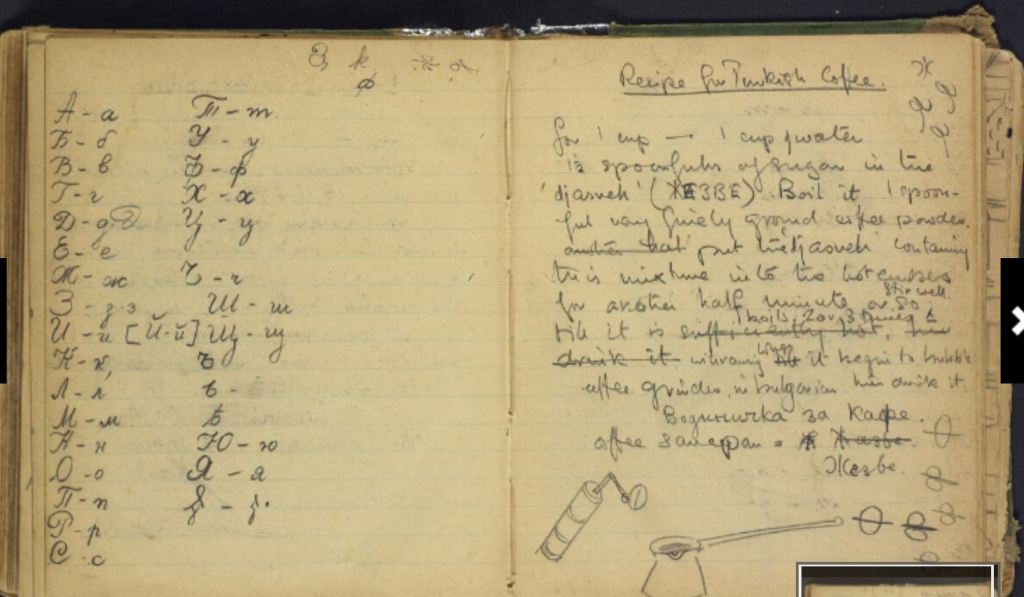
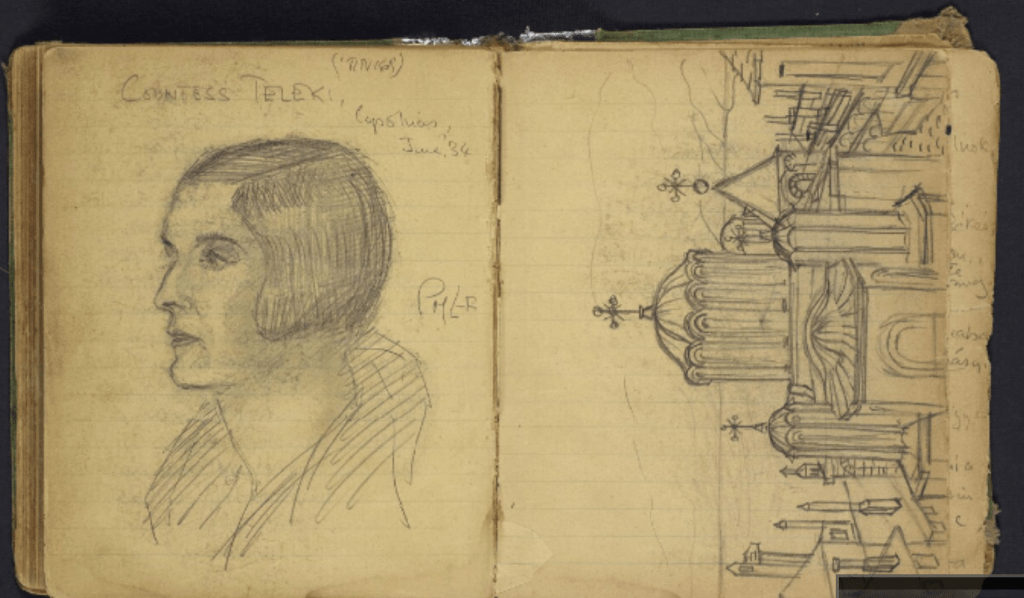
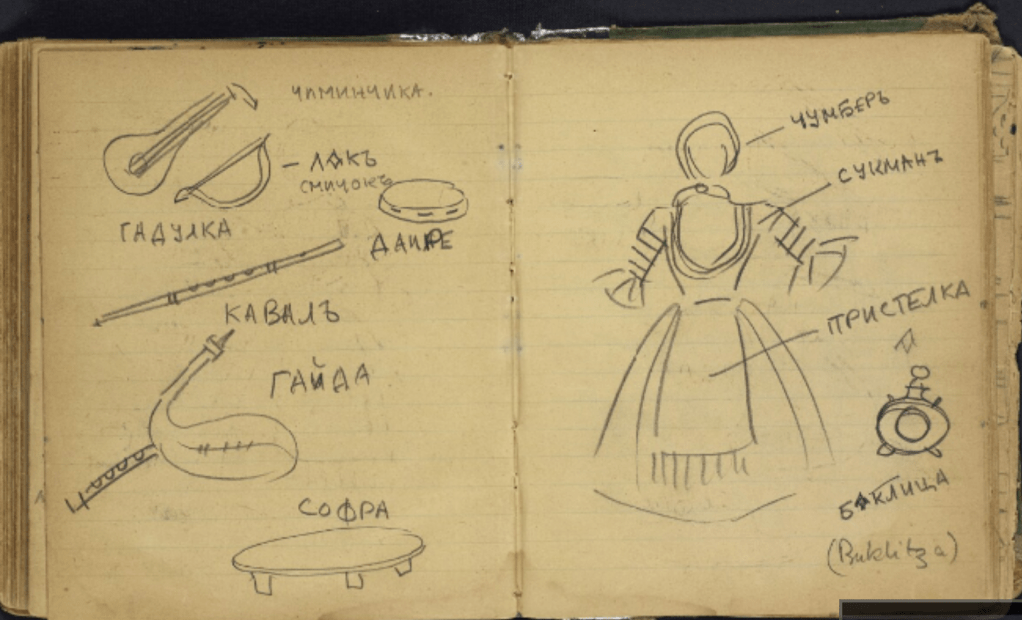
I must have bought the manuscript book in Bratislava. It is a thick, battered, stiffly-bound cloth-backed volume containing 320 closely-written pages in pencil. After a long initial passage, the narrative breaks off for a month or two, then starts up again in notes, stops once more, and blossoms out again in proper diary form. And so it goes on, sporadically recording my travels in all the countries between Bratislava and Constantinople, whence it moves to Mount Athos and stops. In the back of the book is a helpful list of overnight sojourns; there are rudimentary vocabularies in Hungarian, Bulgarian, Rumanian, Turkish and Modern Greek and a long list of names and addresses. As I read these, faces I had forgotten for many years began to come back to me: a vintner on the banks of the Tisza, an innkeeper in the Banat, a student in Berkovitza, a girl in Salonica, a Pomak hodja in the Rhodope mountains… There are one or two sketches of the details of buildings and costumes, some verses, the words of a few folk-songs and the alphabetical jottings I mentioned two chapters back. The stained covers are still warped from their unvarying position in my rucksack and the book seemed—it still seems—positively to smell of that old journey.

It was an exciting trove; a disturbing one too. There were some discrepancies of time and place between the diary and what I had already written but they didn’t matter as they could be put right. The trouble was that I had imagined—as one always does with lost property—that the contents were better than they were. Perhaps that earlier loss in Munich wasn’t as serious as it had seemed at the time. But, with all its drawbacks, the text did have one virtue: it was dashed down at full speed. I know it is dangerous to change key, but I can’t resist using a few passages of this old diary here and there. I have not interfered with the text except for cutting and condensing and clearing up obscurities. It begins on the day I set out from Bratislava.

Of the two days he prints, March 19 and 20 of 1934, I’ll give only the end of the second since it is a favorite scene of mine. First is the final Time of Gifts version:

At last we got there. The Schloss—the Kastely (pronounced koshtey) as the boy called it in Magyar—stood in a clump of trees. Only a few windows were lit. The baron’s housekeeper Sari let us in and gave the boy a drink. She was a dear old thing with a kerchief tied under her chin. Hand kissed for second time! I found Baron Schey in his library in a leather armchair and slippers reading Marcel Proust.
….
“I’m on the last volume,” Baron Pips said, lifting up a French paper-bound book. It was Le Temps Retrouvé and an ivory paper-knife marked the place three quarters of the way through. “I started the first volume in October and I’ve been reading it all winter.” He put it back on the table by his chair. “I feel so involved in them all, I don’t know what I’ll do when I’ve finished. Have you ever tried it?”

And now the same section from the Green Diary:

Only a few windows were lit up and the baron’s housekeeper, a sweet old thing, with a neckerchief tied Hungarian fashion, over(?) her head, with the rest under the chin. I found Baron Schey in his library, reading Marcel Proust in an easy chair and bedroom slippers. He greeted me warmly and we were soon sitting down to eat dinner in a little table in the corner of the room. He told me he had lived here quite alone all the winter, reading all the works of Marcel Proust volume by volume and said that he was the most wonderful author.

There’s rearranging of the material – the published version splits the introduction to Baron Pips with a description of his house and library where those passages entirely follow the introduction in the Green Diary – and some dialogue padding but the core of everything is in place.

Some bonus sketches from the diary:

pg 226

pg 235

pg 254

And surely it is not a melancholy conceite to thinke we are all asleepe in this world

From Thomas Browne’s Religio Medici (Part 2, section 12 or pg.84 of my single volume Selected Writings from Univ. of Chicago Press):

There is surely a neerer apprehension of any thing that delights us in our dreames than in our waked senses; without this I were unhappy, for my awaked judgement discontents mee, ever whispering unto me, that I am from my friend, but my friendly dreames in the night requite me, and make me thinke I am within his armes. I thanke God for my happy dreames, as I doe for my good rest, for there is a satisfaction in them unto reasonable desires, and such as can be content with a fit of happinesse; and surely it is not a melancholy conceite to thinke we are all asleepe in this world, and that the conceits of this life are as meere dreames to those of the next, as the Phantasmes of the night, to the conceite of the day. There is an equall delusion in both, and the one doth but seeme to bee the embleme or picture of the other; wee are somewhat more than our selves in our sleepes, and the slumber of the body seemes to bee but the waking of the soule. It is the ligation of sense, but the liberty of reason, and our awaking conceptions doe not match the fancies of our sleepes.

And the tenth to madness extreme enough to make people throw stones

From Apuleius’ Florida (20.1-2 in the Loeb edition):

There is a famous saying of a wise man over dinner: “The first bowl,” said he, “is for thirst, the second for cheer, the third for pleasure, the fourth for delirium.” Not so the Muses’ bowl: the more often drunk and the more strongly mixed, the more it promotes the health of the mind.

Sapientis viri super mensam celebre dictum est: “Prima,” inquit, “creterra ad sitim pertinet, secunda ad hilaritatem, tertia ad voluptatem, quarta ad insaniam.” Verum enimvero Musarum creterra versa vice quanto crebrior quantoque meracior, tanto propior ad animi sanitatem.

The footnote compares this to a saying of Anarcharsis reported by Diogenes Laertius (1.103):

It was a saying of his that the vine bore three kinds of grapes: the first of pleasure, the next of intoxication, and the third of disgust.

Οὗτος τὴν ἄμπελον εἶπε τρεῖς φέρειν βότρυς· τὸν πρῶτον ἡδονῆς· τὸν δεύτερον μέθης· τὸν τρίτον ἀηδίας.

But there is a more extensive and more amusing version by Eubulus quoted in Athenaeus (2.36.c). Dionysus is speaking:

Because I mix up only three bowls of wine for
sensible people. One is dedicated to good health,
and they drink it first. The second is dedicated
to love and pleasure, and the third to sleep;
wise guests finish it up
and go home. The fourth bowl no longer
belongs to me but to outrage.
The fifth belongs to arguments;
the sixth to wandering drunk through the streets; the seventh to black eyes;
the eighth to the bailiff; the ninth to an ugly black humor;
and the tenth to madness extreme enough to make people throw stones.

τρεῖς γὰρ μόνους κρατῆρας ἐγκεραννύω
τοῖς εὖ φρονοῦσι· τὸν μὲν ὑγιείας ἕνα,
ὃν πρῶτον ἐκπίνουσι, τὸν δὲ δεύτερον |
ἔρωτος ἡδονῆς τε, τὸν τρίτον δ᾿ ὕπνου,
ὃν ἐκπιόντες οἱ σοφοὶ κεκλημένοι
οἴκαδε βαδίζουσ᾿. ὁ δὲ τέταρτος οὐκέτι ἡμέτερός ἐστ᾿, ἀλλ᾿
ὕβρεος· ὁ δὲ πέμπτος βοῆς·
ἕκτος δὲ κώμων· ἕβδομος δ᾿ ὑπωπίων·
<ὁ δ᾿> ὄγδοος κλητῆρος· ὁ δ᾿ ἔνατος χολῆς·
δέκατος δὲ μανίας, ὥστε καὶ βάλλειν ποεῖ

Somewhere in my head there’s a related French proverb or quote but all I can conjure right now is Après bon vin, bon coussin (after good wine, a good pillow).

And there is nothing about them that I praise so much as their abhorrence of a dull, vacant mind


From Apuleius’ Florida (6.6-12). Classical authors of course often treat the ‘gymnosophists’ – like Tactitus’ Germani – as a means of indirectly criticizing their own culture but that shouldn’t devalue the sentiment.

Sunt apud illos et varia colentium genera … Est praeterea genus apud illos praestabile, gymnosophistae vocantur. Hos ego maxime admiror, quod homines sunt periti non propagandae vitis nec inoculandae arboris nec proscindendi soli; non illi norunt arvum colere vel aurum colare vel equum domare vel taurum subigere vel ovem vel capram tondere vel pascere. Quid igitur est? Unum pro his omnibus norunt: sapientiam percolunt tam magistri senes quam discipuli iuniores. Nec quicquam aeque penes illos audo, quam quod torporem animi et otium oderunt. Igitur ubi mensa posita, priusquam edulia apponantur, omnes adulescentes ex diversis locis et officiis ad dapem conveniunt; magistri perrogant, quod factum a lucis ortu ad illud diei bonum fecerint. Hic alius se commemorat inter duos arbitrum delectum, sanata simultate, reconciliata gratia, purgata suspicione amicos ex infensis reddidisse; itidem alius sese parentibus quaepiam imperantibus oboedisse, et alius aliquid meditatione sua repperisse vel alterius demonstratione didicisse, denique <cetera> ceteri commemorant. Qui nihil habet afferre cur prandeat, impransus ad opus foras extruditur.

Among the Indians there are various classes of inhabitant … They also have a preeminent class of so-called “gymnosophists.” These I admire most of all, because they are men with no skill to train a vine, graft a branch or plow the earth; they have no idea how to till a field, sieve gold, break a horse, tame a bull, or shear or pasture a sheep or a goat. What then is the reason? They know one thing worth all the rest: they study philosophy, both the old men as teachers and the young as pupils. And there is nothing about them that I praise so much as their abhorrence of a dull, vacant mind. Consequently, when the table is laid and the food not yet served, all the young men gather from their different places and occupations to dine, and their teachers ask what good deed they have done from early dawn until that hour of the day.  At this, one reports that he was chosen to arbitrate between two people, and has turned enemies into friends by patching up their quarrel, restoring their goodwill, and allaying their suspicions. Similarly, another reports that he has obeyed certain orders of his parents, and another that he has made some discovery from his own meditation or from another’s explanation, and after that the others mention other matters. If anyone cannot produce a reason why he should dine, he is driven outdoors to work without his dinner.