Omnia certe concacavit

From Seneca’s Apocolocyntosis (The Pumpkinification), on the death of Claudius. I hate politics but the mind can’t help but drift sometimes and pumpkins are often orange…

The following were the last words of his to be heard on earth, after he had emitted a louder noise from that end from which he spoke the easiest: “Oh my, I think I just shat myself.” For all I know, he did. He certainly shat on everything else.

ultima vox eius haec inter homines audita est, cum maiorem sonitum emisisset illa parte, qua facilius loquebatur: “vae me, puto, concacavi me.” quod an fecerit, nescio; omnia certe concacavit.


I’ve always wondered if Vespasian’s last words – according to Suetonius, at least (23.4) – don’t have an echo of this – Vae, puto deus fio (“Alas, I think I am becoming a god”).

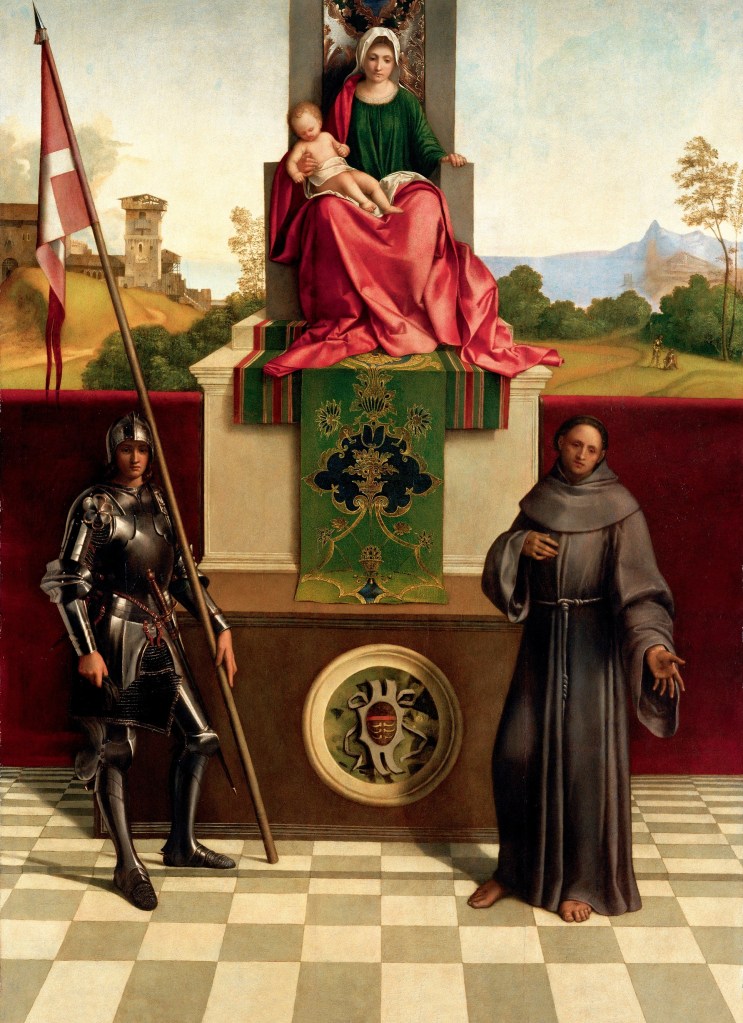
The Castelfranco Madonna

On my mind today because I bought my wife as Christmas gift a book on the theft(s) of the Adoration of the Mystic Lamb – this is Giorgione’s Castelfranco Madonna, usually dated to 1503-4 and one of only a few works of his where the attribution is not periodically overturned – much like the monthly reversals on the worth of eggs and red wine.

This one was stolen in 1972 but recovered – via ransom – a few weeks later in an abandoned house in the city. The original NY Times brief is below but I haven’t found a full summary of the recovery, unfortunately. It is back in situ and, a rare plus, there’s little chance of being bothered by others if you should visit.

VENICE, Italy. Dec. 19— Thieves broke into the cathedral of Castelfranco Veneto, northwest of here, last night and stole Giorgione’s painting “The Madonna With SS. Liberalis and Francis.” The disappearance of the celebrated work—one of the few attributed with certainty to Giorgione and believed to date from 1504.—caused consternation throughout Italy.

Officials of the Government’s Department for Antiquities and Fine Arts here called the stolen painting “absolutely priceless.” They theorized that the thieves had acted on commission from racketeers, who could never sell a rare authenticated Giorgione, but could collect a huge ransom for its return.

Bernardo Rossi Doria, secretary general of Italia Nostra, the country’s strongest conservationist organization, voiced concern that the Giorgione theft may strengthen the argument for taking art treasures out of churches and other traditional places of display and locking them up in museums.

The vulture that probes our inmost liver

A fragment of Petronius, quoted by Fulgentius (Mythologies 2.6):

[on Prometheus] although Nicagoras . . . records that Prometheus was the first to have embodied the image, and that he exposes his liver to a vulture, as if it portrays a metaphor for envy. From this Petronius also says: “The vulture that probes our inmost liver and tears out our heart and inmost entrails, is not a bird, as our witty poets claim, but the evils of our heart, envy and lust.”

[de Prometheo] quamvis Nicagorus . . . primum illum formasse idolum referat et, quod vulturi iecur praebeat, livoris quasi pingat imaginem. unde et Petronius Arbiter ait

“qui vultur iecur intimum pererrat
pectusque eruit intimasque fibras,
non est quem lepidi vocant poetae,
sed cordis <mala>, livor atque luxus.”

Reminiscent of Ishmael’s analysis of Ahab in ch.44 of Moby Dick:

God help thee, old man, thy thoughts have created a creature in thee; and he whose intense thinking thus makes him a Prometheus; a vulture feeds upon that heart for ever; that vulture the very creature he creates.

I seem to have been only like a boy playing on the seashore

This started when I remembered last year’s Advent Carol service at Westminster where I’d ended up sitting next to Isaac Newton’s tomb and the whole time kept trying to reconstruct the wording of a famous quote I’d frequently seen attributed to him:

I do not know what I may appear to the world; but to myself I seem to have been only like a boy playing on the seashore, and diverting myself in now and then finding a smoother pebble or a prettier shell than ordinary, whilst the great ocean of truth lay all undiscovered before me

I then forgot until today to look up the source. It turns out to have several but none are Newton’s own writings. The usual citation is to an 1855 work – Memoirs of the Life, Writings, and Discoveries of Sir Isaac Newton by David Brewster (pg. 407) – that provides no originating source. But there is a much earlier work – Anecdotes, Observations and Characters, of Books and Men by the Rev. Joseph Spence (pg. 41) – from the mid 18th century that presents it as something Newton said “a little before he died” and sources the report to Andrew Michael Ramsay while also in a footnote connecting the imagery to this passage from Milton’s Paradise Regained (4.322-330)


who reads
Incessantly, and to his reading brings not
A spirit and judgment equal or superior
(And what he brings, what needs he elsewhere seek)
Uncertain and unsettl’d still remains,
Deep verst in books and shallow in himself,
Crude or intoxicate, collecting toys,
And trifles for choice matters, worth a spunge;
As Children gathering pibles on the shore.

But – so as not to bundle it too neatly – I notice that Ramsay’s Wikipedia biography (for what it is worth) puts him in France at the time of Newton’s death (1727).

The civilest way of describing an ignoramus

From the author’s footnote to Anecdotes – Juvenal in v.1 of Thomas de Quincey’s Posthumous Works:

The passion which made Juvenal a poet.‘ The scholar needs no explanation; but the reader whose scholarship is yet amongst his futurities (which I conceive to be the civilest way of describing an ignoramus) must understand that Juvenal, the Roman satirist, who was in fact a predestined poet in virtue of his ebullient heart, that boiled over once or twice a day in anger that could not be expressed upon witnessing the enormities of domestic life in Rome, was willing to forego all pretensions to natural power and inspiration for the sake of obtaining such influence as would enable him to reprove Roman vices with effect.

Porcus Troianus

For all the sex and violence in Petronius’ Satyricon, the food in the Cena Trimalchionis (Dinner at Trimalchio’s) episode is what most stuck with me when I secretly read my father’s copy of the old penguin edition at age 10. This scene is from ch 40 (pg. 137) in the brand new Loeb edition with text and translation by Gareth Schmeling (who also has a wonderful 700 page commentary on the work):

Not yet did we know where to turn our expectations, when a large disturbance was raised outside the dining room, and Spartan dogs began to run about, even around the table. A tray followed them, on which had been placed a huge boar, wearing a cap of freedom, and from his tusks hung two little baskets woven from palm leaves, one filled with sweet Syrian dates and the other with dry Egyptian. The boar was surrounded by rather small piglets made of hard cake, hovering, as it were, over the teats, which indicated that it was a sow. These piglets were meant as gifts to be taken away. But that Carpus who had mangled the fowls did not come in to cut up the boar, instead a huge bearded man with cloth bands wrapped round his legs and dressed in a multicolored hunting coat. He drew a hunting knife and drove it vigorously into the boar’s side. From this gash thrushes flew out; fowlers were ready with limed reeds and quickly caught the birds as they flew around the dining room.

necdum sciebamus, <quo> mitteremus suspiciones nostras, cum extra triclinium clamor sublatus est ingens, et ecce canes Laconici etiam circa mensam discurrere coeperunt. | secutum est hos repositorium, in quo positus erat primae magnitudinis aper, et quidem pilleatus, e cuius dentibus sportellae dependebant duae palmulis textae, altera caryotis altera thebaicis repleta. | circa autem minores porcelli ex coptoplacentis facti, quasi uberibus imminerent, <qui> scrofam esse positam significabant. et hi quidem apophoreti fuerunt. | ceterum ad scindendum aprum non ille Carpus accessit, qui altilia laceraverat, sed barbatus ingens, fasciis cruralibus alligatus et alicula subornatus polymita, strictoque venatorio cultro latus apri vehementer percussit, ex cuius plaga turdi evolaverunt. | parati aucupes cum harundinibus fuerunt et eos circa triclinium volitantes momento exceperunt.

The term for this dish, according to Macrobius (Saturnalia 3.13.13), is porcus troianus (Trojan pig, turducken):

Nam Titius in suasione legis Fanniae obicit saeculo suo quod porcum Troianum mensis inferant, quem illi ideo sic vocabant, quasi aliis inclusis animalibus gravidum, ut ille Troianus equus gravidus armatis fuit.

Titius, in his speech supporting the law of Fannius reproaches his contemporaries for serving Trojan pig, so-called because it is “pregnant” with other animals enclosed within, just as the famous Trojan horse was “pregnant with armed men.

There is another instance a few chapters later in Petronius (49):

He was still babbling on and on, when a tray containing a large pig took possession of the table. We began to express astonishment at the speed of the cooking, swearing that not even a cock could have been thoroughly cooked so quickly, especially as the pig seemed to us to be much larger than the boar had been a little while earlier. Looking at it more and more closely Trimalchio said: “What’s all this? Hasn’t this pig been gutted? By god, it hasn’t been. Call the cook, get the cook here in our presence.” When the sad cook stood at the table and said that he had forgotten to gut it, Trimalchio shouted: “What’re you saying? You forgot? You’d think that he’d not added pepper and cumin. Off with his shirt!” Without delay the cook was stripped and stood there dolefully between two torturers. Then we all began to intercede for him and say: “This happens; we ask that you let him go; if he does it again, none of us will intercede on his behalf.” I felt very hard-hearted and could not contain myself, but leaned over to Agamemnon’s ear and said: “He just has to be the most completely worthless slave; how could someone forget to gut a pig? By god, I would not forgive him, if he forgot to gut a fish.” But not so Trimalchio, his face softened into a smile and he said: “Well, because you’re so forgetful, gut it right here in front of us.” The cook got back his tunic, seized the knife, and with an apprehensive hand slit the pig’s belly on this side and that. At once the slits widened from the pressure of the weight inside, and sausages seasoned with thyme and black pudding tumbled out.

 nondum efflaverat omnia, cum repositorium cum sue ingenti mensam occupavit. | mirari nos celeritatem coepimus et iurare, ne gallum quidem gallinaceum tam cito percoqui potuisse, tanto quidem magis, quod longe maior nobis porcus videbatur esse quam paulo ante apparuerat. | deinde magis magisque Trimalchio intuens eum “quid? quid?” inquit. | “porcus hic non est exinteratus? non mehercules est. voca, voca cocum in medio.” | cum constitisset ad mensam cocus tristis et diceret se oblitum esse exinterare, “quid? oblitus?” Trimalchio exclamat “putares illum piper et cuminum non coniecisse. despolia.” | non fit mora, despoliatur cocus atque inter duos tortores maestus consistit. deprecari tamen omnes coeperunt et dicere: “solet fieri; rogamus, mittas; postea si fecerit, nemo nostrum pro illo rogabit.” | ego, crudelissimae severitatis, non potui me tenere, sed inclinatus ad aurem Agamemnonis “plane” inquam “hic debet servus esse nequissimus; aliquis oblivisceretur porcum exinterare? non mehercules illi ignoscerem, si piscem praeterisset.” | at non Trimalchio, qui relaxato in hilaritatem vulto “ergo” inquit “quia tam malae memoriae es, palam nobis illum exintera.” | recepta cocus tunica cultrum arripuit porcique ventrem hinc atque illinc timida manu secuit. | nec mora, ex plagis ponderis inclinatione crescentibus thumatula cum botulis effusa sunt.

A sort of exaggerated combo of the two pigs had the honor/horror of making it into Fellini’s gruesome adaptation of the scene:

Those who search for gold dig up much earth and find little

A motto here of my endless reading – Clement of Alexandria, quoting Heraclitus in his Stromata (4.4.2, via Loeb’s Early Greek Philosophy v.3 pg.161):

Those who search for gold dig up much earth and find little.
χρυσὸν γὰρ οἱ διζήμενοι γῆν πολλὴν ὀρύσσουσι καὶ εὑρίσκουσιν ὀλίγον.


possibly to be connected – for verb choice – with a brief quote from Plutarch’s Adversus Colotem (20.1118C, and Loeb pg. 159)

I searched for myself.
ἐδιζησάμην ἐμεωυτόν.


and – though the Loeb editors put it in a different section (pg 189) – with this from Diogenes Laertius (9.7):

He who travels on every road would not find out the limits of the soul in the course of walking: so deep is its account
ψυχῆς πείρατα ἰὼν οὐκ ἂν ἐξεύροι ὁ πᾶσαν ἐπιπορευόμενος ὁδόν· οὕτω βαθὺν λόγον ἔχει.

The anecdote of the rabbit hunt offered by M. de Talleyrand to Napoleon

At one point in Souvenir’s d’egostisme (ch 5) Stendhal refers to “the anecdote of the rabbit hunt offered by M. de Talleyrand to Napoleon.” Recent editions add an additional line – one of his clipped notes to self – “Domesticated rabbits and hogs in the Bois de Boulogne.”

The reference took a while (and there are several competing sources that are too much to go into) but I found an account by Stendhal himself written for the April 1827 volume of New Monthly Magazine (I assume translated by the magazine?). Here’s the original scan with a tidied version is pasted below:

I have been favoured with a peep at some curious Memoirs, written by an old Jacobin. They extend from 1800 to 1814, and they show more clearly than Thibaudeau’s work Bonaparte’s fear of the Jacobins, and how his brother Lucien gradually inspired him with the idea of making himself a sovereign. The following anecdote from these Memoirs is at once characteristic of the vanity of Napoleon and the ill-nature of Talleyrand, who disliked Bonaparte chiefly because he was an upstart!

Talleyrand had a country-house at Auleuil, a little village situated between the Seine and the Bois de Boulogne. “I will come and breakfast with you some day,” said Bonaparte to Talleyrand.—“Do, General,” replied the latter, and as my house is close to the Bois de Boulogne, you may amuse yourself by shooting after breakfast.”—“I do not like shooting,’’ replied Bonaparte ; “but I am very fond of hunting. Are there any wild boars in the Bois de Boulogne?” Bonaparte was at this time a very young man, and, not having been much in Paris, he did not know that the Bois de Boulogne is like your Hyde-Park, merely a place for walking and riding. Wild boars were of course out of the question. But a Frenchman can never resist a joke, though it should be at the expense of those to whom he renders the most courtier-like servility. Talleyrand, who prides himself much on his nobility, could not endure to see a poor lieutenant of artillery rising into popularity and power, not by the influence of high birth, but by the vulgar road of intellect and merit: his ill-nature, therefore, suggested to him the idea of playing a trick upon Bonaparte; and when the latter inquired whether there were any wild boars in the Bois de Boulogne, he replied, “Very few, but I dare say, General, you will be able to find one.” The breakfast and the hunt were fixed for the following day, and it was arranged that Bonaparte should be at Auteuil at seven in the morning. Talleyrand, ready to die with laughter, sent to the market of Paris, and purchased two large black hogs. These were immediately conveyed to the Bois de Boulogne under the care of two servants, who were directed to drive them about and practise them in running. Bonaparte arrived at Auteuil at the appointed time, accompanied by an aide-de-camp, who was much diverted by the General’s frequent use of several hunting-phrases, and which he misapplied in the most extraordinary way. Breakfast being ended, the party set out for the Bois de Boulogne, taking with them some hounds, which had been borrowed from the neighbouring farmers. At length one of the hogs was let loose, and Bonaparte joyfully exclaimed: “I see the wild boar!” Talleyrand, who was aware that the animal would be in no hurry to escape from its pursuers, had directed a servant mounted on a small Spanish horse, and armed with a long whip, to ride after it. But Bonaparte was too intent on his sport to observe this. He galloped furiously after the supposed wild boar, which after about half an hour’s chase was overtaken by the hunters. By this time, the aide-de-camp beginning to understand the trick, fearing les the affair might become a subject of public ridicule, determined to undeceive the General, and riding up to him said, “Surely, Sir, yon must be aware that this is not a wild boar, but a hog.”

Bonaparte flew into a violent fit of passion. He immediately returned full gallop to Auteuil. He would doubtless have vented bitter reproaches on Talleyand, and probably would have proceeded from words to blows, had he not recollected that Tallevrand was on terms of intimacy with all the good society in Paris, to whom he would have been held up as a laughing stock, had he taken the joke too seriously. On his arrival at Auteuil, therefore, he laughed and pretended to be highly amused at the trick, but his anger was ill-disguised. Incredible as it may seem, Talleyrand, who was in a merry mood, immediately conceived the idea of hoaxing him a second time: Well, General,” said he, “you have been disappointed of the wild-boar hunt, it is true. But it is yet early. You must not think of returning to Paris so soon. There are plenty of rabbits in the Bois de Boulogne. Louis XVI used often to shoot there. Lock-making and rabbit-shooting were his favourite amusements, poor man ! He was an excellent shot, you know.”—“ Yes, but I am a very bad shot,” said Bonaparte, who had not yet recovered his good-humour. Your ride must have given you an appetite,” resumed Talleyrand, “ While you sit down and partake of some refreshment, I will send to Paris for my guns. They belonged to Louis XVI.”
The repast was prolonged for the space of two hours, during which M. Talleyrand overwhelmed the future Emperor with that elegant flattery in which he is such an adept. Meanwhile servants had been despatched to Paris with orders to purchase all the tame rabbits they could procure. They collected as many as five or six hundred, and conveyed them in fiacres to the Bois de Boulogne. Bonaparte set out, armed with his gun, and attended as before by his aide-de-camp. “I am not a Louis XVI,” said he, “I am quite certain that I shall not shoot a single rabbit.” However, be soon shot several. The aide-de-camp seeing the gravity with which Napoleon massacred the poor animals, talking all the while about Louis XVI, was seized with a strong inclination to laugh. The fiftieth rabbit was now shot, and Bonaparte delighted with his success. At length the aide-de-camp could hold out no longer, and stepping up to him he whispered, “Really, General, I begin to think that these are not wild rabbits. I suspect that that rascal of a priest has been playing us another trick.”

Bonaparte, violently enraged, galloped back to Paris. He was not reconciled to Talleyrand for six months after, and he probably threatened vengeance if he dared to speak of rabbit-shooting or boar-hunting in any of the saloons of the Faubourg St. Germain; for it is very certain that these two anecdotes have never been circulated in Paris
If this book is boring, two years from now it will be wrapping butter at the grocer’s

From Stendhal’s Souvenirs d’egotisme (Memoirs of an Egotist in an English translation):

Si ce livre est ennuyeux, au bout de deux ans il enveloppera le beurre chez l’épicier ….

If this book is boring, two years from now it will be wrapping butter at the grocer’s ….

I would like a history of all such phrases – bad books as food wrappings. I know of three in Latin literature and a near parallel in English but I’m sure I’ve read others without retaining them:

Catullus XCV.9:

But the Annals of Volusius will die by the river Padua where they were born, and will often furnish a loose wrapper for mackerels.

at Volusi annales Paduam morientur ad ipsamet laxas scombris saepe dabunt tunicas


Horace Epistles 2.1.265-70

Not for me attentions that are burdensome, and I want neither to be displayed anywhere in wax, with my features misshaped, nor to be praised in verses ill-wrought, lest I have to blush at the stupid gift, and then, along with my poet, outstretched in a closed chest, be carried into the street where they sell frankincense and perfumes and pepper and everything else that is wrapped in sheets of useless paper.

nil moror officium quod me gravat, ac neque ficto in peius voltu proponi cereus usquamnec prave factis decorari versibus opto,ne rubeam pingui donatus munere, et unacum scriptore meo, capsa porrectus operta, deferar in vicum vendentem tus et odores et piper et quidquid chartis amicitur ineptis

Persius 1.40-45

 Is there anyone who would disown the desire to earn the praise of the people?—or, when he’s produced compositions good enough for cedar oil, to leave behind him poetry which has nothing to fear from mackerels or incense?

an erit qui velle recusetos populi meruisse et cedro digna locutuslinquere nec scombros metuentia carmina nec tus?

And – in a different vein – Lyly’s Euphues (To the Gentleman readers):

We commonly see the book that at Christmas lieth bound on the stationer’s stall at Easter to be broken in the haberdasher’s shop