Only the outer bark of my attention

From Montaigne’s Essais bk 3 – De Trois Commerces.  The translation is Screech’s Penguin Classics.

Reading, by its various subjects, particularly serves to arouse my discursive reason: it sets not my memory to work but my judgement.  So, for me, few conversations are arresting unless they are vigorous and powerful.  It is true that grace and beauty occupy me and fulfil me as much or more as weight and profundity.  And since I doze off during any sort of converse and lend it only the outer bark of my attention, it often happens that during polite conversation (with its flat, well-trodden sort of topics) I say stupid things unworthy of a child, or make silly, ridiculous answers, or else I remain stubbornly silent which is even more inept and rude.  I have a mad way of withdrawing into myself as well as a heavy, puerile ignorance of everyday matters.

La lecture me sert specialement à esveiller par divers objects mon discours, à embesongner mon jugement, non ma memoyre. Peu d’entretiens doncq m’arretent sans vigueur et sans effort. Il est vray que la gentillesse et la beauté me remplissent et occupent autant ou plus que le pois et la profondeur. Et d’autant que je sommeille en toute autre communication et que je n’y preste que l’escorce de mon attention, il m’advient souvent, en telle sorte de propos abatus et laches, propos de contenance, de dire et respondre des songes et bestises indignes d’un enfant et ridicules, ou de me tenir obstiné en silence, plus ineptement encore et incivilement. J’ay une façon resveuse qui me retire à moy, et d’autre part une lourde ignorance et puerile de plusieurs choses communes.

I apply this phrase to myself several times a day.
The Pottery of Tenedos

A pretty antique metaphor grown apt for post-modern literary practice – from Dio Chrysostom’s 42 Discourse, “An Address to His Native City.”  The text and translation are from the Loeb edition

For almost all men are acquainted with my speeches, and they distribute them broadcast in all directions, just as lads in the cities sing cheap ditties at eventide. Moreover, almost all report my speeches to one another, not as they were delivered, but after having made them still better in accordance with their own ability, some making improvements purposely and—evidently being ashamed to remember such stuff—introducing numerous changes and rearrangements by way of betterment, while others possibly do so unconsciously through not remembering very well. And so one no longer buys my wisdom from the market in abundant supply at an obol, as somebody has it, but instead one merely stoops and plucks it from the ground. One might almost say, therefore, that my speeches have had much the same fate as the pottery of Tenedos; for while all who sail that way put on board pottery from there, yet no one finds it easy to get it across in sound condition; but many crack or smash it, and ere they are aware they have naught but sherds

καὶ τοὺς ἐμοὺς λόγους σχεδὸν πάντες ἀλλήλοις ἀπαγγέλλουσιν, οὐχ ὅπως ἐρρήθησαν, ἀλλ᾿ ἔτι βελτίους ποιήσαντες κατὰ τὴν αὑτῶν δύναμιν, οἱ μὲν ἑκόντες ἐπανορθούμενοι καὶ—δῆλον ὅτι αἰσχυνόμενοι τὸ μεμνῆσθαι τοιούτων—ἀλλάττοντες καὶ μετατιθέντες πολλὰ καὶ κρείττονα, οἱ δὲ ἴσως καὶ ἄκοντες διὰ τὸ μὴ σφόδρα μεμνῆσθαι· ὥστε οὐκέτι ὀβολοῦ, καθάπερ εἶπέ τις, εὔπορον ἐκ τῆς ἀγορᾶς πρίασθαι τὴν ἐμὴν σοφίαν, ἀλλὰ κύψαντα ἀνελέσθαι χαμᾶθεν. σχεδὸν οὖν παραπλήσιον πεπόνθασιν οἱ ἐμοὶ λόγοι τῷ κεράμῳ τῷ Τενεδίῳ· καὶ γὰρ ἐκεῖθεν πᾶς μὲν ὁ παραπλέων ἐμβάλλεται κέραμον, οὐδεὶς δὲ ὑγιῆ διακομίζει ῥᾳδίως, ἀλλὰ πολλοὶ σαθρὸν ποιήσαντες ἢ συντρίψαντες ὄστρακα ἔχοντες λανθάνουσιν αὑτούς.

Cocktail Hour 1 – The Last Word

This variant comes from Jim Meehan’s new Bartender Manual.  Somehow I continue to buy cocktail books without any longer caring to experiment past my settled favorites, of which this is one.

1 part Gin (.75oz, navy strength recommended)
1 part Luxardo Maraschino liqueur (.75oz)
1 part Green Chartreuse (.75oz)
1 part lime juice (.75oz)
Shake, strain, serve in a coupe.

I personally like less lime, less Luxardo, more gin, and more Chartreuse.  But I’ve never tried navy strength here so maybe the .75oz works.  I go:

1oz gin (Citadelle has somehow become my default)
.5oz Luxardo
1oz Green Chartreuse
.25oz lime juice

Goes well with Saki, Norman Douglas, and (early) Evelyn Waugh.

You don’t always do what you want when you’re dead.

From Bussy-Rabutin: Le Libertin Puni (by Daniel-Henri Vincent, 2011, pg.70).  Vincent never cites his sources so I’m not sure if this is from one of his letters or his memoirs, though I don’t remember it in the memoirs.

[Bussy’s] good friend Jumeaux learned of the news [of his serious illness].  Displaying a moderated optimism, he reminded him of the promise they had made – that the first who died would return to give news of the other world to his comrade.  Bussy promised again not to fail, but it was Jumeaux who died soon afterwards from a great debauche.  Still one left!  Roger, without fear, awaited his visit every evening that followed.  Friend Jumeaux did not come.  Bussy then concluded with much good sense – and without putting in doubt the good faith of his comrade – ‘that you didn’t always do what you wanted when you were dead.’

Son grand ami Jumeaux prit de ses nouvelles.  Faisant prevue d’un optimisme mesure, il lui rappela la promesse qu’ils s’etaient faite, que le premier qui mourrait viendrait donner a son compagnon des nouvelles de l’autre monde.  Bussy s’engagea a nouveau a n’y pas manquer, mais c’est Jumeaux qui mourut peu apres d’une grande debauche.  Encore une! Roger attendit sa visite, toutes les nuits qui suivirent, sans frayeur.  L’ami Jumeaux ne vint pas.  Bussy en conclut avec beaucoup de bons sens, et sans mettre en cause la fidelite de son camarade, “qu’on ne faisait pas toujours ce qu’on voulait quand on etait mort.”

The charm of modern London is that it is not built to last; it is built to pass.

From Virginia Woolf’s essay Oxford Street Tide (published as part of the collection The London Scene)

….it cannot be denied that these Oxford Street palaces are rather flimsy abodes – perching-grounds rather than dwelling-places. One is conscious that one is walking on a strip of wood laid upon steel girders, and that the outer wall, for all its florid stone ornamentation, is only thick enough to withstand the force of the wind. A vigorous prod with an umbrella point might well inflict irreparable damage upon the fabric. Many a country cottage built to house farmer or miller when Queen Elizabeth was on the throne will live to see these palaces fall into the dust. The old cottage walls, with their oak beams and their layers of honest brick soundly cemented together still put up a stout resistance to the drills and bores that attempt to introduce the modern blessing of electricity. But any day of the week one may see Oxford Street vanishing at the tap of a workman’s pick as he stands perilously balanced on a dusty pinnacle knocking down walls and façades as lightly as if they were made of yellow cardboard and sugar icing.

And again the moralists point the finger of scorn. For such thinness, such papery stone and powdery brick reflect, they say, the levity, the ostentation, the haste and irresponsibility of our age. Yet perhaps they are as much out in their scorn as we should be if we asked of the lily that it should be cast in bronze, or of the daisy that it should have petals of imperishable enamel. The charm of modern London is that it is not built to last; it is built to pass. Its glassiness, its transparency, its surging waves of coloured plaster give a different pleasure and achieve a different end from that which was desired and attempted by the old builders and their patrons, the nobility of England. Their pride required the illusion of permanence. Ours, on the contrary, seems to delight in proving that we can make stone and brick as transitory as our own desires. We do not build for our descendants, who may live up in the clouds or down in the earth, but for ourselves and our own needs. We knock down and rebuild as we expect to be knocked down and rebuilt. It is an impulse that makes for creation and fertility. Discovery is stimulated and invention on the alert.

The palaces of Oxford Street ignore what seemed good to the Greeks, to the Elizabethan, to the eighteenth-century nobleman; they are overwhelmingly conscious that unless they can devise an architecture that shows off the dressing-case, the Paris frock, the cheap stockings, and the jar of bath salts to perfection, their palaces, their mansions and motor cars and the little villas out at Croydon and Surbiton where their shop assistants live, not so badly after all, with a gramophone and wireless, and money to spend at the movies – all this will be swept to ruin. Hence they stretch stone fantastically; crush together in one wild confusion the styles of Greece, Egypt, Italy, America; and boldly attempt an air of lavishness, opulence, in their effort to persuade the multitude that here unending beauty, ever fresh, ever new, very cheap and within the reach of everybody, bubbles up every day of the week from an inexhaustible well. The mere thought of age, of solidity, of lasting for ever is abhorrent to Oxford Street.

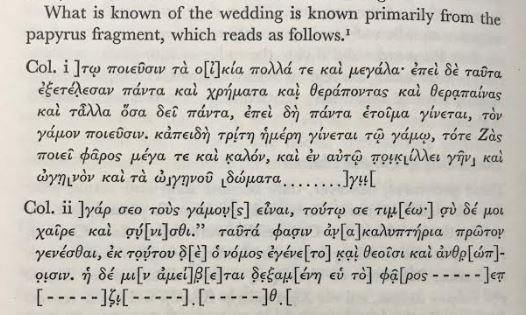
Cthonie’s Robe

Pherecydes‘ prose is too heavily paratactic to do well in close English rendering but it is more the image than the language that is catchingly pretty here – especially on the reconstruction that Cthonie becomes Ge/Gaia by donning the robe and enfolding herself in the image of the earth’s surface.

For him (Zeus/Zas) [the other gods] built homes many and great; And then they provided all the necessary goods and servants male and female and as much else as was needed.  And when all was ready, they held a wedding.  And then on the third day of the wedding Zas made a robe, great and beautiful. And on it he fashioned Earth and Ogenos (Oceanus) and the homes of Ogenos.

 ….. [he said to Cthonie] I honour you with this robe. Rejoice and be my consort!’ This they say was the first feast of unveiling, and hence arose the custom for both gods and men. And she responded as she received the robe from him…..

Capture

And weary days they must have been to this friendless custom-house officer

From Melville’s Redburn: His First Voyage (ch.29) – only interesting as a personal prophecy given that several decades later Melville himself would work as a customs official for about twenty years.

During the many visits of Captain Riga to the ship, he always said something courteous to a gentlemanly, friendless custom-house officer, who staid on board of us nearly all the time we lay in the dock.

And weary days they must have been to this friendless custom-house officer; trying to kill time in the cabin with a newspaper; and rapping on the transom with his knuckles. He was kept on board to prevent smuggling; but he used to smuggle himself ashore very often, when, according to law, he should have been at his post on board ship. But no wonder; he seemed to be a man of fine feelings, altogether above his situation; a most inglorious one, indeed; worse than driving geese to water.

Impossible to come, lie follows

From Proust’s Le Temps Retrouve (pg.281 of v.4 of the Pleiade):

…sans que Gilberte sut si son mari arriverait vraiment ou s’il n’enverrait pas une de ces depeches dont M. de Guermantes avait spirituellement fixe le modele: IMPOSSIBLE VENIRE, MENSONGE SUIT

…without Gilberte knowing whether her husband would arrive or would send one of those telegrams, the model of which M. De Guermantes had wittily set in place: Impossible to come, lie follows

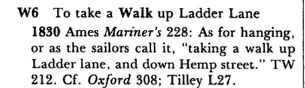
A walk up Ladder-lane, and down Hemp-street

From Herman Melville’s Redburn: His First Voyage (ch. 17)

Sailors have a great fancy for naming things that way on shipboard. When a man is hung at sea, which is always done from one of the lower yard-arms, they say he “takes a walk up Ladder-lane, and down Hemp-street.”

The phrase does actually appear in Bartlett Whiting’s Early American Proverbs and Proverbial Phrasings.

Capture

Incredulity is sometimes the vice of a fool, and credulity the failing of a man of intelligence

From Denis Diderot’s Pensees Philosophiques (no. 32), though I found the quote through Baudelaire’s La Fanfarlo, where he presents it as the something like the key to his main character’s behavior (see further below):

Incredulity is sometimes the vice of a fool, and credulity the failing of a man of intelligence.  The man of intelligence sees far into the immensity of possibilities; the fool sees hardly anything as possible except what already exists.  It is this perhaps which makes the one a coward, the other rash.

L’incrédulité est quelquefois le vice d’un sot, et la crédulité le défaut d’un homme d’esprit. L’homme d’esprit voit loin dans l’immensité des possibles ; le sot ne voit guère de possible que ce qui est. C’est là peut-être ce qui rend l’un pusillanime, et l’autre téméraire.

Baudelaire’s further commentary:

This pensee of Diderot explains as well all the blunders Samuel committed in his life, blunders that a fool would not have committed.  This portion of the public that is essentially cowardly will hardly understand the character of Samuel, who was essentially credulous and rich in imagination, to the point that, as poet, he believed in his public – as man, in his own passions.

La pensée de Diderot …. explique aussi toutes les bévues que Samuel a commises dans sa vie, bévues qu’un sot n’eût pas commises. Cette portion du public qui est essentiellement pusillanime ne comprendra guère le personnage de Samuel, qui était essentiellement crédule et imaginatif, au point qu’il croyait, comme poëte, à son public, — comme homme, à ses propres passions.