The arming of Marduk

Marduk’s arming against Tiamat from the Enuma Elish, the Babylonian account of creation.

They erected for him a ample throne.
Facing his fathers, he sat down, presiding.
“You are the most honored of the great gods,
Your decree is unrivaled, your command is Anu
You, Marduk are the most honored of the great gods,
Your decree is unrivaled, your word is Anu.
From this day unchangeable shall be your pronouncement.
To raise or bring low—these shall be in your hand.
Your utterance shall be true, your command shall be unimpeachable.
No one among the gods shall transgress your bounds!
Adornment being wanted for the seats of the gods,
Let the place of their shrines ever be in your place.
O Marduk, you are indeed our avenger.
We have granted you kingship over the entire universe.
Your word shall be supreme when you sit in assembly.
Your weapons shall not fail; they shall smash your foes!
O lord, spare the life of him who trusts you,
But pour out the life11 of the god who seized evil.”
Having placed in their midst a piece of cloth,
They addressed themselves to Marduk, their first-born
“Lord, truly your decree is first among gods.
Say but to wreck or create; it shall be.
Open your mouth; the cloth will vanish!
Speak again, and the cloth shall be whole!”
At the word emerged from his mouth the cloth vanished.
He spoke again, his fathers, saw the outcome of his word,
When the gods, his fathers, saw the outcome of his word,
Joyfully they paid homage: “Marduk is king!”
They conferred on him scepter, throne, and vestment;
They gave him unequaled weapons that ward off the foes:
“Go and terminate the life of Tiamat.
May the winds bear her blood to places undisclosed.”
Marduk’s destiny thus fixed, the gods, his fathers,
Caused him to go the way of success and achievement.
He constructed a bow, marked it as his weapon,
Attached thereto the arrow, grasped it in his right hand;
He raised the mace, grasped it in his right hand;
He hung bow and quiver at his side.
In front of him he sat the lightening,
He filled his body with blazing flame.
He then made a net to enfold Tiamat,
He stationed the four winds that nothing of her might escape,
The South Wind, the North Wind, the East Wind, the West Wind.
Close to his side he held the net, the gift of his father, Anu.
He brought forth Imhullu “the Evil Wind,” the Whirlwind, the Hurricane,
The Fourfold Wind, the Sevenfold Wind, the Cyclone, the Matchless Wind;
Then he sent forth the seven winds he had brought forth.
To stir up the inside of Tiamat they rose up behind him.
Then the lord raised up the flood-storm, his mighty weapon.
He mounted the storm-chariot irresistible and terrifying.
He harnessed and yoked to it a team-of-four,
The Killer, the Relentless, the Trampler, the Swift.
Sharp were their poison bearing teeth.
They were versed in ravage, skilled in destruction.
On his right he posted the Smiter, fearsome in battle,
On the left the Combat, which repels all the zealous.
His cloak was an armor of terror,
His head was turbaned with his fearsome halo.
The lord went forth and followed his course,
He set his face Towards the raging Tiamat.
He held a spell between his lips;
A plant to put out poison was grasped in his hand.
Then they milled about him, the gods milled about him,
The gods, his fathers, milled about him, the gods milled about him.

Henry Wotton and the burning of The Globe

From a July 2 1613 letter of Henry Wotton to his nephew Edmund Bacon, found through Frances Yates’ Shakespeare’s Last Plays (and widely quoted elsewhere) but originally from Reliquiae Wottonianae. It somehow never hit home until today that this Wotton is the same ambassador to Venice who so constantly pops up in the accounts of early English travelers to Italy. But for such an interesting figure in so rich a time there’s curiously little written about him. When I went looking a few years back, all I could find were an excellent brief life by his contemporary and good friend Izaak Walton (who also quotes him frequently in his Compleat Angler), two turn of the century biographies (Sir Henry Wotton: A Biographical Sketch by Adolphus Ward and The life and letters of Sir Henry Wotton by Logan Pearsall Smith), and a more recent overview in Harold Acton’s Three extraordinary ambassadors

The King’s players had a new play, called All is True, representing some principal pieces of the reign of Henry VIII, which was set forth with many extraordinary circumstances of pomp and majesty, even to the matting of the stage; the Knights of the Order with their Georges and garters, the Guards with their embroidered coats, and the like: sufficient in truth within a while to make greatness very familiar, if not ridiculous. Now, King Henry making a masque at the Cardinal Wolsey’s house, and certain cannons being shot off at his entry, some of the paper, or other stuff, wherewith one of them was stopped, did light on the thatch, where being thought at first but an idle smoke, and their eyes more attentive to the show, it kindled inwardly, and ran round like a train, consuming within less than an hour the whole house to the very ground.

Monsieur de Fortgibu and the plum-pudding

From Carl Jung’s essay Synchronicity: An Acausal Connecting Principle in vol. 8 of his collected works, The Structure and Dynamics of the Psyche. It feels odd that this example of the idea got relegated to a footnote (pg 431 – and citing pg 194 of Camille Flammarion’s The Unknown) since it’s the most concise and one of the most memorable he provides.

A certain M. Deschamps, when a boy in Orleans, was once given a piece of plum-pudding by a M. de Fortgibu. Ten years later he discovered another plum-pudding in a Paris restaurant, and asked if he could have a piece. It turned out, however, that the plum-pudding was already ordered – by M. de Fortgibu. Many years afterwards M. Deschamps was invited to partake of a plum-pudding as a special rarity. While he was eating it he remarked that the only thing lacking was M. de Fortgibu. At that moment the door opened and an old, old man in the last stages of disorientation walked in: M. de Fortgibu, who had got hold of the wrong address and burst in on the party by mistake.

The reason we have suffering

Pascal, On Diversion/Divertissement:

When I have occasionally set myself to consider the different distractions of men, the pains and perils to which they expose themselves at court or in war, whence arise so many quarrels, passions, bold and often bad ventures, etc., I have discovered that all the unhappiness of men arises from one single fact, that they cannot stay quietly in their own chamber. A man who has enough to live on, if he knew how to stay with pleasure at home, would not leave it to go to sea or to besiege a town. A commission in the army would not be bought so dearly, but that it is found insufferable not to budge from the town; and men only seek conversation and entering games, because they cannot remain with pleasure at home.

Quand je m’y suis mis quelquefois à considérer les diverses agitations des hommes et les périls et les peines où ils s’exposent dans la Cour, dans la guerre, d’où naissent tant de querelles, de passions, d’entreprises hardies et souvent mauvaises, etc., j’ai dit souvent que tout le malheur des hommes vient d’une seule chose, qui est de ne savoir pas demeurer en repos dans une chambre. Un homme qui a assez de bien pour vivre, s’il savait demeurer chez soi avec plaisir, n’en sortirait pas pour aller sur la mer ou au siège d’une place. On n’achète une charge à l’armée si cher, que parce qu’on trouverait insupportable de ne bouger de la ville. Et on ne recherche les conversations et les divertissements des jeux que parce qu’on ne peut demeurer chez soi avec plaisir.

Responded to by Vauvenargues’ Maxime 198:

Fire, air, intellect, light – everything exists by virtue of activity. Thence come the interaction and co-operation of all the elements; thence unity and harmony in the universe. However, this law of nature, so fruitful in result, is found to be an offence in mankind, and because we are compelled to observe it, being unable to exist in inactivity, we suppose we are out of our proper element.

Le feu, l’air, l’esprit, la lumière, tout vit par l’action ; de là la communication et l’alliance de tous les êtres ; de là l’unité et l’harmonie dans l’univers Cependant cette loi de la nature, si féconde, nous trouvons que c’est un vice dans l’homme ; et, parce qu’il est obligé d’y obéir, ne pouvant subsister dans le repos, nous concluons qu’il est hors de sa place.

And – somewhat out of context but it’s what launched this association chain – Lao-Tzu section 13 of the Tao Teo Ching:

The reason we have suffering / is because we have a body / if we didn’t have a body / we wouldn’t have suffering

There are related Seneca and Plotinus quotes I can’t manage to call to mind and surely countless others worth citing in this line of dialogue.

The truth is, we are both only really happy living among lunatics.

From W.H. Auden and Louis MacNeice’s Letters from Iceland, this from Auden’s A letter to Christopher Isherwood, Esq. (The honorary, even if accurate, feels very much a part of the joke.)

10. ‘What feelings did you visit give you about life on small island?’
If you have no particular intellectual interests or ambitions and are content with the company of your family and friends, then life on Iceland must be very pleasant, because the inhabitants are friendly, tolerant, and sane. They are genuinely proud of their country and its history, but without the least trace of hysterical nationalism. I always found that they welcomed criticism. But I had the feeling, also, that for myself it was already too late. We are all too deeply involved with Europe to be able, or even to wish to escape. Though I am sure you would enjoy a visit as much as I did, I think that, in the long run, the Scandinavian sanity would be too much for you, as it is for me. The truth is, we are both only really happy living among lunatics.

A certain jollity of mind, pickled in the scorn of fortune

The opening of the author’s prologue to the fourth book of Rabelais’ Gargantua and Pantagruel in the Thomas Urquhart translation, (re)discovered through the epigraph of a Rabelais biography I picked up last week – Mary Willcocks’ The Laughing Philosopher. Urquhart always manages the magic of hitting the spirit by departing from the letter.

Good people, God save and keep you! Where are you? I can’t see you: stay–I’ll saddle my nose with spectacles–oh, oh! ’twill be fair anon: I see you. Well, you have had a good vintage, they say: this is no bad news to Frank, you may swear. You have got an infallible cure against thirst: rarely performed of you, my friends! You, your wives, children, friends, and families are in as good case as hearts can wish; it is well, it is as I would have it: God be praised for it, and if such be his will, may you long be so. For my part, I am thereabouts, thanks to his blessed goodness; and by the means of a little Pantagruelism (which you know is a certain jollity of mind, pickled in the scorn of fortune), you see me now hale and cheery, as sound as a bell, and ready to drink, if you will. Would you know why I’m thus, good people? I will even give you a positive answer –Such is the Lord’s will, which I obey and revere; it being said in his word, in great derision to the physician neglectful of his own health, Physician, heal thyself.


à ce qu’on m’a dit. Je n’en serai jamais fâché. Vous avez trouvé un remède éternel contre toutes les soifs violentes ? Voilà une opération efficace. Êtes-vous, ainsi que vos femmes, enfants, parents et familles, dans la santé que vous désirez ? Cela va bien, cela est bon, cela me plaît. Puisse Dieu, le Dieu de bonté, en être éternellement loué, et (si telle est sa sainte volonté) puissiez-vous y demeurer longtemps.

Quant à moi, par sa sainte bonté, me voilà, et je me recommande à lui. Je suis, moyennant un peu de Pantagruélisme (entendez par là une certaine gaieté d’esprit pleine de mépris pour les coups du sort), sain et dispos ; prêt à boire, si vous voulez. Ne me demandez-vous pas pourquoi, gens de bien ? Réponse irrécusable : telle est la volonté du Dieu très bon, très grand, auquel j’accepte de croire, auquel je me soumets, et dont je révère la très sainte parole, porteuse de bonnes nouvelles, c’est-à-dire l’Évangile où il est dit, Luc, 4, avec une moquerie poignante et une dérision sanglante, au médecin négligent de sa propre santé : « Médecin, oh ! guéris-toi toi-même. »

Ferrying the dead

From Procopius’ History of the Wars (8.20), a fascinating myth told among the Austrasian Celts – or, by other estimates, a gossipy garbling of some ritual or practice of theirs. Either way a pretty story and a unique variant on ferrying the dead. The destination island Brittia was supposedly set somewhere between Great Britain and Thule.

Since I have reached this point in the history, it is necessary for me to record a story which bears a very close resemblance to mythology, a story which did not indeed seem to me at all trustworthy, although it was constantly being published by countless persons who maintained that they had done the thing with their own hands and had heard the words with their own ears, and yet it cannot be altogether passed over, lest, in writing an account of the island of Brittia, I gain a lasting reputation for ignorance of what takes place there.

They say, then, that the souls of men who die are always conveyed to this place. And as to the manner in which this is done, I shall presently explain, having many a time heard the people there most earnestly describe it, though I have come to the conclusion that the tales they tell are to be attributed to some power of dreams. Along the coast of the ocean which lies opposite the island of Brittia there are numerous villages. These are inhabited by men who fish with nets or till the soil or carry on a sea-trade with this island, being in other respects subject to the Franks, but never making them any payment of tribute, that burden having been remitted to them from ancient times on account, as they say, of a certain service, which will here be described by me.

The men of this place say that the conduct of souls is laid upon them in turn. So the men who on the following night must go to do this work relieving others in the service, as soon as darkness comes on, retire to their own houses and sleep, awaiting him who is to assemble them for the enterprise. And at a late hour of the night they are conscious of a knocking at their doors and hear an indistinct voice calling them together for their task. And they with no hesitation rise from their beds and walk to the shore, not understanding what necessity leads them to do this, but compelled nevertheless. There they see skiffs in readiness with no man at all in them, not their own skiffs, however, but a different kind, in which they embark and lay hold of the oars. And they are aware that the boats are burdened with a large number of passengers and are wet by the waves to the edge of the planks and the oarlocks, having not so much as one finger’s breadth above the water; they themselves, however, see no one, but after rowing a single hour they put in at Brittia. And yet when they make the voyage in their own skiffs, not using sails but rowing, they with difficulty make this passage in a night and a day. Then when they have reached the island and have been relieved of their burden, they depart with all speed, their boats now becoming suddenly light and rising above the waves, for they sink no further in the water than the keel itself.

And they, for their part, neither see any man either sitting in the boat with them or departing from the boat, but they say that they hear a kind of voice from the island which seems to make announcement to those who take the souls in charge as each name is called of the passengers who have come over with them, telling over the positions of honour which they formerly held and calling out their fathers’ names with their own. And if women also happen to be among those who have been ferried over, they utter the names of the men to whom they were married in life. This, then, is what the men of this country say takes place.

Ex Libris (Post Mortem)

On vacation last week I went into a promising little used/antiquarian bookshop. Finding more Latin Teubners than a man has any right to expect of any store, I started checking for owner’s marks and discovered I’d been browsing the unwanted residue of an old professor’s personal library. This reminded me of the bookplate below, which I’d saved a few years back partly because I liked the spirit of the joke and partly because I knew it to be only half a joke. As I made room in my library this morning for new editions of Valerius Flaccus and Macrobius, the joke end of the scale seemed to lose weight.

In looking at things spiritual, we are too much like oysters observing the sun through the water

From Ch 7 (The Chapel) of Moby Dick, the chapter’s concluding reflection. Obvious Cartesian influence aside, Melville here seems to combine ideas from two passages of Plato given below. He may also be indirectly recalling (or expecting the reader to recall) the famous 1 Corinthians (13:12) ‘For now we see through a glass, darkly; but then face to face.’

It needs scarcely to be told, with what feelings, on the eve of a Nantucket voyage, I regarded those marble tablets, and by the murky light of that darkened, doleful day read the fate of the whalemen who had gone before me. Yes, Ishmael, the same fate may be thine. But somehow I grew merry again. Delightful inducements to embark, fine chance for promotion, it seems—aye, a stove boat will make me an immortal by brevet. Yes, there is death in this business of whaling—a speechlessly quick chaotic bundling of a man into Eternity. But what then? Methinks we have hugely mistaken this matter of Life and Death. Methinks that what they call my shadow here on earth is my true substance. Methinks that in looking at things spiritual, we are too much like oysters observing the sun through the water, and thinking that thick water the thinnest of air. Methinks my body is but the lees of my better being. In fact take my body who will, take it I say, it is not me. And therefore three cheers for Nantucket; and come a stove boat and stove body when they will, for stave my soul, Jove himself cannot.

From Plato’s Phaedo (starting 109b), a sort of early version of the allegory of the cave – only grounded purely in the physical.

The earth itself is pure and lies in the pure heaven in which there are the stars. Indeed, the majority of those who are accustomed to talk about these things call it the ether. It’s of this that these elements (the water, mist and air) are the sediment and they continually flow together into the hollows of the earth. Now we who live in its hollows have failed to observe this and think we live above on the earth, as if someone living in the middle of the depths of the ocean were to think he was dwelling on the surface of the sea and, seeing the sun and the rest of the stars through the water, he were to think the sea was the heaven; but, on account of his slowness and weakness, he had never yet got to the surface of the sea, or had even seen, on emerging and lifting his head out of the sea and looking up at our world here, how much purer and more beautiful it actually is than his own environment, nor had heard from anyone else who had seen it. So this then is exactly what we too have experienced, because, living in some hollow in the earth, we think we’re on the surface of it, and we call the air heaven as though this were the heaven through which the stars pass. But it’s the same thing; as a result of our weakness and slowness we’re unable to get out to the farthest reaches of the air. Since if someone were to get to the surface, or grew wings and flew up, he’d lift up his head and see, just as fish here look up out of the sea and see what’s here, so someone would see what’s up there, and if he were naturally capable of holding out and viewing the sight, he’d realize that is truly heaven and the true light and the real earth.


εἶναι γὰρ πανταχῇ περὶ τὴν γῆν πολλὰ κοῖλα καὶ παντοδαπὰ καὶ τὰς ἰδέας καὶ τὰ μεγέθη, εἰς ἃ συνερρυηκέναι τό τε ὕδωρ καὶ τὴν ὁμίχλην καὶ τὸν ἀέρα· αὐτὴν δὲ τὴν γῆν καθαρὰν ἐν καθαρῷ κεῖσθαι τῷ οὐρανῷ ἐν ᾧπέρ ἐστι τὰ ἄστρα, ὃν δὴ αἰθέρα ὀνομάζειν τοὺς πολλοὺς τῶν περὶ τὰ τοιαῦτα εἰωθότων λέγειν· οὗ δὴ ὑποστάθμην ταῦτα εἶναι καὶ συρρεῖν ἀεὶ εἰς τὰ κοῖλα τῆς γῆς. ἡμᾶς οὖν οἰκοῦντας ἐν τοῖς κοίλοις αὐτῆς λεληθέναι καὶ οἴεσθαι ἄνω ἐπὶ τῆς γῆς οἰκεῖν, ὥσπερ ἂν εἴ τις ἐν μέσῳ τῷ πυθμένι τοῦ πελάγους οἰκῶν οἴοιτό τε ἐπὶ τῆς θαλάττης οἰκεῖν καὶ διὰ τοῦ ὕδατος ὁρῶν τὸν ἥλιον καὶ τὰ ἄλλα ἄστρα τὴν θάλατταν ἡγοῖτο οὐρανὸν εἶναι, διὰ δὲ βραδυτῆτά τε καὶ ἀσθένειαν μηδεπώποτε ἐπὶ τὰ ἄκρα τῆς θαλάττης ἀφιγμένος μηδὲ ἑωρακὼς εἴη, ἐκδὺς καὶ ἀνακύψας ἐκ τῆς θαλάττης εἰς τὸν ἐνθάδε τόπον, ὅσῳ καθαρώτερος καὶ καλλίων τυγχάνει ὢν τοῦ παρὰ σφίσι, μηδὲ ἄλλου ἀκηκοὼς εἴη τοῦ ἑωρακότος. ταὐτὸν δὴ τοῦτο καὶ ἡμᾶς πεπονθέναι· οἰκοῦντας γὰρ ἔν τινι κοίλῳ τῆς γῆς οἴεσθαι ἐπάνω αὐτῆς οἰκεῖν, καὶ τὸν ἀέρα οὐρανὸν καλεῖν, ὡς διὰ τούτου οὐρανοῦ ὄντος τὰ ἄστρα χωροῦντα· τὸ δὲ εἶναι ταὐτόν, ὑπ’ ἀσθενείας καὶ βραδυτῆτος οὐχ οἵους τε εἶναι ἡμᾶς διεξελθεῖν ἐπ’ ἔσχατον τὸν ἀέρα· ἐπεί, εἴ τις αὐτοῦ ἐπ’ ἄκρα ἔλθοι ἢ πτηνὸς γενόμενος ἀνάπτοιτο, κατιδεῖν <ἂν> ἀνακύψαντα, ὥσπερ ἐνθάδε οἱ ἐκ τῆς θαλάττης ἰχθύες ἀνακύπτοντες ὁρῶσι τὰ ἐνθάδε, | οὕτως ἄν τινα καὶ τὰ ἐκεῖ κατιδεῖν, καὶ εἰ ἡ φύσις ἱκανὴ εἴη ἀνασχέσθαι θεωροῦσα, γνῶναι ἂν ὅτι ἐκεῖνός ἐστιν ὁ ἀληθῶς οὐρανὸς καὶ τὸ ἀληθινὸν φῶς καὶ ἡ ὡς ἀληθῶς γῆ.

And from Phaedrus (250 E):

For, as has been said, every soul of man has by the law of nature beheld the realities, otherwise it would not have entered into a human being, but it is not easy for all souls to gain from earthly things a recollection of those realities, either for those which had but a brief view of them at that earlier time, or for those which, after falling to earth, were so unfortunate as to be turned toward unrighteousness through some evil communications and to have forgotten the holy sights they once saw. Few then are left which retain an adequate recollection of them; but these when they see here any likeness of the things of that other world, are stricken with amazement and can no longer control themselves; but they do understand their condition, because they do not clearly perceive. Now in the earthly copies of justice and temperance and the other ideas which are precious to souls there is no light, but only a few, approaching the images through the darkling organs of sense, behold in them the nature of that which they imitate, and these few do this with difficulty. But at that former time they saw beauty shining in brightness, when, with a blessed company—we following in the train of Zeus, and others in that of some other god—they saw the blessed sight and vision and were initiated into that which is rightly called the most blessed of mysteries, which we celebrated in a state of perfection, when we were without experience of the evils which awaited us in the time to come, being permitted as initiates to the sight of perfect and simple and calm and happy apparitions, which we saw in the pure light, being ourselves pure and not entombed in this which we carry about with us and call the body, in which we are imprisoned like an oyster in its shell.


καθάπερ γὰρ εἴρηται, πᾶσα μὲν ἀνθρώπου ψυχὴ φύσει τεθέαται τὰ ὄντα, ἢ οὐκ ἂν ἦλθεν εἰς τόδε τὸ ζῷον,· ἀναμιμνῄσκεσθαι δ᾿ ἐκ τῶνδε ἐκεῖνα οὐ ῥᾴδιον ἁπάσῃ, οὔτε ὅσαι βραχέως εἶδον τότε τἀκεῖ, οὔτε αἳ δεῦρο πεσοῦσαι ἐδυστύχησαν, ὥστε ὑπό τινων ὁμιλιῶν ἐπὶ τὸ ἄδικον τραπόμεναι λήθην ὧν τότε εἶδον ἱερῶν ἔχειν. ὀλίγαι δὴ λείπονται, αἷς τὸ τῆς μνήμης ἱκανῶς πάρεστιν· αὗται δέ, ὅταν τι τῶν ἐκεῖ ὁμοίωμα ἴδωσιν, ἐκπλήττονται καὶ οὐκέθ᾿ αὑτῶν γίγνονται, ὃ δ᾿ ἔστι τὸ πάθος ἀγνοοῦσιν διὰ τὸ μὴ ἱκανῶς διαισθάνεσθαι. δικαιοσύνης μὲν οὖν καὶ σωφροσύνης, καὶ ὅσα ἄλλα τίμια ψυχαῖς, οὐκ ἔνεστι φέγγος οὐδὲν ἐν τοῖς τῇδε ὁμοιώμασιν, ἀλλὰ δι᾿ ἀμυδρῶν ὀργάνων μόγις αὐτῶν καὶ ὀλίγοι ἐπὶ τὰς εἰκόνας ἰόντες θεῶνται τὸ τοῦ εἰκασθέντος γένος· κάλλος δὲ τότ᾿ ἦν ἰδεῖν λαμπρόν, ὅτε σὺν εὐδαίμονι χορῷ μακαρίαν ὄψιν τε καὶ θέαν, ἑπόμενοι μετὰ μὲν Διὸς ἡμεῖς, ἄλλοι δὲ μετ᾿ ἄλλου θεῶν, εἶδόν τε καὶ ἐτελοῦντο τῶν τελετῶν ἣν θέμις λέγειν μακαριωτάτην, ἣν ὠργιάζομεν ὁλόκληροι μὲν αὐτοὶ ὄντες καὶ ἀπαθεῖς κακῶν, ὅσα ἡμᾶς ἐν ὑστέρῳ χρόνῳ ὑπέμεν, ὁλόκληρα δὲ καὶ ἁπλᾶ καὶ ἀτρεμῆ καὶ εὐδαίμονα φάσματα μυούμενοί τε καὶ ἐποπτεύοντες ἐν αὐγῇ καθαρᾷ, καθαροὶ ὄντες καὶ ἀσήμαντοι τούτου, ὃ νῦν σῶμα περιφέροντες ὀνομάζομεν, ὀστρέου τρόπον δεδεσμευμένοι.

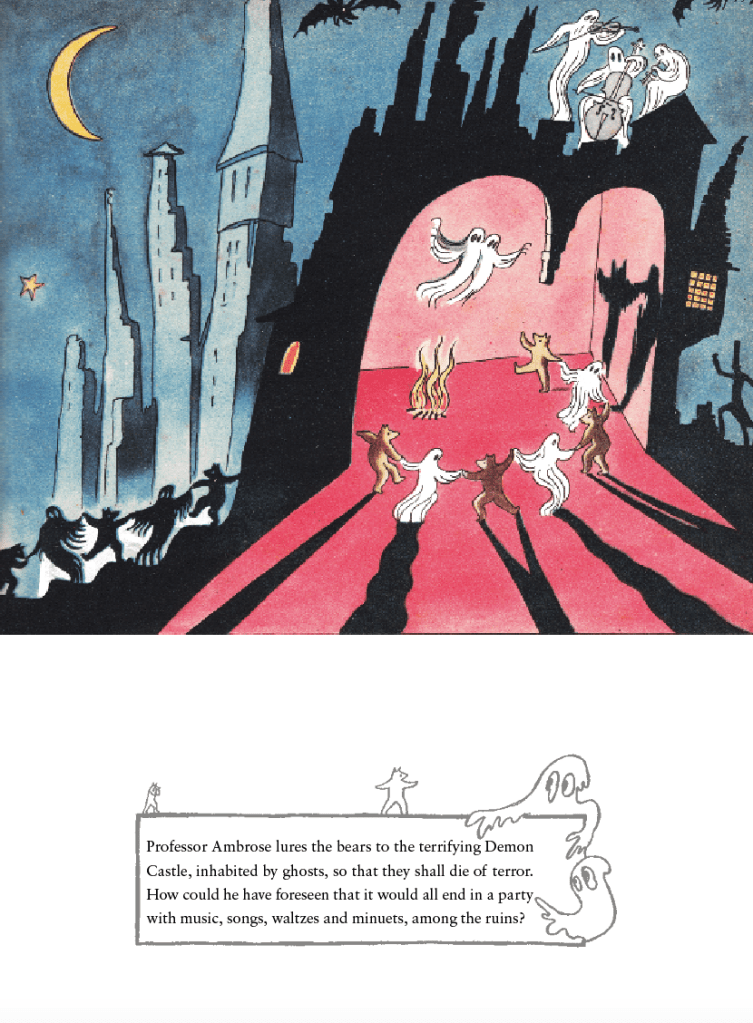
And perhaps if we showed a little more confidence they would become friendly

From Dino Buzzati’s The Bears’ Famous Invasion of Sicily, a childhood favorite that I find almost better as an adult thanks to how respectfully Buzzati speaks to his prime audience. He also offered endless subversion of tropes before subversion became itself the dullest of tropes.

In the neighbourhood there was an old castle – in fact at that time there were many old castles, but the one we mean is Demon Castle, which was all in ruins and hideous, and full of wild beasts, but which was the most famous because it was inhabited by ghosts. As you very well know, all old castles are generally haunted by a ghost or, at most, by two or three. But in Demon Castle there were so many that you could not count them. There were hundreds of them, if not thousands, lying hidden by day: there were even ghosts in the keyholes.

There are some mothers who say: “I cannot imagine what pleasure people get out of telling children ghost stories: it terrifies them, and afterwards at night they start screaming if they hear a mouse.” Perhaps the mothers are right. Still, there are three things to remember. First of all, ghosts, always supposing they exist, have never done children any harm – in fact they have never done anyone any harm: it is simply that people insist on getting frightened. Ghosts and spirits, if they exist (and today they have almost vanished off the face of the earth), are natural and innocent things like the wind or the rain, or shadows of trees, or the voice of the cuckoo in the evening – and they are probably sad at having to live all by themselves in dreary, old, uninhabited houses – and they are probably afraid of people as they hardly ever see them, and perhaps if we showed a little more confidence they would become friendly and would enjoy playing with us at, say, hide-and-seek.

Secondly, Demon Castle does not exist any more, the Grand Duke’s city does not exist any more, there are no more bears in Sicily, and the whole story is now so remote that there is no cause for alarm.

Thirdly, that is how the story was, and we cannot alter it.

And Buzzati’s accompanying art (skipping a bit forward in the story)