Car l’énergie, même dans les mauvaises passions, excite toujours en nous un étonnement et une espèce d’admiration involontaire

From Prosper Mérimée’s La Vénus d’Ille. The translation is my own and I hate the quality but some tones just don’t make it to English gracefully.

Mademoiselle de Puygarrig was eighteen. Her figure, supple and delicate, contrasted with the thick-boned build of her sturdy fiancé. She was not only beautiful, she was enticing. I admired the perfect naturalness of all her replies. And her air of goodness, which, however, was not free from a light tinge of mischief, recalled, despite myself, my host’s Venus. In this internal comparison, I wondered if the statue’s superiority of beauty did not come, in great part, from its tigress expression. For dynamism, even directed to the wrong desires, always excites in us an astonishment and a sort of involuntary admiration.

Mademoiselle de Puygarrig avait dix-huit ans; sa taille souple et délicate contrastait avec les formes osseuses de son robuste fiancé. Elle était non seulement belle, mais séduisante. J’admirais le naturel parfait de toutes ses réponses; et son air de bonté, qui pourtant n’était pas exempt d’une légère teinte de malice, me rappela, malgré moi, la Vénus de mon hôte. Dans cette comparaison que je fis en moi-même, je me demandais si la supériorité de beauté qu’il fallait bien accorder à la statue ne tenait pas, en grande partie, à son expression de tigresse; car l’énergie, même dans les mauvaises passions, excite toujours en nous un étonnement et une espèce d’admiration involontaire.

In books, not authors, curious is my Lord

From Alexander Pope’s Epistle to Burlington (131-138):

And when up ten steep slopes you’ve dragg’d your thighs,
Just at his study door he’ll bless your eyes.
His study! with what authors is it stor’d?
In books, not authors, curious is my Lord;
To all their dated backs he turns you round:
These Aldus printed, those Du Sueil has bound.
Lo, some are vellum, and the rest as good
For all his Lordship knows, but they are wood.

Aldus Manutius was the famed early publisher of classic and humanist texts (an aside for the curious – his prefaces to the Latin and Greek classics he printed are now translated and in print). Du Seuil is Augustin du Seuil (1673-1746) whose entry in Bookbinding and the Conservation of Books informs me was “a celebrated Parisian bookbinder who held the position of royal binder to Louis XV of France” and adds, quoting the above passage, that “he is the only French binder written of in English literature.”

The Twickenham editor (Bateson) suggests that Pope may have been inspired by a passage from La Bruyère (translation is mine but I lost my citation, apologies):

…. je vais trouver cet homme, qui me reçoit dans une maison où dès l’escalier je tombe en faiblesse d’une odeur de maroquin noir dont ses livres sont tous couverts. Il a beau me crier aux oreilles, pour me ranimer, qu’ils sont dorés sur tranche, ornés de filets d’or, et de la bonne édition, me nommer les meilleurs l’un après l’autre, dire que sa galerie est remplie à quelques endroits près, qui sont peints de manière qu’on les prend pour de vrais livres arrangés sur des tablettes, et que l’oeil s’y trompe, ajouter qu’il ne lit jamais, qu’il ne met pas le pied dans cette galerie, qu’il y viendra pour me faire plaisir; je le remercie de sa complaisance, et ne veux, non plus que lui, voir sa tannerie, qu’il appelle bibliothèque.

I go visit this man, who receives me in a house where in the stairwell I fall faint from the smell of the leather in which the books are covered. Trying to resuscitate me in vain he shouts in my ears that their spines are gilded, they’re ornamented with gold tooling, and they’re all the right editions. He names the best ones, one after another. He tells me the room is filled, except in some places which are painted so that everyone – taking them for books arranged on shelves – is deceived. He adds that he never reads, that he never sets foot in the room, that he came there as a favor to me. I thank him for his kindness and wish, no more than he, to see his tannery that he terms a library.

“I am shy with women: therefore there is no God” is highly unconvincing metaphysics

From Fernando Pessoa’s The Education of the Stoic (pg 37-38) – spoken, it should be pointed out, in Pessoa’s heteronym persona of the Baron of Tieve. Minus the harsh phrasing I’ve found the same basic hurdle to appreciating parts of Leopardi and Vigny (de Quental I’ve not read).

There’s something vile – and all the more vile because ridiculous – in the tendency of feeble men to make universal tragedies out of the sad comedies of their private woes.

My recognition of this fact has always prevented me – unjust, I realize – from experiencing the full emotion of the great pessimistic poets. My disenchantment only increased when I read about their lives. The three great pessimistic poets of the last century – Leopardi, Vigny and Antero de Quental – became unbearable to me. The sexual basis of their pessimism, after I’d discerned it in their works and confirmed it in there life stories left a nauseous feeling in my mind.
……
How can I take Leopardi’s atheism seriously or react to it sympathetically, if I know it could have been cured by sexual intercourse? How can I sincerely respect and respond to Antero de Quental’s wistfulness, sadness and despair, if I realize that it all sprang directly from his forlorn heart, which never found its complement – physical or psychological, it matters little – in the real world? How can I be impressed by Vigny’s pessimism apropos women, by his exemplary and outrageous La Colere de Samson, if in the very outrage of the poem I recognize the “loved by few or loved poorly, and suffering cruelly on that account” of the critic Faguet, if I see it’s but the lofty expression of a cuckold’s ordinary torment.

How can anyone take seriously the argument “I’m shy with women, therefore God doesn’t exist,” which is at the heart of Leopardi’s work? How not reject Antero de Quental’s conclusion that “I’m sorry I don’t have a woman who loves me, therefore sorrow is a universal condition”? How can I accept, and not instinctively disdain Vigny’s attitude: “I’m not loved in the way I’d like, therefore women are vile, mean and despicable creatures, with none of the goodness and nobility of men”?

A later fragment repeats the Leopardi commentary (pg 50)

This is one of the cases in which we must all be Freuds. It is impossible to lean not to sexual explanation, because the social behaviors Leopardi erects of his own problem……

The worst of this sort of tragedy is that it is comic. It is not comic in the sense that Swinburne’s love poems are comic.

“I am shy with women: therefore there is no God” is highly unconvincing metaphysics.

Ex Libris #4 – Oeuvres de Marcel Schwob

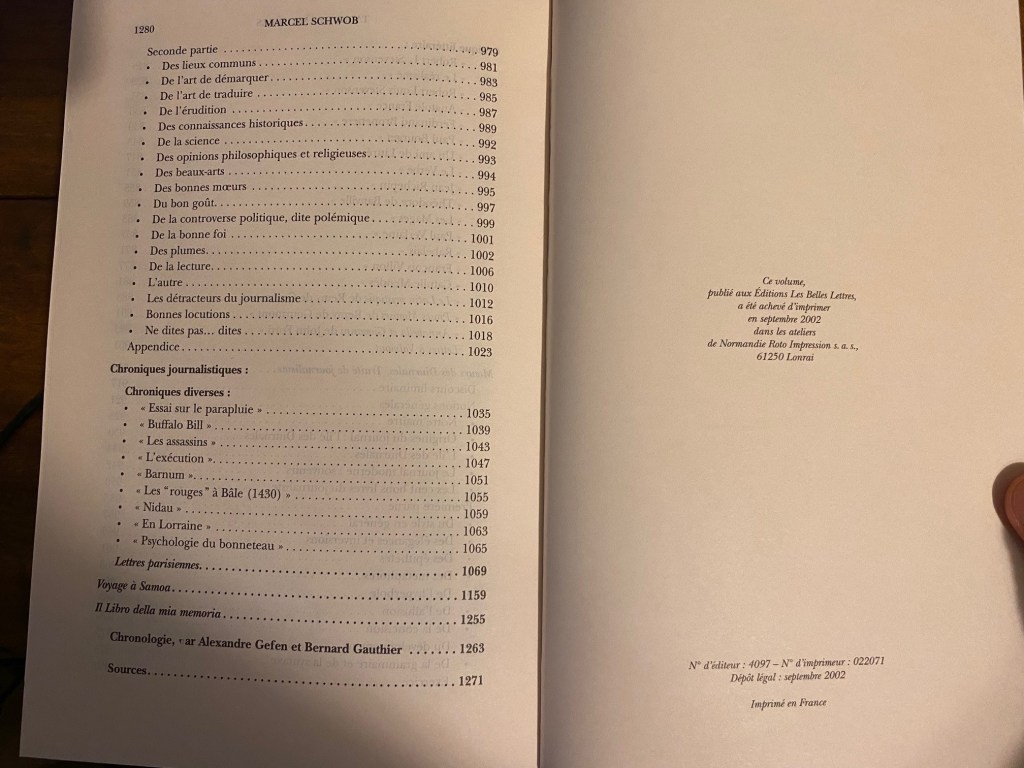
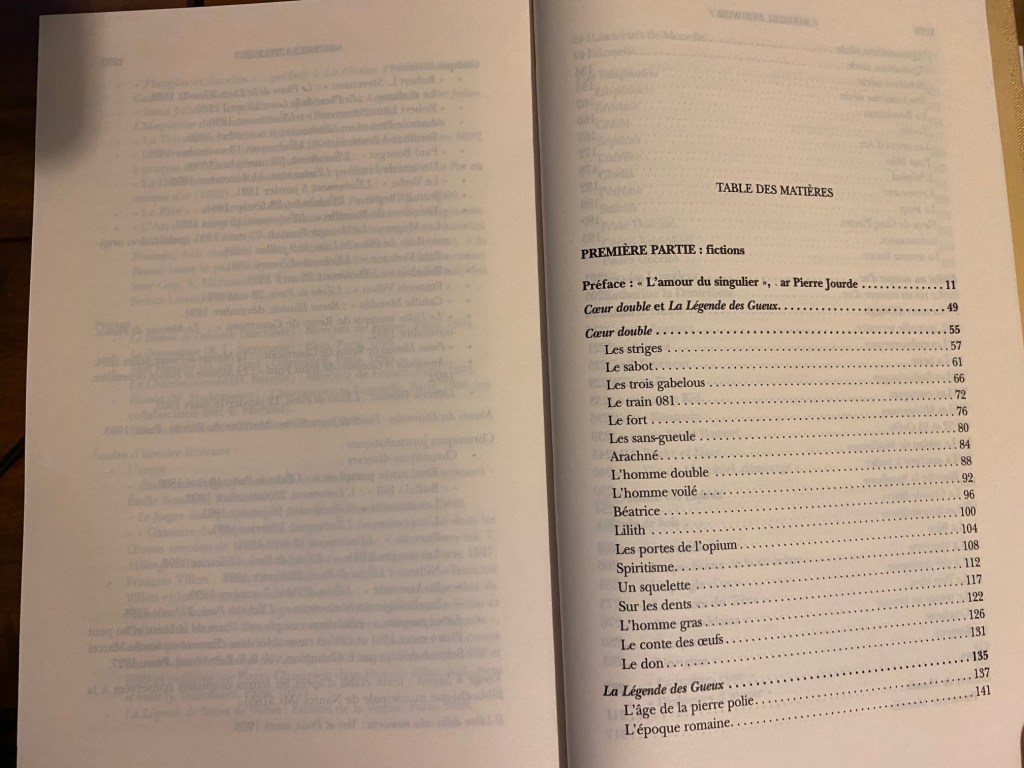
This is a favorite rather than a new acquisition – the 2002 Belles Lettres edition of the works of Marcel Schwob (ISBN 9782251442204). It isn’t complete – it lacks his correspondence (published by Droz, with another volume by Editions Allia dedicated to the Schwob/Robert Louis Stevenson letters) – but it has all his fiction, non-fiction, critical essays, and travel writings. I think this later paperback edited by Schwob’s biographer would cover the same material but I distrust the binding durability on 900 page paperbacks. That said, it is 1/5 the price or less. Editions Allia have also recently been reprinting his major non-fiction studies (on Villon, Rabelais, and argot) but for a while this edition was the single easy access point for anything past the Vies Imaginaires, Le Coeur Double, Le Roi au Masque d’or, and Le Livre de Monelle (In English Wakefield Press have recently been releasing translations of Schwob’s major fiction).

I’m putting pictures of the entire table of contents below because I got frustrated not being able to find them online when buying my copy several years back.

And good for anyone interested in Schwob – there’s a single biography I’ve been able to find – Marcel Schwob ou Les Vies imaginaires by Sylvain Goudemare (editor of the above paperback edition). For all its fullness, I still prefer the brief essay Schwob’s friend Pierre Champion wrote after his death, Marcel Schwob parmi ses livres (reprinted as the preface to Editions Allia’s Catalogue de la bibliothèque de Marcel Schwob). I’ve today bought Marcel Schwob et son temps, also by Pierre Champion and seeming to include letters/thoughts from other friends like Jules Renard and Colette but I’ve got to wait for shipping.

Thought, which for other people is a compass to guide action, is for me its microscope

From Fernando Pessoa’s The Education of the Stoic (pg 22-23):

My lack of initiative was the root cause of all my troubles – of my inability to want something before having thought about it, of my inability to commit myself, of my inability to decide in the only way one can decide: by deciding, not by thinking. I’m like Buridan’s donkey, dying at the mathematical midpoint between the water of emotion and the hay of action; if I didn’t think, I m might still die, but it wouldn’t be from thirst or hunger.

Whatever I think or feel inevitably turns into a form of inertia. Thought, which for other people is a compass to guide action, is for me its microscope, making me see whole universes to span where a footstep would have sufficed, as if Zeno’s argument about the impossibility of crossing a given space – which, being infinitely divisible, is therefore infinite – were a strange drug that had intoxicated my psychological self. And feeling, which in other people enters the will like a hand in a glove, or list a fist tin the guard of a sword, was always in me another form of thought – futile like a rage that makes us tremble so much we can’t move, or like a panic (the panic, in my case, of feeling too intensely) that freezes the frightened man in his tracks, when his fright should make him flee.

My whole life has been a battle lost on the map. Cowardice didn’t even make it to the battlefield, where perhaps it would have dissipated; it haunted the chief of staff in his office, all alone with his certainty of defeat. He didn’t dare implement his battle plan, since it was sure to be imperfect, and he didn’t dare perfect it (though it could never be truly perfect) since his convection that it would never be perfect killed all his desires to strive for perfection. Nor did it ever occur to him that his plan, though imperfect, might be closer to perfection than the enemy’s. The truth is that my real enemy, victorious over me since God, was that very idea of a perfection, marching against me at the head of all the troops of the world – in the tragic vanguard of all the world’s armed men.

Is it not better to do this than to engage in politics with you?

Some anecdotes of Heraclitus:

Diog. Laert. 9.12

They say that when he was asked why he kept silent, he said, “So that you can chatter.”

φασὶ δὲ αὐτὸν ἐρωτηθέντα διὰ τί σιωπᾷ, φάναι “ἵν᾽ ὑμεῖς λαλῆτε.”


Diog. Laert. 9.2–3

When he was asked by them [i.e. the Ephesians] to give them laws, he scorned to do so, since the city was already dominated by its bad constitution. And he withdrew into the temple of Artemis, where he spent his time playing dice with the children; when the Ephesians gathered around him he asked, “Why are you surprised, you wretches? Is it not better to do this than to engage in politics with you?”

ἀξιούμενος δὲ καὶ νόμους θεῖναι πρὸς αὐτῶν ὑπερεῖδε διὰ τὸ ἤδη κεκρατῆσθαι τῇ πονηρᾷ πολιτείᾳ τὴν πόλιν. ἀναχωρήσας δὲ εἰς τὸ ἱερὸν τῆς Ἀρτέμιδος μετὰ τῶν παίδων ἠστραγάλιζε· περιστάντων δ᾽ αὐτὸν τῶν Ἐφεσίων, “τί, ὦ κάκιστοι, θαυμάζετε;” εἶπεν· “ἢ οὐ κρεῖττον τοῦτο ποιεῖν ἢ μεθ᾽ ὑμῶν πολιτεύεσθαι;”

We have had enough of action, and of motion we

I was watching My Man Godfrey earlier and noticed a small detail I hadn’t ever picked up on – in a scene (a bit past halfway) that opens with Carlo reading to Cornelia he’s actually reading the opening lines of Alfred, Lord Tennyson’s Lotos-eaters.

“Courage!” he said, and pointed toward the land,
“This mounting wave will roll us shoreward soon.”
In the afternoon they came unto a land
In which it seemed always afternoon.
All round the coast the languid air did swoon,
Breathing like one that hath a weary dream.
Full-faced above the valley stood the moon;
And like a downward smoke, the slender stream
Along the cliff to fall and pause and fall did seem.

A land of streams! some, like a downward smoke,
Slow-dropping veils of thinnest lawn, did go;
And some thro’ wavering lights and shadows broke,
Rolling a slumbrous sheet of foam below.
They saw the gleaming river seaward flow
From the inner land: far off, three mountain-tops,
Three silent pinnacles of aged snow,
Stood sunset-flush’d: and, dew’d with showery drops,
Up-clomb the shadowy pine above the woven copse.

The charmed sunset linger’d low adown
In the red West: thro’ mountain clefts the dale
Was seen far inland, and the yellow down
Border’d with palm, and many a winding vale
And meadow, set with slender galingale;
A land where all things always seem’d the same!
And round about the keel with faces pale,
Dark faces pale against that rosy flame,
The mild-eyed melancholy Lotos-eaters came.

Branches they bore of that enchanted stem,
Laden with flower and fruit, whereof they gave
To each, but whoso did receive of them,
And taste, to him the gushing of the wave
Far far away did seem to mourn and rave
On alien shores; and if his fellow spake,
His voice was thin, as voices from the grave;
And deep-asleep he seem’d, yet all awake,
And music in his ears his beating heart did make.

They sat them down upon the yellow sand,
Between the sun and moon upon the shore;
And sweet it was to dream of Fatherland,
Of child, and wife, and slave; but evermore
Most weary seem’d the sea, weary the oar,
Weary the wandering fields of barren foam.
Then some one said, “We will return no more”;
And all at once they sang, “Our island home
Is far beyond the wave; we will no longer roam.”

CHORIC SONG
I
There is sweet music here that softer falls
Than petals from blown roses on the grass,
Or night-dews on still waters between walls
Of shadowy granite, in a gleaming pass;
Music that gentlier on the spirit lies,
Than tir’d eyelids upon tir’d eyes;
Music that brings sweet sleep down from the blissful skies.
Here are cool mosses deep,
And thro’ the moss the ivies creep,
And in the stream the long-leaved flowers weep,
And from the craggy ledge the poppy hangs in sleep.”

II
Why are we weigh’d upon with heaviness,
And utterly consumed with sharp distress,
While all things else have rest from weariness?
All things have rest: why should we toil alone,
We only toil, who are the first of things,
And make perpetual moan,
Still from one sorrow to another thrown:
Nor ever fold our wings,
And cease from wanderings,
Nor steep our brows in slumber’s holy balm;
Nor harken what the inner spirit sings,
“There is no joy but calm!”
Why should we only toil, the roof and crown of things?

III
Lo! in the middle of the wood,
The folded leaf is woo’d from out the bud
With winds upon the branch, and there
Grows green and broad, and takes no care,
Sun-steep’d at noon, and in the moon
Nightly dew-fed; and turning yellow
Falls, and floats adown the air.
Lo! sweeten’d with the summer light,
The full-juiced apple, waxing over-mellow,
Drops in a silent autumn night.
All its allotted length of days
The flower ripens in its place,
Ripens and fades, and falls, and hath no toil,
Fast-rooted in the fruitful soil.

IV
Hateful is the dark-blue sky,
Vaulted o’er the dark-blue sea.
Death is the end of life; ah, why
Should life all labour be?
Let us alone. Time driveth onward fast,
And in a little while our lips are dumb.
Let us alone. What is it that will last?
All things are taken from us, and become
Portions and parcels of the dreadful past.
Let us alone. What pleasure can we have
To war with evil? Is there any peace
In ever climbing up the climbing wave?
All things have rest, and ripen toward the grave
In silence; ripen, fall and cease:
Give us long rest or death, dark death, or dreamful ease.

V
How sweet it were, hearing the downward stream,
With half-shut eyes ever to seem
Falling asleep in a half-dream!
To dream and dream, like yonder amber light,
Which will not leave the myrrh-bush on the height;
To hear each other’s whisper’d speech;
Eating the Lotos day by day,
To watch the crisping ripples on the beach,
And tender curving lines of creamy spray;
To lend our hearts and spirits wholly
To the influence of mild-minded melancholy;
To muse and brood and live again in memory,
With those old faces of our infancy
Heap’d over with a mound of grass,
Two handfuls of white dust, shut in an urn of brass!

VI
Dear is the memory of our wedded lives,
And dear the last embraces of our wives
And their warm tears: but all hath suffer’d change:
For surely now our household hearths are cold,
Our sons inherit us: our looks are strange:
And we should come like ghosts to trouble joy.
Or else the island princes over-bold
Have eat our substance, and the minstrel sings
Before them of the ten years’ war in Troy,
And our great deeds, as half-forgotten things.
Is there confusion in the little isle?
Let what is broken so remain.
The Gods are hard to reconcile:
‘Tis hard to settle order once again.
There is confusion worse than death,
Trouble on trouble, pain on pain,
Long labour unto aged breath,
Sore task to hearts worn out by many wars
And eyes grown dim with gazing on the pilot-stars.

VII
But, propt on beds of amaranth and moly,
How sweet (while warm airs lull us, blowing lowly)
With half-dropt eyelid still,
Beneath a heaven dark and holy,
To watch the long bright river drawing slowly
His waters from the purple hill—
To hear the dewy echoes calling
From cave to cave thro’ the thick-twined vine—
To watch the emerald-colour’d water falling
Thro’ many a wov’n acanthus-wreath divine!
Only to hear and see the far-off sparkling brine,
Only to hear were sweet, stretch’d out beneath the pine.

VIII
The Lotos blooms below the barren peak:
The Lotos blows by every winding creek:
All day the wind breathes low with mellower tone:
Thro’ every hollow cave and alley lone
Round and round the spicy downs the yellow Lotos-dust is blown.
We have had enough of action, and of motion we,
Roll’d to starboard, roll’d to larboard, when the surge was seething free,
Where the wallowing monster spouted his foam-fountains in the sea.
Let us swear an oath, and keep it with an equal mind,
In the hollow Lotos-land to live and lie reclined
On the hills like Gods together, careless of mankind.
For they lie beside their nectar, and the bolts are hurl’d
Far below them in the valleys, and the clouds are lightly curl’d
Round their golden houses, girdled with the gleaming world:
Where they smile in secret, looking over wasted lands,
Blight and famine, plague and earthquake, roaring deeps and fiery sands,
Clanging fights, and flaming towns, and sinking ships, and praying hands.
But they smile, they find a music centred in a doleful song
Steaming up, a lamentation and an ancient tale of wrong,
Like a tale of little meaning tho’ the words are strong;
Chanted from an ill-used race of men that cleave the soil,
Sow the seed, and reap the harvest with enduring toil,
Storing yearly little dues of wheat, and wine and oil;
Till they perish and they suffer—some, ’tis whisper’d—down in hell
Suffer endless anguish, others in Elysian valleys dwell,
Resting weary limbs at last on beds of asphodel.
Surely, surely, slumber is more sweet than toil, the shore
Than labour in the deep mid-ocean, wind and wave and oar;
O, rest ye, brother mariners, we will not wander more.
Patience, sagacity, tolerance, veracity, perseverance, loyalty—all the qualities, in other words, that defined madness

From Machado de Assis’ The Alienist:

Back and forth he went, the great alienist, from one end to the other of his vast library, lost in meditation, oblivious to everything except the daunting intellectual problem of cerebral pathology. Suddenly, he stopped. Standing at a window, with his left elbow in his open right hand and his chin on his closed left hand, he asked himself:

“Were they really insane? And did I really cure them? Or …”

And digging deeper, he concluded that he really could not claim to have added anything to his patients’ already existing mental faculties. The apparent cures had simply revealed an underlying mental imbalance that was present all along—latent, perhaps, but present.

This conclusion produced in the spirit of the illustrious alienist two contrary reactions: gratification and discouragement. He felt gratified that, after such arduous labors and prolix investigations, he could at long last affirm the following truth: Nobody was crazy in Itaguaí, nobody at all. But no sooner had this idea refreshed his soul, than another sprang forth to discourage him. The second idea was doubt. Was it possible that Itaguaí possessed not a single perfectly balanced mind? Must not such a conclusion be, ipso facto, erroneous? And did it not, therefore, invalidate all his theories and destroy the majestic scientific edifice that he had so patiently erected?

According to the old chroniclers of Itaguaí, the affliction experienced by the egregious Simão Bacamarte at that moment figures among the most awesome spiritual tempests in the annals of mankind. Tempests terrify only the weak, however. The strong confront the thunder and do not tremble, but only grow stronger. After twenty minutes, a gentle light illuminated the face of the alienist.

“Yes, it must be that,” he thought.

And “that” was this. Simão Bacamarte had found all the characteristics of a perfect mental and moral equilibrium within himself. Patience, sagacity, tolerance, veracity, perseverance, loyalty—all the qualities, in other words, that defined madness. He had reservations about this conclusion, too, of course, and almost discarded it as illusory. Prudent man that he was, however, he assembled a jury of his friends and asked for a frank opinion. Their verdict was affirmative.

Opinion is set upon all things

Xenophanes on our subjection to opinion (δόκος), appropriately preserved by quote in Sextus Empiricus (in Adversus Mathematicos 7.49, against the logicians). Text and translation is the Loeb Early Greek Philosophy v.3:

And thus there has never been any man, nor will there ever be one,
Who knows what is clear about the gods and whatever I say about all things.
For even if he happened most to say something perfect,
He himself nonetheless does not know: opinion is set upon all things.

καὶ τὸ μὲν οὖν σαφὲς οὔτις ἀνὴρ γένετ’ οὐδέ τις ἔσται
εἰδὼς ἀμφὶ θεῶν τε καὶ ἅσσα λέγω περὶ πάντων·
εἰ γὰρ καὶ τὰ μάλιστα τύχοι τετελεσμένον εἰπών,
αὐτὸς ὅμως οὐκ οἶδε· δόκος δ᾽ ἐπὶ πᾶσι τέτυκται.


Beyond my anxiety and beyond this writing the universe waits, inexhaustible

From Borge’s El Otro, El Mismo (which my Collected Poems takes as The Self and The Other). Borges famously took up Anglo-Saxon in his seventies (eighties?). I hope to do the same with Persian.

Poem Written in a Copy of Beowulf

At various times I have asked myself what reasons
moved me to study while my night came down,
without particular hope of satisfaction,
the language of the blunt-tongued Anglo-Saxons.
Used up by the years my memory
loses its grip on words that I have vainly
repeated and repeated. My life in the same way
weaves and unweaves its weary history.
Then I tell myself: it must be that the soul
has some secret sufficient way of knowing
that it is immortal, that its vast encompassing
circle can take in all, accomplish all.
Beyond my anxiety and beyond this writing
the universe waits, inexhaustible, inviting.

Composición escrita en un ejemplar de la gesta de Beowulf

A veces me pregunto qué razones
me mueven a estudiar sin esperanza
de precisión, mientras mi noche avanza
la lengua de los ásperos sajones.
Gastada por los años la memoria
deja caer la en vano repetida
palabra y es así como mi vida
teje y desteje su cansada historia.
Será (me digo entonces) que de un modo
secreto y suficiente el alma sabe
que es inmortal y que su vasto y grave
círculo abarca todo y puede todo.
Más allá de este afán y de este verso
me aguarda inagotable el universo.

Spanish is far the weakest of my languages but I find aspects of this translation baffling. A couple of examples:

lines 2-3 – sin esperanza de precisión (‘without particular hope of satisfaction’). Precisión is exactness. The sense here is not lacking satisfaction (which suggests an emotional element) but lacking mastery at the technical level. I don’t know where the qualifying ‘particular’ crept in from.

final line – ‘me aguarda inagotable el universo’ (‘the universe waits, inexhaustible, inviting’). I have a minor quibble with removing the direct object (me) and a more major one with including ‘inviting’ when it doesn’t appear in the original unless you want to give aguarda a double translation ‘waits and invites.’