So much of motion, is so much of life, and so much of joy

From Tristram Shandy, as Tristram dashes through France:

‘Make them like unto a wheel,’ is a bitter sarcasm, as all the learned know, against the grand tour, and that restless spirit for making it, which David prophetically foresaw would haunt the children of men in the latter days; and therefore, as thinketh the great bishop Hall, ’tis one of the severest imprecations which David ever utter’d against the enemies of the Lord—and, as if he had said, ‘I wish them no worse luck than always to be rolling about.’—So much motion, continues he (for he was very corpulent)—is so much unquietness; and so much of rest, by the same analogy, is so much of heaven.

Now, I (being very thin) think differently; and that so much of motion, is so much of life, and so much of joy—and that to stand still, or get on but slowly, is death and the devil—


Suivre ses idées à la piste, comme le chasseur poursuit le gibier, sans affecter de tenir aucune route

From Xavier de Maistre’s Voyage Autour de ma Chambre.  I now wish I’d read this when I first heard of it several years ago since I found here a rare fellow Shandean.

I have no affection for people who are so effectively the masters of their steps and their ideas, who say: “Today, I will make three visits, write four letters, I will finish this work I’ve begun.” – My soul is so open to all sorts of ideas, tastes, and feelings; it receives so greedily everything that presents itself … – And why should it refuse the joys that are scattered on the difficult road of life?  They are so rare, so dispersed, that you’d have to be a fool not to stop, even to turn aside from the path, to gather all those that are in our reach.  Amongst these there is nothing more attractive – in my view – than following ideas in their course, as a hunter pursues his prey, without pretending to keep to any route.  Hence, when I travel in my chamber, I rarely travel a straight line.

Je n’aime pas les gens qui sont si fort les maîtres de leurs pas et de leurs idées, qui disent: “Aujourd’hui, je ferai trois visites, j’écrirai quatre lettres, je finirai cet ouvrage que j’ai commencé.”—Mon ame est tellement ouverte à toutes sortes d’idées, de goûts et de sentimens; elle reçoit si avidement tout ce qui se présente!…—Et pourquoi refuserait-elle les jouissances qui sont éparses sur le chemin difficile de la vie? Elles sont si rares, si clair-semées, qu’il faudrait être fou pour ne pas s’arrêter, se détourner même de son chemin, pour cueillir toutes celles qui sont à notre portée. Il n’en est pas de plus attrayante, selon moi, que de suivre ses idées à la piste, comme le chasseur poursuit le gibier, sans affecter de tenir aucune route. Aussi, lorsque je voyage dans ma chambre, je parcours rarement une ligne droite

The means he used to make his ass leave off kicking

From Tristram Shandy. I will for tomorrow find the quote referenced, which Sterne likely took from Burton’s Anatomy of Melancholy and Burton in his turn from Saint Jerome’s Life of Hilarion

If any thing in this world, which my father said, could have provoked my uncle Toby, during the time he was in love, it was the perverse use my father was always making of an expression of Hilarion the hermit; who, in speaking of his abstinence, his watchings, flagellations, and other instrumental parts of his religion—would say—tho’ with more facetiousness than became an hermit—’That they were the means he used, to make his ass (meaning his body) leave off kicking.’

It pleased my father well; it was not only a laconick way of expressing—but of libelling, at the same time, the desires and appetites of the lower part of us; so that for many years of my father’s life, ’twas his constant mode of expression—he never used the word passions once—but ass always instead of them—So that he might be said truly, to have been upon the bones, or the back of his own ass, or else of some other man’s, during all that time.

Every thing in this world, said my father, is big with jest

From Tristram Shandy:

Every thing in this world, said my father, is big with jest, and has wit in it, and instruction too,—if we can but find it out.

—Here is the scaffold work of Instruction, its true point of folly, without the Building behind it.

—Here is the glass for pedagogues, preceptors, tutors, governors, gerund-grinders, and bear-leaders to view themselves in, in their true dimensions.—

Oh! there is a husk and shell, Yorick, which grows up with learning, which their unskilfulness knows not how to fling away!

—Sciences May Be Learned by Rote But Wisdom Not.

He had but too many temptations in life, of scattering his wit and his humour

From Tristram Shandy, a description I flatteringly (?) read as equally applicable to myself:

But, in plain truth, [Yorick] was a man unhackneyed and unpractised in the world, and was altogether as indiscreet and foolish on every other subject of discourse where policy is wont to impress restraint. Yorick had no impression but one, and that was what arose from the nature of the deed spoken of; which impression he would usually translate into plain English without any periphrasis;—and too oft without much distinction of either person, time, or place;—so that when mention was made of a pitiful or an ungenerous proceeding—he never gave himself a moment’s time to reflect who was the hero of the piece,—what his station,—or how far he had power to hurt him hereafter;—but if it was a dirty action,—without more ado,—The man was a dirty fellow,—and so on.—And as his comments had usually the ill fate to be terminated either in a bon mot, or to be enlivened throughout with some drollery or humour of expression, it gave wings to Yorick’s indiscretion. In a word, tho’ he never sought, yet, at the same time, as he seldom shunned occasions of saying what came uppermost, and without much ceremony;—he had but too many temptations in life, of scattering his wit and his humour,—his gibes and his jests about him.—They were not lost for want of gathering.

It was the attachment to those objects

From part 1 of Within a Budding Grove

“The most I was capable of was astonishment, when my visit was at all prolonged, at the nullity of achievement, at the utter inconclusiveness of those hours spent in the enchanted dwelling. But my disappointment arose neither from the inadequacy of the works of art that were shown to me nor from the impossibility of fixing upon them my distracted gaze. For it was not the intrinsic beauty of the objects themselves that made it miraculous for me to be sitting in Swann’s library, it was the attachment to those objects—which might have been the ugliest in the world—of the particular feeling, melancholy and voluptuous, which I had for so many years located in that room and which still impregnated it”

Tout au plus m’étonnais-je quand la visite se prolongeait, à quel néant de réalisation, à quelle absence de conclusion heureuse, conduisaient ces heures vécues dans la demeure enchantée. Mais ma déception ne tenait ni à l’insuffisance des chefs-d’oeuvre montrés, ni à l’impossibilité d’arrêter sur eux un regard distrait. Car ce n’était pas la beauté intrinsèque des choses qui me rendait miraculeux d’être dans le cabinet de Swann, c’était l’adhérence à ces choses—qui eussent pu être les plus laides du monde—du sentiment particulier, triste et voluptueux que j’y localisais depuis tant d’années et qui l’imprégnait encore;

The bolded phrase is probably the closest Proust comes to summing up what I find to be the core uniting theme of the social/emotional psychology his novel posits.  Whether it be the sentimental and aesthetic value of the narrator’s memories, Swann’s (externally) inexplicable passion for Odette, the narrator’s fixation on Gilberte/the Swanns and later Albertine, the Verdurins’ cultivation of a salon, etc. etc. it all comes together in this idea that is – by independent evolution or direct inspiration? – so close to the opening of section 5 of Epictetus’ Enchiridion:

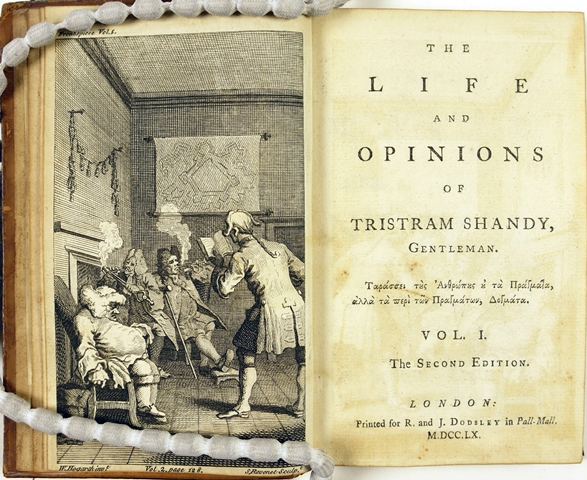
ταράσσει τοὺς ἀνθρώπους οὐ τὰ πράγματα, ἀλλὰ τὰ περὶ τῶν πραγμάτων δόγματα

What disturbs men are the things themselves, but their beliefs about those things

Which – for another hint at the many unappreciated links between Proust and Sterne – is also the epigraph to the first volume of Tristram Shandy

tristram


The two illustrious brothers Shandy combined in one person

From Sir Leslie Stephen’s essay on Sir Thomas Browne in Hours in a Library (first essay in vol. 2 of my 4 vol. edition – a different one is on Gutenberg):

A mind endowed with an insatiable curiosity as to all things knowable and unknowable; an imagination which tinges with poetical hues the vast accumulation of incoherent facts thus stored in a capacious memory; and a strangely vivid humour that is always detecting the quaintest analogies, and, as it were, striking light from the most unexpected collocations of uncompromising materials: such talents are by themselves enough to provide a man with work for life, and to make all his work delightful. To them, moreover, we must add a disposition absolutely incapable of controversial bitterness; ‘a constitution,’ as he says of himself, ‘so general that it consorts and sympathises with all things;’ an absence of all antipathies to loathsome objects in nature, for all theological systems; an admiration even of our natural enemies, the French, the Spaniards, the Italians, and the Dutch; a love of all climates, of all countries; and, in short, an utter incapacity to ‘absolutely detest or hate any essence except the devil.’ … A man so endowed … is admirably qualified to discover one great secret of human happiness. No man was ever better prepared to keep not only one, but a whole stableful of hobbies, nor more certain to ride them so as to amuse himself, without loss of temper or dignity, and without rude collisions against his neighbours. That happy art is given to few, and thanks to his skill in it, Sir Thomas reminds us strongly of the two illustrious brothers Shandy combined in one person. To the exquisite kindliness and simplicity of Uncle Toby he unites the omnivorous intellectual appetite and the humorous pedantry of the head of the family.
Such convenience is not to be enjoyed — nor such liberty taken — with the living

From the letters of Laurence Sterne:

…Indeed I have no inclination to visit, or say a syllable to but a few persons in this lower vale of vanity and tears beside you: — But I often derive a peculiar satisfaction in conversing with the ancient and modern dead, —- who yet live and speak excellently in their works. — My neighbors think me often alone, — and yet at such times I am in company with more than five hundred mutes —- each of whom, at my pleasure, communicates his ideas to me by dumb signs — quite as intelligibly as any person living can do by uttering of words. — They always keep the distance from me which I direct —- and, with a motion of my hand, I can bring them as near to me as I please.  I lay hands on fifty of them sometimes in an evening, and handle them as I like — they never complain of ill-usage, — and when dismissed from my presence, — tho’ ever so abruptly —- take no offence.  Such convenience is not to be enjoyed — nor such liberty taken — with the living: —- We are bound —- in point of good manners to admit all our pretended friends when they knock for entrance, and dispense with all the nonsense or impertinence which they broach ’till they think proper to with-draw…