…who made “learning by suffering” into an effective law

From Proust’s Le temps retrouvé (pg 284 in v.4 of the Pleiade edition, translation from the Modern Library updated Moncrieff):

What is odd, though I cannot here enlarge upon the topic, is the degree to which, at that time, all the people whom Albertine loved, all those who might have been able to persuade her to do what they wanted, asked, entreated, I will even say begged to be allowed to have, if not my friendship, at least some sort of acquaintance with me. No longer should I have had to offer money to Mme Bontemps as an inducement to send Albertine back to me. But this turn of fortune’s wheel, taking place when it was no longer of the slightest use, merely saddened me profoundly, not because of Albertine, whom I would have received without pleasure had she been brought back not from Touraine but from the other world, but because of a young woman with whom I was in love and whom I could not contrive to meet. I told myself that, if she died, or if I no longer loved her, all those who might have brought us together would suddenly be at my feet. Meanwhile, I tried in vain to work upon them, not having been cured by experience, which ought to have taught me—if ever it taught anybody anything—that loving is like an evil spell in a fairy-story against which one is powerless until the enchantment has passed.

Ce qui est curieux et ce sur quoi je ne puis m’étendre, c’est à quel point, vers cette époque-là, toutes les personnes qu’avait aimées Albertine, toutes celles qui auraient pu lui faire faire ce qu’elles auraient voulu, demandèrent, implorèrent, j’oserai dire mendièrent, à défaut de mon amitié, quelques relations avec moi. Il n’y aurait plus eu besoin d’offrir de l’argent à Mme Bontemps pour qu’elle me renvoyât Albertine. Ce retour de la vie, se produisant quand il ne servait plus à rien, m’attristait profondément, non à cause d’Albertine, que j’eusse reçue sans plaisir si elle m’eût été ramenée, non plus de Touraine mais de l’autre monde, mais à cause d’une jeune femme que j’aimais et que je ne pouvais arriver à voir. Je me disais que si elle mourait, ou si je ne l’aimais plus, tous ceux qui eussent pu me rapprocher d’elle tomberaient à mes pieds. En attendant, j’essayais en vain d’agir sur eux, n’étant pas guéri par l’expérience, qui aurait dû m’apprendre–si elle apprenait jamais rien–qu’aimer est un mauvais sort comme ceux qu’il y a dans les contes contre quoi on ne peut rien jusqu’à ce que l’enchantement ait cessé.

The above is no exceptional passage but a sample of why I incline to reading into Proust a 3000 page expansion of vanitas vanitatum, omnia vanitas that builds on the guiding principle from the Hymn to Zeus in Aeschylus’ Agamemnon (160-180):

[Zeus] who set mortals on the road
to understanding, who made
“learning by suffering” into an effective law.
There drips before the heart, instead of sleep,
the misery of pain recalled: good sense comes to men
even against their will.

τὸν φρονεῖν βροτοὺς ὁδώ-
σαντα, τὸν “πάθει μάθος”
θέντα κυρίως ἔχειν.
στάζει δ᾿ ἀνθ᾿ ὕπνου πρὸ καρδίας
μνησιπήμων πόνος· καὶ παρ᾿ ἅ-
κοντας ἦλθε σωφρονεῖν.
Patrick Leigh Fermor’s Green Diary pt.2

A continuation of Patrick Leigh Fermor’s Green Diary

It doesn’t do to go prodding as critic into details and timelines of Fermor’s actual journey but there’s no foul play in observing bits of the transformation process in order to better appreciate the end product.

It is on the way through Slovakia that (old author) Fermor mentions recovery of the diary now digitized by the National Library of Scotland.

So I headed north-east instead of south. I was still on the wrong side of the Danube and getting further from the river with every step and deeper into Slovakia. My new plan was to make a wide Slovakian loop, strike the Danube again about a hundred miles downstream and cross into Hungary by the Parkan-Esztergom bridge.

Meanwhile, an important change has come over the raw-material of these pages.

Recently—after I had set down all I could remember of these ancient travels—I made a journey down the whole length of the Danube, starting in the Black Forest and ending at the Delta; and in Rumania, in a romantic and improbable way too complicated to recount, I recovered a diary I had left in a country house there in 1939.

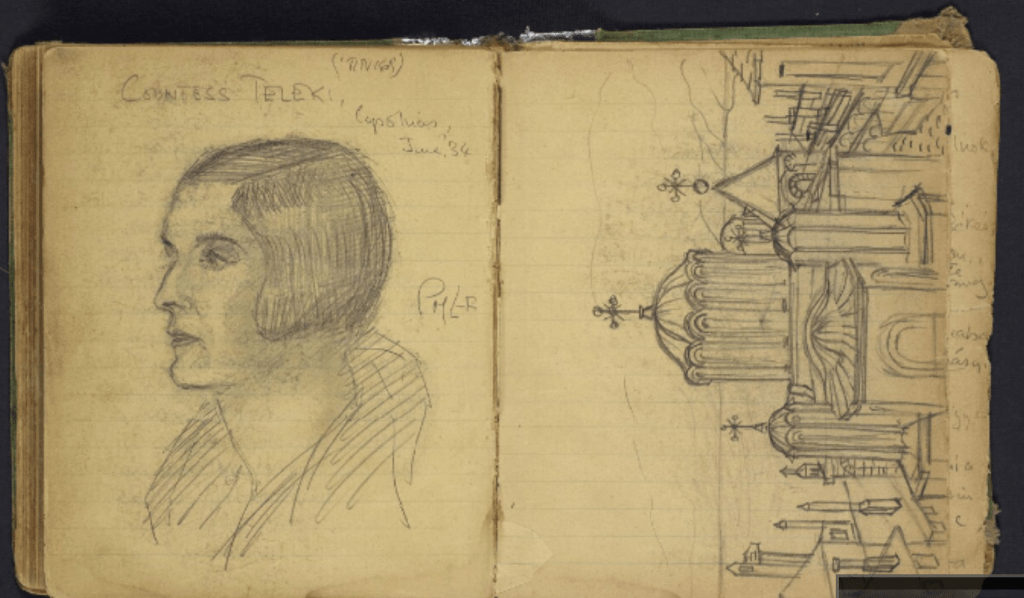
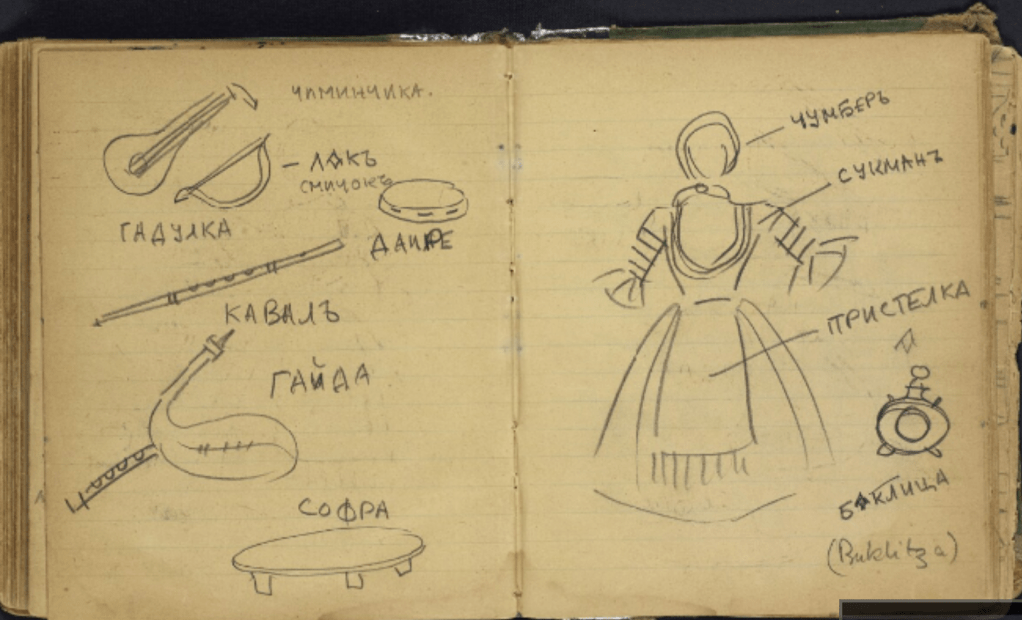
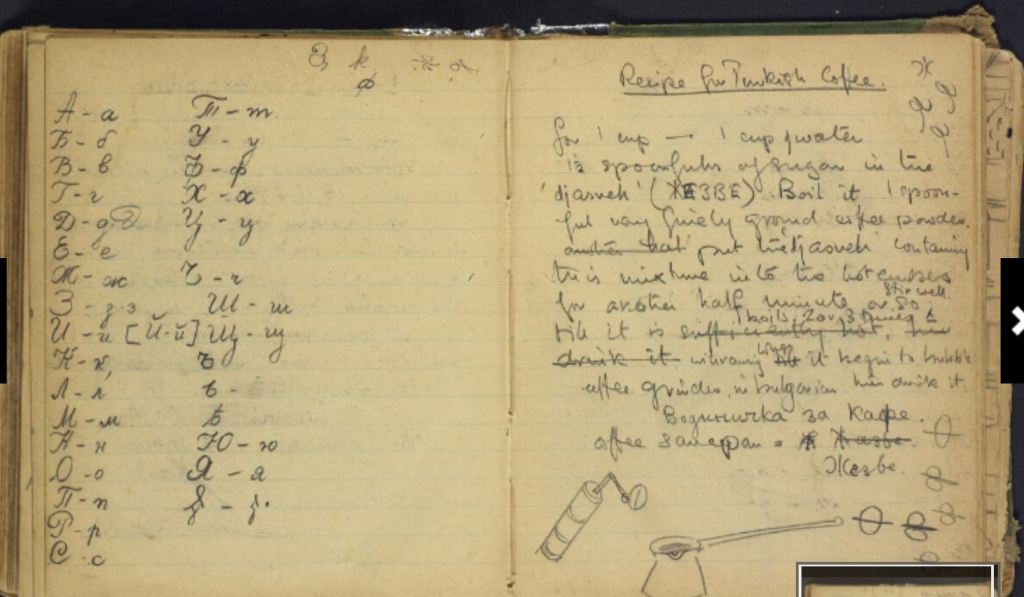
I must have bought the manuscript book in Bratislava. It is a thick, battered, stiffly-bound cloth-backed volume containing 320 closely-written pages in pencil. After a long initial passage, the narrative breaks off for a month or two, then starts up again in notes, stops once more, and blossoms out again in proper diary form. And so it goes on, sporadically recording my travels in all the countries between Bratislava and Constantinople, whence it moves to Mount Athos and stops. In the back of the book is a helpful list of overnight sojourns; there are rudimentary vocabularies in Hungarian, Bulgarian, Rumanian, Turkish and Modern Greek and a long list of names and addresses. As I read these, faces I had forgotten for many years began to come back to me: a vintner on the banks of the Tisza, an innkeeper in the Banat, a student in Berkovitza, a girl in Salonica, a Pomak hodja in the Rhodope mountains… There are one or two sketches of the details of buildings and costumes, some verses, the words of a few folk-songs and the alphabetical jottings I mentioned two chapters back. The stained covers are still warped from their unvarying position in my rucksack and the book seemed—it still seems—positively to smell of that old journey.

It was an exciting trove; a disturbing one too. There were some discrepancies of time and place between the diary and what I had already written but they didn’t matter as they could be put right. The trouble was that I had imagined—as one always does with lost property—that the contents were better than they were. Perhaps that earlier loss in Munich wasn’t as serious as it had seemed at the time. But, with all its drawbacks, the text did have one virtue: it was dashed down at full speed. I know it is dangerous to change key, but I can’t resist using a few passages of this old diary here and there. I have not interfered with the text except for cutting and condensing and clearing up obscurities. It begins on the day I set out from Bratislava.

Of the two days he prints, March 19 and 20 of 1934, I’ll give only the end of the second since it is a favorite scene of mine. First is the final Time of Gifts version:

At last we got there. The Schloss—the Kastely (pronounced koshtey) as the boy called it in Magyar—stood in a clump of trees. Only a few windows were lit. The baron’s housekeeper Sari let us in and gave the boy a drink. She was a dear old thing with a kerchief tied under her chin. Hand kissed for second time! I found Baron Schey in his library in a leather armchair and slippers reading Marcel Proust.
….
“I’m on the last volume,” Baron Pips said, lifting up a French paper-bound book. It was Le Temps Retrouvé and an ivory paper-knife marked the place three quarters of the way through. “I started the first volume in October and I’ve been reading it all winter.” He put it back on the table by his chair. “I feel so involved in them all, I don’t know what I’ll do when I’ve finished. Have you ever tried it?”

And now the same section from the Green Diary:

Only a few windows were lit up and the baron’s housekeeper, a sweet old thing, with a neckerchief tied Hungarian fashion, over(?) her head, with the rest under the chin. I found Baron Schey in his library, reading Marcel Proust in an easy chair and bedroom slippers. He greeted me warmly and we were soon sitting down to eat dinner in a little table in the corner of the room. He told me he had lived here quite alone all the winter, reading all the works of Marcel Proust volume by volume and said that he was the most wonderful author.

There’s rearranging of the material – the published version splits the introduction to Baron Pips with a description of his house and library where those passages entirely follow the introduction in the Green Diary – and some dialogue padding but the core of everything is in place.

Some bonus sketches from the diary:

pg 226

pg 235

pg 254

The thought still has too much elbow-room in the expression

From Lichtenberg’s The Waste Books (D.18 in the Hollindale translation):

The thought still has too much elbow-room in the expression. I have pointed with the end of a stick when I should have pointed with the point of a needle

Reminiscent of Walter Benjamin’s oft-quoted observation on Proust:

There has never been anyone else with Proust’s ability to show us things; Proust’s pointing finger is unequaled.

Which, for contextual honestly, should for once be quoted in critical fullness:

Something that is manifested irritatingly and capriciously in so many [of the Proustian narrator’s] anecdotes is the combination of an unparalleled intensity of conversation with an unsurpassable aloofness from his partner. There has never been anyone else with Proust’s ability to show us things; Proust’s pointing finger is unequaled. But there is another gesture in amicable togetherness, in conversation physical contact. To no one is this gesture more alien than to Proust.

For use almost can change the stamp of nature

Hamlet to Gertrude at 3.4.159-167, on the power of habit. And because I hear Proust in the background of everything I imagine a connection to his ‘L’habitude! aménageuse habile‘ early in Swann’s Way and similar reflections elsewhere (which is less absurd if you remember that he did give Hamlet as his sole response to the ‘heroes in fiction’ prompt in the original Proust questionnaire).

HAMLET
That monster, custom, who all sense doth eat,
Of habits devil, is angel yet in this,
That to the use of actions fair and good
He likewise gives a frock or livery,
That aptly is put on. Refrain to-night,
And that shall lend a kind of easiness
To the next abstinence: the next more easy;
For use almost can change the stamp of nature,
and either [in]* the devil, or throw him out
With wondrous potency.

The reading of what follows ‘either’ in the next to last line here is a fun point of conjecture. Q2 has nothing (‘and either the devil, or throw him out’) and Q3 has (I think) ‘and either maister the devil, or throw him out.’ Other suggestions go:

and either master ev’n the devil, or throw him out
and either master the devil, or throw him out
and either curb the devil, or throw him out
and either entertain the devil, or throw him out
and either house the devil, or throw him out
and either lodge the devil, or throw him out
and either shame the devil, or throw him out

Arden takes ‘shame’ from the proverb ‘tell truth and shame the devil’ Shakespeare uses elsewhere but I like the neater Oxford conjecture of a lost preposition – that when replaced gives a synchesis:
______A______B___________B___A
either in the devil, or throw him out

Un subject merveilleusement vain, divers, et ondoyant

From Montaigne’s Essai 1.1 Par Divers Moyens On Arrive à Pareille Fin (By different means one arrives at the same end).

Certes, c’est un subject merveilleusement vain, divers, et ondoyant, que l’homme. Il est malaisé d’y fonder jugement constant et uniforme

Certainly he is a subject marvellously vain, diverse, and undulating – man.  It is not easy to found a steady and unchanging judgment on him.

There’s nothing remarkable in the sentiment but the word choice is so beautifully Montaigne and so good an instance of one of Proust’s insights into style:

Il en est ainsi pour tous les grands écrivains, la beauté de leurs phrases est imprévisible, comme est celle d’une femme qu’on ne connaît pas encore; elle est création puisqu’elle s’applique à un objet extérieur auquel ils pensent—et non à soi—et qu’ils n’ont pas encore exprimé. Un auteur de mémoires d’aujourd’hui, voulant sans trop en avoir l’air, faire du Saint-Simon, pourra à la rigueur écrire la première ligne du portrait de Villars: «C’était un assez grand homme brun… avec une physionomie vive, ouverte, sortante», mais quel déterminisme pourra lui faire trouver la seconde ligne qui commence par: «et véritablement un peu folle». La vraie variété est dans cette plénitude d’éléments réels et inattendus, dans le rameau chargé de fleurs bleues qui s’élance, contre toute attente, de la haie printanière qui semblait déjà comble, tandis que l’imitation purement formelle de la variété (et on pourrait raisonner de même pour toutes les autres qualités du style) n’est que vide et uniformité, c’est-à-dire ce qui est le plus opposé à la variété, et ne peut chez les imitateurs en donner l’illusion et en rappeler le souvenir que pour celui qui ne l’a pas comprise chez les maîtres.


So it is with all great writers: the beauty of their sentences is as unforeseeable as is that of a woman whom we have never seen; it is creative, because it is applied to an external object which they have thought of—as opposed to thinking about themselves—and to which they have not yet given expression. An author of memoirs of our time, wishing to write without too obviously seeming to be writing like Saint-Simon, might at a pinch give us the first line of his portrait of Villars: “He was a rather tall man, dark . . . with an alert, open, expressive physiognomy,” but what law of determinism could bring him to the discovery of Saint-Simon’s next line, which begins with “and, to tell the truth, a trifle mad”? The true variety is in this abundance of real and unexpected elements, in the branch loaded with blue flowers which shoots up, against all reason, from the spring hedgerow that seemed already overcharged with blossoms, whereas the purely formal imitation of variety (and one might advance the same argument for all the other qualities of style) is but a barren uniformity, that is to say the very antithesis of variety, and cannot, in the work of imitators, give the illusion or recall the memory of it save to a reader who has not acquired the sense of it from the masters themselves.

The anecdote about the tip to the concierge at the Ritz

From Jean Cocteau’s Opium: Diary of His Cure (Opium, journal d’une désintoxication – though I only have the translation).  I’ve lost my page citation but I think it was towards the middle of the book – along with a few other notes on Proust.

I have recounted elsewhere the anecdote about the tip to the concierge at the Ritz Hotel.  “Can you lend me fifty francs?” “Here you are, Monsieur Proust.” “Keep it, it’s for you.”

Needless to say, the concierge was to receive three times the amount next morning.

A perpetual generation of passions

Reflexion IX of La Rochefoucauld’s. Obvious style differences notwithstanding, Proust is to me the true end heir of La Rochefoucauld’s tradition and I always think it would be a curious experiment for an editor to try adding various maxims throughout the novel as aid to help first time readers stay on track. This one maybe most of all prompts that thought.

There is in the human heart a perpetual generation of passions, such that the wreck of one is almost always the establishment of another.

Il y a dans le cœur humain une génération perpétuelle de passions, en sorte que la ruine de l’une est presque toujours l’établissement d’une autre.

One of the systems of mental hygiene among which we are at liberty to choose

From Within a Budding Grove

And it is, after all, as good a way as any of solving the problem of existence to get near enough to the things and people that have appeared to us beautiful and mysterious from a distance to be able to satisfy ourselves that they have neither mystery nor beauty. It is one of the systems of mental hygiene among which we are at liberty to choose our own, a system which is perhaps not to be recommended too strongly, but gives us a certain tranquility with which to spend what remains of life, and also—since it enables us to regret nothing, by assuring us that we have attained to the best, and that the best was nothing out of the ordinary—with which to resign ourselves to death.


Et c’est en somme une façon comme une autre de résoudre le problème de l’existence, qu’approcher suffisamment les choses et les personnes qui nous ont paru de loin belles et mystérieuses, pour nous rendre compte qu’elles sont sans mystère et sans beauté; c’est une des hygiènes entre lesquelles on peut opter, une hygiène qui n’est peut-être pas très recommandable, mais elle nous donne un certain calme pour passer la vie, et aussi comme elle permet de ne rien regretter, en nous persuadant que nous avons atteint le meilleur, et que le meilleur n’était pas grand-chose — pour nous résigner à la mort.

I don’t like Moncrieff/his revisers using ‘not to be recommended too strongly’ for ‘n’est peut-être pas très recommandable’.  I think the sense is closer to ‘perhaps not very commendable.’

But I also have a hard time with a couple of points of the original.  It is unclear what tone to give this observation since while it seems to match the system the narrator himself adopts (or, not to suggest a conscious policy guiding his path through life, discovers) it is outlined here with ambivalence.  Then it is also unclear what to do with the reasoning sequence of ‘ it enables us to regret nothing, by assuring us that we have attained to the best, and that the best was nothing out of the ordinary.’  There comes to mind the passage in Time Regained where the narrator talks of how he would like to be a collector of first editions but first not in the sense of first printings but of the first he himself encountered, the precise copy through which he first came to know a work.  The perspective underlying this reorientation of value – from monetary/aesthetic to personal – requires rejecting external criteria for assessing what is best/most desirable and instead referring the judgment to inner fermentation, to what most enriches our inner-looking mental selves.  In that sense, both ‘best’ and ‘ordinary’ lose their meaning and the above program of ‘hygiene’ derives its worth not from offering the tranquilizing disillusionment of a vague nihilism but from freeing us – in that disillusionment – to transfer the imagination’s focus from the external to the internal.

But one sort of penetration, to awaken an idea

From Within a Budding Grove:

As I came away from the church I saw by the old bridge a cluster of girls from the village …. My eyes rested upon her skin; and my lips, had the need arisen, might have believed that they had followed my eyes. But it was not only to her body that I should have liked to attain, there was also her person, which abode within her, and with which there is but one form of contact, namely to attract its attention, but one sort of penetration, to awaken an idea in it.

…..

That was what I wished her to know, so that she should regard me as someone of importance. But when I had uttered the words ‘Marquise’ and ‘carriage and pair,’ suddenly I had a great sense of calm. I felt that the fisher-girl would remember me, and I felt vanishing, with my fear of not being able to meet her again, part also of my desire to meet her. It seemed to me that I had succeeded in touching her person with invisible lips, and that I had pleased her. And this assault and capture of her mind, this immaterial possession had taken from her part of her mystery, just as physical possession does.


Comme je quittais l’église, je vis devant le vieux pont des filles du village … Mes regards se posaient sur sa peau et mes lèvres à la rigueur pouvaient croire qu’elles avaient suivi mes regards. Mais ce n’est pas seulement son corps que j’aurais voulu atteindre, c’était aussi la personne, qui vivait en lui et avec laquelle il n’est qu’une sorte d’attouchement, qui est d’attirer son attention, qu’une sorte de pénétration, y éveiller une idée.

C’était cela que je voulais qu’elle sût pour prendre une grande idée de moi. Mais quand j’eus prononcé les mots «marquise» et «deux chevaux», soudain j’éprouvai un grand apaisement. Je sentis que la pêcheuse se souviendrait de moi et se dissiper avec mon effroi de ne pouvoir la retrouver, une partie de mon désir de la retrouver. Il me semblait que je venais de toucher sa personne avec des lèvres invisibles et que je lui avais plu. Et cette prise de force de son esprit, cette possession immatérielle, lui avait ôté de son mystère autant que fait la possession physique.

Unfortunately some of us only realize well into life that if attracting and holding someone’s mental attention can be viewed as a form of seduction, it can also rouse in that person the same senses of grievance, entitlement, and presumed intimacy of spirit that an actual seduction and withdrawal would do.  But obviously this is in the context of more prolonged contact than the scene above.


Those that we inspire contract it

From Within a Budding Grove. Another prodding to read Henri Bergson one day.

The time which we have at our disposal every day is elastic; the passions that we feel expand it, those that we inspire contract it; and habit fills up what remains.

Le temps dont nous disposons chaque jour est élastique; les passions que nous ressentons le dilatent, celles que nous inspirons le rétrécissent et l’habitude le remplit.