We wear the mask that grins and lies

We Wear the Mask by Paul Laurence Dunbar – found in the selection from his writings in last year’s Library Of America African American Poetry anthology:

We wear the mask that grins and lies,
It hides our cheeks and shades our eyes,—
This debt we pay to human guile;
With torn and bleeding hearts we smile,
And mouth with myriad subtleties.

Why should the world be over-wise,
In counting all our tears and sighs?
Nay, let them only see us, while
       We wear the mask.

We smile, but, O great Christ, our cries
To thee from tortured souls arise.
We sing, but oh the clay is vile
Beneath our feet, and long the mile;
But let the world dream otherwise,
       We wear the mask!

And – since Dunbar seems, at least initially, to have been better known for his poetry in dialect – here also is his When de Co’n Pone’s Hot. Co’n Pone – Corn Pone – seems to have some trouble in definition but the Wikipedia one feels neutral enough.

Dey is times in life when Nature
Seems to slip a cog an’ go,
Jes’ a-rattlin’ down creation,
Lak an ocean’s overflow;
When de worl’ jes’ stahts a-spinnin’
Lak a picaninny’s top,
An’ yo’ cup o’ joy is brimmin’
‘Twell it seems about to slop,
An’ you feel jes’ lak a racah,
Dat is trainin’ fu’ to trot—
When yo’ mammy says de blessin’
An’ de co’n pone’s hot.

When you set down at de table,
Kin’ o’ weary lak an’ sad,
An’ you ‘se jes’ a little tiahed
An’ purhaps a little mad;
How yo’ gloom tu’ns into gladness,
How yo’ joy drives out de doubt
When de oven do’ is opened,
An’ de smell comes po’in’ out;
Why, de ‘lectric light o’ Heaven
Seems to settle on de spot,
When yo’ mammy says de blessin’
An’ de co’n pone’s hot.

When de cabbage pot is steamin’
An’ de bacon good an’ fat,
When de chittlins is a-sputter’n’
So’s to show you whah dey’s at;
Tek away yo’ sody biscuit,
Tek away yo’ cake an’ pie,
Fu’ de glory time is comin’,
An’ it’s ‘proachin’ mighty nigh,
An’ you want to jump an’ hollah,
Dough you know you’d bettah not,
When yo’ mammy says de blessin’
An’ de co’n pone’s hot.

I have hyeahd a’ lots o’ sermons,
An’ I’ve hyeahd o’ lots o’ prayers,
An I’ve listened to some singin’
Dat has tuck me up de stairs
Of de Glory-Lan’ an’ set me
Jes’ below de Mastah’s th’one,
An’ have lef’ my hea’t a-singin’
In a happy aftah tone;
But dem wu’ds so sweetly murmured
Seem to tech de softes’ spot,
When my mammy says de blessin’,
An’ de co’n pone’s hot.

A silence that was intolerable because perfectly negative

From Alberto Moravia’s Contempt (Il Disprezzo) (ch. 10). I’m too delicate to find Moravia’s dark intensity purely enjoyable, but he’s too good in his line not to appreciate regardless.

I do not wish to give a description here of our dinner in all its details but merely to depict my own state of mind, a state of mind which was entirely new to me that evening but which was thenceforth to become normal in my relations with Emilia. They say that, if we manage to live without too great an effort, it is entirely owing to the automatism which makes us unconscious of a great part of our movements. In order to take one single step, it seems, we displace an infinite number of muscles, and yet, thanks to this automatism, we are unaware of it. The same thing happens in our relations with other people. As long as I believed myself to be loved by Emilia, a kind of happy automatism had presided over our relations; and only the final completion of any course of conduct on my part had been illuminated by the light of consciousness, all the rest remaining in the obscurity of affectionate and unnoticed habit. But now that the illusion of love had faded, I discovered myself to be conscious of every one of my actions, even the smallest. I offered her something to drink, I passed her the salt, I looked at her, I stopped looking at her: each gesture was accompanied by a painful, dull, impotent, exasperated consciousness. I felt myself completely shackled, completely numbed, completely paralyzed; at each act, I found myself wondering: am I doing right, am I doing wrong? I had, in fact, lost all confidence. With complete strangers one can always hope to regain it. But with Emilia, it was an experience of the past, a thing defunct: I could have no hope whatever.

And so, between us, there was a silence that was only broken from time to time by some quite unimportant remark: “Will you have some wine? Will you have some bread? Some more meat?” I should like to describe the intimate quality of this silence because it was that evening that it was established for the first time between us, never to leave us again. It was, then, a silence that was intolerable because perfectly negative, a silence caused by the suppression of all the things I wanted to say and felt incapable of saying. To describe it as a hostile silence would be incorrect. In reality there was no hostility between us, at least not on my side; merely impotence. I was conscious of wanting to speak, of having many things to say, and was at the same time conscious that there could now be no question of words, and that I should now be incapable of finding the right tone to adopt. With this conviction in my mind, I remained silent, not with the relaxed, serene sensation of one who feels no need to speak, but rather with the constraint of one who is bursting with things to say and is conscious of it, and runs up against this consciousness all the time, as against the iron bars of a prison. But there was a further complication: I felt that this silence, intolerable as it was, was nevertheless, for me, the most favorable condition possible. And that if I broke it, even in the most cautious, the most affectionate manner, I should provoke discussions even more intolerable, if possible, than the silence itself.


Non voglio qui descrivere il pranzo nei particolari, voglio soltanto dipingere il mio stato d’animo, per me nuovissimo quella sera, ma che in seguito doveva diventare normale nei miei rapporti con Emilia. Dicono che noi riusciamo a vivere senza troppa fatica grazie soltanto all’automatismo che ci rende inconsapevoli di gran parte dei nostri movimenti. Per fare un sol passo, a quanto sembra, spostiamo un’infinità di muscoli e tuttavia, in virtù dell’automatismo, non ce ne rendiamo conto. Lo stesso avviene nei nostri rapporti con gli altri. Finché avevo creduto di essere amato da Emilia, una specie di felice automatismo aveva presieduto ai nostri rapporti; e soltanto il fiore terminale della mia condotta era stato illuminato dalla luce della coscienza, tutto il resto rimanendo nell’oscurità di una consuetudine affettuosa e inavvertita. Ma adesso che l’illusione d’amore era caduta, scoprivo di essere consapevole di ogni mia benché minima azione. Le offrivo da bere, le porgevo il sale, la guardavo, cessavo di guardarla, ogni gesto era accompagnato da una consapevolezza dolorosa, ottusa, impotente, esasperata. Mi sentivo tutto legato, tutto intorpidito, tutto paralizzato; ad ogni mio atto, mi rendevo conto di domandarmi: farò bene, farò male? Avevo insomma perduto ogni confidenza. Ma con gli stranieri completi si può sempre sperare di riacquistarla. Con Emilia, essa era un’esperienza passata e defunta: non potevo sperare nulla.

Così, tra noi, c’era il silenzio, appena interrotto ogni tanto da qualche frase senza importanza: “Vuoi del vino? Vuoi del pane? Ancora della carne?” Vorrei descrivere la qualità intima di questo silenzio perché fu quella sera che esso si stabilì per la prima volta tra noi, per non abbandonarci mai più. Dunque era un silenzio insopportabile perché perfettamente negativo, fatto della soppressione di tutte le cose che avrei voluto dire e che mi sentivo incapace di dire. Definirlo un silenzio ostile, sarebbe inesatto. In realtà non c’era ostilità tra noi, almeno da parte mia; ma soltanto impotenza. Io mi rendevo conto che volevo parlare, che avevo molte cose da dire, e nello stesso tempo mi rendevo conto che non era ormai più questione di parole e che non avrei più saputo trovare il tono che ci voleva. In questa convinzione, restavo zitto; ma non con la sensazione distesa e serena di chi non senta necessità di parlare, bensì con quella di chi scoppi di cose da dire e ne sia consapevole, e tuttavia urti invano contro questa consapevolezza come contro le sbarre di ferro di una prigione. Ma c’è di più: sentivo che questo silenzio tanto intollerabile era per me tuttavia la condizione più favorevole. E che se l’avessi rotto, sia pure nella maniera più accorta e più affettuosa, avrei provocato discorsi ancor più intollerabili, se era possibile, del silenzio stesso.

A pack of cards is a book of adventure, of the kind called romances

From Anatole France’s The Queen Pedauque (La Rôtisserie de la reine Pédauque) (ch17):

“That’s well,” sail M, d’Anquetil. “You have some wine, I have dice and cards in my pocket. We can play.”

“It is true,” said my good master, “that is a pleasant pastime. A pack of cards is a book of adventure, of the kind called romances. It is so far superior to other books of a similar kind that it can be made and read at the same time, and that it is not necessary to have brains to make it, nor knowledge of reading to read it. It is a marvellous work, also, in that it offers a regular and new sense every time its pages are shuffled. It is a contrivance never to be too much admired, because out of mathematical principles it extracts thousands on thousands of curious combinations, and so many singular affinities that it is believed, contrary to all truth, that in it are discoverable the secrets of hearts, the mystery of destinies and the arcanum of the future. What I have said is particularly applicable to the tarot of the Bohemians, which is the finest of all games, piquet not excepted.

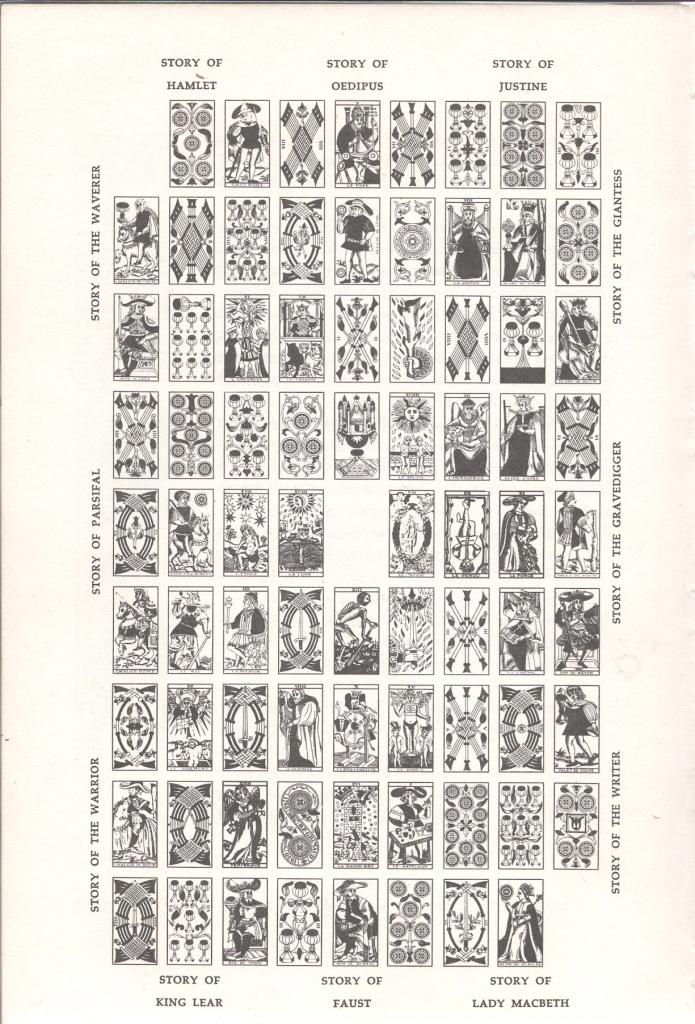
It’s probably either a trope I don’t recognize or a chance convergence of thought but this reminds me much of the notion behind Italo Calvino’s The Castle of Crossed Destinies. Either way, Calvino’s explanation of the formation of that work – in which characters, unable to speak, tell their tales through setting out Tarot cards and are given verbal interpretations by the narrator – is curious enough to deserve quoting. At bottom is an image of how this process played out:

I publish this book to be free of it: it has obsessed me for years. I began by trying to line up tarots at random, to see if I could read a story in them. “The Waverer’s Tale” emerged; I started writing it down; I looked for other combinations of the same cards; I realized the tarots were a machine for constructing stories; I thought of a book, and I imagined its frame: the mute narrators, the forest, the inn; I was tempted by the diabolical idea of conjuring up all the stories that could be contained in a tarot deck.

I thought of constructing a kind of crossword puzzle made of tarots instead of letters, of pictographic stories instead of words. I wanted each of the stories to have a coherent significance, and I wanted them to afford me pleasure in writing them—or in rewriting them, if they were already classic stories…. And so I spent whole days taking apart and putting back together my puzzle; I invented new rules for the game, I drew hundreds of patterns, in a square, a rhomboid, a star design; but some essential cards were always left out, and some superfluous ones were always there in the midst. The patterns became so complicated (they took on a third dimension, becoming cubes, polyhedrons) that I myself was lost in them.

To escape from this impasse I gave up patterns and resumed writing the tales that had already taken shape, not concerning myself with whether or not they would find a place in the network of the others. But I felt that the game had a meaning only if governed by ironclad rules; an established framework of construction was required, conditioning the insertion of one story in the others. Without it, the whole thing was gratuitous.
There was another fact: not all the stories I succeeded in composing visually produced good results when I set myself to writing them down. There were some that sparked no impulse in the writing, and I had to eliminate them because they would have lowered the tension of the style. Then there were others that passed the test and immediately acquired the cohesive strength of the written word which, once written, will not be budged.

Suddenly, I decided to give up, to drop the whole thing; I turned to something else. It was absurd to waste any more time on an operation whose implicit possibilities I had by now explored completely, an operation that made sense only as a theoretical hypothesis. A month went by, perhaps a whole year, and I thought no more about it. Then all of a sudden, it occurred to me that I could try again in a different way, more simple and rapid, with guaranteed success. I began making patterns again, correcting them, complicating them. Again I was trapped in this quicksand, locked in this maniacal obsession. Some nights I woke up and ran to note a decisive correction, which then led to an endless chain of shifts. On other nights I would go to bed relieved at having found the perfect formula; and the next morning, on waking, I would tear it up. Even now, with the book in galleys, I continue to work over it, take it apart, rewrite. I hope that when the volume is printed I will be outside it once and for all. But will this actually happen?

Does it only need an empty purse to make me dream, like so many other people, of the rebirth of humanity?

From Alberto Moravia’s Contempt (Il Disprezzo) (ch 3):

There was another factor which contributed at that time to increase my feeling of anguish and impotence in face of material difficulties. I felt that the metal of my spirit, like a bar of iron that is softened and bent by a persistent flame, was being gradually softened and bent by the troubles that oppressed it. In spite of myself, I was conscious of a feeling of envy for those who did not suffer from such troubles, for the wealthy and the privileged; and this envy, I observed, was accompanied—still against my will—by a feeling of bitterness towards them, which, in turn, did not limit its aim to particular persons or situations, but, as if by an uncontrollable bias, tended to assume the general, abstract character of a whole conception of life. In fact, during those difficult days, I came very gradually to feel that my irritation and my intolerance of poverty were turning into a revolt against injustice, and not only against the injustice which struck at me personally but the injustice from which so many others like me suffered. I was quite aware of this almost imperceptible transformation of my subjective resentments into objective reflections and states of mind, owing to the bent of my thoughts which led always and irresistibly in the same direction: owing also to my conversation, which, without my intending it, always harped upon the same subject. I also noticed in myself a growing sympathy for those political parties which proclaimed their struggle against the evils and infamies of the society to which, in the end, I had attributed the troubles that beset me—a society which, as I thought, in reference to myself, allowed its best sons to languish and protected its worst ones. Usually, and in simpler, less cultivated people, this process occurs without their knowing it, in the dark depths of consciousness where, by a kind of mysterious alchemy, egoism is transmuted into altruism, hatred into love, fear into courage; but to me, accustomed as I was to observing and studying myself, the whole thing was clear and visible, as though I were watching it happen in someone else; and yet I was aware the whole time that I was being swayed by material, subjective factors, that I was transforming purely personal motives into universal reasons. I had never wished to become a member of any political party, as almost everyone did during that uneasy period after the war, just because it seemed to me that I could not take part in politics, as so many did, for personal motives, but only from intellectual conviction, which, however, I had so far lacked; and I was therefore very angry when I felt my ideas, my conversation, my whole demeanor going very gradually adrift on the current of my own interests, slowly changing color according to the difficulties of the moment. “So I’m really just like everyone else,” I thought furiously; “does it only need an empty purse to make me dream, like so many other people, of the rebirth of humanity?”


Un altro fatto contribuì in quel tempo ad accrescere il mio senso di angoscia e di impotenza di fronte alle difficoltà materiali. Simile ad una sbarra di ferro che una fiamma persistente ammollisca e pieghi, sentivo allora che il metallo del mio animo veniva gradualmente ammollito e piegato dalle angustie che l’opprimevano. Mio malgrado, mi rendevo conto di provare invidia per coloro che non soffrivano di queste angustie, per i ricchi e i privilegiati; e all’invidia, sempre mio malgrado, mi accorgevo che si accompagnava il rancore verso di loro, il quale, a sua volta, non si limitava a prendere di mira particolari persone o condizioni, ma, come per un’invincibile inclinazione, tendeva ad assumere il carattere generale ed astratto di una concezione della vita. Insomma, pian piano, attraverso quei giorni difficili, sentivo che la mia irritazione e la mia insofferenza della povertà diventavano rivolta contro l’ingiustizia e non soltanto quella che colpiva la mia persona, ma anche quella di cui soffrivano tanti altri simili a me. Mi rendevo conto di questa insensibile trasformazione dei miei più interessati risentimenti in stati d’animo e riflessioni disinteressate, attraverso la piega dei miei pensieri, che prendevano sempre e irresistibilmente la stessa direzione; attraverso i miei discorsi, che, senza che lo volessi, battevano sempre sullo stesso argomento. Nello stesso tempo, mi accorgevo di provare una simpatia crescente per quei partiti politici che proclamavano di lottare contro i mali e le storture di quella stessa società alla quale io avevo finito per attribuire le angustie di cui soffrivo: una società, come pensavo con riferimento a me stesso, che lasciava languire i suoi figli migliori e proteggeva i peggiori. Tutto questo, di solito, nelle persone più semplici e incolte, avviene inconsapevolmente, in quel fondo oscuro della coscienza in cui, per una specie di misteriosa alchimia, l’egoismo si trasforma in altruismo, l’odio in amore, la paura in coraggio; ma a me, avvezzo a sorvegliarmi e a studiarmi, questo processo era chiaro e visibile, come se l’avessi seguito in un altro; e però mi rendevo conto tutto il tempo di ubbidire a determinazioni materiali e interessate, di trasformare in ragioni universali motivi meramente personali. Io non avevo mai voluto iscrivermi ad alcun partito, come facevano quasi tutti in quel tempo inquieto del dopoguerra, appunto perché mi sembrava di non poter far della politica, come tanti, per motivi personali, bensì soltanto per una convinzione di pensiero, che, tuttavia, mi era sinora mancata; e perciò molto mi indispettiva di sentire le mie idee, i miei discorsi, il mio contegno andare insensibilmente alla deriva sulla corrente dei miei interessi, cambiare pian piano colore secondo le difficoltà del momento. “Sono dunque fatto alla maniera di tutti quanti”, pensavo con rabbia, “mi basta, come a tanti, di aver la borsa vuota per sognare la palingenesi dell’umanità?”

And in days of yore it was the saying in Gaul that the soldier’s best friend was Madame Marauding

From Anatole France’s At the Sign of The Reine Pédauque (La Rôtisserie de la reine Pédauque).

“Well then,” M. d’Anquetil continued, “whatever may be printed of it in the gazettes, war consists, above all things, of stealing the pigs and chickens of peasants. Soldiers in the fields have no other occupation.”

“You are right,” said M. Coignard, “and in days of yore it was the saying in Gaul that the soldier’s best friend was Madame Marauding.


—Eh bien! reprit M. d’Anquetil, quoi que disent les gazettes, la guerre consiste uniquement à voler des poules et des cochons aux vilains. Les soldats en campagne ne sont occupés que de ce soin.

—Vous avez bien raison, dit mon bon maître, et l’on disait jadis en Gaule que la bonne amie du soldat était madame la Picorée.

As best I can trace it, the Madame Marauding/madame la Picorée witticism makes its first appearance in the 16th century memoirs of François de la Noue which cover the early wars of religion. In his description of the 1562 fall of Boisgency (modern Beaugency, I think) and the cruelty of the soldiers towards the inhabitants he says:

…So our infantry lost its virginity and from this illegitimate conjunction followed the conception of Madamoiselle La Picorée, who has since so increased in dignity that we now call here Madame. And if the civil war continues on, I have no doubt that she will become a Princess.


The passage and full text are here on google books

‘For once I admire your mise en Seine,’ Keats said.

What better return from a holiday than Flann O’Brien. These are from The Various Lives of Keats and Chapman, a selection of stories from his Cruiskeen Lawn column in the Irish Times. The Keats and Chapman tales are all more or less elaborate setups to more or less terrible puns.

ON TOUR IN FRANCE
Chapman once went theatre-mad and started a small fit-up company with which he toured France playing Molière. Keats disapproved of this affectation but went along to take in the money. One night the company was scheduled to perform in a small village a few miles upriver from Paris, where Chapman’s small stock of execrable scenery had to be conveyed by barge. There was a frightful accident at the landing stage, all the stuff falling into the water. Chapman burst into tears.

‘For once I admire your mise en Seine,’ Keats said.


STRADIVARIUS
Keats was once presented with an Irish terrier, which he humorously named Byrne. One day the beast strayed from the house and failed to return at night Everybody was distressed, save Keats himself. He reached reflectively for his violin, a fairly passable timber of the Stradivarius feciture, and was soon at work with wrist and jaw.

Chapman, looking in for an after-supper pipe, was astonished at the poet’s composure, and did not hesitate to say so. Keats smiled (in a way that was rather lovely).

‘And why should I not fiddle,’ he asked, ‘While Byrne roams?’


IN THE COFFIN
Keats and Chapman were conversing one day on the street, and what they were conversing about I could not tell you. But anyway there passed a certain character who was renowned far and wide for his piety, and who was reputed to have already made his own coffin, erected it on trestles, and slept in it every night,

‘Did you see our friend?’ Keats said,

‘Yes,’ said Chapman, wondering what was coming.

‘A terrible man for his bier,’ the poet said.

All this is very vieux jeu

From Rose Macaulay’s Told By An Idiot:

Such are time’s revenges that the so daring social, literary and intellectual cleavages made by our forefathers in those years are now regarded as quaintly old-fashioned compromises with freedom, even as our own audacities will doubtless be regarded thirty years hence. But the people of the [eighteen] nineties, even as the people of the eighties, seventies, sixties, and so back, and even as the people of the twentieth century, thought they were emancipating themselves from tradition, saw themselves as bold buccaneers sailing uncharted seas, and found it great fun. The illusion of advance is sustaining, to all right-minded persons, and should by all means be cultivated. It gives self-confidence and poise. It even seems to please elderly persons to mark or fancy changes of habit, which they have no wish to emulate, among their juniors, and it certainly pleases their juniors to be thus remarked upon, for they, too, believe that they are something new—the new young, as they have always delighted to call themselves—so all are pleased and no harm is done.

And shortly before:

“Well, your grandfather thinks even Una is too modern. It’s the golf and bicycling and [dropping her] g’s, I suppose. I expect the fact is that it’s difficult, in these days, to avoid being new. You children and your friends all are. In fact, the whole world seems to be.”

“The world is always new, mamma darling, and always old. It’s no newer than it was in 1880, or 1870—in fact, not so new, by some years. The only year in which it was really new was, according to grandpapa and the annotators of the Book of Genesis, 4004 B.C.”

“Yes, I dare say it was sadly new then, and no doubt grandpapa would have found it so. But somehow one hears the word a good deal just now, used by young people as well as old. What with new women, and new art, and new literature, and new humour, and the new hedonism that Denman and Stanley talk about, and that seems to mean making your drawing-room like an old curiosity shop and burning incense in it and lighting it with darkened crimson lamps and lying on divans with black and gold cushions and smoking scented cigarettes and reading improper plays aloud . . . Only Rome says that isn’t new in the least, but thousands of years old.”

“Oh, Rome. Rome thinks nothing new. She was born blasée. She hasn’t got grandpapa’s or Stanley’s fresh mind. She always expects the unexpected. Oscar Wilde says that to do that shows a thoroughly modern mind. If Rome had been Eve, she’d have looked at the new world through a monocle (she’d have worn that, even if nothing else) and seen that it was stale, and said with a yawn, ‘All this is very vieux jeu.’”

“And very possibly,” said mamma, “it was.”

I do wonder if Macaulay’s judgment on the illusion of advance – ‘all are pleased and no harm is done’ – would remain the same today.

In this way the reader does not have to begin the book near a given cover and finish it at a point nearer the opposite cover.

From the prologue to Felipe Alfau’s Locos: A Comedy of Gestures. I’d heard of this for years but disappointingly found it one of those cult-following books more interesting for its place in the history of experimental technique (written in 1928) than enjoyable for its content. The conception laid out below is so promising but the enactment falls short of similar experiments in Unamuno’s Niebla (Fog) from ~15 years earlier, Pirandello’s Sei Personnagi in Cerca d’Autore (Six Characters in Search of An Author) from ~5 years earlier, and Flann O’Brien’s At Swim-Two-Birds from ~10 years later.

This . . . novel is written in short stories with the purpose of facilitating the task of the reader. In this way the reader does not have to begin the book near a given cover and finish it at a point nearer the opposite cover. Each chapter being a complete story in itself, the reader may pick up this book and begin it at the back and end it at the front, or he may begin it and end it in the middle, depending on his mood. In other words, he can read it in any fashion except, perhaps, upside down.

However, for the benefit of those in whom the habit of reading a book in the usual manner is deeply set and painful to eradicate, the pages have been numbered clearly and the stories arranged less clearly in a conventional order which my friend. Dr. José de los Rios, and myself have found somewhat adequate.

Aside from this superficial arrangement, I am not entirely to blame for committing this novel; the characters used in it being, I believe, far more responsible than myself.

For some time I have been realizing more and more clearly the way which characters have of growing independent, of rebelling against their creator’s will and command, of mocking their author, of toying with him, dragging him through some unsuspected and grotesque path all their own, often entirely contrary to that which the author has planned for them. This tendency is so marked in my characters that it makes my work most difficult and places me in many a predicament.
…..
The result of this is a bunch of contradictory characters inconsequent as their author and just as clumsy in their performance. As their personality is a passing and unsteady thing that lasts at most a book’s length, they have lost respect for it and change it at will, because they have a faint idea that life is abrupt and unexpected.

Their knowledge of reality is vague and imprecise. Sometimes I have given a character the part of a brother or a son, and in the middle of the action he begins to make love to his sister or his mother, because he has heard that men sometimes make love to women. Another character appears as a child in a situation that takes place when he should be a mature man, because he attributes his persistent failure to understand the situation to immaturity typical of childhood. Again, another character, who has the part of a chicken, begins to bark in the middle of her lines, because she has seen a dog she likes. Time and space do not exist for these people, and that naturally ruins my work completely.

By the end of this book my characters are no longer a tool for my expression, but I am a helpless instrument of their whims and absurd contretemps.