It was wrong, this idea that you know someone better because you have shared a bed and a bathroom

From early in John O’Hara’s Appointment in Samarra, what feels somehow a very Musil-esque observation.

He stood at the table, looking down at the handkerchief case and stud box, and was afraid. Upstairs was a girl who was a person. That he loved her seemed unimportant compared to what she was. He only loved her, which really made him a lot less than a friend or an acquaintance. Other people saw her and talked to her when she was herself, her great, important self. It was wrong, this idea that you know someone better because you have shared a bed and a bathroom with her. He knew, and not another human being knew, that she cried “I” or “high” in moments of great ecstasy. He knew, he alone knew her when she let herself go, when she herself was not sure whether she was wildly gay or wildly sad, but one and the other. But that did not mean that he knew her. Far from it. It only meant that he was closer to her when he was close, but (and this was the first time the thought had come to him) maybe farther away than anyone else when he was not close. It certainly looked that way now. “Oh, I’m a son of a bitch,” he said.

He didn’t have any use for history because he never expected to meet it again

From A Late Encounter with the Enemy in Flannery O’Connor’s A Good Man is Hard to Find.

She meant to stand on that platform in August with the General sitting in his wheel chair on the stage behind her and she meant to hold her head very high as if she were saying, “See him! See him! My kin, all you upstarts! Glorious upright old man standing for the old traditions! Dignity! Honor! Courage! See him!” One night in her sleep she screamed, “See him! See him!” and turned her head and found him sitting in his wheel chair behind her with a terrible expression on his face and with all his clothes off except the general’s hat and she had waked up and had not dared to go back to sleep again that night.

For his part, the General would not have consented even to attend her graduation if she had not promised to see to it that he sit on the stage. He liked to sit on any stage. He considered that he was still a very handsome man. When he had been able to stand up, he had measured five feet four inches of pure game cock. He had white hair that reached to his shoulders behind and he would not wear teeth because he thought his profile was more striking without them. When he put on his full-dress general’s uniform, he knew well enough that there was nothing to match him anywhere.

This was not the same uniform he had worn in the War between the States. He had not actually been a general in that war. He had probably been a foot soldier; he didn’t remember what he had been; in fact, he didn’t remember that war at all. It was like his feet, which hung down now shriveled at the very end of him, without feeling, covered with a blue-gray afghan that Sally Poker had crocheted when she was a little girl. He didn’t remember the Spanish-American War in which he had lost a son; he didn’t even remember the son. He didn’t have any use for history because he never expected to meet it again. To his mind, history was connected with processions and life with parades and he liked parades.

So he can feel again the gorgeous clarity, the lightning sanity of those four fists.

From The Four Fists in F. Scott Fitzgerald’s Flappers and Philosophers. This being the conclusion of the story, there’s something in the way of a spoiler so the (very brief) full tale can be read here instead.

The setup is a charmingly simple morality tale where a man’s social and moral failings always earn him a punch when manifested. Each punch yields a life-reforming reflection and he goes forward a better man, having shed another bad quality.

I suppose that there’s a caddish streak in every man that runs crosswise across his character and disposition and general outlook. With some men it’s secret and we never know it’s there until they strike us in the dark one night. But Samuel’s showed when it was in action, and the sight of it made people see red. He was rather lucky in that, because every time his little devil came up it met a reception that sent it scurrying down below in a sickly, feeble condition. It was the same devil, the same streak that made him order Gilly’s friends off the bed, that made him go inside Marjorie’s house.

If you could run your hand along Samuel Meredith’s jaw you’d feel a lump. He admits he’s never been sure which fist left it there, but he wouldn’t lose it for anything. He says there’s no cad like an old cad, and that sometimes just before making a decision, it’s a great help to stroke his chin. The reporters call it a nervous characteristic, but it’s not that. It’s so he can feel again the gorgeous clarity, the lightning sanity of those four fists.

I’ll tattoo on your head the great and shameless stone which even in Hades hangs above the head of Tantalus

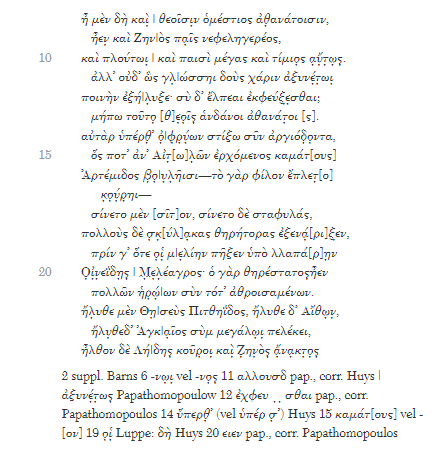
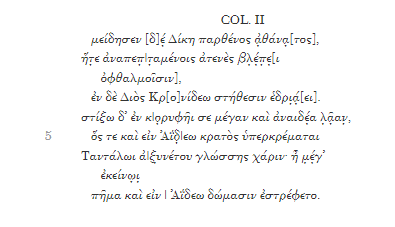
Dubiously attributed to Hermesianax, this passage is the better preserved half of a papyrus fragment containing a curse poem – the curse here being a threat to tattoo (στίξω) on the offender a series of representative reminders of select mytho-historical punishments. The text is from the Loeb Hellenistic Collection. The volume also contains bibliography on the (slim, to me) arguments for assigning the poem to Hermesianax.

Justice, immortal maiden, gave a smile,
Who watches fixedly with open eyes,
And lodges in the breast of Cronian Zeus.
I’ll tattoo on your head the great and shameless stone
Which even in Hades hangs above the head
Of Tantalus for his foolish tongue; in truth, a great
Woe overhung him even in Hades’ halls.
Indeed, he feasted with the immortal gods,
And was the son of cloud-gathering Zeus,
Both rich in wealth, and sons, and honoured too.
Yet, giving licence to his foolish tongue, even so
He could not sidestep punishment; and you hope to flee?
May this never be pleasing to the immortal gods.
I’ll tattoo above your brows a white-tusked boar,
Which once, falling upon the Aetolians’ toils,
At Artemis’ command—it was her will—
Ravaged their standing crops, ravaged their vines,
Slew many hunting dogs, until there fixed
His ashen spear beneath the monster’s jowls
Oeneus’ son, Meleager, best of those
Many heroes then assembled for the hunt.
There came Theseus from Pittheus, came Aithon,
Came Ancaeus with a colossal axe,
Came the sons of Leda and of sovereign Zeus.

WordPress cannot handle transposing conjectural readings so the Greek must be through snips.

And, O my son, be, on the one hand, good, / And do not, on the other hand, be bad;

I’ve been reading Luis de Gongora‘s The Solitudes (Las Soledades) the last couple of days and, without intending mockery, can’t shake treating the whole thing in the vein of A.E. Housman’s parodic sendup of ancient tragedy, Fragment of a Greek Tragedy.

The setup here is that Alcmaeon has been ordered by his father Amphiarus to kill his mother Eriphyle. Amphiarus had earlier discovered that Eriphyle had accepted a bribe to urge him into the campaign against Thebes (of Seven Against Thebes fame) where he, being a prophet, knew he was doomed to die.

Most of the lines are either borrowed from or heavily modeled on surviving tragedy. My title is, I think, a pained reflection of Housman’s dealing with how students insist on translating μέν … δέ constructions.

Chorus. O suitably-attired-in-leather-boots
Head of a traveller, wherefore seeking whom
Whence by what way how purposed are you come
To this well-nightingaled vicinity?
My object in enquiring is to know.
But if you happen to be deaf and dumb
And do not understand a word I say,
Nod with your hand to signify as much.
Alcmaeion. I journeyed hither a Boeotian road.
Cho. Sailing on horseback or with feet for oars?
Alc. Plying by turns my partnership of legs.
Cho. Beneath a shining or a rainy Zeus?
Alc. Mud’s sister, not himself, adorns my legs.
Cho. To learn your name would not displease me much.
Alc. Not all that men desire do they obtain.
Cho. Might I then hear at what your presence shoots?
Alc. A shepherd’s questioned mouth informed me that –
Cho. What? for I know not yet what you will say.
Alc. Nor will you ever, if you interrupt.
Cho. Proceed, and I will hold my speechless tongue.
Alc. – this house was Eriphyla’s, no one’s else.
Cho. Nor did he shame his throat with hateful lies.
Alc. Might I then enter, passing through the door?
Cho. Go, chase into the house a lucky foot.
And, O my son, be, on the one hand, good,
And do not, on the other hand, be bad;
For that is very much the safest plan.
Alc. I go into the house with heels and speed.

CHORUS

In speculation
I would not willingly acquire a name
For ill-digested thought,
But, after pondering much,
To this conclusion I at last have come:
Life is uncertain.
This truth I have written deep
In my reflective midriff,
On tablets not of wax.
Nor with a pen did I inscribe it there
For many reasons: Life, I say, is not
A stranger to uncertainty.
Not from the flight of omen-yelling fowls
This fact did I discover,
Nor did the Delphic tripod bark it out,
Nor yet Dodona.
Its native ingenuity sufficed
My self-taught diaphragm.

Why should I mention
The Inachian daughter, loved of Zeus,
Her whom of old the gods,
More provident than kind,
Provided with four hoofs, two horns, one tail,
A gift not asked for:
And sent her forth to learn
The unfamiliar science
Of how to chew the cud?
She, therefore, all about the Argive fields,
Went cropping pale green grass and nettle-tops,
Nor did they disagree with her.
Yet, howso’er nutritious, such repasts,
I do not hanker after.
Never may Cypris for her seat select
My dappled liver!
Why should I mention lo? Why indeed?
I have no notion why.

But now does my boding heart
Unhired, unaccompanied, sing
A strain not meet for the dance.
Yea, even the palace appears
To my yoke of circular eyes
(The right, nor omit I the left)
Like a slaughterhouse, so to speak,
Garnished with woolly deaths
And many shipwrecks of cows.

I therefore in a Cissian strain lament,
And to the rapid,
Loud, linen-tattering thumps upon my chest
Resounds in concert
The battering of my unlucky head.

Eriphyla (within). O, I am smitten with a hatchet’s jaw;
And that in deed and not in word alone.
Cho. I thought I heard a sound within the house
Unlike the voice of one that jumps for joy.
Erip. He splits my skull, not in a friendly way,
Once more: he purposes to kill me dead.
Cho. I would not be reputed rash, but yet
I doubt if all be gay within the house.
Erip. O! O! another stroke! That makes the third.
He stabs me to the heart against my wish.
Cho. If that be so, thy state of health is poor;
But thine arithmetic is quite correct.

What were they but dew from the meadows?

From Jorge Manrique‘s Verses on the Death of His Father (Coplas por la muerte de su padre). For all its fame in Spanish literature, this work seems sadly unattended to by English translators. The two verse renderings I can find are an old Longfellow that, borrowing a phrase from Sarah Caudwell, is more than a bit ’emancipated’ and a more recent online-only version by Alan Steinle. There’s also a prose by J.M. Cohen in The Penguin Book of Spanish Verse that I’ve not been able to check yet.

Here are the three opening stanzas from Steinle’s version plus the XIX since it has my favorite line of the poem. Steinle’s full version – from which I’ve also lifted this lovely side-by-side formatting – is available here. And Longfellow is here for comparison.

I.I.
Recuerde el alma dormida,Arouse your sleeping soul,
avive el seso y despierteRevive your brain, wake up
__contemplando__And you will see
cómo se pasa la vida,How life goes by so fast,
cómo se viene la muerteHow death creeps up on us
__tan callando;__So quietly;
cuán presto se va el placer,How pleasures quickly fade,
cómo después de acordadoAnd when we think of them
__da dolor,__We feel malaise;
cómo a nuestro parecer,How always it appears
cualquiera tiempo pasadoThat former times comprised
__fue mejor.__Much better days.
II.II.
Pues si vemos lo presenteThe present times will go
cómo en un punto se es idoWithin a second’s tick,
__y acabado,__An hour’s chimes,
si juzgamos sabiamente,And if we judge with sense,
daremos lo no venidoThe future will be seen
__por pasado.__Like former times;
No se engañe nadie, no,So do not be deceived;
pensando que ha de durarDon’t think that future things
__lo que espera__Will come to stay;
más que duró lo que vio,Those things will not endure;
pues que todo ha de pasarThey all must disappear
__por tal manera.__The selfsame way.
III.III.
Nuestras vidas son los ríosOur lives are like the streams
que van a dar en la mar,That flow into the sea
__que es el morir:__And terminate;
allí van los señoríos,That’s where the manors go—
derechos a se acabarThey meet their end and they
__y consumir;__Disintegrate;
allí los ríos caudales;Just as the rivers large,
allí los otros medianosThe medium and small
__y más chicos,__Go to the sea,
y llegados son iguales,We all arrive as one,
los que viven por sus manosAs workers in the field
__y los ricos.__Or rich and free.
XIX.XIX.
Las dádivas desmedidas,The boundless gifts of men,
los edificios realesThe royal palaces
__llenos de oro,__So full of gold;
las vajillas tan fabridas,The shiny cups and bowls,
los enriques y realesThe golden coins and all
__del tesoro,__The wealth untold;
los jaeces y caballosThe trappings of the steeds,
de su gente, y atavíosThe people’s finery
__tan sobrados,__All unconcealed—
¿dónde iremos a buscallos?Where can we find them now?
¿qué fueron sino rocíosWhat were they but the dew
__de los prados?__In yonder field?

A fragment of Hermesianax

The opening third of a fragment from book 3 of Leontion by the Hellenistic poet Hermesianax. The full passage is nearly 100 lines long and only survives thanks to Athenaeus’ quoting it at Deipnosophistae 13.597 (though this text and translation are from the Loeb Hellenistic Collection). This book of the work is what Athenaeus describes as a κατάλογον … ἐρωτικῶν – a catalogue of love affairs. Some of these will be sillier to ponder than others.

Such as Oeagrus’ dear son [Orpheus] summoned back
From Hades, furnished with his lyre: Agriope [= Eurydice]
Of Thrace. He sailed to that implacable, harsh place
Where Charon draws into his public craft
Departed souls, and cries across the lake
That pours its stream through beds of lofty reed.
That lone musician Orpheus suffered much
Beside the wave, but won the various gods;
Lawless Cocytus with his menacing scowl
And the dread regard of Cerberus he withstood,
His voice sharpened in fire, in fire his cruel eye,
On triple rank of heads freighted with fear.
With song he won the underworld’s great lords,
For Agriope to regain the gentle breath of life.

Nor did the Graces’ master, Mene’s son,
Musaeus, leave Antiope unsung,
Who, to the adepts by Eleusis’ strand,
Expressed glad cries from secret oracles,
Leading Demeter’s Rarian celebrant
With ordered step; in Hades still she’s known.

And I say that even Boeotian Hesiod
Lord of all knowledge, left his home and came,
In love, to Ascra, Heliconian town;
And, wooing Eoie, Ascraean maid,
He suffered much, composed whole catalogues
In homage, with the girl heading the list.

The very bard, whom Zeus’ fate upholds
Sweetest divinity of all versed in song,
The godlike Homer set mean Ithaca
To verse for love of wise Penelope.
Smarting for her, he settled in a tiny isle,
Leaving his own broad homeland far behind;
And hymned Icarius’ race, Amyclas’ town
And Sparta, touching on his own distress.


οἵην μὲν φίλος υἱὸς ἀνήγαγεν Οἰάγροιο
Ἀγριόπην Θρῇσσαν στειλάμενος κιθάρην
Ἁιδόθεν· ἔπλευσεν δὲ κακὸν καὶ ἀπειθέα χῶρον,
ἔνθα Χάρων κοινὴν ἕλκεται εἰς ἄκατον
ψυχὰς οἰχομένων, λίμνης δ᾿ ἐπὶ μακρὸν ἀυτεῖ
ῥεῦμα διὲκ μεγάλων χευομένης δονάκων.
πόλλ᾿ ἔτλη παρὰ κῦμα μονόζωστος κιθαρίζων
Ὀρφεύς, παντοίους δ᾿ ἐξανέπεισε θεούς·
Κωκυτόν τ᾿ ἀθέμιστον ὑπ᾿ ὀφρύσι μηνίσαντα
ἠδὲ καὶ αἰνοτάτου βλέμμ᾿ ὑπέμεινε κυνός,
ἐν πυρὶ μὲν φωνὴν τεθοωμένου, ἐν πυρὶ δ᾿ ὄμμα
σκληρὸν, τριστοίχοις δεῖμα φέρον κεφαλαῖς.
ἔνθεν ἀοιδιάων μεγάλους ἀνέπεισεν ἄνακτας
Ἀγριόπην μαλακοῦ πνεῦμα λαβεῖν βιότου.

οὐ μὴν οὐδ᾿ υἱὸς Μήνης ἀγέραστον ἔθηκεν
Μουσαῖος, Χαρίτων ἤρανος, Ἀντιόπην·
ἥ τε πολὺν μύστῃσιν Ἐλευσῖνος παρὰ πέζαν
εὐασμὸν κρυφίων ἐξεφόρει λογίων,
Ῥάριον ὀργειῶνα νόμῳ διαπομπεύουσα
Δημήτρᾳ· γνωστὴ δ᾿ ἐστὶ καὶ εἰν Ἀίδῃ.

φημὶ δὲ καὶ Βοιωτὸν ἀποπρολιπόντα μέλαθρα
Ἡσίοδον, πάσης ἤρανον ἱστορίης,
Ἀσκραίων ἐσικέσθαι ἐρῶνθ᾿ Ἑλικωνίδα κώμην·
ἔνθεν ὅ γ᾿ Ἠοίην μνώμενος Ἀσκραϊκὴν
πόλλ᾿ ἔπαθεν, πάσας δὲ λόγων ἀνεγράψατο βίβλους
ὑμνῶν, ἐκ πρώτης παιδὸς ἀνερχόμενος.

αὐτὸς δ᾿ οὗτος ἀοιδός, ὃν ἐκ Διὸς αἶσα φυλάσσει
ἥδιστον πάντων δαίμονα μουσοπόλων,
λεπτὴν ᾗς Ἰθάκην ἐνετείνατο θεῖος Ὅμηρος
ᾠδῇσιν πινυτῆς εἵνεκα Πηνελόπης·
ἣν διὰ πολλὰ παθὼν ὀλίγην ἐσενάσσατο νῆσον,
πολλὸν ἀπ᾿ εὐρείης λειπόμενος πατρίδος·
ἔκλεε δ᾿ Ἰκαρίου τε γένος καὶ δῆμον Ἀμύκλου
καὶ Σπάρτην, ἰδίων ἁπτόμενος παθέων.
They have taken me from a place where there was gin to a place where there is no gin

From Sarah Caudwell‘s Thus Was Adonis Murdered, the first of her four Hilary Tamar mysteries. This post’s title phrase has echoed in me for years as a means of capturing declined situations.

Heathrow Airport.
Thursday afternoon.

Dearest Selena,

“Twelve adulteries, nine liaisons, sixty-four fornications and something approaching a rape” are required of me for your innocent entertainment. Well, you will have to be patient—the aeroplane is not designed to accommodate such adventures. I am beginning, however, as I mean to go on, and in accordance with your own instructions—that is to say, with an exactly contemporaneous account of everything that happens.

It occurs to me that to abide literally by this resolution may have a slightly inhibiting effect on the adulteries, liaisons, etc. In certain circumstances, therefore, I shall hope, as regards precise contemporaneity, for a measure of indulgence—which, since you are the most reasonable of women, I do not doubt to receive.

It is about an hour and a half since you left me at the airport. Things, since you left, have not gone well with me: they have taken me from a place where there was gin to a place where there is no gin, and from a place where I could smoke to a place where I cannot smoke. That is to say, from the departure lounge to the aeroplane. They have also taken my passport.

….

And it’s no use your saying, Selena, that I am a British subject and they can’t do that to me. They have done. It began with a difference of opinion about my suitcase; I had thought it was hand luggage, which I could keep with me; the stewardess, at the last moment, decided that it was not. Deferring to the expert view, I handed it over, and she pushed it down a sort of chute. Only as it slid, with irreversible momentum, into the bowels of the aircraft, did I remember that my passport is in the side pocket. I shall not see my passport again until I get my luggage back: which will be, if my memory of airport procedure is not at fault, on the other side of the Passport Control Barrier. We have the makings of an impasse.

Too late, too late, Selena, I recall your as always excellent advice, to keep my passport at all times in my handbag. Together with such other essential documents as my ticket, my traveller’s cheques, my Italian phrasebook, Ragwort’s Guide to Venice and my copy of this year’s Finance Act. Will any of these, do you think, be accepted as proof of my identity? Or am I doomed to be shuffled for ever between Venice and London, with occasional diversions, on account of administrative error, to Ankara and Bangkok?

A flame in his burning mouth can be suppressed more easily by a wise man than he can hold back witticisms

Another line from an unidentified tragedy of Ennius, reported by Cicero in De Oratore (2.221):

what is extremely difficult for funny and sharp-tongued men is to take account of people and circumstances and to forego opportunities that arise when something could be said most wittily. And so some humorous men explain this very point not inelegantly. For they say that Ennius says that “a flame in his burning mouth can be suppressed more easily by a wise man than he can hold back witticisms”…


quod est hominibus facetis et dicacibus difficillimum, habere hominum rationem et temporum et ea quae occurrant, cum salsissime dici possunt, tenere. itaque nonnulli ridiculi homines hoc ipsum non insulse interpretantur. dicere enim aiunt Ennium, “flammam a sapiente facilius ore in ardente opprimi, quam bona dicta teneat”…

Philosophandum est, paucis; nam omnino haud placet

Reported by Aulus Gellius (5.15.9) and from an unidentified tragedy of Ennius – though speculation seems to lean toward Andromache.

When we heard or read these and other similar stimuli to clever and delightful inactivity and did not see in these philosophical problems either some genuine advantage referring to the conduct of life or any purpose to the inquiry, we approved of the Ennian Neoptolemus, who indeed spoke thus:

one must do philosophy, but in moderation; for it does not please completely


hos aliosque talis argutae delectabilisque desidiae aculeos cum audiremus vel lectitaremus neque in his scrupulis aut emolumentum aliquod solidum ad rationem vitae pertinens aut finem ullum quaerendi videremus, Ennianum Neoptolemum probabamus, qui profecto ita ait:

philosophandum est, paucis; nam omnino haud placet

Reminded me of the Proustian Often but a little at a time.