Heaven opened to a soul while yet on earth, Earth forced on a soul’s use while seeing heaven

From Robert Browning’s An Epistle Containing the Strange Medical Experience of Karshish, The Arab Physician, in his Men and Women. The full poem – an outsider’s account of encountering Lazarus long after his resurrection – is online here.

Not terribly related but John Ruskin made amusing mention of this one in a letter to Browning about the collection – “I can’t say I have really made out any one yet … except the epistle from the Arabian physician, which I like immensely.”

This grown man eyes the world now like a child.
Some elders of his tribe, I should premise,
Led in their friend, obedient as a sheep,
To bear my inquisition. While they spoke, 120
Now sharply, now with sorrow, told the case,
He listened not except I spoke to him,
But folded his two hands and let them talk,
Watching the flies that buzzed: and yet no fool.
And that’s a sample how his years must go.
Look, if a beggar, in fixed middle-life,
Should find a treasure, can he use the same
With straitened habits and with tastes starved small,
And take at once to his impoverished brain
The sudden element that changes things, 130
That sets the undreamed-of rapture at his hand
And puts the cheap old joy in the scorned dust?
Is he not such an one as moves to mirth—
Warily parsimonious, when no need,
Wasteful as drunkenness at undue times?
All prudent counsel as to what befits
The golden mean, is lost on such an one:
The man’s fantastic will is the man’s law.
So here—we call the treasure knowledge, say,
Increased beyond the fleshly faculty— 140
Heaven opened to a soul while yet on earth,
Earth forced on a soul’s use while seeing heaven:
The man is witless of the size, the sum,
The value in proportion of all things,
Or whether it be little or be much.
Discourse to him of prodigious armaments
Assembled to besiege his city now,
And of the passing of a mule with gourds—
‘T is one! Then take it on the other side,
Speak of some trifling fact, he will gaze rapt 150
With stupor at its very littleness,
(Far as I see) as if in that indeed
He caught prodigious import, whole results;
And so will turn to us the bystanders
In ever the same stupor (note this point)
That we too see not with his opened eyes.
Wonder and doubt come wrongly into play,
Preposterously, at cross purposes.
Should his child sicken unto death, why, look
For scarce abatement of his cheerfulness, 160
Or pretermission of the daily craft!
While a word, gesture, glance from that same child
At play or in the school or laid asleep,
Will startle him to an agony of fear,
Exasperation, just as like. Demand
The reason why—”‘t is but a word,” object—
“A gesture”—he regards thee as our lord
Who lived there in the pyramid alone,
Looked at us (dost thou mind?) when, being young,
We both would unadvisedly recite 170
Some charm’s beginning, from that book of his,
Able to bid the sun throb wide and burst
All into stars, as suns grown old are wont.
Thou and the child have each a veil alike
Thrown o’er your heads, from under which ye both
Stretch your blind hands and trifle with a match
Over a mine of Greek fire, did ye know!
He holds on firmly to some thread of life—
(It is the life to lead perforcedly)
Which runs across some vast distracting orb 180
Of glory on either side that meagre thread,
Which, conscious of, he must not enter yet—
The spiritual life around the earthly life:
The law of that is known to him as this,
His heart and brain move there, his feet stay here.
So is the man perplext with impulses
Sudden to start off crosswise, not straight on,
Proclaiming what is right and wrong across,
And not along, this black thread through the blaze—
“It should be” balked by “here it cannot be.” 190
And oft the man’s soul springs into his face
As if he saw again and heard again
His sage that bade him “Rise” and he did rise.
Something, a word, a tick o’ the blood within
Admonishes: then back he sinks at once
To ashes, who was very fire before,
In sedulous recurrence to his trade
Whereby he earneth him the daily bread;
And studiously the humbler for that pride,
Professedly the faultier that he knows 200
God’s secret, while he holds the thread of life.

Libels, On Pope; Curll & Company; Libels on Swift & Pope

From the intro to the Twickenham edition of The Dunciad, on who was responsible for the notes added to the 1729 Dunciad Variorum

When allowance has been made for all such assistance, there still seems good reason to believe that Pope wrote the greater part of the notes himself, compiled the Testimonies of Authors, the List of Books and Papers, the Parallel of the Characters of Mr Dryden and Mr Pope, and the Index of Things (including Authors). For one thing, he was the only person likely to have in his possession the information on which many of the statements were based. For years he had been carefully collecting the various printed attacks upon him. He had even got Tonson to bind them together in six volumes, labelled “Curll and Company,” “Libels on Pope,” etc. The volumes are still in existence*; and it is significant that Pope had underlined and occasionally annotated the more outrageous statements of Dennis, Curll, and the rest, as if he intended to make some reply.

*In the British Museum, C 116 b 1-4, and Victoria and Albert Museum

These volumes of annotated libels being the sort of eccentric document that fascinates me, I went looking for more info. They do still exist, though they are (now) held by the British Library (record here). There are no scans (that I can find) and that record is so minimal that it leaves me with some confusion on volumes – Sutherland above says six but the reference number (C.116.b.1-4) would suggest four. The latter is supported by a helpful note from an F.G. in an 1879 issue of Notes and Queries (scanned here):

Pope himself had a collection of [attacks on him] bound up in four volumes. Two of these volumes, in 8vo., were lettered “ Libels upon Pope. Vols. I. and II. Another volume of 12mo. pamphlets was lettered Curll and Company, and the fourth volume Libels on Swift and Pope.

(The author also includes a footnote – ‘Do these volumes still exist?’ I hope this earlier fellow traveler found his answer eventually.)

Final confirmation of volumes and titles comes from a letter of Pope’s to the Tonson mentioned above (presumably this letter is what Sutherland had in evidence for his statement but he doesn’t cite it). The Tonson concerned here is Jacob Tonson junior, not his more famous uncle Jacob Tonson senior. Both were booksellers and publishers with ongoing relationships with Pope and in 1733/34 Pope sent Tonson Jr. the following (Sherburn’s edition of Pope’s Correspondence, v.3 399 – and a small victory to me in that citation since my wife questioned when I’d ever use this set when I bought it a few weeks back):

Sir, — I desire you’l take these five Setts of the Odyssey, & do what you can with ’em.

I desire also you’l cause the Pacquet I send, to be bound together, as many in a volume as are tyed together. Let the Octavo be made to match in colour & Size this which is already bound, & Letter it LIBELS, ON POPE &c. Vol. 2d

Pray Bind the duodecimos also in another vol. the same colour, Letterd CURL[L] & COMPANY

And Bind the Gulliveriana, & letter it (Same Colour) thus, LIBELS ON SWIFT & POPE

So one problem solved – though an editor’s footnote opens another question – “Since the latest pamphlet included is dated 1733, one assumes that the binding was done currently – especially since Tonson is asked to find a perfect copy of one of the items.” Assuming that the dating of the letter is correct, Pope couldn’t have used the volumes as such in compiling the Variorum notes since he would only have had the several ‘pacquets’ to work with. It’s a small distinction but somehow cuts into the jest of the idea for me.

As to contents, the list of all the bound pamphlets is presumably contained in the Pope’s second appendix to the Dunciad A List of Books, Papers, and Verses, in which our Author was abused, printed before the Publication of the Dunciad: With the true Names of the Authors (with later editions expanding to include an After the Dunciad section). A scan of the Twickenham edition with its helpful notes can be found here (starting pg 207 of the text, 268 of the scan). I have not yet attempted to find any of these sources but I expect the sensible route would be first searching out scholarship on contemporary responses to Pope or The Dunciad and hoping for lengthy quotes there. But none of this helps with my initial hope of finding Pope’s hand annotations to any of the criticism so I have no recourse left but a visit to the BL in the coming year, assuming my curiosity can survive that long.


This extraordinary catalogue of undsoundnesses

From The Taming of the Shrew (3.2), Petruccio’s arrival at his wedding:

BIONDELLO
Why, Petruccio is coming in a new hat and an old
jerkin, a pair of old breeches thrice turned, a pair
of boots that have been candle-cases, one buckled,
another laced, an old rusty sword ta’en out of the
town-armory, with a broken hilt, and chapeless;
with two broken points: his horse hipped with an
old mothy saddle and stirrups of no kindred;
besides, possessed with the glanders and like to mose
in the chine; troubled with the lampass, infected
with the fashions, full of wingdalls, sped with
spavins, rayed with yellows, past cure of the fives,
stark spoiled with the staggers, begnawn with the
bots, swayed in the back and shoulder-shotten;
near-legged before and with, a half-chequed bit
and a head-stall of sheeps leather which, being
restrained to keep him from stumbling, hath been
often burst and now repaired with knots; one girth
six time pieced and a woman’s crupper of velure,
which hath two letters for her name fairly set down
in studs, and here and there pieced with packthread.

It is a virtuoso description but one filled with textual issues since many of the terms were already rare at the time and nearly all the rest have fallen out of the language since. As an example – using the famous difficulty with the form/meaning of ‘mose’ the editor of the second Arden edition opens with ‘No one knows what this means’ and the editor of the third edition concludes with ‘whether the text or Biondello is at fault hardly matters, for OED cites both terms as obscure.’ Below are all the notes on this section (minus Petruccio’s entrance) from the older (second) Arden edition – the more recent editor either didn’t get into the spirit of the thing or assumed (probably correctly) most readers wouldn’t care for the details. But appreciation of the minutia leads to appreciation of the marvel of Shakespeare’s having so deep a vocabulary in so specific a realm. At least one critic (Madden, cited below, who also provided my title) took this line of thinking so far as to fall into biographizing speculation (294-96).

The standard works on horsemanship and farriery in Shakespeare’s day were Thomas Blundeville’s The Fowerchiefyst offices belongyng to Horsemanshippe (1565-6) [online here], and the many works of Gervase Markham. Almost all the diseases mentioned in this passage are discussed in Markham’s A discource of horsmanshippe (1593), and later editions; see also his Cauelarice (1607), and Maister-peece (1610). Petruchio’s horse receives detailed consideration in Madden, Diary, pp. 304-6 [online here], and Shakespeare’s England, 11. 423-6. Bond’s notes on this passage [in the first Arden edition], also, are detailed and extensive.

46-8. his . . . besides] F reads ‘his horse hip’d with an olde mothy saddle, and stirrops of no kindred: besides’,

which is nonsense. NCS transposes ‘with an old mothy saddle, and stirrups of no kindred’ to follow after ‘two broken points’, on the hypothesis that the transcriber omitted the line accidentally, added it later in the margin, and the compositor inserted it incorrectly. Subsequent editors have preferred Sisson’s solution (New Readings, 1. 165), which simply involves repunctuating the F text so that everything between ‘with’ and ‘kindred’ is a parenthesis.

46 hipped] ‘A horse was said to be hipped when his hip-bone was dislocated so that he halted much and trailed his legs’ (Shakespeare’s England, 424). See OED, Hipped, a.1.3

47 of no kindred] that do not match.

48 the glanders] ‘a contagious disease in horses, the chief symptoms of which are swellings beneath the jaw and discharge of mucous matter from the nostrils’ (OED, Glander, 2, quoting Dekker, Witch of Edmonton, iv. i, ‘My Horse this morning runs most pitiously of the glaunders’). Markham (quoted in Shakespeare’s England, 11. 424) disagreed, and called such inflammation the strangle, and the glanders he defined as ‘a Running Imposthume, ingendred either by cold of by Famine.’

48-9. mose in the chine] No one knows what this means. The verb ‘mose’ is not known outside this passage, and OED suggests that it is a corruption of ‘Mourn’. Under Mourn, v.2, OED gives ‘A perversion of the French name for glanders’, noting that it occurs only in phrases like ‘Mourn of the chine’. Markham’s Maister-peece (ch. 42) connects the two complaints as successive stages of one disease: ‘this consumption proceeds from a cold, which afterwards grows to a poze, then to a glaunders, and lastly to this mourning of the chine.’ He confines the symptoms of this last stage to a discharge from the nostrils, ‘dark, thinne, reddish, with little streakes of blood in it’. Thus, Biondello seems to be saying that the horse is suffering from the glanders, and is likely soon to display that disease’s terminal symptom. Madden {Diary, pp. 305-6) suggests that many of the words in this ‘catalogue of unsoundnesses’ differ from the accepted terms of farriery because Shakespeare did not, like Jonson, learn them from books, but from blacksmiths and in the stables. Hence, ‘mose’ might be a local, unrecorded, variant of ‘mourn’. It might equally be a misprint. All the possible meanings of ‘chine’ are discussed by Hilda M. Hulme {Explorations, pp. 126-30). Here, it is probably an alternative name for the disease {OED, sb.2 5), which has become fossilized in the ‘mourning’ phrase.

49. lampass] ‘a disease incident to horses, consisting in a swelling of the fleshy lining of the roof of the mouth behind the front teeth’ (OED, sb.1).

fashions] farcy, or farcin, ‘a disease of animals, especially of horses, closely allied to glanders’ (OED, Farcy, sb.). Cf. Greene, Looking Glasse {Plays and Poems, ed. Collins, 1. 152), 1. ii. 230 ff. : ‘For let a Horse take a cold, or be troubled with the bots, and we straight giue him a potion or a purgation, in such phisicall maner that he mends straight : if he haue outward diseases, as the spauin, splent, ring-bone, wind-gall or fashion, or, sir, a galled backe, we let him blood and clap a plaister to him with a pestilence.’
windgalls] ‘a soft tumour on either side of a horse’s leg just above the fetlock, caused by distension of the synovial bursa’ {OED).

50-1. sped with spavins] ruined by swellings of the leg-joints. There is a wet and a dry spavin. Cf. H8, 1. iii.12-13.

51 rayed] soiled, defiled; a variant form of Berayed {OED, v.2 5). Cf.iv. i. 3.
the yellows] jaundice {OED, Yellows, 1. 1). The symptoms in horses are a yellow colouring of the eyes, lips and nostrils, with sweating of ears and flank, faintness, and refusal to eat.

52. fives] a swelling of the parotid glands in horses; the strangles. The full form of the word is ‘avives’, which came into English through French or Spanish from an Arabic original (see OED, Avives, and Fives). The aphetic English form ‘vives’ seems to have been the normal use in Elizabethan farriery. Madden {Diary, p. 306) writes ‘No one but an ignorant smith, or one bred in a stable, would speak of “the fives”. If he had even a smattering of the book-learning of farriery, he would have known that the “vives” are “certaine kernels growing under the horse’s eare. . . . The Italians call them vivole.’
stark spoiled] completely ruined.
the staggers] ‘a name for various diseases affecting domestic animals, of which a staggering gait is a symptom’ (OED, sb.1.2). Markham’s Maisterpeece (quoted by Bond) describes it as ‘a dizzy madnesse of the braine . . . from surfeit of meat, surfeit of trauell, or from corruption of blood’, accompanied by ‘staggering and reeling of the horse, and beating of his head against the walles’.
begnawn with] gnawed at by. Cf. R3,I. iii. 222.

53. the bots] A bot, or bott, is, strictly speaking, the name of a parasitical worm or maggot; now restricted to the larvae of flies of the genus Oestrus. But the phrase ‘the botts’ came to be used for the disease caused by these parasites. Cf. 1H4,II. i. 9-10, ‘that is the next way to give poor jades the bots’.
swayed. . . back] ‘Of a horse: Having a depression in the spinal column, caused by strain’ (OED, Swayed, ppl.a. 1). Bond quotes Markham (Maisterpeece, ii. c. 46) : ‘A Horse is said to be swayed in the backe, when .. . he hath taken an extreame wrinch in the lower part of his backe below his short ribbes . . . whereof are a continuall reeling and rowling of the horses hinder parts in his going.’ F reads ‘Waid’, but the existence, well attested, of the phrase ‘swayed in the back’ makes Hanmer’s emendation universally acceptable. shoulder-shotten] ‘having a strained or dislocated shoulder’ (OED, Shoulder, sb. 9. c).

54. near-legged before] ‘knock-kneed in the front legs’ is Hibbard’s gloss, and it is probably the best available. OED (Near-legged) gives ‘Going near with the (fore) legs’, but quotes only this line from Shr. in support. By his ‘nere’ Madden (Diary, p. 305) understands ‘never’, suggesting that nearlegged’ conveys no distinct meaning, while ‘ne’er-legged’ plainly signifies what would be called in stable language ‘gone before’: ‘the “ne’erlegged” horse is bound to stumble, even without the additional infirmities enumerated in the text.’ NCS intends, by ‘near-legged’, the sense of standing with the fore-legs close together, and adds (p. 157), ‘As this is a virtue in a horse, it is clear that what the author intended to write was “near-legged behind” ‘. This is a lame solution.
half-cheeked] ‘applied to a bit in which the bridle is attached halfway up the cheek or side-piece, thus giving insufficient control over the horse’s mouth’ (Onions). See also Shakespeare’s England, 11. 421, for a slightly different interpretation (with illustrations). Madden (Diary, p. 308, n. 1) finds the term obscure.

55. headstall] ‘the part of a bridle or halter that fits round the head’ (OED).
sheep’s leather] less strong than the pigskin or cowhide which was normally used.

56. restrained] drawn tightly (OED,v. 6). Cf. 2H4, 1. i. 176.

57. new-repaired] Bond and others accept F’s text, arguing that ‘hath been’ is construed with both ‘burst’ and ‘repaired’. This is perfectly possible, and receives some support from the syntax of 11. 55-7, where ‘being restrained’ and ‘hath been’ are both dependent on the relative pronoun ‘which’. But Walker’s emendation (Crit. Exam., 11. 214) gives a less contorted sense, makes clearer the fact that the ‘repairing’ has been done not once but many times, and could easily be explained as a misreading of the manuscript copy, since o and e can be much alike in Secretary hand.
girth] the band of leather or cloth going round a horse’s belly and tightened to hold the saddle in place (OED^b.1 1).

58. pieced] mended, repaired. Cf.Ant., 1. v. 45-6, ‘I will piece/Her opulent throne with kingdoms’.
crupper] leather strap which passes in a loop from the saddle round the horse’s tail to prevent the saddle from slipping. Cf. iv. i. 73.
velure] velvet. In the heavy ridinggear used in Shakespeare’s day, a lady’s crupper might be covered with velvet and mounted with her initials in silver or brass studs.

60. pieced] The piecing, or mending, with pack-thread would apply to the velvet of the crupper, not to the lettering.
Let’s be no stoics nor no stocks, I pray

From The Taming of the Shrew (1.1.25-).

LUCENTIO
….
And therefore, Tranio, for the time I study,
Virtue and that part of philosophy
Will I apply that treats of happiness
By virtue specially to be achieved.
Tell me thy mind; for I have Pisa left
And am to Padua come, as he that leaves
A shallow plash to plunge him in the deep
And with satiety seeks to quench his thirst.
TRANIO
Mi perdonato, gentle master mine,
I am in all affected as yourself;
Glad that you thus continue your resolve
To suck the sweets of sweet philosophy.
Only, good master, while we do admire
This virtue and this moral discipline,
Let’s be no stoics nor no stocks, I pray;
Or so devote to Aristotle’s cheques
As Ovid be an outcast quite abjured:
Balk logic with acquaintance that you have
And practise rhetoric in your common talk;
Music and poesy use to quicken you;
The mathematics and the metaphysics,
Fall to them as you find your stomach serves you;
No profit grows where is no pleasure ta’en:
In brief, sir, study what you most affect.

I like the sentiment but there’s also an interesting pun here – one that John Lyly had used twice a few years earlier in Euphues. It is rooted in the near identical pronunciation at the time of ‘Stoic’ – as adherent of the philosophy – and ‘stock’ – as OED 1c ‘as the type of what is lifeless, motionless, or void of sensation. Hence, a senseless or stupid person.’ Lyly’s two uses are less compressed than Shakespeare’s (and better capture the continuing instability of spelling in both instances)

Who so severe as the Stoickes, which lyke stocks were moved with no melodie?

Thought he him a Stoycke, that he woulde not be moued, or a stocke that he could not?

For the bored, more of Shakespeare’s liftings from Lyly can be found here and the full (standardised spelling) text of Euphues here

When didst thou see me heave up my leg and make water against a gentlewoman’s farthingale?

From Shakespeare’s Two Gentlemen of Verona (4.4)

Enter LAUNCE, with his his Dog
LAUNCE
When a man’s servant shall play the cur with him,
look you, it goes hard: one that I brought up of a
puppy; one that I saved from drowning, when three or
four of his blind brothers and sisters went to it.
I have taught him, even as one would say precisely,
‘thus I would teach a dog.’ I was sent to deliver
him as a present to Mistress Silvia from my master;
and I came no sooner into the dining-chamber but he
steps me to her trencher and steals her capon’s leg:
O, ’tis a foul thing when a cur cannot keep himself
in all companies! I would have, as one should say,
one that takes upon him to be a dog indeed, to be,
as it were, a dog at all things. If I had not had
more wit than he, to take a fault upon me that he did,
I think verily he had been hanged for’t; sure as I
live, he had suffered for’t; you shall judge. He
thrusts me himself into the company of three or four
gentlemanlike dogs under the duke’s table: he had
not been there–bless the mark!–a pissing while, but
all the chamber smelt him. ‘Out with the dog!’ says
one: ‘What cur is that?’ says another: ‘Whip him
out’ says the third: ‘Hang him up’ says the duke.
I, having been acquainted with the smell before,
knew it was Crab, and goes me to the fellow that
whips the dogs: ‘Friend,’ quoth I, ‘you mean to whip
the dog?’ ‘Ay, marry, do I,’ quoth he. ‘You do him
the more wrong,’ quoth I; ”twas I did the thing you
wot of.’ He makes me no more ado, but whips me out
of the chamber. How many masters would do this for
his servant? Nay, I’ll be sworn, I have sat in the
stocks for puddings he hath stolen, otherwise he had
been executed; I have stood on the pillory for geese
he hath killed, otherwise he had suffered for’t.
Thou thinkest not of this now. Nay, I remember the
trick you served me when I took my leave of Madam
Silvia: did not I bid thee still mark me and do as I
do? when didst thou see me heave up my leg and make
water against a gentlewoman’s farthingale? didst
thou ever see me do such a trick?

With Harold Goddard’s commentary on Lance from his classic The Meaning of Shakespeare (v. 1)

But how about Launce? someone will ask. How did such a masterpiece of characterization get into this early play? It is a question that must be confronted, unless we adopt the improbable hypothesis that he is a later interpolation. Launce—or rather Launce-and-his-dog-Crab, for the two are inseparable—is stamped with Shakespeare’s genius. He could walk into any play the author ever wrote and not jar us with any sense of immaturity in either conception or execution. Perhaps in this paradox we may find a clue to how Shakespeare wanted his play taken, how so apprentice-like a piece could have been produced so close chronologically to works that so utterly surpass it.

Launce has more sense, humor, and intelligence in his little finger than all the other men in the play have in their so-called brains combined, and it happens that in the course of it he gives his opinion of each of the two gentlemen of Verona. Proteus, his master, he tells us, is “a land of a knave,” and Valentine, the other gentleman, “a notable lubber.” Now it happens that the play confirms these judgments to the hilt. Indeed, Proteus’ treatment, in succession, of Julia, Valentine, and Silvia makes the name “knave” quite too good for him, as Silvia recognizes when she calls him a “subtle, perjur’d, false, disloyal man,” or when she declares that she would rather be eaten by a lion than rescued by such an abject creature. We have his own word for it that he is a sly trickster, and the story proves him to have been not only that but a perfidious friend, a liar, a coward, a slanderer, and a ruffian and would-be ravisher of the woman for whom he had deserted his first love. And this, forsooth, is the man whom his friend Valentine describes as having spent his youth in putting on an “angel-like perfection” of judgment and experience, until

He is complete in feature and in mind
With all good grace to grace a gentleman.

Valentine, it is true, is a paragon of virtue compared with such a bounder as Proteus, but his estimate of his friend does little credit to his intelligence and is enough in itself to justify the label “lubber” that Launce puts on him. But if Launce’s say-so is not enough, proof is afforded to an almost supernatural degree by the “ladder scene.” How any man could act more inanely than Valentine does on that occasion it would be hard to imagine, if we did not have the final incredible scene of the play in which the same man outdoes himself.

Now if Launce had reached the same conclusions about these two gentlemen that the action of the play forces on us independently, it is hard to believe that Shakespeare himself was not in the secret. It sets us wondering just what he meant by his title, The Two Gentlemen of Verona, and how far he may have written the play with his tongue in his cheek. If there is anything in this suggestion, we may have to revise our opinion of its juvenility and consider whether some of its apparent flaws are not consciously contrived ironical effects. This is the second of the two possible ways of taking the play.

This last work, his spirit’s secret chamber, clearly remains the most interesting for poets and philosophers

From Baudelaire’s response to Flaubert’s Madame Bovary (in L’Artiste, 18 Oct. 1857), given here for the concluding remarks on selections he had read from the first rewrite of The Temptation of Saint Anthony (La Tentation de saint Antoine). I’ve been rereading the ‘play'(?) the last few days and have no better thought offering than this passage. The full article is online here (or in v.2 pg 76 of the Pleiade).

I originally had the project, having two books by the same author in hand (Madame Bovary and The Temptation of Saint Anthony, the fragments of which haven’t yet been gathered by the bookseller), to set up a sort of parallel between the two of them. I wanted to establish equations and correspondences. It would have been easy for me to find under Madame Bovary’s meticulous fabric, the lofty faculties of irony and lyricism which illuminate to excess The Temptation of Saint Anthony. Here the poet was not disguised, and his Bovary, tempted by all the demons of illusion, of heresy, by all the lecheries of the surrounding matter, – his Saint Anthony in fact , exhausted by all the madness that surrounds us, would have championed him better than his tiny bourgeois fiction. – In this work, of which the author has unfortunately only given us fragments, there are dazzling pieces; I am not talking only of the prodigious feast of Nebuchadnezzar, of the wonderful apparition of this made little queen of Sheba, a miniature dancing on the retina of an ascetic, of the staging so full of quackery and bombast of Apollonius of Tyana followed by his driver, or rather his keeper, the stupid millionaire he drags across the world; – I would above all like to draw the reader’s attention to this suffering, underground and rebellious faculty, which runs through all the work, this dark vein which illuminates, – what the English call the subcurrent, – and which serves as a guide through this pandemoniac disordered assemblage of solitude.

It would have been easy for me to show, as I have already said, that M. Gustave Flaubert voluntarily veiled in Madame Bovary the high lyrical and ironic faculties manifested without reserve in The Temptation, and that this last work, his spirit’s secret chamber, clearly remains the most interesting for poets and philosophers.


J’avais primitivement le projet, ayant deux livres du même auteur sous la main (Madame Bovary et La Tentation de saint Antoine, dont les fragments n’ont pas encore été rassemblés par la librairie), d’installer une sorte de parallèle entre les deux. Je voulais établir des équations et des correspondances. Il m’eût été facile de retrouver sous le tissu minutieux de Madame Bovary, les hautes facultés d’ironie et de lyrisme qui illuminent à outrance La Tentation de saint Antoine. Ici le poète ne s’était pas déguisé, et sa Bovary, tentée par tous les démons de l’illusion, de l’hérésie, par toutes les lubricités de la matière environnante, – son saint Antoine enfin, harassé par toutes les folies qui nous circonviennent, aurait apologisé mieux que sa toute petite fiction bourgeoise. – Dans cet ouvrage, dont malheureusement l’auteur ne nous a livré que des fragments, il y a des morceaux éblouissants ; je ne parle pas seulement du festin prodigieux de Nabuchodonosor, de la merveilleuse apparition de cette petite folle de reine de Saba, miniature dansant sur la rétine d’un ascète, de la charlatanesque et emphatique mise en scène d’Apollonius de Tyane suivi de son cornac, ou plutôt de son entreteneur, le millionnaire imbécile qu’il entraîne à travers le monde ; – je voudrais surtout attirer l’attention du lecteur sur cette faculté souffrante, souterraine et révoltée, qui traverse toute l’oeuvre, ce filon ténébreux qui illumine, – ce que les Anglais appellent le subcurrent, – et qui sert de guide à travers ce capharnaüm pandémoniaque de la solitude.

Il m’eût été facile de montrer, comme je l’ai déjà dit, que M. Gustave Flaubert a volontairement voilé dans Madame Bovary les hautes facultés lyriques et ironiques manifestées sans réserve dans La Tentation, et que cette dernière oeuvre, chambre secrète de son esprit, reste évidemment la plus intéressante pour les poètes et les philosophes.

Thus Wit, like Faith, by each Man is apply’d to one small Sect, and All are damn’d beside

From Alexander Pope’s An Essay on Criticism (394-399).

Some foreign Writers, some our own despise;
The Ancients only, or the Moderns prize:
(Thus Wit, like Faith, by each Man is apply’d
To one small Sect, and All are damn’d beside.)
Meanly they seek the Blessing to confine,
And force that Sun but on a Part to shine;

The parentheses are not original. The couplet was taken by some as reducing ‘every Church to a sect, and at the same time sharply attack[ing] the Roman Catholic doctrine of Salvation’ (Twickenham editors) so Pope added the parentheses in a second edition to better indicate the ‘aside’ nature of the remark, which he intended as ironic commentary on those accusing the Catholic church of such exclusivity. This wasn’t change enough so he later – in a very Pope-ian move – removed them to restore the more inflammatory version.

Great Wits sometimes may gloriously offend, And rise to Faults true Criticks dare not mend;

From Alexander Pope’s An Essay on Criticism, lines 130-157. I’d started to post an earlier couplet – “Be Homer’s Works your Study, and Delight, / Read them by Day, and meditate by Night” (borrowed from Horace Ars Poetica) – in celebration of my pure chance finding of the rare two volumes of Pope’s Iliad in the Twickenham edition but I ended up preferring a lengthier thought that followed it.

When first young Maro in his boundless Mind
A Work t’outlast Immortal Rome design’d,
Perhaps he seem’d above the Critick’s Law,
And but from Nature’s Fountains scorn’d to draw:
But when t’examine ev’ry Part he came,
Nature and Homer were, he found, the same.
Convinc’d, amaz’d, he checks the bold Design,
And Rules as strict his labour’d Work confine,
As if the Stagyrite o’erlook’d each Line.
Learn hence for Ancient Rules a just Esteem;
To copy Nature is to copy Them.
Some Beauties yet, no Precepts can declare,
For there’s a Happiness as well as Care.
Musick resembles Poetry, in each
Are nameless Graces which no Methods teach,
And which a Master-Hand alone can reach.
If, where the Rules not far enough extend,
(Since Rules were made but to promote their End)
Some Lucky LICENCE answers to the full
Th’ Intent propos’d, that Licence is a Rule.
Thus Pegasus, a nearer way to take,
May boldly deviate from the common Track.
Great Wits sometimes may gloriously offend,
And rise to Faults true Criticks dare not mend;
From vulgar Bounds with brave Disorder part,
And snatch a Grace beyond the Reach of Art,
Which, without passing thro’ the Judgment, gains
The Heart, and all its End at once attains.

The things which no one sees, except for Berkeley’s God

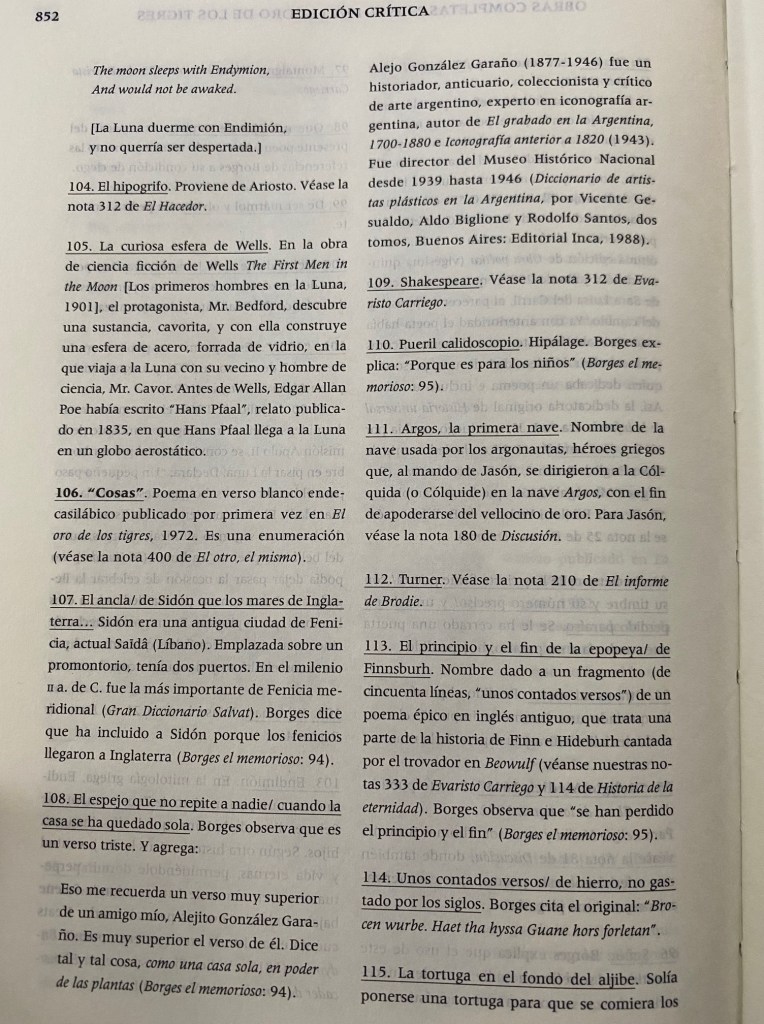
Things (Cosas) from Borges’ The Gold of the Tigers (El Oro de los tigros) followed by notes from the critical edition.

Things
The fallen volume; hidden by the others
from sight in the recesses of the bookshelves,
and which the days and nights muffle over
with slow and noiseless dust. Also, the anchor
of Sidon, which the seas surrounding England
press down into its blind and soft abyss.
The mirror which shows nobody’s reflection
after the house has long been left alone.
Fingernail filings which we leave behind
across the long expanse of time and space.
The indecipherable dust, once Shakespeare.
The changing figurations of a cloud.
The momentary but symmetric rose
which once, by chance, took substance in the shrouded
mirrors of a boy’s kaleidoscope.
The oars of Argus, the original ship.
The sandy footprints which the fatal wave
as though asleep erases from the beach.
The colours of a Turner when the lights
are turned out in the narrow gallery
and not a footstep sounds in the deep night.
The other side of the dreary map of the world.
The tenuous spiderweb in the pyramid.
The sightless stone and the inquiring hand.
The dream I had in the approaching dawn
and later lost in the clearing of the day.
The ending and beginning oí the epic
of Finsburh, today a few sparse verses
of iron, unwasted by the centuries.
The mirrored letter on the blotting paper.
The turtle in the bottom of the cistern.
And that which cannot be. The other horn
of the unicorn. The Being, Three in One.
The triangular disk. The imperceptible moment
in which the Eleatic arrow,
motionless in the air, reaches the mark.
The violet pressed between the leaves of Becquer.
The pendulum which time has stayed in place.
The weapon Odin buried in the tree.
The volume with its pages still unslit.
The echo of the hoofbeats at the charge
of Junin, which in some enduring mode
never has ceased, is part of the webbed scheme.
The shadow of Sarmiento on the sidewalks.
The voice heard by the shepherd on the mountain.
The skeleton bleaching white in the desert.
The bullet which shot dead Francisco Borges.
The other side of the tapestry. The things
which no one sees, except for Berkeley’s God


Cosas
El volumen caído que los otros
ocultan en la hondura del estante
y que los días y las noches cubren
de lento polvo silencioso. El ancla
de sidón que los mares de Inglaterra
oprimen en su abismo ciego y blando.
El espejo que no repite a nadie
cuando la casa se ha quedado sola.
Las limaduras de uña que dejamos
a lo largo del tiempo y del espacio.
El polvo indescifrable que fue Shakespeare.
Las modificaciones de la nube.
La simétrica rosa momentánea
que el azar dio una vez a los ocultos
cristales del pueril calidoscopio.
Los remos de Argos, la primera nave.
Las pisadas de arena que la ola
soñolienta y fatal borra en la playa.
Los colores de Turner cuando apagan
las luces en la recta galería
y no resuena un paso en la alta noche.
El revés del prolijo mapamundi.
La tenue telaraña en la pirámide.
La piedra ciega y la curiosa mano.
El sueño que he tenido antes del alba
y que olvidé cuando clareaba el día.
El principio y el fin de la epopeya
de Finsburh, hoy unos contados versos
de hierro, no gastado por los siglos.
La letra inversa en el papel secante.
La tortuga en el fondo del aljibe
Lo que no puede ser. El otro cuerno
del unicornio. El Ser que es Tres y es Uno.
El disco triangular. El inasible
instante en que la flecha del eleata,
inmóvil en el aire, da en el blanco.
La flor entre las páginas de Becquer.
El péndulo que el tiempo ha detenido.
El acero que Odín clavó en el árbol.
El texto de las no cortadas hojas.
El eco de los cascos de la carga
de Junín, que de algún eterno modo
no ha cesado y es parte de la trama.
La sombra de Sarmiento en las aceras.
La voz que oyó el pastor en lá montaña.
La osamenta blanqueando en el desierto.
La bala que mató a Francisco Borges.
El otro lado del tapiz. Las cosas
que nadie mira, salvo el Dios de Berkeley.

And below are the (untranslated) notes from the Obras Completas Edicion Critica. These turn out generally less helpful than you’d want but feel more valuable here in helping pinpoint the direction of certain references.

To arrange a library is to practice, in a quiet and modest way, the art of criticism

From Borges’ In Praise of Darkness (Elogio de la sombra), in the Norman Thomas di Giovanni translation.

JUNE 1968
On a golden evening,
or in a quietness whose symbol
might be a golden evening,
a man sets up his books
on the waiting shelves,
feeling the parchment and leather and cloth
and the satisfaction given by
the anticipation of a habit
and the establishment of order.
Stevenson and that other Scotsman, Andrew Lang,
will here pick up again, in a magic way,
the leisurely conversation broken off
by oceans and by death,
and Alfonso Reyes surely will be pleased
to share space close to Virgil.
(To arrange a library is to practice,
in a quiet and modest way,
the art of criticism.)
The man, who is blind,
knows that he can no longer read
the handsome volumes he handles
and that they will not help him write
the book which in the end might justify him,
but on this evening that perhaps is golden
he smiles at his strange fate
and feels that special happiness
which comes from things we know and love.


JUNIO, 1968
En la tarde de oro
o en una serenidad cuyo símbolo
podría ser la tarde de oro,
el hombre dispone los libros
en los anaqueles que aguardan
y siente el pergamino, el cuero, la tela
y el agrado que dan
la previsión de un hábito
y el establecimiento de un orden.
Stevenson y el otro escocés, Andrew Lang,
reanudarán aquí, de manera mágica,
la lenta discusión que interrumpieron
los mares y la muerte
y a Reyes no le desagradará ciertamente
la cercanía de Virgilio.
(Ordenar bibliotecas es ejercer,
de un modo silencioso y modesto,
el arte de la crítica.)
El hombre, que está ciego,
sabe que ya no podrá descifrar
los hermosos volúmenes que maneja
y que no le ayudarán a escribir
el libro que lo justificará ante los otros,
pero en la tarde que es acaso de oro
sonríe ante el curioso destino
y siente esa felicidad peculiar
de las viejas cosas queridas