it follows that when it came to philosophy, Lenin was a Neo-Thomist

From Umberto Eco’s On the Shoulders of Giants – in his lecture on The Abstract and the Relative

A specular theory of truth is adaequatio rei et intellectus (the equation of the intellect and the thing), as if our mind were a mirror that, when working properly and not a distorting one or misted over, must faithfully reflect things as they are.  This is the theory put forward by Thomas Aquinas, for example, but also by Lenin in his Materialism and Empirio-Criticism (1909).  And since Aquinas could not have been a Leninist, it follows that when it came to philosophy, Lenin was a Neo-Thomist.

βούλομαι γὰρ Ἀθηναίους τοῦτο λαλεῖν

From Plutarch’s Life of Alcibiades (9.1)

ὄντος δὲ κυνὸς αὐτῷ θαυμαστοῦ τὸ μέγεθος καὶ τὸ εἶδος, ὃν ἑβδομήκοντα μνῶν ἐωνημένος ἐτύγχανεν, ἀπέκοψε τὴν οὐρὰν πάγκαλον οὖσαν. ἐπιτιμώντων δὲ τῶν συνήθων καὶ λεγόντων ὅτι πάντες ἐπὶ τῷ κυνὶ δάκνονται καὶ λοιδοροῦσιν αὐτόν, ἐπιγελάσας, ‘γίνεται τοίνυν,’ εἶπεν, ‘ὃ βούλομαι: βούλομαι γὰρ Ἀθηναίους τοῦτο λαλεῖν, ἵνα μή τι χεῖρον περὶ ἐμοῦ λέγωσι.’

Possessing a dog of wonderful size and beauty, which had cost him seventy minas, he had its tail cut off, and a beautiful tail it was, too. His comrades chid him for this, and declared that everybody was furious about the dog and abusive of its owner. But Alcibiades burst out laughing and said: ‘That’s just what I want; I want Athens to talk about this, that it may say nothing worse about me.’

Strictly speaking, this story should not be written or told at all

From Flann O’Brien’s John Duffy’s Brother

Strictly speaking, this story should not be written or told at all. To write it or to tell it is to spoil it. This is because the man who had the strange experience we are going to talk about never mentioned it to anybody, and the fact that he kept his secret and sealed it up completely in his memory is the whole point of the story. Thus we must admit that handicap at the beginning—that it is absurd for us to tell the story, absurd for anybody to listen to it, and unthinkable that anybody should believe it.

A few background touches to that idyllic voyage

From Stanislaw Lem’s More Tales of Pirx the Pilot:

The radiotelegraph operator, however, coped not by belting up but by jettisoning things: trapped in the space between ceiling, deck, and walls, he would reach into his pants pockets, throw out the first item at hand—his pockets were a storage bin of miscellaneous weights, key chains, metal clips—and allow the thrust to propel him gently in the opposite direction. An infallible method, unerring confirmation of Newton’s second law, but something of an inconvenience to his shipmates, because, once discarded, the stuff would ricochet off the walls, and the resulting whirligig of hard and potentially damaging objects might last a good while. This is just to add a few background touches to that idyllic voyage.

the original pair that were preserved in Noah’s Ark

From Richard Cowtan’s 1872 Memories of the British Museum – quoted as less length in the opening pages of Marjorie Caygill’s Treasures of the British Museum

When we think of the facilities now afforded to visitors of the Museum, it should be remembered that, in those early days (~1835), persons wishing to view the collections were requested to leave their names, and attend at a fixed hour on some other day appointed, when they were hurried through the several rooms without any respect to their taste for any particular department

….

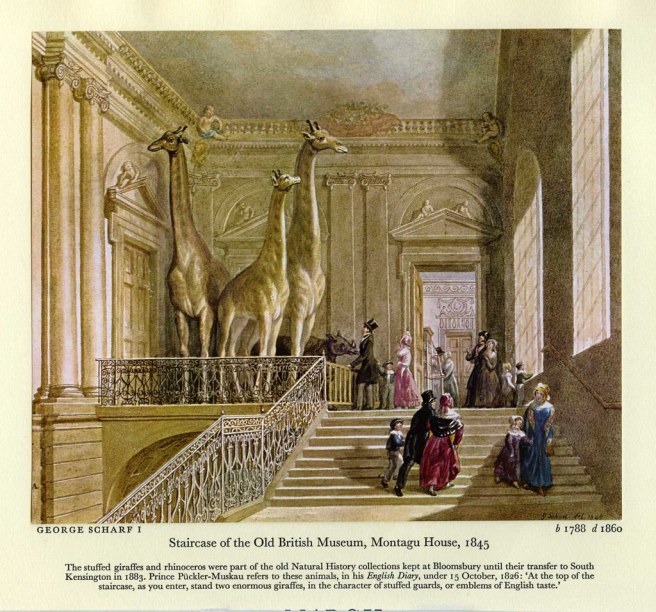
Few that saw them [in the Montagu House entrance hall] will forget the giraffes that stood on the upper landing of the staircase, which looked so stiff and rigid as to have given one an idea that they died under the influence of strychnia, or were the original pair that were preserved in Noah’s Ark.

The giraffes in question:

3238846144_7accf11e9b_b

Oh! Thank heaven to be away from it all!

From Flann O’Brien’s (as Lir O’Connor) I’m Telling You No Lie! – collected in The Short Fiction of Flann O’Brien

Or perhaps it is because—and here, I believe, we are getting nearer to the truth—the colours of the creature have awakened in me a feeling that I had thought was long since dead. For, whenever I hear a few bars from an old Irish song or have a few glasses of an old Irish whiskey my thoughts go out across oceans and continents to the land where I was born. Through the swirling mists I can picture a little thatched, whitewashed crubeen on the side of a hill. Leaning over the half-door, a leather-faced bonnav-dealer puffs away at his blackened old cruiskeen lawn as he gazes down thoughtfully into the valley. Through the smoky twilight within I see his aged help-meet, or colleen bawn, crouching over the turf fire stirring away at her three-legged poteen of carrageen, pausing now and then to gather an odd sad air from her harpeen. With a heart too full for words I reflect that this is my country, and that these people are my own kith and kin, and something like a prayer escapes me as I sob: “Oh! Thank heaven to be away from it all!”

Liquor power rankings

Last Saturday evening I found myself 1 scotch cocktail, 1 madeira, 1 calvados, and 1 gin deep – a situation for which the blues provided no applicable song – and felt compelled to compile my personal liquor power rankings.  My determining elements were simply 1)what do I always need on stock and 2)what do I, in self-managed settings, refuse to mix.  My labored results:

1 – Gin – My top is the duty-free exclusive Roku Select – which has more sakura and ends up a bit sweeter than the normal.  Sipsmith takes the honorable mention as winner of the traditionals.

2 – Pear brandy – Massenez or Trimbach, though the slightly softer Massenez probably edges out.  No pear taking up half the bottle.

3 – Calvados – I like Pere Magloire V.S.O.P or XO but I’ve yet to test most of the pricier options.  Chauffe-Coeur VSOP is what I was drinking the other night.

4 – Mezcal – I prefer the Mezcal Vago line’s yearly variable Ensamble en Barro releases.  But the variability makes this an internally contentious issue.

5 – Armagnac – Chateau du Busca.

I cheated by excluding Amari and Chartreuse.  Amari are too difficult to classify but my winners are Varnelli’s Dell’Erborista and Casoni’s Del Ciclista.  Chartreuse I love, keep several liters of, but have never learned to touch by itself.

 

Our own absurdities, not his.

From Cees Nooteboom’s A Dark Premonition: Journeys to Hieronymus Bosch

“…suddenly he is much closer to me, this most enigmatic of all painters, suddenly I see his hand, I see how he changed the position of a head with his nervous lines, how on the hill before divine Jerusalem he has moved a windmill somewhere else; I see him at work, which suddenly makes it seem as if he is standing beside us, as if we could ask the man who never said anything if it is true what the exegetes say, that in his work a key always means knowledge, and a mussel shell infidelity, that an egg is the most important symbol of the mysterious powers of alchemy, or that a rat always stands for sex or for lies against the church, of if he would agree with what Dirk Bax, a later compatriot from the twentieth century, claimed, that he was a “moralist who felt contempt for the lower classes, with no sympathy for the poor, and who employed his bitterest symbolism to mock beggars, pilgrims, prostitutes, gypsies, vagrants, minstrels, and actors” – but mainly I would like to know what he thought about what Fra de Siguenza wrote about him, who had to defend him posthumously against claims of heresy and said: “If there are absurd things to be seen here, then they are our own absurdities, not his.”

I have no equal when it comes to cutting short unwanted conversations

From Cees Nooteboom’s The Following Story – the narrator responding to the observation that he sits so still for so long while reading that from a distance he appears dead.

“What you call dead, madam, is in fact concentration,” I said, because I have no equal when it comes to cutting short unwanted conversations.  But she insisted on knowing what I spent all my time reading.  Such moments are quite enjoyable, for this conversation took place in one neighborhood cafe De Klepel, and I have a powerful, some would even say aggressive, voice.  “Last night I was reading Theophrastus’ Characters, madame, and after that I read some page of Nonnos’s Dionysiaca.” That sort of remark is guaranteed to bring an instant hush in such surroundings, and from then on I am left in peace.