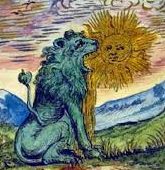
To be gulped down by the throat of death

From Miller Williams’ Sonnets of Giuseppe Belli – a selection of ~100 of the total 2000+.  I discovered Belli recently through Nuccio Ordine’s lovely Une Annee Avec Les Classiques.

The Coffeehouse Philosopher

People differ the way one coffee bean
in a sack will differ from another
when they’re spooned into some expresso machine
to meet the fate they all come to together.

They go round and round, behind, before,
always changing place; they’ve barely begun
when there they go through that iron door
that crushes them into powder, all one.

So all the people live on this earth,
mixed together by fate, swirled around
and changing places, bumping along from birth.

not knowing or caring why, some out of breath,
some taking it easy, all sinking toward the ground
to be gulped down by the throat of death.

‘Italian’ from Mecello Teodonio’s 1998 edition:

Er caffettiere fisolofo

L’ommini de sto Monno sò ll’istesso
che vvaghi de caffè nner mascinino:
c’uno prima, uno doppo, e un antro appresso,
tutti cuanti però vvanno a un distino.

Spesso muteno sito, e ccaccia spesso
er vago grosso er vago piccinino,
e ss’incarzeno tutti in zu l’ingresso
der ferro che li sfraggne in porverino.

E ll’ommini accusí vviveno ar Monno
10misticati pe mmano de la sorte
che sse li ggira tutti in tonno in tonno;

e mmovennose oggnuno, o ppiano, o fforte,
senza capillo mai caleno a ffonno
pe ccascà nne la gola de la Morte.

And a bonus version by Peter Nicholas Dale, rendered in what a note tells me is called “Strine, the dialect spoken in Australia down to the 1960s.”

The coffee-pot f’lofficer

The men a this wirld, well, the lod are all like . .
Beans in a coffee grinder as they’re getten groundèd:
Wun pops up after anutha as they riggle in that tite
Space, but in the end they’re all faded ta be pounded.

Offen they switch pozzies, an wun’ull elbow away,
If he’s bigger, the smaller bean ta the ouder,
They tumble ad each utha’s heels in the doorway
T’wards the ion screw’ut’ull flatten’em in’a mere powder.

An that’s how men live here on earth, I’ve foun’:
Fate wirks the lottuv’em in’u’a fine blend
As it spins’em, wun an all, round an roun’,

An as each wun moves, slow or strong, big or thin,
They all sift thru, clueless, ta the bottom, an end
Up fallen down its craw as deth drinks’em in.

πολυμαθίη νόον οὐ διδάσκει

A Heraclitus fragment – via Diogenes Laertius XI.1 – I’d like better to take to heart.  Fortunately it’s one of the easier ones to deal with, at least for straight translation.

Diels has:

πολυμαθίη νόον (ἔχειν) οὐ διδάσκει· Ἡσίοδον γὰρ ἂν ἐδίδαξε καὶ Πυθαγόρην αὖτις τε Ξενοφάνεά (τε) καὶ Ἑκαταῖον.

but Marcel Conche (PUF, 1986) and Francesco Fronterotta (BUR, 2013) both excise ἔχειν and unbracket the second τε, leaving:

πολυμαθίη νόον οὐ διδάσκει· Ἡσίοδονγὰρ ἂν ἐδίδαξε καὶ Πυθαγόρην αὖτις τε Ξενοφάνεά τε καὶ Ἑκαταῖον.

Kahn (in The Art and Thought of Heraclitus) makes of it:

Much learning does not teach understanding.  For it would have taught Hesiod and Pythagoras, and also Xenophanes and Hecateus

Conche and Fronterotta have the same in their respective languages.

If I had time I would summarize the different interpretations of the various commentators but not today.  Which itself seems the clearest proof of my πολυμαθίη failing to teach any νόος.


Well, it could probably just as well be otherwise

From Robert Musil’s The Man Without Qualities (part 1, ch.4):

But if there is a sense of reality, and no one will doubt that it has its justification for existing, then there must also be something we can call a sense of possibility.

Whoever has it does not say, for instance: Here this or that has happened, will happen, must happen; but he invents: Here this or that might, could, or ought to happen. If he is told that something is the way it is, he will think: Well, it could probably just as well be otherwise. So the sense of possibility could be defined outright as the ability to conceive of everything there might be just as well, and to attach no more importance to what is than to what is not. The consequences of so creative a disposition can be remarkable, and may, regrettably, often make what people admire seem wrong, and what is taboo permissible, or, also, make both a matter of indifference. Such possibilists are said to inhabit a more delicate medium, a hazy medium of mist, fantasy, daydreams, and the subjunctive mood.

Putting it another and perhaps better way, the man with an ordinary sense of reality is like a fish that nibbles at the hook but is unaware of the line, while the man with that sense of reality which can also be called a sense of possibility trawls a line through the water and has no idea whether there’s any bait on it. His extraordinary indifference to the life snapping at the bait is matched by the risk he runs of doing utterly eccentric things. An impractical man—which he not only seems to be, but really is—will always be unreliable and unpredictable in his dealings with others. He will engage in actions that mean something else to him than to others, but he is at peace with himself about everything as long as he can make it all come together in a fine idea.

I lost my name in the wash

From Michel de Certeau’s The Possession at Loudun (pg.43-44):

Fragile, unstable, contested, the words ascribed to the diabolical transcendence flew out of sight.  They were compensated for by increased exhibitionism.  Soon they were to be replaced by the themes of preaching: the preaching devils would represent the last of diabolical discourse, but a discourse nonetheless useful.  Already, with the secondary and facetious malice to which Jeanne des Anges alluded in her autobiography, the possessed women themselves would deny the exorcists those proper words that they expected:

When asked: Quis es tu, mendax, pater mendacii? Quod est nomen tuum [Who are you, liar, father of lies? What is your name?] the demon said, after a long silence: “I forgot my name.  I can’t find it … ”

And commanded once more to say his name, he said: “I lost my name in the wash.”

The intervention of royal justice will strike a blow against this linguistic esoterism from which it will not recover.  The devil will be either the witnesses or the accused, and they will speak French like everybody else.

I wish I had the French edition to check but I’m assuming – because the text always indicates and translates Latin – that the final reply is in French and captures the frustrated breakdown of the possessed’s pretense to Latin.

Dressed most modestly in their faith

From C.P. Cavafy’s The Canon

Manuel Komnenos

The Emperor Manuel Komnenos
on one melancholy September day
felt death to be near.  The court astrologers
the well-paid ones) went on babbling
that he would live for many more years.
As they were having their say, he recalls
old habits, devout customs of times past,
and from the cells of monks orders
ecclesiastical vestments be brought to him
and puts them on, happy to assume
the modest aspect of a priest or monk.

Fortunate all those who believe,

and like Emperor Manuel end their days
dressed most modestly in their faith.

Μανουήλ Κομνηνός

Ο βασιλεύς κυρ Μανουήλ ο Κομνηνός
μια μέρα μελαγχολική του Σεπτεμβρίου
αισθάνθηκε τον θάνατο κοντά. Οι αστρολόγοι
(οι πληρωμένοι) της αυλής εφλυαρούσαν
που άλλα πολλά χρόνια θα ζήσει ακόμη.
Ενώ όμως έλεγαν αυτοί, εκείνος
παληές συνήθειες ευλαβείς θυμάται,
κι απ’ τα κελλιά των μοναχών προστάζει
ενδύματα εκκλησιαστικά να φέρουν,
και τα φορεί, κ’ ευφραίνεται που δείχνει
όψι σεμνήν ιερέως ή καλογήρου.

Ευτυχισμένοι όλοι που πιστεύουν,
και σαν τον βασιλέα κυρ Μανουήλ τελειώνουν
ντυμένοι μες την πίστι των σεμνότατα.

But that did not prevent the serving of snacks to the spectators who filled the churches

From Michel de Certeau’s The Possession at Loudun (pg. 3):

Possession became a great public confrontation between science and religion, a debate on what is certain and what uncertain, on reason, the supernatural, authority. This was orchestrated by an entire erudite literature and the popular press.  It was a “theater” that attracted the curious from all of France and practically all of Europe, a circus “for the satisfaction of these gentlemen,” according to the wording of many official transcripts of the day.

The show was staged in Loudun for almost ten years, and soon provided a center for edification, apologetics, pilgrimages, and pious or philanthropic associations. The diabolical was becoming commonplace. It was gradually becoming profitable. It was reintroduced in the language of a society, while at the same time continuing to perturb that society. In this story, the diabolical played the role set out for it by the rules of the already traditional commedia dell’arte. An evolution took place The Devil, violent at first, was slowly becoming civilized. He would lead disputations. He was discussed. He would end up repeating himself monotonously. The horror was transformed into a spectacle, the spectacle into a sermon. True, there was still weeping and wailing during the exorcisms that continued to be carried out after the execution of “the sorcerer,” Urbain Grandier, but that did not prevent the serving of snacks to the spectators who filled the churches

It’s as a half-caste that I bring my song to the bards’ rites

Below is the prologue to Persius’ Satires in Susanna Morton Braund’s Loeb edition.

I neither cleansed my lips in the nag’s spring nor recall dreaming on twin-peaked Parnassus so as to emerge an instant poet. The Heliconians and pale Pirene I leave to people with their statues licked by clinging ivy. It’s as a half-caste that I bring my song to the bards’ rites. Who equipped the parrot with his “Hello” and taught the magpie to attempt human speech? It was that master of expertise, that bestower of talent, the belly—an expert at copying sounds denied by nature. Just let the prospect of deceitful money gleam and you’d think raven poets and poetess magpies were chanting the nectar of Pegasus.

Nec fonte labra prolui caballino
nec in bicipiti somniasse Parnaso
memini, ut repente sic poeta prodirem.
Heliconidasque pallidamque Pirenen
illis remitto quorum imagines lambunt
hederae sequaces; ipse semipaganus
ad sacra vatum carmen adfero nostrum.
quis expedivit psittaco suum “chaere”
picamque docuit nostra verba conari?
magister artis ingenique largitor
venter, negatas artifex sequi voces.
quod si dolosi spes refulserit nummi,
corvos poetas et poetridas picas
cantare credas Pegaseium nectar.

Her translations of Juvenal and especially Persius – who is forever less attended to – are far my favorites now.  Generally when she departs from the Latin it’s for a punch that strict conformity can’t get across – e.g. here ‘nag’s spring’ for fonte caballino where caballinus is really a neutral adjective ‘pertaining to a horse’, ‘an instant poet’ for repente poeta where the adverbial repente truly does better as adjective – but I very much dislike ‘half-caste’ for semipaganus.  Lewis and Short give it ‘half-rustic, half a clown’ based off the varying senses of the root element paganus

paganus

‘Half-caste’ sounds to me too much a British empire insult and too much privileges the connotation of semi over that of paganus – which, without rousing all the dull dribblings of the ‘persona of the satirist’ arguments, still seems very much at the heart of the scene with its clear references to Hesiod (including ποιμένες ἄγραυλοι, ‘field-dwelling shepherds’, Theogony 26) and (as becomes apparent in the ensuring satires) the author’s distaste for the culture of his urban surroundings.  I prefer an Americanized ‘half a hillbilly’.

Enjoy the wine today, tomorrow there will be none

The opening to ch.15 of Antal Szerb’s Journey by Moonlight:

THE NEXT DAY they did indeed visit the Villa Giulia. They looked at the graves and the sarcophagi, with their lids supporting terracotta statues of the old Etruscan dead enjoying their lives—eating, drinking, embracing their spouses, and proclaiming the Etruscan philosophy. This, being wise enough not to have developed literature in the evolution of their cultural life, they never  committed to writing, though of course it can be read unmistakably on the faces of their statues: only the present matters, and moments of beauty are eternal.

Waldheim pointed out some broad drinking bowls. These were for wine, as the inscription proclaimed: Foied vinom pipafo, cra carefo.

“Enjoy the wine today, tomorrow there will be none,” Waldheim translated. “Tell me, could it be expressed more succinctly or truly? That statement, in its archaic splendour, is as definitive and unshakeable as any polygonic city-walls or cyclopean buildings. Foied vinom pipafo, cra carefo.

The patera – pictured below – is real, as is the inscription (only with vino in place of vinom).  It is one of the few meaningful bits of an old Italic language, Faliscan, related to but distinct from Latin.  The Old Latin version of the same is reconstructed as ‘hodie vinom bibabo, cras carebo.’  The literal translation is “today I will drink wine, tomorrow I won’t have any”

dw5hkjevsaele83

With the text clearer – reading right to left:

falisco


Ainsi le jeu se déroule-t-il avec des yeux qui paraissent clos mais qui, en réalité, sont ouverts

From Torquato Accetto’s Della dissimulazione onesta – in a French edition (Verdier, 1990)  because there does not seem to be an English one.

XI DE LA DISSIMULATION ENVERS LES SIMULATEURS

Ceux qui s’attachent au plaisir de cette part qui en nous est sujette à la mort, méprisant l’usage de leur raison, se muent en animaux sauvages; car tels il convient de les considérer, comme l’exprimait pictète le stoïcien qui disait : « Moi, que suis-je en effet ? Un pauvre homme, et ma chair misérable! Réellement misérable, certes, mais tu as, néan- moins, quelque chose qui est supérieur à la chair misérable. Pourquoi, alors, l’as-tu négligé et t’es-tu attaché à la chair? A cause de ces liens avec la chair, les uns, s’abandonnant à elle, se font semblables à des loups, infidèles, perfides et insidieux, les autres, semblables à des lions, brutaux, féroces et sauvages ; puis, la plupart d’entre nous deviennent semblables à des renards… . » D’où l’on peut déduire quel est l’un des obstacles redoutables que rencontre la dissimulation; car se garder de loups et de lions est chose plus aisée, en raison de leur violence qui est connue et parce que rares sont les fois où on les rencontre; en revanche, nombreux sont parmi nous les renards et pas tou- jours connus, et, quand on les connaît, il est malaisé pourtant d’user de l’art contre l’art et, en ce cas, plus habile se révélera celui qui plus saura garder l’apparence d’un sot, parce que, affectant de croire en celui qui veut nous tromper, il peut être cause que celui-ci croie en nos façons ; et c’est là le r d’une grande intelligence que de donner à voir que l’on ne voit pas, alors que l’on voit tout, car ainsi le jeu se déroule-t-il avec des yeux qui paraissent clos mais qui, en réalité, sont ouverts.

An eternal, non-deciduous and non-bearing composite of meanings and forms

From ch.1 of Sigizmund Krzhizhanovsky’s The Letter Killers Club:

‘Yes, and then I made up my mind: to shut the inkwell lid and return to the kingdom of free, pure, and unsubstantiated conceptions. Sometimes, out of long habit, I was drawn to paper, and a few words would steal out from under my pencil: but I killed those freaks and dealt ruthlessly with my old writerly ways. Have you ever heard of the giardinetti di San Francesco — the gardens of Saint Francis? In Italy I often visited them: the tiny flower gardens of one or two beds, three feet square, inside high solid walls, in almost all Franciscan monasteries. Now, in exchange for silver soldi and in violation of the tradition of Saint Francis, one may view them, if only through a grille, from without. In the past, even that was forbidden: flowers grew there—as Saint Francis had willed—not for others, but for themselves: they could not be picked or replaced outside the enclosure; those who had not taken vows could not set foot in the gardens, or even look at the flowers: immune from people’s touch, protected from eyes and scissors, they could bloom and be fragrant for themselves.’

‘Well, I decided—I hope you won’t find this strange—to plant a garden immured in silence and secrecy in which all my conceptions, all my most exquisite phantasms and monstrous inventions might, far from people’s eyes, grow and bloom for themselves. I hate the coarse rinds of heavily pendant fruits that torment and wither branches; I wanted my tiny garden to contain an eternal, non-deciduous and non-bearing composite of meanings and forms’ Don’t think I am an egoist who cannot step out of his ‘I,’ a misanthrope who hates thoughts not his own. No: in the world only one thing is truly hateful to me: letters. Anyone who can and will pass through this secrecy to live and work here, by the beds of pure conception, I welcome as a brother.’