
Cette sépulcrale chasseresse

I’d advertise spoilers if I thought anyone would read this.  The conclusion to Maupassant’s Les Tombales:

I went off, quite struck, asking myself what I had just seen, to what race of beings belonged this sepulchral huntress.  Was she a common girl, an inspired prostitute who went to gather among the graves men gloomy – haunted by a woman, wife or mistress – and still troubled with the memory of lost caresses? Was she unique?  Are there more like her? Is it a profession? Do they patrol the cemetery as they do the pavement?  Les Tombales! Or rather had she alone had this admirable idea – so truly philosophical – of exploiting the love longings that come back to life in these funereal place?

And I would indeed have liked to know whose widow she was that day.


Je m’en allai stupéfait, me demandant ce que je venais de voir, à quelle race d’êtres appartenait cette sépulcrale chasseresse. Était-ce une simple fille, une prostituée inspirée qui allait cueillir sur les tombes les hommes tristes, hantés par une femme, épouse ou maîtresse, et troublés encore du souvenir des caresses disparues ? Était-ce unique ? Sont-elles plusieurs ? Est-ce une profession ? Fait-on le cimetière comme on fait le trottoir ? Les Tombales ! Ou bien avait-elle eu seule cette idée admirable, d’une philosophie profonde d’exploiter les regrets d’amour qu’on ranime en ces lieux funèbres ?

Et j’aurais bien voulu savoir de qui elle était veuve, ce jour-là ?
 

I called Jean Cocteau Jean and mixed him dry martinis

From John Julius Norwich’s preface to his History of France:

Looking back on those days [in post-war Paris when my father was ambassador], I have only one regret: I was two or three years too young.  I was, I think, moderately precocious for my age, but all these celebrities were only names to me; I called Jean Cocteau Jean and mixed him dry martinis, but I had never read a word he had written.  Had I been eighteen in 1944 instead of fifteen I would have known – and learnt – so much more.  But there: no complaints.  I was lucky to have been there at all.

That’s what lies beneath those professorial words

From Mikhail Bulgakov’s Morphine

18th May

It’s a stuffy night.  There’s going to be a storm.  The black belly in the distance beyond the forest is growing and swelling.  And there it is, a pale and alarming flash.  The storm’s coming.


There’s a book in front of my eyes, and it says in it, regarding abstinence from morphine:

…great anxiety, a state of disquiet and depression, irritability, deterioration of the memory, sometimes hallucinations and, to a limited extent, blackouts…

I haven’t experienced hallucinations, but regarding the remainder I can say: oh, what tame,  banal words, words that say nothing! “A state of depression”!…

No, having fallen sick with this dreadful illness, I warn doctors to be more compassionate towards their patients. It’s not “a state of depression,” but a slow death that takes hold of a morphine addict, as soon as you deprive him of morphine for an hour or two.  The air is insubstantial, it can’t be swallowed … there isn’t a cell in the body that doesn’t thirst … For what? That can be neither defined nor explained.  It short, the man is gone.  He’s switched off.  It’s a corpse that moves, yearns, suffers.  He wants nothing, thinks about nothing but morphine.  Morphine!

Death from thirst is a heavenly , blissful one in comparison with the thirst for morphine.  This is probably the way someone buried alive tries to catch the last, insignificant little air bubbles in the coffin and tears the skin on his chest with his nails.  This is the way a heretic at the stake groans and stirs when the first tongues of flame lick at his feet …

Death – a dry, slow death …

That’s what lies beneath those professorial words “a state of depression”.

The radio has made fools of us all

An again relevant observation from Iris Origo’s A Chill in the Air: An Italian War Diary, 1939-1940.

April 8th 1939

The ultimate result of unceasing propaganda has now been to cancel out the effect of all news alike.  One man said to me, “The radio has made fools of us all.” Late last night a further Italian bulletin stated that the accounts given in anti-Fascist countries of the Albanian operations “are so fantastic that it is not worth while to deny them – as they follow the same methods adopted during the Ethiopian war.  It is now known and proved that the Fascist regime uses one method only: always to tell the truth.”

See that you don’t cheat and say you won, after my death

Pulled from James Romm’s anthology of Seneca’s writings on death – How to Die: An Ancient Guide to the End of Life (this passage is from On Serenity of Mind 14.4).

Julius Canus, an exceptionally great man … got into a long dispute with Caligula.  As he was leaving the room, Caligula, that second Phalaris, said: “Just so you don’t take comfort from an absurd hope, I’ve ordered you to be led away for execution.” “Thank you, best of rulers, “Canus replied…

He was playing a board game when the centurion in charge of leading off the throngs of the condemned told him it was time to move.  Hearing the call, Canus counted up the pieces and said to his partner: “See that you don’t cheat and say you won, after my death.” Then he turned to the centurion and said, “You’re my witness; I was ahead by one.”

Cheeky anecdotes aside, I realized I can’t much stand Seneca these days.  I don’t doubt his sincerity – or care about his work’s potential inconsistency next to his output as playwright and service as government counselor – but there’s something too grossly Roman-forensic-utilitarian in his handling of philosophy.  He browbeats you by repetition, insinuation, and hazy equivocations and I generally feel no more than a jury member being swayed.

Of tailors and their opinions I have a comprehensive, constant, and intense fear

From Robert Walser’s The Walk (pg 49 in the New Directions edition):

It was now meet to conquer, master, surprise, and abash in his utterly unshakable convictions an obstinate, recalcitrant tailor, or marchand tailleur, a person obviously in every respect convinced of the infallibility of his doubtless eminent skill, as well as completely saturated with a sense of his own efficiency.

The toppling of a master tailor’s fixity of mind must be considered one of the most difficulty and hazardous tasks which courage can undertake and daredevil determination determine to carry forward. Of tailors and their opinions I have a comprehensive, constant, and intense fear, of which, however, I am not at all ashamed for fear is, in this instance, readily explicable.

So I was, then, prepared for trouble, perhaps even for trouble of the worst kind, and I armed myself for such a highly perilous attack with qualities such as courage, scorn, wrath, indignation, disdain, even the disdain of death; and with these indubitably very appreciable weapons I hoped to advance, victoriously and successfully, against biting irony and mockery lurking under a simulation of friendliness.

My thoughts, these are my whores

The opening paragraph of Denis Diderot’s Le Neveu de Rameau:

Whether the weather is good, whether it is bad, it’s my custom to take a walk at the Palais Royal at five in the evening.  It’s me you’ll see, always alone, daydreaming on the Argenson bench.  I converse with myself on politics, love, taste, or philosophy.  I leave my wit entirely to its own debauch. I leave it master to follow the first idea wise or foolish which presents itself – just as we see in Foy’s path our dissolute young men trail on the steps of a courtesan with an inviting air, a laughing look, a lovely eye, a turned up nose [but] leave her for another, heading for all of them but clinging to none.  My thoughts, these are my whores.

Qu’il fasse beau, qu’il fasse laid, c’est mon habitude d’aller sur les cinq heures du soir me promener au Palais-Royal. C’est moi qu’on voit, toujours seul, rêvant sur le banc d’Argenson. Je m’entretiens avec moi-même de politique, d’amour, de goût ou de philosophie. J’abandonne mon esprit à tout son libertinage. Je le laisse maître de suivre la première idée sage ou folle qui se présente, comme on voit dans l’allée de Foy nos jeunes dissolus marcher sur les pas d’une courtisane à l’air éventé, au visage riant, à l’oeil vif, au nez retroussé, quitter celle-ci pour une autre, les attaquant toutes et ne s’attachant à aucune. Mes pensées, ce sont mes catins.


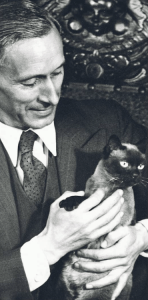
Ernst Junger’s cat

My wife and I adopted a Siamese kitten today and in the week before we take her home we have to find her a name.  I want Tristram or (Saki’s) Tobermory but can’t find a taker so I’ve spent the better part of the afternoon searching for alternatives.  This led – as all things do – to books with cats and writers with cats and ultimately writers with Siamese cats.  They were fashionable in the 1930s-1950s so quite a few writers of the period – Jean Cocteau especially, it seems – owned the breed.

I then remembered the above picture of Ernst Junger with a cat – and that I’d been curious in the past to figure out the name of his pet cats.  I found it featured a Siamese and after a bit of creative German googling I dug out this lovely blog entry.  The passage below – from Strahlungen II – unfortunately didn’t include a page citation and it would take me a few days to get the relevant volume anyway so here’s what I’ve got on his cat “Prinzessin Li-Ping:”

“The little thing is beige-coloured; head, tail, and legs are as if smoked with Chinese ink.  There is a graceful exquisiteness in her, Far Eastern suppleness with suggestions of Bamboo, Silk, and Opium.”

Das Tierchen ist beigefarben; Kopf, Schwanz und Beine sind wie mit chinesischer Tusche angeraucht. Es steckt grazile Erlesenheit in ihr, fernöstliche Geschmeidigkeit mit Anklängen von Bambus, Seide, Opium

It’s a good description of ours as well but doesn’t fix the name problem.

Edit after the fact: As kindly noted in a comment below I’d originally had a picture of an older Junger with a later Siamese, Amanda (now below).  Max points out the timing doesn’t work for Junger’s age but Amanda shows up several times in his later journal Siebzig Verweht.  Several of those mentions are in the post linked above.

Whatever you have read is only a name

From Chhandogya Upanishad (7.1-3) in Swami Nikhilananda’s translation:

1.

Narada approached Sanatkumara [as a pupil] and said: “Venerable Sir, please teach me.”

Sanatkumara said to him: “Please tell me what you already know.  Then I shall tell you what is beyond.”

2.

Narada said: “Venerable Sir, I know the Rig-Veda, the Yajur-Veda, the Sama-Veda, the Atharva-Veda as the fourth, the epics and ancient lore as the fifth, the Veda of the Vedas (i.e. grammar), the rules of the sacrifices by which the Manes are gratified, the science of numbers, the science of portents, the science of time, logic, ethics, etymology, Brahma-vidya (i.e. the science of pronunciation, ceremonials, prosody, etc.), the science of elemental spirits, the science of weapons, astronomy, the science of serpents, and the fine arts.  All that I know, Venerable Sir.

3.

“But, venerable Sir, with all that I know world only; I do not know the Self.  I have heard from men like you that he who knows the Self overcomes sorrow.  I am on afflicted with sorrow.  Do you, venerable Sir, help me to cross over the the other side of sorrow.”

Sanatkumara said to him: “Whatever you have read is only a name.”

Yes, I think that the novel leads readers to vanity and egoism

From Buddha and Personality in v. 2 of Conversations between Borges and Osvaldo Ferrari:

Ferrari: Of course, you also indicated in that essay that the Western novel prefers ‘the flavour of souls’, in Proust and in other novelists.  And in Buddhism the negation of that flavour of souls, of that individuality of souls.

Borges: Yes, I think that the novel leads readers to vanity and egoism.  Novels talk about a single person and the features that distinguish them from other people, which encourages the reader to try and be a specific person and to have features that distinguish them from other people.  So that reading a novel indirectly promotes egoism and vanity and trying to be interesting.  Which is what happens with all young people.  When I was young, I was purposefully unhappy, because I wanted to be, well, Hamlet, or Byron, or Poe, or Baudelaire, or a character in a Russian novel.  On the other hand, now I try to seek calm, and not think about the personality, well, of a writer called Borges, who lived, let’s say, in the twentieth century (laughs), although he was born in the nineteenth.  I try t o forget those pedantic circumstance, no?  I try to live calmly, forgetting that character who is my companion.