The Englishman swallowed the insult agreeably, but expostulated on the waste of good liquor

From Robert Graves’ Lars Porsena or the Future of Swearing and Improper Language

Undistinguished as the oath by St George has become, he has at any rate had the honour of outlasting all his peers…. Once in a public house a young Italian and a middle-aged Londoner were arguing politics.  The Italian paid a warm tribute to the Vatican and its works.  “Oh, to hell with the Pope!” remarked the Englishman.  “And to hell,” replied the furious Italian, upsetting the glasses with a blow of his fist, “and to hell with your Archbishop of Canterbury!”  The Englishman swallowed the insult agreeably, but expostulated on the waste of good liquor. (pg 7-8)

A curious word choice in Racine’s Esther

From one of the choral sections in Jean Racine’s Esther.

Quel carnage de toutes parts !
On égorge à la fois les enfants, les vieillards ;
Et la soeur, et le frère ;
Et la fille, et la mère ;
Le fils dans les bras de son père.
Que de corps entassés ! que de membres épars,
Privés de sépulture !
Grand Dieu ! tes saints sont la pâture
Des tigres et des léopards. (316-324)

What slaughter on all sides!
They cut the throats at the same time of infants and the elderly;
and the sister and the brother;
and the daughter and the mother;
children in the arms of their father.
What piles of bodies! what limbs strewn about,
deprived of burial!
Great God! Your saints have become the pâture
of tigers and leopards

Since I don’t have a better dictionary on hand, Larousse gives the following definitions for pâture

  • Nourriture des animaux, en particulier du bétail ; action de pâturer.
  • (food of animals, en particular of livestock; the action of grazing)
  • Synonyme de pâturage.
  • (synonym of the word for the physical pasture where grazing occurs)
  • Ce qui sert d’aliment à une activité, en particulier intellectuelle, à une passion : Les films noirs sont sa pâture préférée.
  • (irrelevant here)

My issue is that everywhere else here there’s an insistence on flesh and blood and the whole image ends with carnivores consuming the victims of this slaughter.  Pâture in this context feels terribly out of sync.  The seeming disconnect can be fudged in English by taking it as ‘fodder’ but I think that only works because of English idioms – like cannon-fodder – that don’t, in my experience (though I’m far from certain), exist in French.

Since my commentary gives no help – and I wish the Forestier edited Pleiade was more attentive to philological curiosities – the best I can make of it is that the image aims at depicting the end result of the slaughter – ‘the heaps of bodies and scattered limbs, unburied’ – as forming an unnatural grazing ground of flesh for beasts who, in the natural order of things, must hunt down their prey.

In this sense it seems a one step advancement in horror over the opening of the Iliad:

πολλὰς δ᾽ ἰφθίμους ψυχὰς Ἄϊδι προΐαψεν
ἡρώων, αὐτοὺς δὲ ἑλώρια τεῦχε κύνεσσιν
οἰωνοῖσί τε πᾶσι (1.3-5)

[Achilles’ wrath that] hurled to Hades many stout souls
of heroes, and made their bodies prey for dogs
and all birds…

Greek terror at desecration of the corpse aside, scavengers scavenging is at least in the natural order of things.

All my moments are only an eternal crossing

From Jean Racine’s Berenice.  Trying to polish even a few lines of translated Racine is a lesson in humility.

Qu’ai-je donc fait, grands Dieux! Quel cours infortuné
à ma funeste vie aviez-vous destiné?
Tous mes moments ne sont qu’un éternel passage
De la crainte à l’espoir, de l’espoir à la rage. (1309-1312)

What then have I done, great Gods! What unblessed course
have you determined for my gloomy life?
All my moments are only an eternal crossing
from fear to hope, from hope to fury

That too is hard, to join fools in their folly

From Euripides’ Phoenician Women (lines 394-395)

Πολυνείκης: τὰς τῶν κρατούντων ἀμαθίας φέρειν χρεών
Ἰοκάστη: καὶ τοῦτο λυπρόν, συνασοφεῖν τοῖς μὴ σοφοῖς.

Kovacs in his new Loeb edition translates these lines as:

Polynices: You must endure the follies of your ruler.
Jocasta: That too is hard, to join fools in their folly

However smooth an English rendering, this seems to me an excessive softening of the exchange.

Polynices – It is necessary to endure the ignorances of your rulers

ἀμαθίας is, broken to its constituents, a combination of μαθία (learning) and what is called the alpha privative, a negating prefix.  So literally ‘absence of learning/knowledge’.

The φέρειν χρεών verbal construction is impersonal (not second person as Kovacs gives it).  It is frequently translated with the second person, but it doesn’t to me carry the same neutrality as the french ‘on…dit’ construction.  It is best left impersonal since the rhetorical strategy here is to force Jocasta to acknowledge and accede to a universal law in play everywhere and at all times – hence the plurals of ἀμαθίας and κρατούντων even though only one issue and one person are in question here.

Jocasta: This too is distressing, to act unwisely together with those who are not wise.

Mine is not pretty English, but it hits a couple of points Kovacs smooths out.

λυπρόν is stronger than ‘hard.’  Liddell and Scott give it as: ‘of states and conditions, painful, distressing.’  The first occurrence in this sense is a lyric section of Aeschylus’ Persians where Xerexes, speaking of his loss to the Greeks, says it is λυπρά, χάρματα δ᾽ ἐχθροῖς or “painful [for us] but a source of delight for our enemies.”

συνασοφεῖν is (in five minutes of my searching) a hapax legomenon or a word only used once – meaning Euripides likely coined it here.  The construction is easily explicable – συν (together) + α (alpha privative again) + σοφεῖν (to be wise) – but the resulting English  (“be unwise together/share in acting unwisely”) isn’t very functional in a sentence.

τοῖς μὴ σοφοῖς is another simple construction built on using the adjective σοφός (wise, as in σοφεῖν) substantively and negating it with μὴ – ‘men not wise, fools’.  Kovacs’ “join fools in their folly’ very nicely captures the figura etymologica but loses what seems to me an equally important aspect of Jocasta’s reply – her double echoing of Polynices’s negative construction (ἀμαθίας) in συνασοφεῖν and μὴ σοφοῖς.

To conclude-ish, I haven’t read deeply enough in Euripides to say for certain and I’ve never looked into the specific sense contrast of μαθία and σοφία, but I suspect there is a subtle but pointed shifting of terms here that Kovacs misses by using folly in both lines and erasing the sequence of negative constructions.

Mist muged on the mor, malt on the mountes

Some of what is best in Sir Gawain and the Green Knight are the transit passages – moving through nature in passing from one human zone to another.  For all the poet enjoys describing life at court, he also shows a surprising – for the time – attentiveness to natural landscapes.


And went on his way with his wyye one,
That schulde teche hym to tourne to that tene place
Ther the ruful race he schulde resayve.
They bowen bi bonkkes ther boghes ar bare,
Thay clomben bi clyffes ther clenges the colde,
The heven was up half, bot ugly therunder;
Mist muged on the mor, malt on the mountes,
Uch hille hade a hatte, a myst hakel huge,
Brokes byled and breke bi bonkkes aboute,
Schyre schaterande on schores ther thay doun schowved.
Wela wylle was the way ther thay bi wod schulden…. (2074-2084)

Then he went on his way with the one whose task
was to point out the road to that perilous plcae
where the knight would receive the slaughterman’s strikel
They scrambled up bankings where branches were bare,
clambered up cliff faces crazed by the cold.
The clouds which had climbed now cooled and dropped
so the moors and the mountains were muzzy with mist
and every hill wore a hat of mizzle on its head.
The streams on the slopes seemed to fume and foam,
whitening the waysid with spume and spray.
They wandered onwards through teh wildest woods (Simon Armitage translation)

We are gripped by the anguish of one who is always turning away from wonderful riches in whichever direction he goes

From Ernst Junger’s The Adventurous Heart: Figures and Capriccios:

It often appears to us that the purpose of the depths is to generate the surface, that rainbow-colored skin of the world whose sight so intensely moves us.  In other moments, this colorful patterns appears to be composed only of signs and letters by which the depths speak to us of their secrets.  Consequently, whether we live within or without, we are gripped by the anguish of one who is always turning away from wonderful riches in whichever direction he goes.  Anxiety seizes us during the austere enjoyment of solitude, just as at the festively decorated table of the world. (On Crystallography, pgs 3-4)

Knowledge of the world is the dissolution of the solidity of the world

From Italo Calvino’s Lezioni Americane: Sei proposte per il prossimo millennio (translated as Six Memos for the Next Millenium):

For Ovid too everything can be transformed into new forms; so also for Ovid knowledge of the world is the dissolution of the solidity of the world;  And for Ovid there is an essential parity among all things that exist – in contrast to every hierarchy of powers and values.  If the world of Lucretius is made of unchangeable atoms, that of Ovid is made of qualities, attributes, and forms that define the diversity of all things – plants, animals, and people; But these are only weak casings of a common substance that – if stirred with deep passion – can be changed into what is most different.

Anche per Ovidio tutto può trasformarsi in nuove forme; anche per Ovidio la
conoscenza del mondo è dissoluzione della compattezza del mondo;
anche per Ovidio c’è una parità essenziale tra tutto ciò che
esiste, contro ogni gerarchia di poteri e di valori. Se il mondo
di Lucrezio è fatto d’atomi inalterabili, quello d’Ovidio è fatto
di qualità, d’attributi, di forme che definiscono la diversità
d’ogni cosa e pianta e animale e persona; ma questi non sono che
tenui involucri d’una sostanza comune che, – se agitata da
profonda passione – può trasformarsi in quel che vi è di più
diverso.

For thagh men ben mery quen they han mayn drynk

I don’t properly know Middle English.  I can mostly get through it with a crib translation, but my grammar is too hazy to come out on top in some alliterative clusters where the context alone doesn’t make the different roles clear – as is the case in line 4 of the below excerpt from Sir Gawain and the Green Knight, which has stumped me for a while now.

The original:
Gawan watz glad to begynne those gomnes in halle,
Bot thagh the ende be hevy, haf ye no wonder;
For thagh men ben mery quen they han mayn drynk,
A yere yernes ful yerne, and yeldez never lyke;
The forme to the fynisment foldez ful selden (495-499)

The Simon Armitage poetic rendering (Norton, 2007):
And Gawain had been glad to begin the game,
but don’t be so shocked should the plot turn pear-shaped:
for men might be merry when addled with mead
but each year, short lived, is unlike the last
and rarely resolves in the style it arrived

The James Winny mostly literal rendering (Broadview, 1992):
Gawain was glad enough to begin those games in the hall,
But if the outcomes prove troublesome don’t be surpised;
For though men are light-hearted when they have strong drink,
A year pass swiftly, never bringing the same:
Beginning and ending selom take the same form.

My literal but illiterate rendering:
Gawain was glad to to begin those games in the hall,
but that the conclusion was harsh, have no wonder;
For though men become merry when they have many a drink,
A year seeks fulfillment swiftly but never yields the same [kind of year],
The [initial] appearance full seldom agrees with the conclusion.

I take “A yere yernes ful yerne” as:
yere – year (subject)
yernes – desire (verb)
But I’m using the poorly attested secondary meaning from the Univerity of Michigan Middle English Dictionary entry for yernen
yerne – swiftly (adv)

I think there are two problems here.  First – ‘yernen’ has to be taken with a rare secondary sense and the translators I’ve looked at appear – understandably – to glide over this difficulty by giving preference to dictates of context.  Second – I think the poet’s image itself lacks full logical continuity.  The situation in lines 1-2 (Gawain begins his task lightly but concludes in different manner) is supposed to be clarified by a parallel example in lines 3-4.  The import of both examples is then summed up by the gnomic line 5.  Easy enough.  But the shift in focus from 3-4 (men are happy when they drink/ but a year passes quickly..) is so violent that the intended elaborating power feels lost to me.  I can still only guess what 3-4 ‘needs’ to mean by setting it aside what precedes and what follows.  Now it’s lunch and I’ve earned my ‘mayn drynk’
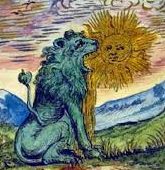
and downe sate Sisyphus uppon his rolling stone

Ovid’s Metamorphoses, on Orpheus’ performing in the underworld.  The translation is Arthur Golding’s.

Talia dicentem nervosque ad verba moventem
exsangues flebant animae: nec Tantalus undam
captavit refugam, stupuitque Ixionis orbis,
nec carpsere iecur volucres, urnisque vacarunt
Belides, inque tuo sedisti, Sisyphe, saxo (10.40-44)

As he this tale did tell,
And played on his instrument, the bloodlesse ghostes shed teares:
To tyre on Titius growing hart the greedy Grype forbeares:
The shunning water Tantalus endevereth not to drink:
And Danaus daughters ceast to fill theyr tubbes that have no brink.
Ixions wheele stood still: and downe sate Sisyphus uppon
His rolling stone.

What is God, what is not God, and what lies between

From Euripides’ Helen:

ὅ τι θεὸς ἢ μὴ θεὸς ἢ τὸ μέσον,
τίς φησ᾽ ἐρευνήσας βροτῶν
μακρότατον πέρας ηὑρεν
ὃς τὰ θεῶν ἐσορᾷ
δεῦρο καὶ αὖθις ἐκεῖσε
καὶ πάλιν ἀντιλόγοις
πηδῶντ᾽ ἀνελπίστοις τύχαις; (1137-42)

What is God, what is not God, and what lies between –
Who among mortals can search out and tell?
The farthest limit has he found,
who looks upon the things sent by the gods
as springing here and now there
and back again with contradictory
and unanticipated fortunes.