At non formosa est, at non bene culta puella

Ovid Amores 3.7 (in the Loeb text and translation), the poem behind yesterday’s The Imperfect Enjoyment. Love Ovid though I do, I find Rochester’s reworking more effective than the original – but then Ovid and Rochester are playing with different poetics so a strict counterweighing is misguided.

Was she then not beautiful, not attractively groomed, not longed for a thousand times in my dreams? And yet when I held her in my arms, I was unhappily limp and could not perform, but lay a shameful burden on an idle bed; but though I was eager for it, and she no less, I could not use the pleasurable part of my languid loins. Her ivory arms, gleaming more brightly than Thracian snow, she cast about my neck and with eager tongue implanted wanton kisses, and lasciviously slid her limbs beneath mine. She whispered endearments, calling me master, and all the natural rapturous utterances as well. But my body, as if drugged with chill hemlock, was paralysed and failed to achieve my intent. I lay like a dead tree-trunk, a mere spectacle, a useless weight, and it was unclear whether I was body or ghost.

What kind of old age lies in store for me, if indeed one does, when my youth lives not up to its full measure? Ah, I am ashamed to be my age: what is the point of being young and male? My girl-friend found me neither young nor male. She left the bed as chaste as the devout priestess who rises to tend Vesta’s undying fire and as a sister leaves the side of the dear brother whose respect she commands. Yet not long ago I satisfied blonde Chlide twice running with my attentions, thrice fair Pitho and thrice Libas; I remember Corinna’s asking from me and my supplying nine measures in one short night.

Was my body listless under the spell of Thessalian drugs? Was I the wretched victim of charms and herbs, or did a witch curse my name upon a red wax image and stick fine pins into the middle of the liver? When damned by charms the corn withers on the sterile stalk, and when a well is damned by charms, its water dries up; through incantations acorns drop from oaks and grapes from vines, and apples fall when no one has touched them. What prevents the cessation of my energy being due to magical practices? It is perhaps from that source that my powers became inadequate. Shame also played a part, for my very shame at what happened inhibited me: that was a second cause of my trouble.

But what a lovely girl did I just gaze upon and touch, and touch as closely as her garments do! Her touch could have made Nestor young again and given Tithonus a virility belying his years. Such a one had I in my grasp, though she no man in hers. What on earth can I now ask for in my future prayers? I also fancy the mighty gods regret offering me a boon which I so shamefully treated. Yes, I desired admittance—and won it; to kiss her—and did; to be in her bed—and was. What did I gain from such great fortune, what did I gain from a kingship I never exercised? Nothing, except possess wealth like a rich miser. So thirsts the betrayer of secretsa in midstream and has fruit he can never enjoy. Does anyone leave a pretty girl at dawn in a state permitting him forthwith to approach the sacred gods?

But perhaps it was not an alluring girl I left? Perhaps she did not lavish exquisite kisses on me or use every resource to rouse me? Not a bit! That girl’s allure could have moved tough oak, hard adamant, and unfeeling stone: certainly she could have moved anyone alive and man; but then I was neither alive nor man, as I had been. What would be the use of Phemius singing to deaf ears? What profit is a painting to blind Thamyras?

And yet what joys had I not conceived in the privacy of my mind, what ways of love not arranged in my imagination? But my body lay in disgrace as though already dead, more jaded than the rose of yesterday. (Now, too late, just look at it, it is well and strong, now clamouring for business and the fray. Lie down there, you shamefaced creature, worthless part of me: I have been tricked by promises like this before. You deceive your master; through you I have been caught defenceless, and suffered a painful and humiliating reverse.)

Moreover my playmate did not refrain from applying her hand and gently coaxing it. But when she realised it would not get up and was lying down oblivious of her, she exclaimed: “Why do you insult me? Are you out of your mind? Who asked you to come to bed if you are not in the mood? Either some practitioner of Circe’s spells has been piercing a woollen figure of you and has you bewitched or you have come here exhausted from lovemaking elsewhere.” With that she leapt out of bed, wrapped in her ungirdled robe (and a pretty sight she was, as she tripped forth barefoot). And to stop the maids realising that she had not enjoyed me, she covered up my sorry performance by taking a bath.

At non formosa est, at non bene culta puella,
at, puto, non votis saepe petita meis!
hanc tamen in nullos tenui male languidus usus,
sed iacui pigro crimen onusque toro;
nec potui cupiens, pariter cupiente puella,
inguinis effeti parte iuvante frui.
illa quidem nostro subiecit eburnea collo
bracchia Sithonia candidiora nive,
osculaque inseruit cupida luctantia lingua
lascivum femori supposuitque femur,
et mihi blanditias dixit dominumque vocavit,
et quae praeterea publica verba iuvant.
tacta tamen veluti gelida mea membra cicuta
segnia propositum destituere meum;
truncus iners iacui, species et inutile pondus,
et non exactum, corpus an umbra forem.
Quae mihi ventura est, siquidem ventura, senectus,
cum desit numeris ipsa iuventa suis?
a, pudet annorum: quo me iuvenemque virumque?
nec iuvenem nec me sensit amica virum!
sic flammas aditura pias aeterna sacerdos
surgit et a caro fratre verenda soror.
at nuper bis flava Chlide, ter candida Pitho,
ter Libas officio continuata meo est;
exigere a nobis angusta nocte Corinnam
me memini numeros sustinuisse novem.
Num mea Thessalico languent devota veneno
corpora? num misero carmen et herba nocent,
sagave poenicea defixit nomina cera
et medium tenuis in iecur egit acus?
carmine laesa Ceres sterilem vanescit in herbam,
deficiunt laesi carmine fontis aquae,
ilicibus glandes cantataque vitibus uva
decidit, et nullo poma movente fluunt.
quid vetat et nervos magicas torpere per artes?
forsitan inpatiens fit latus inde meum.
huc pudor accessit: facti pudor ipse nocebat;
ille fuit vitii causa secunda mei.
At qualem vidi tantum tetigique puellam!
sic etiam tunica tangitur illa sua.
illius ad tactum Pylius iuvenescere possit
Tithonosque annis fortior esse suis.
haec mihi contigerat; sed vir non contigit illi.
quas nunc concipiam per nova vota preces?
credo etiam magnos, quo sum tam turpiter usus,
muneris oblati paenituisse deos.
optabam certe recipi—sum nempe receptus;
oscula ferre—tuli; proximus esse—fui.
quo mihi fortunae tantum? quo regna sine usu?
quid, nisi possedi dives avarus opes?
sic aret mediis taciti vulgator in undis
pomaque, quae nullo tempore tangat, habet.
a tenera quisquam sic surgit mane puella,
protinus ut sanctos possit adire deos?
Sed, puto, non blanda: non optima perdidit in me
oscula; non omni sollicitavit ope!
illa graves potuit quercus adamantaque durum
surdaque blanditiis saxa movere suis.
digna movere fuit certe vivosque virosque;
sed neque tum vixi nec vir, ut ante, fui.
quid iuvet, ad surdas si cantet Phemius aures?
quid miserum Thamyran picta tabella iuvat?
At quae non tacita formavi gaudia mente!
quos ego non finxi disposuique modos!
nostra tamen iacuere velut praemortua membra
turpiter hesterna languidiora rosa—
quae nunc, ecce, vigent intempestiva valentque,
nunc opus exposcunt militiamque suam.
quin istic pudibunda iaces, pars pessima nostri?
sic sum pollicitis captus et ante tuis.
tu dominum fallis; per te deprensus inermis
tristia cum magno damna pudore tuli.
Hanc etiam non est mea dedignata puella
molliter admota sollicitare manu;
sed postquam nullas consurgere posse per artes
inmemoremque sui procubuisse videt,
“quid me ludis?” ait, “quis te, male sane, iubebat
invitum nostro ponere membra toro?
aut te traiectis Aeaea venefica lanis
devovet, aut alio lassus amore venis.”
nec mora, desiluit tunica velata soluta
—et decuit nudos proripuisse pedes!
—neve suae possent intactam scire ministrae,
dedecus hoc sumpta dissimulavit aqua.


The Imperfect Enjoyment

John Wilmot is what Henry Miller would like to have been.

If I weren’t rusticating away from my books this long weekend I’d include the Ovid poem – Amores 3.7 – that gave rise to this and several similarly themed pieces.

Naked she lay, clasped in my longing arms,
I filled with love, and she all over charms;
Both equally inspired with eager fire,
Melting through kindness, flaming in desire.
With arms, legs, lips close clinging to embrace,
She clips me to her breast, and sucks me to her face.
Her nimble tongue, love’s lesser lightning, played
Within my mouth, and to my thoughts conveyed
Swift orders that I should prepare to throw
The all-dissolving thunderbolt below.
My fluttering soul, sprung with the pointed kiss,
Hangs hovering o’er her balmy brinks of bliss.
But whilst her busy hand would guide that part
Which should convey my soul up to her heart,
In liquid raptures I dissolve all o’er,
Melt into sperm, and spend at every pore.
A touch from any part of her had done ’t:
Her hand, her foot, her very look’s a cunt.
    Smiling, she chides in a kind murmuring noise,
And from her body wipes the clammy joys,
When, with a thousand kisses wandering o’er
My panting bosom, “Is there then no more?”
She cries. “All this to love and rapture’s due;
Must we not pay a debt to pleasure too?”
    But I, the most forlorn, lost man alive,
To show my wished obedience vainly strive:
I sigh, alas! and kiss, but cannot swive.
Eager desires confound my first intent,
Succeeding shame does more success prevent,
And rage at last confirms me impotent.
Ev’n her fair hand, which might bid heat return
To frozen age, and make cold hermits burn,
Applied to my dear cinder, warms no more
Than fire to ashes could past flames restore.
Trembling, confused, despairing, limber, dry,
A wishing, weak, unmoving lump I lie.
This dart of love, whose piercing point, oft tried,
With virgin blood ten thousand maids has dyed,
Which nature still directed with such art
That it through every cunt reached every heart—
Stiffly resolved, ’twould carelessly invade
Woman or man, nor ought its fury stayed:
Where’er it pierced, a cunt it found or made—
Now languid lies in this unhappy hour,
Shrunk up and sapless like a withered flower.
    Thou treacherous, base deserter of my flame,
False to my passion, fatal to my fame,
Through what mistaken magic dost thou prove
So true to lewdness, so untrue to love?
What oyster-cinder-beggar-common whore
Didst thou e’er fail in all thy life before?
When vice, disease, and scandal lead the way,
With what officious haste doest thou obey!
Like a rude, roaring hector in the streets
Who scuffles, cuffs, and justles all he meets,
But if his king or country claim his aid,
The rakehell villain shrinks and hides his head;
Ev’n so thy brutal valor is displayed,
Breaks every stew, does each small whore invade,
But when great Love the onset does command,
Base recreant to thy prince, thou dar’st not stand.
Worst part of me, and henceforth hated most,
Through all the town a common fucking post,
On whom each whore relieves her tingling cunt
As hogs on gates do rub themselves and grunt,
Mayst thou to ravenous chancres be a prey,
Or in consuming weepings waste away;
May strangury and stone thy days attend;
May’st thou never piss, who didst refuse to spend
When all my joys did on false thee depend.
   And may ten thousand abler pricks agree
   To do the wronged Corinna right for thee.

They drove him into the underworld like a peg

A modestly amusing footnote in the Loeb edition of Apollonius’ Argonautica (1.55ish), as the poet enumerates the crew.

And from wealthy Gyrton came Caeneus’ son, Coronus—a brave man, but no braver than his father. For bards sing of how Caeneus, although still living, perished at the hands of the Centaurs, when, all alone and separated from the other heroes, he routed them. They rallied against him, but were not strong enough to push him back nor to kill him, so instead, unbroken and unbending, he sank beneath the earth, hammered by the downward force of mighty pine trees*

They drove him into the underworld like a peg, hence he perished while still alive; cf. Pindar, fr. 128f.


ἤλυθε δ᾿ ἀφνειὴν προλιπὼν Γυρτῶνα Κόρωνος
Καινεΐδης, ἐσθλὸς μέν, ἑοῦ δ᾿ οὐ πατρὸς ἀμείνων.
Καινέα γὰρ ζωόν περ ἔτι κλείουσιν ἀοιδοὶ
Κενταύροισιν ὀλέσθαι, ὅτε σφέας οἶος ἀπ᾿ ἄλλων
ἤλασ᾿ ἀριστήων· οἱ δ᾿ ἔμπαλιν ὁρμηθέντες
οὔτε μιν ἀγκλῖναι προτέρω σθένον οὔτε δαΐξαι,
ἀλλ᾿ ἄρρηκτος ἄκαμπτος ἐδύσετο νειόθι γαίης,
θεινόμενος στιβαρῇσι καταΐγδην ἐλάτῃσιν

The Pindar fragment (with the Loeb edition by the same editor/translator as Apollonius) is:

128f The same papyrus gives scraps of vv. 3–8. A scholion on Apollonius Rhodius, Argonautica. “Apollonius took it from Pindar, who said” (vv. 7–9):

(lines 1–2 are fragmentary)
excel(?)
famous(?)
5and Castor(?)
. . . . . .
But Caeneus,6 (struck with) green (fir trees)
disappears after splitting the earth with his upright
foot.

Cf. Plutarch, The Stoics Talk More Paradoxically Than the Poets. “Pindar’s Caeneus used to be criticized for being an implausible creation—invulnerable to iron, feeling nothing in his body, and finally having sunk unwounded under the ground, ‘after splitting the earth with his upright foot.’”

But the best telling is Ovid’s (Metamorphoses 12.490is) in Nestor’s version of the battle of  the Centaurs and the Lapiths:

Now, quite beside themselves, the double monsters rushed on with huge uproar, and all together against that single foe they aimed and drove their weapons. The spears fell blunted, and Caeneus, the son of Elatus, still stood, for all their strokes, unwounded and unstained. The strange sight struck them speechless. Then Monychus exclaimed: ‘Oh, what a shame is this! We, a whole people, are defied by one, and he scarcely a man. And yet he is the man, while we, with our weak attempts, are what he was before. Of what advantage are our monster-forms? What our twofold strength? What avails it that a double nature has united in our bodies the strongest living things? We are not sons of any goddess nor Ixion’s sons, I think. For he was high-souled enough to aspire to be great Juno’s mate, while we are conquered by an enemy but half-man! Come then, let us heap stones and tree-trunks on him, mountains at a time! let’s crush his stubborn life out with forests for our missiles! Let sheer bulk smother his throat, and for wounds let weight suffice.’ He spoke and, chancing on a tree-trunk overthrown by mad Auster’s might, he hurled it at his sturdy foe. The others followed him; and in short time Othrys was stripped of trees and Pelion had lost his shade. Buried beneath that huge mound, Caeneus heaved against the weight of trees and bore up the oaken mass upon his sturdy shoulders. But indeed, as the burden mounted over lips and head, he could get no air to breathe. Gasping for breath, at times he strove in vain to lift his head into the air and to throw off the heaped-up forest; at times he moved, just as if lofty Ida, which we see yonder, should tremble with an earthquake. His end is doubtful. Some said that his body was thrust down by the weight of woods to the Tartarean pit; but the son of Ampycus denied this. For from the middle of the pile he saw a bird with golden wings fly up into the limpid air. I saw it too, then for the first time and the last.


ecce ruunt vasto rabidi clamore bimembres
telaque in hunc omnes unum mittuntque feruntque.
tela retusa cadunt: manet inperfossus ab omni
inque cruentatus Caeneus Elateius ictu.
fecerat attonitos nova res. ‘heu dedecus ingens!’
Monychus exclamat. ‘populus superamur ab uno
vixque viro; quamquam ille vir est, nos segnibus actis,
quod fuit ille, sumus. quid membra inmania prosunt?
quid geminae vires et quod fortissima rerum
in nobis natura duplex animalia iunxit?
nec nos matre dea, nec nos Ixione natos
esse reor, qui tantus erat, Iunonis ut altae
spem caperet: nos semimari superamur ab hoste!
saxa trabesque super totosque involvite montes
vivacemque animam missis elidite silvis!
massa premat fauces, et erit pro vulnere pondus.’
dixit et insanis deiectam viribus austri
forte trabem nactus validum coniecit in hostem
exemplumque fuit, parvoque in tempore nudus
arboris Othrys erat, nec habebat Pelion umbras.
obrutus inmani cumulo sub pondere Caeneus
aestuat arboreo congestaque robora duris
fert umeris, sed enim postquam super ora caputque
crevit onus neque habet, quas ducat, spiritus auras,
deficit interdum, modo se super aera frustra
tollere conatur iactasque evolvere silvas
interdumque movet, veluti, quam cernimus, ecce,
ardua si terrae quatiatur motibus Ide.
exitus in dubio est: alii sub inania corpus
Tartara detrusum silvarum mole ferebant;
abnuit Ampycides medioque ex aggere fulvis
vidit avem pennis liquidas exire sub auras,
quae mihi tum primum, tunc est conspecta supremum.

Nimium amator ingenii sui

From a letter of Laurence Sterne’s of Jan 1, 1760, responding to an unknown addressee’s cautionary remarks about Tristram Shandy.  There are three significantly enough different versions of this letter that the editors of the Florida Edition printed them separately, numbering each 35A, B, and C.  I’m pulling from A.

I know not whether I am entirely free <of> [from?] the fault Ovid is so justly censured for – of being nimum ingenij sui amator.  the hint however is right – to sport too much with a Man’s own wit is surfeiting: like toying with a man’s mistress, it may be delightful enough to the Inamorato but of little or no entertainment to By-standers.   in general I have ever endeavour’d to avoid it, by leaving off as soon as possible whenever a point of humour or Wit was started, for fear of saying too much…

The criticism of Ovid is from Quintilian 10.1.88:

Lascivus quidem in herois quoque Ovidius et nimium amator ingenii sui, laudandus tamen partibus…

Indeed Ovid is too sportive/playful/roguish/badin [lascivus] even in his heroes and too great a lover of his own talent/temperament – but nevertheless he must be praised in certain areas…

Dominae servabimus istos

A portion of Polyphemus’ travesty of a courting appeal to Galatea, from Ovid’s Metamorphoses 13.830:

Nec tibi deliciae faciles vulgataque tantummunera contingent, dammae leporesque caperque,parve columbarum demptusve cacumine nidus: inveni geminos, qui tecum ludere possint,inter se similes, vix ut dignoscere possis,villosae catulos in summis montibus ursae: inveni et dixi “dominae servabimus istos!”

And you shall have no easily gotten pets or common presents, such as does and hares and goats, or a pair of doves, or a nest taken from the cliff. I found on the mountain-top two cubs of a shaggy bear for you to play with, so much alike that you can scarcely tell them apart. I found them and I said: “I’ll keep these for my mistress!


Sed tela tamen sua quisque cruentat

I have been rereading Ovid’s Metamorphoses the last few days – probably inspired by a mention in Calvino’s Six Memos that I read last week.  I’d never before realized how funny – both absurd and grotesque – Ovid is.  I first tried formulating this as “Ovid is the only Roman with a healthy sense of humor” – and contrasting him with the flaccid posturing ‘wit’ of Horace on one hand and the bestializing brutality of Persius and Juvenal (or their satiric personae) on the other.  In the latter camp I’d partially include Petronius – but only if we give more weight to the Cena Trimalchionis than some of the other fragments like the goose debacle.  But then I remembered Apuleius and trailed off…

Anyway, here is the killing of the Calydonian Boar by Meleager (8.420-424):

The others vent their joy by wild bouts of applause and crowd around to press the victor’s hand. They gaze in wonder at the huge beast lying stretched out over so much ground, and still think it hardly safe to touch him. But each dips his spear in the blood.

gaudia testantur socii clamore secundovictricemque petunt dextrae coniungere dextraminmanemque ferum multa tellure iacentemmirantes spectant neque adhuc contingere tutum esse putant, sed tela tamen sua quisque cruentat.

It is the delicacy of the insult in that final sentence – ‘they still think it hardly safe to touch him … but each dips his spear in the blood.’  Terrified of the corpse but still wanting visual justification for claiming a share of the credit.  It is a masterstroke of compressed psychological portraiture – and one I’d imagine very likely inspired by Ovid’s watching wealthy Romans of his own time dip their unused spears in the blood of poor animals slain by their slaves.

Hoc opus, hic labor est

What is certainly one of the Aeneid’s best known passages (6.129ish),

Trojan, son of Anchises, easy is the descent to Avernus:
night and day do the doors of black Dis lay open;
but to retrace your step and escape to the upper air,
this is the task, this the labor

Tros Anchisiade, facilis descensus Averno:
noctes atque dies patet atri ianua Ditis;
sed revocare gradum superasque evadere ad auras,
hoc opus, hic labor est.

Which, with consistent temperamental flippancy, I cannot read without recalling Ovid’s corrupting echo in Ars Amatoria 1.453:

But what you haven’t given, seem always on the cusp of giving:
In this way a barren field has often deceived its owner:
In this way the gambler – so that he won’t lose – does not leave off losing
and often the dice call back his greedy hands.
This is the the task, this the labor – to get her to bed without a preceding gift;
And so that what she’s given won’t have been given for nothing she’ll keep on giving.

At quod non dederis, semper videare daturus:
Sic dominum sterilis saepe fefellit ager:
Sic, ne perdiderit, non cessat perdere lusor,
Et revocat cupidas alea saepe manus.
Hoc opus, hic labor est, primo sine munere iungi;
Ne dederit gratis quae dedit, usque dabit.

He has lived well who has remained unknown

From Ovid’s Tristia (3.4 lines 11-26).  The title is my own rendering, the (mediocre) translation below is the Loeb edition (pg. 116-117).

Thou seest how the light cork floats atop the wave when the heavy burden sinks with itself the woven nets. If I who warn thee now had once myself been warned of this, perchance I should now be in that city in which I ought to be. Whilst I lived for myself, whilst the light breeze wafted me on, this bark of mine sped through calm waters. Who falls on level ground—though this scarce happens—so falls that he can rise from the ground he has touched, but poor Elpenor who fell from the high roof met his king a crippled shade. Why was it that Daedalus in safety plied his wings while Icarus marks with his name the limitless waves? Doubtless because Icarus flew high, the other flew lower; for both had wings not their own. Let me tell thee, he who hides well his life, lives well; each man ought to remain within his proper position.

aspicis ut summa cortex levis innatet unda,
cum grave nexa simul retia mergat onus.
haec ego si monitor monitus prius ipse fuissem,
in qua debebam forsitan urbe forem.
dum tecum vixi, dum me levis aura ferebat,
haec mea per placidas cumba cucurrit aquas,
qui cadit in plano—vix hoc tamen evenit ipsum—
sic cadit, ut tacta surgere possit humo;
at miser Elpenor tecto delapsus ab alto
occurrit regi debilis umbra suo.
quid fuit, ut tutas agitaret Daedalus alas,
Icarus inmensas nomine signet aquas?
nempe quod hic alte, demissius ille volabat;
nam pennas ambo non habuere suas.
crede mihi, bene qui latuit bene vixit, et intra
fortunam debet quisque manere suam.

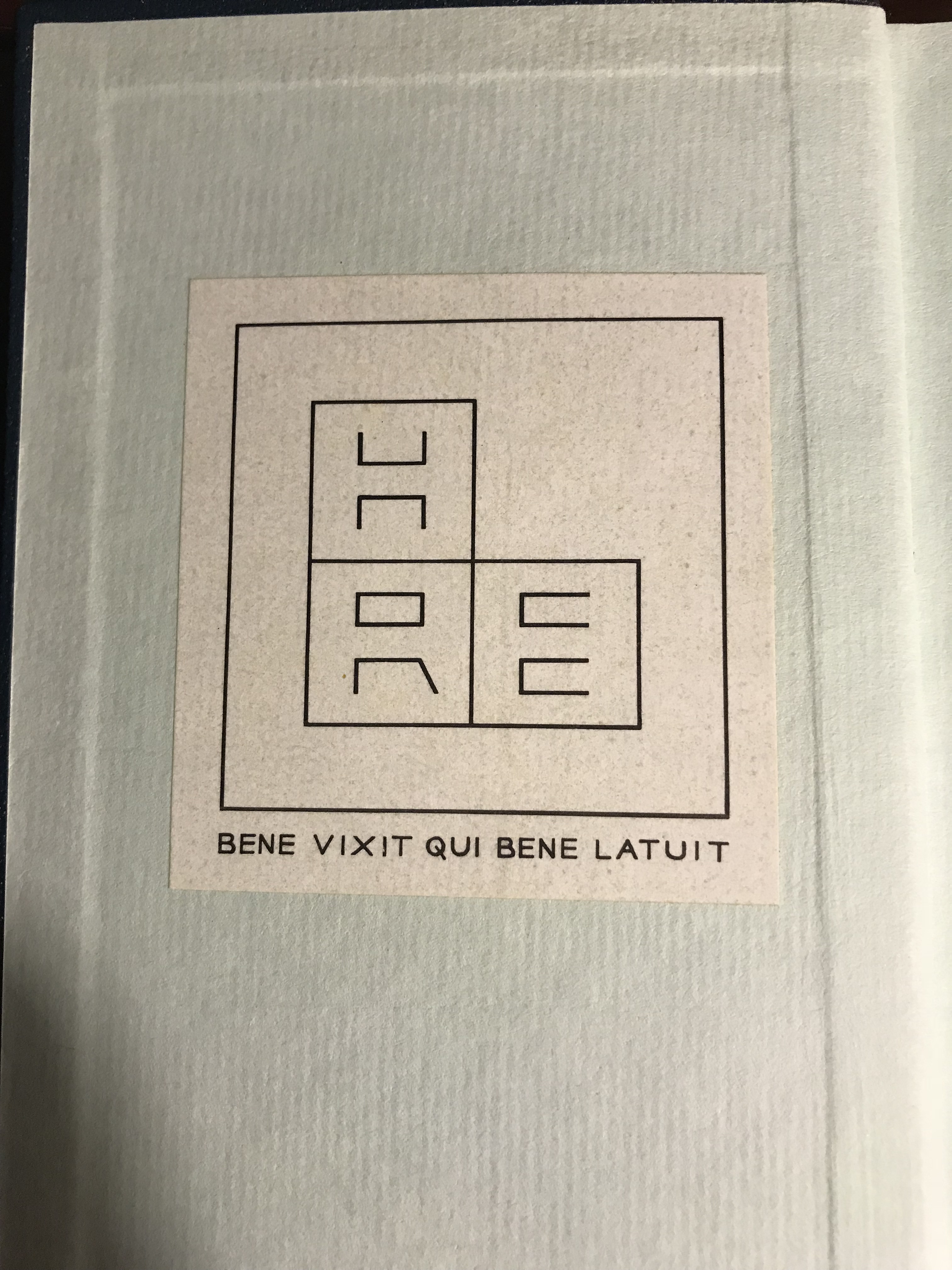
To be honest I only care for the one line here – bene qui latuit bene vixit.  It has the honor of being enough a favorite of Descartes – who lived its advice – to have been included on his first tombstone (but not in his later reburial at Saint-Germain-des-Prés).  But I found it through a lucky purchase several years back – it features on the bookplates of my Pleiade editions of Saint-Simon’s Memoires, alongside a tastefully appropriate instance of what I believe is termed a negative-space font.

IMG_4331

Knowledge of the world is the dissolution of the solidity of the world

From Italo Calvino’s Lezioni Americane: Sei proposte per il prossimo millennio (translated as Six Memos for the Next Millenium):

For Ovid too everything can be transformed into new forms; so also for Ovid knowledge of the world is the dissolution of the solidity of the world;  And for Ovid there is an essential parity among all things that exist – in contrast to every hierarchy of powers and values.  If the world of Lucretius is made of unchangeable atoms, that of Ovid is made of qualities, attributes, and forms that define the diversity of all things – plants, animals, and people; But these are only weak casings of a common substance that – if stirred with deep passion – can be changed into what is most different.

Anche per Ovidio tutto può trasformarsi in nuove forme; anche per Ovidio la
conoscenza del mondo è dissoluzione della compattezza del mondo;
anche per Ovidio c’è una parità essenziale tra tutto ciò che
esiste, contro ogni gerarchia di poteri e di valori. Se il mondo
di Lucrezio è fatto d’atomi inalterabili, quello d’Ovidio è fatto
di qualità, d’attributi, di forme che definiscono la diversità
d’ogni cosa e pianta e animale e persona; ma questi non sono che
tenui involucri d’una sostanza comune che, – se agitata da
profonda passione – può trasformarsi in quel che vi è di più
diverso.

and downe sate Sisyphus uppon his rolling stone

Ovid’s Metamorphoses, on Orpheus’ performing in the underworld.  The translation is Arthur Golding’s.

Talia dicentem nervosque ad verba moventem
exsangues flebant animae: nec Tantalus undam
captavit refugam, stupuitque Ixionis orbis,
nec carpsere iecur volucres, urnisque vacarunt
Belides, inque tuo sedisti, Sisyphe, saxo (10.40-44)

As he this tale did tell,
And played on his instrument, the bloodlesse ghostes shed teares:
To tyre on Titius growing hart the greedy Grype forbeares:
The shunning water Tantalus endevereth not to drink:
And Danaus daughters ceast to fill theyr tubbes that have no brink.
Ixions wheele stood still: and downe sate Sisyphus uppon
His rolling stone.