
Patrick Leigh Fermor’s Green Diary

I found today that the National Library of Scotland has digitized the surviving diary from Patrick Leigh Fermor’s trek across Europe. I’ll try tomorrow to find the section in A Time of Gifts where he touches on the loss and decades later recovery of the thing but for now I was delighted enough to find on its inside cover (and exactly as described in A Time of Gifts) a lovely poem he’d included in his final work:
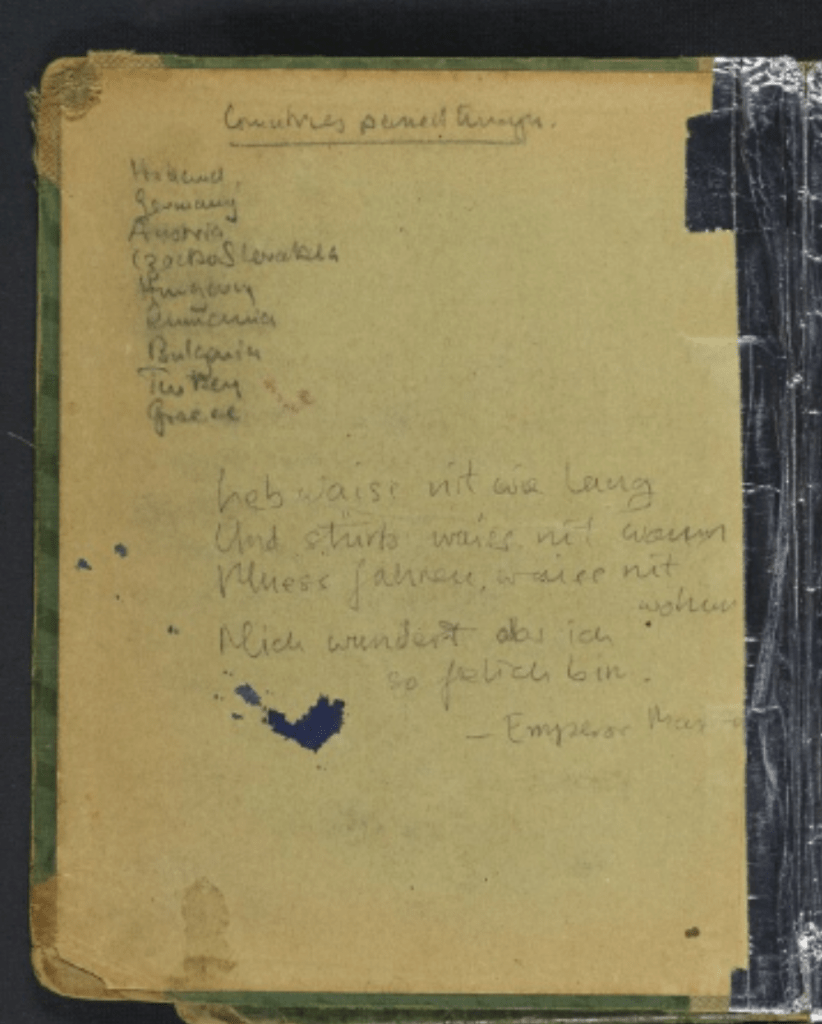
Prompted by my recent preoccupations, perhaps, the conversation veered to Charles V’s grandfather, the first Maximilian: The Last of the Knights, as he was called, half-landsknecht, and, until you looked more carefully at Dürer’s drawing, half playing-card monarch. Someone was describing how he used to escape from the business of the Empire now and then by retiring to a remote castle in the Tyrolese or Styrian forests. Scorning muskets and crossbows and armed only with a long spear, he would set out for days after stag and wild boar. It was during one of these holidays that he composed a four-line poem, and inscribed it with chalk, or in lampblack, on the walls of the castle cellar. It was still there, the speaker said.

Who told us all this? Einer? One of the Austrian couple who were with us? Probably not Robin or Lee or Basset…I’ve forgotten, just as I’ve forgotten the place we were coming from and the name of the castle. Whoever it was, I must have asked him to write it out, for here it is, transcribed inside the cover of a diary I began a fortnight later—frayed and battered now—with the old Austrian spelling painstakingly intact. There was something talismanic about these lines, I thought.

Leb, waiss nit wie lang,
Und stürb, waiss nit wann
Muess fahren, waiss nit wohin
Mich wundert, das ich so frelich bin.*

*Live, don’t know how long,
And die, don’t know when;
Must go, don’t know where;
I am astonished I am so cheerful.

Stop press! I’ve just discovered that the castle is called Schloss Tratzberg. It is near Jenbach, still standing, and not very far from Innsbruck.

Continuation here – Patrick Leigh Fermor’s Green Diary pt.2

You are the drain pipe of my soul, you inattentive and indulgent confessor

From Joris-Karl Huysmans’ Là-bas, the main character addressing his cat:

“In spite of your kill-joy character and your single track mind you testy, old bachelor, you are a very nice cat,” said Durtal, in an insinuating, wheedling tone. “Then too, for many years now, I have told you what one tells no man. You are the drain pipe of my soul, you inattentive and indulgent confessor. Never shocked, you vaguely approve the mental misdeeds which I confess to you. You let me relieve myself and you don’t charge me anything for the service. Frankly, that is what you are here for. I spoil you with care and attentions because you are the spiritual vent of solitude and celibacy, but that doesn’t prevent you, with your spiteful way of looking at me, from being insufferable at times, as you are today, for instance!”

Malgré ton caractère de rabat-joie, de vieux garçon monomane et sans patience, tu es tout de même gentil, fit Durtal, d’un ton insinuant, pour l’amadouer ; puis, il y a assez longtemps que je te raconte ce que chacun se tait ; tu es l’évier de mon âme, toi, le confesseur inattentif et indulgent qui approuve, vaguement, sans surprise, les méfaits d’esprit qu’on lui avoue, afin de se soulager, sans qu’il en coûte ! Au fond, c’est là ta raison d’être, tu es l’exutoire spirituel de la solitude et du célibat ; aussi, je te gave d’attentions et de soins ; mais cela n’empêche qu’avec tes bouderies tu ne sois souvent, ainsi que ce matin, par exemple, insupportable

The thought still has too much elbow-room in the expression

From Lichtenberg’s The Waste Books (D.18 in the Hollindale translation):

The thought still has too much elbow-room in the expression. I have pointed with the end of a stick when I should have pointed with the point of a needle

Reminiscent of Walter Benjamin’s oft-quoted observation on Proust:

There has never been anyone else with Proust’s ability to show us things; Proust’s pointing finger is unequaled.

Which, for contextual honestly, should for once be quoted in critical fullness:

Something that is manifested irritatingly and capriciously in so many [of the Proustian narrator’s] anecdotes is the combination of an unparalleled intensity of conversation with an unsurpassable aloofness from his partner. There has never been anyone else with Proust’s ability to show us things; Proust’s pointing finger is unequaled. But there is another gesture in amicable togetherness, in conversation physical contact. To no one is this gesture more alien than to Proust.

A high price for living too long with a single dream

From The Great Gatsby, overall better observed but shallower than I remembered:

No telephone message [from Daisy] arrived but the butler went without his sleep and waited for it until four o’clock—until long after there was any one to give it to if it came. I have an idea that Gatsby himself didn’t believe it would come and perhaps he no longer cared. If that was true he must have felt that he had lost the old warm world, paid a high price for living too long with a single dream. He must have looked up at an unfamiliar sky through frightening leaves and shivered as he found what a grotesque thing a rose is and how raw the sunlight was upon the scarcely created grass. A new world, material without being real, where poor ghosts, breathing dreams like air, drifted fortuitously about . . . like that ashen, fantastic figure gliding toward him through the amorphous trees.

That was a miserable expedition for them

A fragment of Eubulus (and see Richard Hunter’s book for the best survey) preserved in Athenaeus 1.25:

Where does Homer refer to any Achaean as
eating fish? And all they did with their meat was roast it;
he never has any of them stew something,
not even a little. And none of them laid eyes on a
courtesan; they had to jerk off for ten years.
That was a miserable expedition for them; they only captured
one city, and they left with their assholes enlarged more
than the gates of the town they captured

ἰχθὺν δ᾿ Ὅμηρος ἐσθίοντ᾿ εἴρηκε ποῦ
τίνα τῶν Ἀχαιῶν; κρέα δὲ μόνον ὤπτων, ἐπεὶ
ἕψοντά γ᾿ οὐ πεπόηκεν αὐτῶν οὐδένα,
ἀλλ᾿ οὐδὲ μικρόν. οὐδ᾿ ἑταίραν εἶδέ τις
αὐτῶν, ἑαυτοὺς δ᾿ ἔδεφον ἐνιαυτοὺς δέκα·
πικρὰν στρατείαν δ᾿ εἶδον, οἵτινες πόλιν
μίαν λαβόντες εὐρυπρωκτότεροι πολὺ
τῆς πόλεος ἀπεχώρησαν ἧς εἷλον τότε.

For this is the life of the gods

From Athenaeus’ Deipnosophistae (The Learned Banqueters) 1.8.d:

Ἀντιφάνης δέ φησι·

βίος θεῶν γάρ ἐστιν, ὅταν ἔχῃς ποθὲντἀλλότρια δειπνεῖν, μὴ προσέχων λογίσμασι

Antiphanes (fr. 252) says:For this is the life of the gods—when you have the chance to eat someone else’s food and not worry about the bills.

The vanity of the sciences

From Pascal’s Pensées – 23 in any Lafuma edition.

Vanité des sciences.

 La science des choses extérieures ne me consolera pas de l’ignorance de la morale au temps d’affliction, mais la science des mœurs me consolera toujours de l’ignorance des sciences extérieures

The vanity of the sciences.

Physical science will not console me for the ignorance of morality in the time of affliction. But the science of ethics will always console me for the ignorance of the physical sciences.

English can’t easily capture the fluidity of French science – both (fields of) science and general learning, knowledge.

And the candle cures the seems

I found this passage in an anthology of Iris Origo’s creation, The Vagabond Path (pg 39). It is attributed to Samuel Taylor Coleridge but without specific reference and google returns no results. I imagine it comes from his notebooks – only because the full edition begun in the 50s isn’t in public domain so likely wouldn’t be indexed anywhere online.

A little boy, lying in bed one night in the year 1802, was feeling unhappy. He called for a candle – the seems, he said, were troubling him. “What do you mean, my love?” “The Seems, the seems. What seems to be and is not, men and faces and I do not know what – ugly and sometimes pretty and those turn ugly, and they seem when my eyes are open, and worse when they are shut – and the candle cures the seems.”

He had outgrown his library as one outgrows a waistcoat

Selections from Notebook B of Lichtenberg’s Waste Books (in the NYRB edition translated by Hollingdale):

Every man also has his moral backside which he refrains from showing unless he has to and keeps covered as long as possible with the trousers of decorum

He was so witty that any thing served him as an intermediate term for comparing any pair of other things with one another.

He had outgrown his library as one outgrows a waistcoat. Libraries can in general be too narrow or too wide for the soul.

People often become scholars for the same reason they become soldiers: simply because they are unfit for any other station. Their right hand has to earn them a livelihood; one might say they lie down like bears in winter and seek sustenance from their paws.

If I should ever produce an edition of his life, go straight to the index and look up the words bottle and conceit: they will contain the most important facts about him.

We begin reading early and we often read much too much, so that we receive and retain large amounts of material without putting it into employment and our memory becomes accustomed to keeping open house for taste and feeling; this being so, we often have need of a profound philosophy to restore to our feelings their original state of innocence, to find our way out of the rubble of things alien to us, to begin to feel for ourselves and to speak ourselves, and I might almost say to exist ourselves.

How did you enjoy yourself with these people? Answer: very much, almost as much as I do when alone.

To learn how to teach and test yourself brings much comfort and is not as dangerous as shaving yourself; everyone should learn it at a certain age for fear of one day becoming the victim of an ill-guided razor.

The description of wit is the best I’ve ever seen.