Listening to their insides the least

From A l’ombre des jeunes filles en fleurs (v.2 of À la recherche du temps perdu) with the traditional Moncrieff-Kilmartin-Enright translation. Proust is underappreciated as the patron saint of neurotics.

Neurotic subjects are perhaps less addicted than any, despite the time-honoured phrase, to “listening to their insides”: they hear so many things going on by which they realise later that they were wrong to let themselves be alarmed, that they end by paying no attention to any of them. Their nervous systems have so often cried out to them for help, as though with some serious malady, when it was simply going to start snowing or they were going to move house, that they have acquired the habit of paying no more heed to these warnings than a soldier who in the heat of battle perceives them so little that he is capable, although dying, of carrying on for some days still the life of a man in perfect health.


Les névropathes sont peut-être, malgré l’expression consacrée, ceux qui « s’écoutent » le moins : ils entendent en eux tant de choses dont ils se rendent compte ensuite qu’ils avaient eu tort de s’alarmer, qu’ils finissent par ne plus faire attention à aucune. Leur système nerveux leur a si souvent crié : « Au secours ! » comme pour une grave maladie, quand tout simplement il allait tomber de la neige ou qu’on allait changer d’appartement, qu’ils prennent l’habitude de ne pas plus tenir compte de ces avertissements qu’un soldat, lequel dans l’ardeur de l’action, les perçoit si peu, qu’il est capable, étant mourant, de continuer encore quelques jours à mener la vie d’un homme en bonne santé.

The folds of the gown still clung

The introduction to M. Brichot in the second part of Swann’s Way. In pulling the English I found that Moncrieff took greater than usual liberties here but I like his phrasing.

For he had the sort of curiosity and superstitious worship of life which, combined with a certain scepticism with regard to the object of their studies, earns for some intelligent men of whatever profession, doctors who do not believe in medicine, schoolmasters who do not believe in Latin exercises, the reputation of having broad, brilliant and indeed superior minds. He affected, when at Mme Verdurin’s, to choose his illustrations from among the most topical subjects of the day when he spoke of philosophy or history, principally because he regarded those sciences as no more than a preparation for life, and imagined that he was seeing put into practice by the “little clan” what hitherto he had known only from books, and perhaps also because, having had instilled into him as a boy, and having unconsciously preserved, a reverence for certain subjects, he thought that he was casting aside the scholar’s gown when he ventured to treat those subjects with a conversational licence which in fact seemed daring to him only because the folds of the gown still clung.


Car il avait cette curiosité, cette superstition de la vie qui, unie à un certain scepticisme relatif à l’objet de leurs études, donne dans n’importe quelle profession, à certains hommes intelligents, médecins qui ne croient pas à la médecine, professeurs de lycée qui ne croient pas au thème latin, la réputation d’esprits larges, brillants, et même supérieurs. Il affectait chez Mme Verdurin de chercher ses comparaisons dans ce qu’il y avait de plus actuel quand il parlait de philosophie et d’histoire, d’abord parce qu’il croyait qu’elles ne sont qu’une préparation à la vie et qu’il s’imaginait trouver en action dans le petit clan ce qu’il n’avait connu jusqu’ici que dans les livres, puis peut-être aussi parce que, s’étant vu inculquer autrefois, et ayant gardé à son insu, le respect de certains sujets, il croyait dépouiller l’universitaire en prenant avec eux des hardiesses qui, au contraire, ne lui paraissaient telles, que parce qu’il l’était resté.

Identical emotions do not spring up simultaneously in the hearts of all men in accordance with a pre-established order

From towards the end of the first part of Swann’s Way, an observation I make near daily and never remember for the next day.

And it was at that moment, too—thanks to a peasant who went past, apparently in a bad enough humour already, but more so when he nearly got a poke in the face from my umbrella, and who replied somewhat coolly to my “Fine day, what! Good to be out walking!”—that I learned that identical emotions do not spring up simultaneously in the hearts of all men in accordance with a pre-established order. Later on, whenever a long spell of reading had put me in a mood for conversation, the friend to whom I was longing to talk would at that very moment have finished indulging himself in the delights of conversation, and wanted to be left to read undisturbed. And if I had just been thinking of my parents with affection, and forming resolutions of the kind most calculated to please them, they would have been using the same interval of time to discover some misdeed that I had already forgotten, and would begin to scold me severely as I was about to fling myself into their arms.


Et c’est à ce moment-là encore — grâce à un paysan qui passait, l’air déjà d’être d’assez mauvaise humeur, qui le fut davantage quand il faillit recevoir mon parapluie dans la figure, et qui répondit sans chaleur à mes « beau temps, n’est-ce pas, il fait bon marcher » — que j’appris que les mêmes émotions ne se produisent pas simultanément, dans un ordre préétabli, chez tous les hommes. Plus tard chaque fois qu’une lecture un peu longue m’avait mis en humeur de causer, le camarade à qui je brûlais d’adresser la parole venait justement de se livrer au plaisir de la conversation et désirait maintenant qu’on le laissât lire tranquille12. Si je venais de penser à mes parents avec tendresse et de prendre les décisions les plus sages et les plus propres à leur faire plaisir, ils avaient employé le même temps à apprendre une peccadille que j’avais oubliée et qu’ils me reprochaient sévèrement au moment où je m’élançais vers eux pour les embrasser.

I’m reading Proust this time in the special Pléiade edition released earlier this year. It takes the text of their four volume edition, strips all notes and draft passages, and shrinks everything into two 1500 page volumes of ~1.5in thickness each (as opposed to 2+ for the normal). They explain their rationale as follows:

Selon toute vraisemblance, ce n’est que par crainte de devoir acquitter un supplément de bagage que les voyageurs ne l’emportent pas plus souvent sur l’île déserte.À l’occasion du centième anniversaire de la mort de Proust, la Pléiade propose à titre exceptionnel, et à tirage limité, le texte de la Recherche, intégral et nu (les notes et les Esquisses restant l’apanage de l’édition en quatre volumes), en deux tomes d’environ 1500 pages chacun. Ce tirage satisfera les globe-trotters, sans leur être réservé. Les sédentaires le placeront près de leur fauteuil. Les promeneurs le glisseront dans leurs poches. Toute table de chevet pourra l’accueillir. Une oeuvre-monde, toujours à portée de main, explorable à l’infini.

I put this because pocket copies happen to be a favorite of mine. They’re underappreciated nowadays but I’ve never learned to read on my phone and can tolerate a kindle only in bed or on a plane so I have a great appreciation for anyone who thinks to make my favorite things available in a well-constructed and portable format.

I have tried to provide the reader with, so to speak, an improvised memory

From the opening pages of Proust’s preface to his translation of John Ruskin’s Bible of Amiens. This translation is from the Yale press On Reading Ruskin. The French is available here

To read only one book by an author is to see that author only once. True, in a single conversation with someone we can discern particular traits. But it is only through repeated encounters in varied circumstances that we can recognize these traits as characteristic and essential . For a writer, for a musician, or for a painter, this variation of circumstances that enables us to discern, by a sort of experimentation, the permanent features of character is found in the variety of the works themselves. We meet again in a second book, in another painting, the peculiarities which we might have thought the first time belonged to the subject matter as much as to the writer or the painter himself. By comparing different works, we distinguish common traits which, taken together, reveal the moral character of the artist.

When several portraits by Rembrandt, painted from different models, are gathered in a room, we are immediately struck by what is common to all of them, what constitutes the very features of the Rembrandt face. By inserting a footnote to the text of The Bible of Amiens each time this text evoked, through even remote analogies, the recollection of other works of Ruskin, and by translating in the note the passage which had come to my mind, I have tried to put the reader in the position of one who would not find himself in Ruskin’s presence for the first time but who, having had previous conversations with Ruskin, would be able to recognize in his words what is permanent and fundamental in him. Thus I have tried to provide the reader with ,so to speak, an improvised memory in which I have arranged recollections of other works of Ruskin-a kind of sounding board against which the words of The Bible of Amiens will be able to ring more deeply by awakening fraternal echoes. But these echoes will undoubtedly not correspond to the words of The Bible of Amiens, as they penetrate a memory which is itself composed of horizons generally hidden from our sight and whose various distances our life itself has measured day by day. In order to come into focus with the present word whose resemblance evoked them, these echoes will not have to go through the gentle resistance of that interposed atmosphere which is the span of our life and all the poetry of memory.

Fundamentally, the first part of every critic’s task should be to help the reader appreciate these special traits by drawing his attention to similar traits that enable him to recognize them as the essential features of the genius of a writer.

If the critic is aware of this and has helped others to awareness, his function is almost fulfilled. Ifhe has not perceived it, he can write all the books in the world on Ruskin: the Man, the Writer, the Prophet, the Artist, the Influence of his Thought, the Errors of his Doctrine, and all these works may perhaps reach a very high level of excellence, but skirt the subject. They may exalt the reputation of the critic but, as regards the true understanding of the work, they will be of less value than the exact perception of a correct nuance, however insignificant it might seem.

These expressions alien to our thoughts which by virtue of that very fact reveal them

From the final volume of Proust, Le Temps Retrouvé/Time Regained (pg 401 of v.4 in the new Pléiade) The translation is the modern library:

Meanwhile, two very smart clients, in white tie and tails and wearing overcoats—two Russians, as I guessed from the very slight accent with which they spoke—were standing in the doorway and deliberating whether they should enter. It was visibly the first time that they had been to the place, to which no doubt they had come on somebody’s recommendation, and they appeared torn between desire, temptation and extreme fright. One of the two—a good-looking young man—kept repeating every ten seconds to the other, with a smile that was half a question and half an attempt at persuasion: “Well! After all, what do we care?” But though no doubt he meant by this that after all they did not care about the consequences, it is probable that he cared rather more than he implied, for the remark was not followed by any movement to cross the threshold but by a further glance at his companion, followed by the same smile and the same “After all, what do we care?” And in this “After all, what do we care?” I saw a perfect example of that portentous language, so unlike the language we habitually speak, in which emotion deflects what we had intended to say and causes to emerge in its place an entirely different phrase, issued from an unknown lake wherein dwell these expressions alien to our thoughts which by virtue of that very fact reveal them. I remember an occasion when Françoise, whose approach we had not heard, was about to come into the room while Albertine was completely naked in my arms, and Albertine, wanting to warn me, blurted out: “Good heavens, here’s the beautiful Françoise!” Françoise, whose sight was no longer very good and who was merely going to cross the room at some distance from us, would no doubt have noticed nothing. But the unprecedented phrase “the beautiful Françoise,” which Albertine had never uttered before in her life, was in itself enough to betray its origin; Françoise sensed that the words had been plucked at random by emotion and had no need to look to understand what was happening; she went out muttering in her dialect the word poutana.


Pendant ce temps, deux clients très élégants, en habit et cravate blanche sous leurs pardessus – deux Russes, me sembla-t-il à leur très léger accent – se tenaient sur le seuil et délibéraient s’ils devaient entrer. C’était visiblement la première fois qu’ils venaient là, on avait dû leur indiquer l’endroit et ils semblaient partagés entre le désir, la tentation
et une extrême frousse. L’un des deux – un beau jeune homme – répétait toutes les deux minutes à l’autre avec un sourire mi-interrogateur, mi-destiné à persuader : « Quoi ! Après tout on s’en fiche ? » Mais il avait beau vouloir dire
par là qu’après tout on se fichait des conséquences, il est probable qu’il ne s’en fichait pas tant que cela car cette parole n’était suivie d’aucun mouvement pour entrer mais d’un nouveau regard vers l’autre, suivi du même sourire et du même après tout on s’en fiche. C’était, ce après tout on s’en fiche, un exemplaire entre mille de ce magnifique langage, si différent de celui que nous parlons d’habitude, et où l’émotion fait dévier ce que nous voulions dire et épanouir à la place une phrase tout autre, émergée d’un lac inconnu où vivent ces expressions sans rapport avec la pensée et qui par cela même la révèlent. Je me souviens qu’une fois Albertine, comme Françoise, que nous n’avions pas entendue, entrait au moment où mon amie était toute nue contre moi, dit malgré elle, voulant me prévenir : « Tiens, voilà la belle Françoise. » Françoise qui n’y voyait plus très clair et ne faisait que traverser la pièce assez loin de nous ne se fût sans doute aperçue de rien. Mais les mots si anormaux de « belle Françoise » qu’Albertine n’avait jamais prononcés de sa vie, montrèrent d’eux-mêmes leur origine, elle les sentit cueillis au hasard par l’émotion, n’eut pas besoin de regarder rien pour comprendre tout, et s’en alla en murmurant dans son patois le mot de « poutana ».

Detest bad music but do not make light of it

In Praise of Bad Music From Proust’s Les Plaisirs et Les Jours. If you make allowance for youthful preciousness of sentiment and elitism, this is one of the work’s more clear (and concise) evidences of what Proust would become by way of social observer.

I’ve discovered there’s an English translation of these stories (by Joachim Neugroschel) so I can quote that instead of doing a hack job.

In Praise of Bad Music

Detest bad music but do not make light of it. Since it is played, or rather sung, far more frequently, far more passionately than good music, it has gradually and far more thoroughly absorbed human dreams and tears. That should make it venerable for you. Its place, nonexistent in the history of art, is immense in the history of the emotions of societies. Not only is the respect – I am not saying love – for bad music a form of what might be called the charity of good taste, or its skepticism, it is also the awareness of the important social role played by music. How many ditties, though worthless in an artist’s eye, are among the confidants chosen by the throng of romantic and amorous adolescents. How many songs like “Gold Ring” or “Ah, slumber, slumber long and deep,” whose pages are turned every evening by trembling and justly famous hands, are soaked with tears from the most beautiful eyes in the world: and the purest maestro would envy this melancholy and voluptuous homage of tears, the ingenious and inspired confidants that ennoble sorrow, exalt dreams, and, in exchange for the ardent secret that is confided in them, supply the intoxicating illusion of beauty.

Since the common folk, the middle class, the army, the aristocracy have the same mailmen – bearers of grief that strikes them or happiness the overwhelms them – they have the same invisible messengers of love, the same beloved confessors. These are the bad composers. The same annoying jingle, to which every well-born, well-bred ear instantly refuses to listen, has received the treasure of thousands of souls and guards the secret of thousdands of lives: it has been their living inspiration, their consolation, which is always ready, always half-open on the music stand of the piano – and it has been their dreamy grace and their ideal. Certain arpeggios, certain reentries of motifs have made the souls of more than one lover or dreamer vibrate with the harmonies of paradise or the very voice of the beloved herself. A collection of bad love songs, tattered from overuse, has to touch us like a cemetery or a village. So what if the houses have no style, if the graves are vanishing under tasteless ornaments and inscriptions? Before an imagination sympathetic and respectful enough to conceal momentarily its aesthetic disdain, that dust may release a flock of souls, their breaks holding the still verdant dream that gave them an inkling of the next world and let them rejoice or weep in this world.

ÉLOGE DE LA MAUVAISE MUSIQUE
Détestez la mauvaise musique, ne la médisez pas. Comme on la joue, la chante bien plus, bien plus passionnément que la bonne, bien plus qu’elle elle s’est peu à peu remplie du rêve et des larmes des hommes. Qu’elle vous soit par là vénérable. Sa place, nulle dans l’histoire de l’Art, est immense dans l’histoire sentimentale des sociétés. Le respect, je ne dis pas l’amour, de la mauvaise musique n’est pas seulement une forme de ce qu’on pourrait appeler la charité du bon goût ou son scepticisme, c’est encore la conscience de l’importance du rôle social de la musique. Combien de mélodies, de nul prix aux yeux d’un artiste, sont au nombre des confidents élus par la foule des jeunes gens romanesques et des amoureuses. Que de «bagues d’or», de «Ah! reste longtemps endormie», dont les feuillets sont tournés chaque soir en tremblant par des mains justement célèbres, trempés par les plus beaux yeux du monde de larmes dont le maître le plus pur envierait le mélancolique et voluptueux tribut,—confidentes ingénieuses et inspirées qui ennoblissent le chagrin et exaltent le rêve, et en échange du secret ardent qu’on leur confie donnent l’enivrante illusion de la beauté. Le peuple, la bourgeoisie, l’armée, la noblesse, comme ils ont les mêmes facteurs, porteurs du deuil qui les frappe ou du bonheur qui les comble, ont les mêmes invisibles messagers d’amour, les mêmes confesseurs bien-aimés. Ce sont les mauvais musiciens. Telle fâcheuse ritournelle, que toute oreille bien née et bien élevée refuse à l’instant d’écouter, a reçu le trésor de milliers d’âmes, garde le secret de milliers de vies, dont elle fut l’inspiration vivante, la consolation toujours prête, toujours entr’ouverte sur le pupitre du piano, la grâce rêveuse et l’idéal. Tels harpèges, telle «rentrée» ont fait résonner dans l’âme de plus d’un amoureux ou d’un rêveur les harmonies du paradis ou la voix même de la bien-aimée. Un cahier de mauvaises romances, usé pour avoir trop servi, doit nous toucher comme un cimetière ou comme Un village. Qu’importe que les maisons n’aient pas de style, que les tombes disparaissent sous les inscriptions et les ornements de mauvais goût. De cette poussière peut s’envoler, devant une imagination assez sympathique et respectueuse pour taire un moment ses dédains esthétiques, la nuée des âmes tenant au bec le rêve encore vert qui leur faisait pressentir l’autre monde, et jouir ou pleurer dans celui-ci.

Every man is a divinity in disguise, a god playing the fool

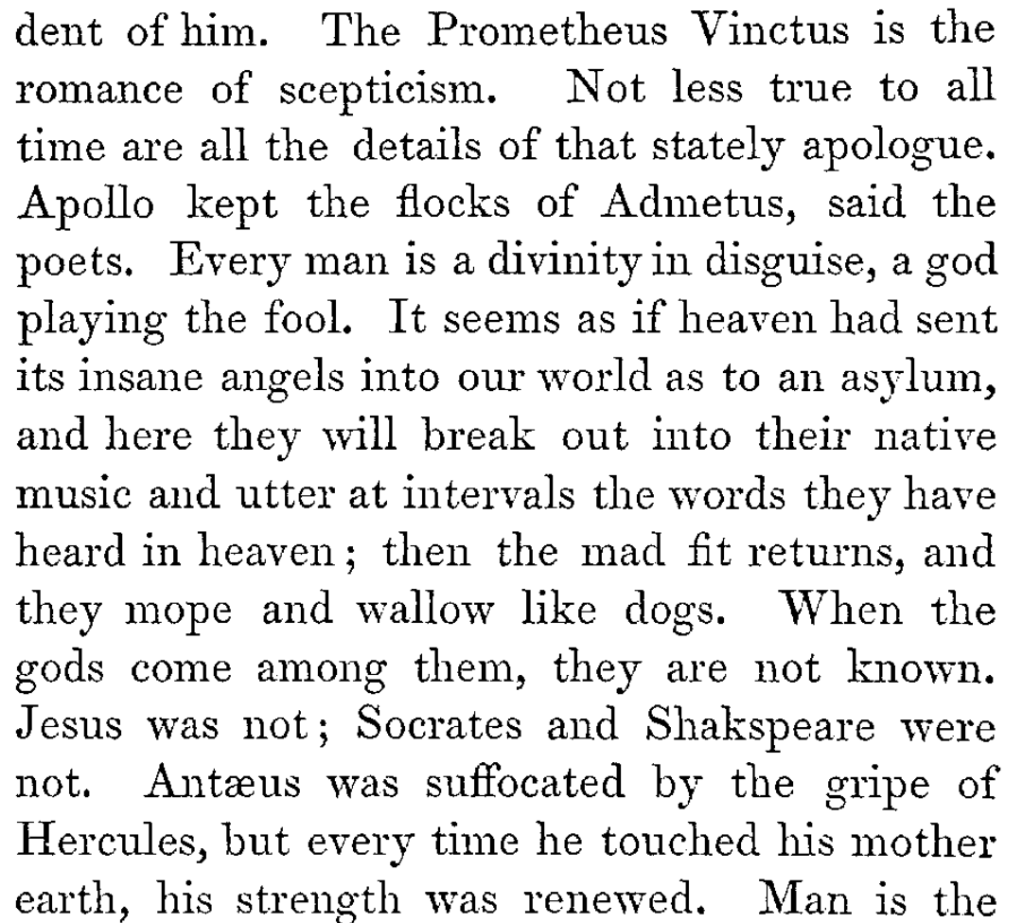
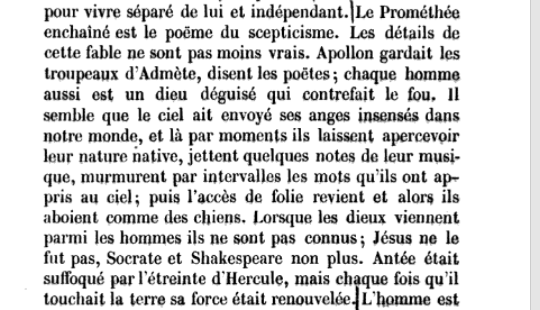
I spent too long on this very minor problem. La Mort de Baldassare Silvande, the first story in baby Proust’s Les Plaisirs et Les Jours has as opening epigraph an unsourced quote from Ralph Waldo Emerson – «Apollon gardait les troupeaux d’Admète, disent les poètes; chaque homme aussi est un dieu déguisé qui contrerait le fou.». The notes in both my Pleaide and Folio texts point to Proust using an 1851 translation of Emerson’s essays by Emile Montegut – Essais de philosophie américaine. And the quote is indeed there on page 78 as part of the First Series essay History (Histoire):

Unfortunately, this doesn’t match the much briefer English in my Library of America edition:

The Prometheus Vinctus is the romance of skepticism. Not less true to all time are the details of that stately apologue. Apollo kept the flocks of Admetus, said the poets. When the gods come among men, they are not known. Jesus was not; Socrates and Shakspeare were not. Antaeus was suffocated by the gripe of Hercules, but every time he touched his mother earth his strength was renewed.

But it turns out the LOA edition uses the revised 1847 text, not the original 1841 and the editor didn’t see fit to comment on this significant change in the textual notes. So here is the full 1841 – restoring Montegut’s good name as translator and my equanimity.

It is all a question of chronology

From Le Temps retrouvé (4.315-6):


Saint-Loup had just come back from Balbec. I learnt later, indirectly, that he had made unsuccessful advances to the manager of the restaurant. The latter owed his position to the money he had inherited from M. Nissim Bernard. He was, in fact, none other than the young waiter whom in the past Bloch’s uncle had “protected.” But wealth in his case had brought with it virtue and it was in vain that Saint-Loup had attempted to seduce him. Thus, by a process of compensation, while virtuous young men abandon themselves in their later years to the passions of which they have at length become conscious, promiscuous youths turn into men of principle from whom any Charlus who turns up too late on the strength of old stories will get an unpleasant rebuff. It is all a question of chronology.

Saint-Loup revenait de Balbec. J’appris plus tard indirectement qu’il avait fait de vaines tentatives auprès du directeur du restaurant. Ce dernier devait sa situation à ce qu’il avait hérité de M. Nissim Bernard. Il n’était autre, en effet que cet ancien jeune servant que l’oncle de Bloch « protégeait ». Mais sa richesse lui avait apporté la vertu. De sorte que c’est en vain que Saint-Loup avait essayé de le séduire. Ainsi par compensation, tandis que des gens vertueux s’abandonnent, l’âge venu, aux passions dont ils ont enfin pris conscience, des adolescents faciles deviennent des hommes à principe contre lesquels des Charlus, venus sur la foi d’anciens récits mais trop tard, se heurtent désagréablement. Tout est affaire de chronologie.


It no longer shocked anyone and that was all about it

From Proust’s Le Temps retrouvé (v.4 pg. 305 of the Pleiade). I think most failures to appreciate Proust’s commentaries on the laws of flux governing public and private opinion could be solved by ctrl+f replacing Dreyfus with whatever the most recent hub of contention had been.

In society (and this social phenomenon is only the application of a much more general psychological law) whether novelties are reprehensible or not, they only excite consternation until they have been assimilated and defended by reassuring elements. As it had been with Dreyfusism, so it was with the marriage of Saint-Loup and Odette’s daughter, a marriage people protested against at first. Now that people met everyone they knew at the Saint-Loups’, Gilberte might have had the morals of Odette herself, people would have gone there just the same and would have agreed with Gilberte in condemning undigested moral novelties like a dowager-duchess. Dreyfusism was now integrated in a series of highly respectable and customary things. As to asking what it amounted to in itself, people now thought as little about accepting as formerly about condemning it. It no longer shocked anyone and that was all about it.

Dans le monde (et ce phénomène social n’est, d’ailleurs, qu’une application d’une loi psychologique bien plus générale), les nouveautés coupables ou non n’excitent l’horreur que tant qu’elles ne sont pas assimilées et entourées d’éléments rassurants. Il en était du dreyfusisme comme du mariage de Saint-Loup avec la fille d’Odette, mariage qui avait d’abord fait crier. Maintenant qu’on voyait chez les Saint-Loup tous les gens « qu’on connaissait », Gilberte aurait pu avoir les mœurs d’Odette elle-même que, malgré cela, on y serait « allé » et qu’on eût approuvé Gilberte de blâmer comme une douairière des nouveautés morales non assimilées. Le dreyfusisme était maintenant intégré dans une série de choses respectables et habituelles. Quant à se demander ce qu’il valait en soi, personne n’y songeait, pas plus pour l’admettre maintenant qu’autrefois pour le condamner. Il n’était plus « shocking ». C’était tout ce qu’il fallait.

The point that was common to one being and another

From Proust’s Le Temps retrouvé (296/7 in v.4 of the Pleiade, with the updated Moncrieff translation):

…insofar as my own character was concerned, my incapacity for looking and listening, which the passage from the Journal had so painfully illustrated to me, was nevertheless not total. There was in me a personage who knew more or less how to look, but it was an intermittent personage, coming to life only in the presence of some general essence common to a number of things, these essences being its nourishment and its joy. Then the personage looked and listened, but at a certain depth only, without my powers of superficial observation being enhanced. Just as a geometer, stripping things of their sensible qualities, sees only the linear substratum beneath them, so the stories that people told escaped me, for what interested me was not what they were trying to say but the manner in which they said it and the way in which this manner revealed their character or their foibles; or rather I was interested in what had always, because it gave me specific pleasure, been more particularly the goal of my investigations: the point that was common to one being and another. As soon as I perceived this my intelligence—until that moment slumbering, even if sometimes the apparent animation of my talk might disguise from others a profound intellectual torpor—at once set off joyously in pursuit, but its quarry then, for instance the identity of the Verdurin drawing-room in various places and at various times, was situated in the middle distance, behind actual appearances, in a zone that was rather more withdrawn. So the apparent, copiable charm of things and people escaped me, because I had not the ability to stop short there—I was like a surgeon who beneath the smooth surface of a woman’s belly sees the internal disease which is devouring it. If I went to a dinner-party I did not see the guests: when I thought I was looking at them, I was in fact examining them with X-rays.

en ce qui me concernait personnellement, mon incapacité de regarder et d’écouter, que le journal cité avait si péniblement illustrée pour moi, n’était pourtant pas totale. Il y avait en moi un personnage qui savait plus ou moins bien regarder, mais c’était un personnage intermittent, ne reprenant vie que quand se manifestait quelque essence générale, commune à plusieurs choses, qui faisait sa nourriture et sa joie. Alors le personnage regardait et écoutait, mais à une certaine profondeur seulement, de sorte que l’observation n’en profitait pas. Comme un géomètre qui, dépouillant les choses de leurs qualités sensibles, ne voit que leur substratum linéaire, ce que racontaient les gens m’échappait, car ce qui m’intéressait, c’était non ce qu’ils voulaient dire, mais la manière dont ils le disaient, en tant qu’elle était révélatrice de leur caractère ou de leurs ridicules ; ou plutôt c’était un objet qui avait toujours été plus particulièrement le but de ma recherche parce qu’il me donnait un plaisir spécifique, le point qui était commun à un être et à un autre. Ce n’était que quand je l’apercevais que mon esprit — jusque-là sommeillant, même derrière l’activité apparente de ma conversation, dont l’animation masquait pour les autres un total engourdissement spirituel — se mettait tout à coup joyeusement en chasse, mais ce qu’il poursuivait alors — par exemple l’identité du salon Verdurin dans divers lieux et divers temps — était situé à mi-profondeur, au delà de l’apparence elle-même, dans une zone un peu plus en retrait. Aussi le charme apparent, copiable, des êtres m’échappait parce que je n’avais plus la faculté de m’arrêter à lui, comme le chirurgien qui, sous le poli d’un ventre de femme, verrait le mal interne qui le ronge. J’avais beau dîner en ville, je ne voyais pas les convives, parce que quand je croyais les regarder je les radiographiais.